Tag Archive: pallet


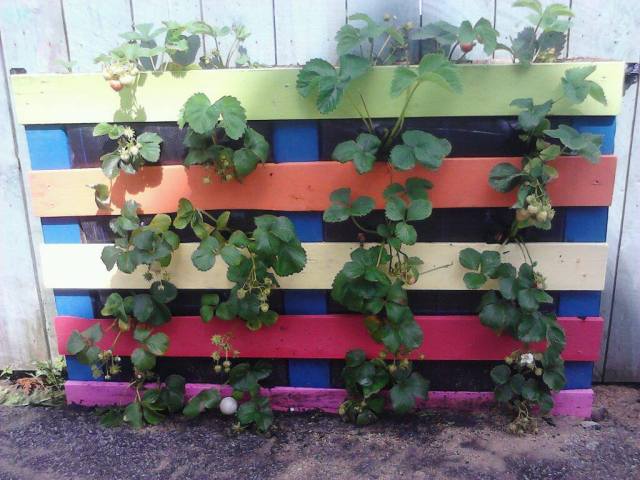
PicPost:Pallet to Strawberry planter

PicPost: Pallet Summer House

by Yves Cummings

I want one!

PicPost: Pallet Artwork

http://www.1001pallets.com/2013/07/pallet-artwork/

Pallet sizes – a handy guide for all you diy enthusiasts!

Pallet Types Pallet Size in  with Size Pallets

palletsSince sharing pictures and ideas for making garden things from pallets or other recycled wood, I’ve come across a super Facebook site ‘1001 pallets’ – take a look and you won’t be disappointed! For now here are a few more cunning ideas for projects from pallets – just click on the images for links to tutorials or instructions.

Do you have any of your own pallet projects to share?

Links:

1001 pallets

How to tell if a pallet is safe for reuse

Other articles about using pallets in the garden:

Pallet Projects – more creative ideas

Polished Primary Pallet Planters

Pallets Plus –  more examples of recycled wood in the garden

Pallet Power- the sequel

Pallet Power

Raised beds on the cheap

Old School Gardener

If you’ve enjoyed reading this post and others on this blog, why not comment and join others by signing up for automatic updates via email (see side bar, above right ) or through an RSS feed (see top of page)?

My previous articles and pictures on projects in the garden using wooden pallets or other recycled wood have featured some wonderful ideas. I’ve been amazed by the response and the articles seem to have also stimulated projects, not only in my own gardening activities, but for other gardeners, some of whom have sent me pictures of their creations. So here is the latest batch of Pallet Projects for you to look at, think about and maybe emulate!

Keep your ideas and pictures coming in!

A play teepee made out of natural wood and recycled pallets

A play teepee made out of natural wood and recycled pallets


A compost bin made out of pallets by Katherine Jacobs. The front fits snuggly into the sides and is removable. Kathereien isn't sure abotu the bag- itm was suggested as a way of keeping the compost warm and preventing 'too much' air getting in- I'm not convinced its a benefit.

A compost bin made out of pallets by Katherine Jacobs. The front fits snuggly into the sides and is removable. Katherine isn’t sure about the bag- it was suggested as a way of keeping the compost warm and preventing ‘too much’ air getting in- I’m not convinced its a benefit.

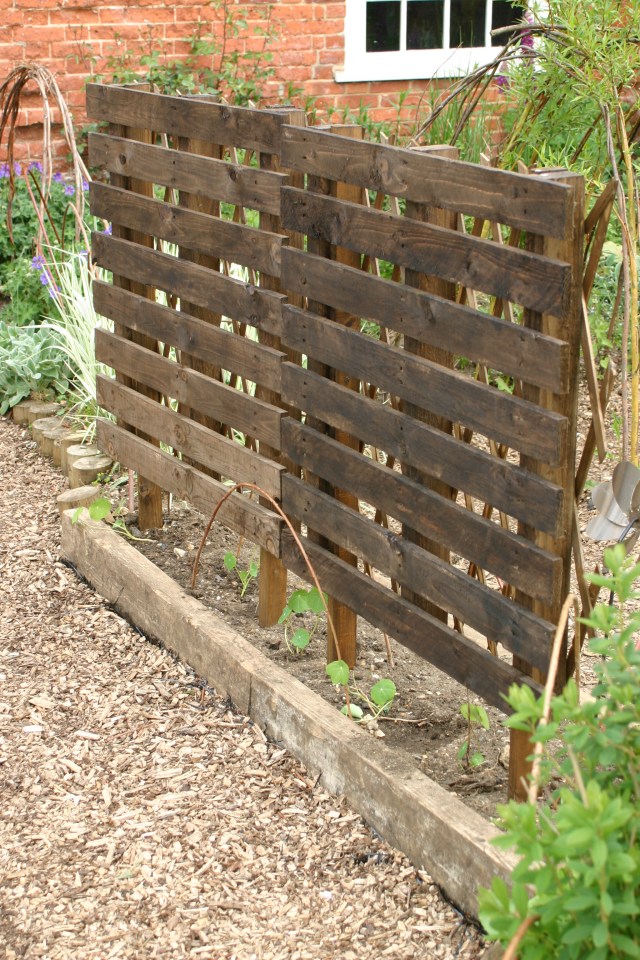
My own attempt at a Trellis screen made from two pallets fixed to posts in a public garden for under fives. The screen has diamond trellis fitted to the back, has been stained and will have climbing Nasturtums growing up it.

My own attempt at a Trellis screen made from two pallets fixed to posts in a public garden for under fives. The screen has diamond trellis fitted to the back, has been stained and will have climbing Nasturtums growing up it.


Other articles about using pallets in the garden:

Polished Primary Pallet Planters

Pallets Plus –  more examples of recycled wood in the garden

Pallet Power- the sequel

Pallet Power

Raised beds on the cheap

Old School Gardener

If you’ve enjoyed reading this post and others on this blog, why not comment and join others by signing up for automatic updates via email (see side bar, above right ) or through an RSS feed (see top of page)?


Photo0126

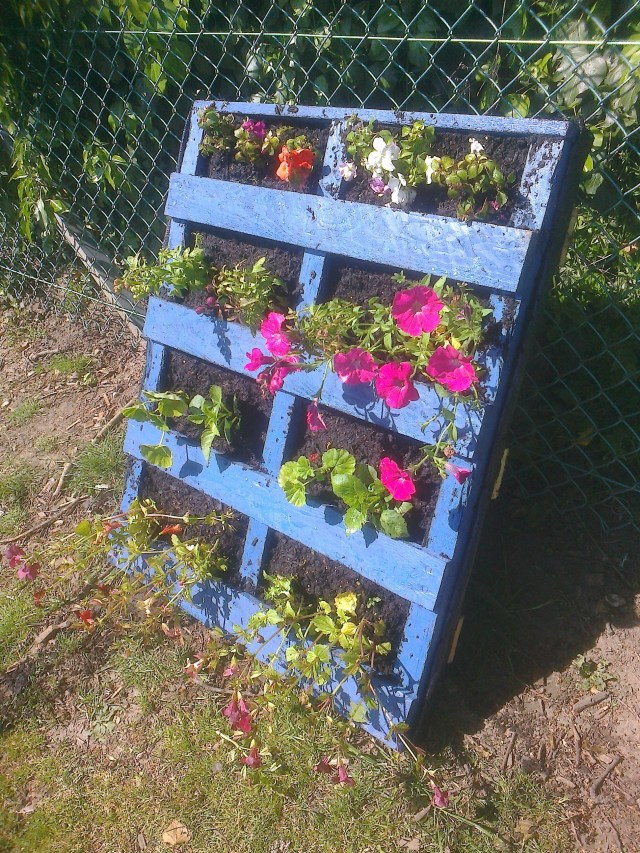
One of the finished planters standing alongside the Playground

My examples of using pallets and other old timber for garden projects seem to have been very popular (see links below). I’m experimenting myself with some ideas, including vertical pallet planters, made with a group of children (aged 7-10)at my local Primary school as part of a Gardening Club there. This has been great fun and a good learning experience for me as well as the children! We used pallets I was given by a builder at the Museum where I volunteer – they were relatively small pallets used for stacking bricks, so were a manageable size for the children.

I followed the guide produced by Garden Designer Mike Rendell (you can access a pdf of this here). It was fairly straightforward and with some help, the children managed to do most of the tasks needed to achieve some pretty flowering planters which now adorn the edge of their playground.

What we did:

1. Sawed off the ends of the slats so that there were solid timber sides to the planter – the children coped with this with a bit of help now and again (it didn’t help that my saws weren’t that sharp!).

2. Removed every other slat to provide space for planting – this proved to be difficult, especially for the children, as it involved a lot of strength and using claw hammers and the like.

3. Nailing two of the spare slats, one to the top, the other to the bottom of the planter – the children enjoyed using hammers and nails (it was helpful being able to use the nails and pre set holes already in the removed slats).

4. Painting the planters – we chose a rich blue paint suitable for outdoor furniture and the children enjoyed painting, though some of the younger ones had to be encouraged to ensure every bit of wood was properly covered!

5. Stapling some spare landscaping fabric to the back of the planter. I’d pre cut the size needed (allowing for a double layer joined in the middle and overlapping it around the sides and top of the planter). The children found it very difficult using the staple gun, which was designed for bigger hands, so I had to do this for them, whilst they held the fabric in place.

6. After this the children nailed the remaining spare slats to the back of the planter to provide reinforcement. Again, with a bit of basic ‘hammer tuiton’ the children managed this pretty well, though we did use some spare nails where some of the old ones got bent in the process.

7. The children then filled and compacted the compost into the planters, starting at the bottom and planting up as they went. We used about 40 litres of peat free compost per planter, a little loose, but with compaction and wetting seemed to hold together reasonably well. The children tired a bit towards the end, so I made sure the compost was properly compacted and roots covered. Once tidied up, the planters were thoroughly watere. Incidentally the plants were kindly donated by a local nursery woman who had held a plant sale at the school a few weeks before. We have a mix of Petunias, Antirrhinums, Dahlias, Geraniums and Impatiens- quite a mix and it will be interesting to see how some of the larger varieties fare in this vertical world!

8. I had fixed some cup hooks to the top and rear of each planter so that they can eventually be hooked into the fence to avoid them falling over, though for now the planters are at an angle to allow the compost and plants to become firmer.

Having  just seen a TV programme about the ‘Pallet Garden’ competition at the ‘Gardening Scotland’ show, I might try to introduce some sort of competition next year within the school (or maybe even between local schools?) …watch this space!

Other articles on pallets and other recycled wood in the garden:

Pallets Plus –  more examples of recycled wood in the garden

Pallet Power

Pallet Power- the sequel

Raised beds on the cheap

Old School Gardener

If you’ve enjoyed reading this post and others on this blog, why not comment and join others by signing up for automatic updates via email (see side bar, above right ) or through an RSS feed (see top of page)?

My earlier articles about projects using pallets seem to have been a big hit – they’ve certainly had a lot of visitors. I’ve been working on my own project with local school children to create vertical planters and these are due to be finished off next week, so I’ll do a piece on that project and the lessons I’ve learned. I’m still collecting examples of novel recycled uses of old wooden things and so here are a few more pictures of some other interesting ideas. If you have any ideas or examples of your own, please send me some pictures!

This amazing shed is made out of old fruit trays. you can see that they're from the 'Royal Fruit Farm' at Sandringham, Norfolk! (For those who don't know, Sandringham is one of the grand residences of the Brtish Royal family - about 30 miles away from  Old School Garden and a lovely landscape with some beautiful trees.

This amazing shed is made out of old fruit trays. you can see that they’re from the ‘Royal Fruit Farm’ at Sandringham, Norfolk! (For those who don’t know, Sandringham is one of the grand residences of the British Royal family – about 30 miles away from Old School Garden and a lovely landscape with some beautiful trees)

pallet decking

Here’s a super example of the ways in which pallets can be reused and how they can be finished off to look like an up market product. These pallets have been taken apart, reassembled and sanded off to give a smooth surface. Laid like giant decking tiles they create a pleasing, practical terrace. Note that it uses quite thick planks, an important consideration if the floor is to bear body weight!

vertical planter adam haden

My previous articles on pallet projects can be seen here:

Pallet Power

Pallet Power- the sequel

Raised beds on the cheap

Old School Gardener

If you’ve enjoyed reading this post and others on this blog, why not comment and join others by signing up for automatic updates via email (see side bar, above right ) or through an RSS feed (see top of page)?

IMG_5641

Looking towards the Terrace and Orchard at Old School Garden

To Walter Degrasse

Dear Walter,

Well, old friend, the morning has started under a veil of mist in Old School Garden, but it hopefully will lift later and we can have more of that elusive sunshine!

It’s been a very busy time in the garden and in my other gardening activities. They say that May is the busiest month in the garden, and so far I’d have to agree. In the last few weeks plants have started to catch up with the ‘slow seasons’ and there is a wonderful fresh greenness around and in the countryside beyond. I tend to wait until the end of May before putting out any tender plants and as a result, my greenhouse and cold frame are bursting with plants at various stages of growth. Hopefully I can move things on over the next couple of weeks so that I can make way for tomatoes and cucumbers (new seedlings kindly supplied by my friend Steve) in the greenhouse.


The Kitchen Garden is starting to fill out and every bed is now full with something (though the new Asparagus I planted last autumn is a ‘no show’ – maybe it drowned in all the winter wet or perhaps it’s just not strong enough to break the surface yet – there’s certainly Asparagus on sale locally). You remember I tried sowing carrots in modular pots last year and they were more or less a failure? I’d hoped that was due to the weather. Touch wood – those I sowed earlier this year and which I’ve now planted out, seem to have established well and are growing away. I invested in some outdoor polypipe as an experiment in building a structure to cover these with mesh (as a protection against Carrot Root Fly) and the result is looking like its doing a good job. I did a very simple job of slotting the pipe into some pipe brackets I’d fixed to wooden spacers screwed to the insides of my wooden raised bed and the new roof seems to be holding its curved shape quite well, though some roof – line reinforcement (perhaps with another length of pipe) may be required to ensure the structure survives the windiest weather. The Parsnip I sowed a couple of weeks ago in this bed also seems to have germinated, so I shall thin those shortly.

I’ve also tried a new design for the support of my Mangetout, creating a sort of angled arc which has 12 healthy plants at its foot ready to clamber their way up the netted structure (they grow to about 4 feet so I didn’t need anything very tall).


You remember that I planted my potatoes (well almost all of them) on 5th April, because that was deemed to be a beneficial date on the lunar calendar? Well, I haven’t got any way of making a scientific comparison, but these are now looking healthy, are well above ground and ready for ‘earthing up’. The reserve tubers which I put into a shadier spot a few weeks later have not yet broken through.

Early potatoes up and looking good

Early potatoes up and looking good

We’ve seen the return of ground elder – an annual event despite what seems like constant weeding. So I’ve been out doing a regular hour or two of hand weeding to try to systematically work my way around the borders, and with the recent rain and the addition of rotted wood chips to the soil, this is a very enjoyable and rewarding activity. It’s just lovely working your way through the soil, carefully ‘mining’ for the roots of the elder and gently easing it out of the ground – ‘just like archaeology’, as Deborah says! Though the flower borders are looking a bit like a wireless station at present (because of all the canes and string I’ve put out to support some of the bigger perennials), the new growth is gradually covering these and the garden is taking on a fuller look. I must keep on with the weeding!

With the lateness of spring the Tulips are still with us and they are making some very pleasant combinations with other plants in the garden. I’ve shown a few examples here.


Have you noticed any snail and slug activity yet? I’ve been very surprised that there seems to be very little obvious damage to Old School Garden as yet (compared to last year when it was disastrous). I did put down some pellets a few weeks ago, especially on the containers with Hostas in them and I’m very pleased that the new leaf growth appears to have virtually no signs of damage at all  – maybe these pellets did the job of killing off the young snails and slugs, though even so I haven’t seen many corpses around, so I’m thinking that maybe the very harsh winter weather did a good job in killing off those slugs and snails that would have normally over wintered. The Courtyard  looks good as a result, with the vine coming into to leaf and garlanding the walls and some new colour coming soon from some Sweet Williams I put into the containers alongside the Hostas.


On the wider front, I’ve continued to work with the children at my local Primary School, and as you may have seen in a recent article, I’m enjoying working on various projects with a group of 7 children on Friday afternoons. Yesterday at the School’s annual Fete, we managed to sell all of the hanging baskets that the children had planted up, so making around £40 profit that can go back into gardening activities. This event was also an opportunity to promote the Master Gardener and Master Composter schemes I’m involved with. A colleague, Jane and I manned the stalls for the afternoon, making  paper pots and sowing Nasturtium seeds with the youngsters, showing them the wormery and the worms doing their job as well as offering quizzes and advice and information on food growing and composting to the many adults who came over to see us. Over the next couple of weeks, the Friday gardening group will be finishing off some vertical planters they’re making out of wooden pallets and thanks to a kind donation of plants from a local nursery – woman these will make a lovely, colourful feature in the play ground. I’ll do a separate article on this project once they’re finished.

Today I’m off the Suffolk to inspect a community – run woodland which has applied  to be awarded a ‘Green Flag’ as a mark of excellence. You may recall that this scheme has been operating for a good number of years and is fast becoming the national benchmark for parks and open spaces in England. I’ve been a judge for about 5 years now and every year I get to visit a couple of really interesting and usually very well presented and run open spaces. I’ve been out to judge one woodland in North Norfolk last week and today’s trip will complete my quota for this year. I’ll write an article about Green Flag and the two sites tomorrow, so keep a look out!

Well, that’s just about brought you up to date with Old School Garden for another month.


Thanks for sending me the pictures of your lovely garden, where I see your herbaceous borders are starting to fill out like mine. And I was particularly impressed with your creations using pallets! The new ‘pallet shed’ looks wonderful and the fact that you managed to make it for almost nothing (given the price of sheds these days) is great. My post on pallets seems to have gone down a storm and is still receiving many visitors every day including from the USA and around the world! I’ve come across a couple of other, novel uses of these and will post the pictures shortly. I managed to obtain a few additional pallets for free from the local Garden Centre and I’m currently thinking about what else I can use them for. I’m certainly going to use some as a sort of raised bed edging where I need to consolidate some soil and support the wooden frame up which I’m training a fan cherry and plum. I’ve cut some pallets in half and will sink these, like fences, into the ground as barriers to keep the soil in (maybe using landscaping fabric inside to contain the soil). I’ll let you know how I get on and post some pictures.

Oh, and some great news, The Radio 4 programme ‘Gardener’s Question Time’ is coming to Gressenhall Farm and Workhouse Museum at the end of June, so this will be a great opportunity to introduce those attending to the gardens and promote the place a bit too, especially as there is a gardening event at the Museum the week after! Stay in touch.

All the best for now,

Old School Gardener

Other posts in this series:

Dear Walter….letter from Old School Garden, 18th April May 2013

Dear Walter….letter from Old School Garden, 11th March 2013

Dear Walter… letter from Old School Garden: 15th February 2013

If you’ve enjoyed reading this post and others on this blog, why not comment and join others by signing up for automatic updates via email (see side bar, above right ) or through an RSS feed (see top of page)?

I’ve just returned from a session of the ‘Gardening Club’ at my local primary school – 7 children of varying ages. What a little preparation and enthusiastic kids can achieve! We:

  • Painted up the pallet planters we’re making for a floral display at the school (we’re planting up hanging baskets next week for sale at the Summer Fair on 19th May) – more on this project in due course…
  • Set up a wormery outside the school kitchen – I bought some worms from a local angling shop and with the day’s fruit peel and other kitchen waste on a bed of leaf mould we set the little critters to work and talked with the School cook about how to keep the process going…
  • Sowed some Squash and Lavender seeds one of the children had brought in – they’re already excited at how tall their sowings of trailing Nasturtiums have grown in two weeks…
  • Had a brief run down on the composting process in the wormery and set them a challenge of finding out some ‘compost facts’ for next week, as well as discussing who’ll be available to help me sell the hanging baskets, make paper pots with children visitors and advise people on food growing and composting at the Summer Fair…

Phew – need  a little sleep….

Old School Gardener

Finding Nature

Nature Connectedness Research Blog by Prof. Miles Richardson

Norfolk Green Care Network

Connecting People with Nature

Discover WordPress

A daily selection of the best content published on WordPress, collected for you by humans who love to read.

Susan Rushton

Celebrating gardens, photography and a creative life

Unlocking Landscapes

Writing, photography and more by Daniel Greenwood

Alphabet Ravine

Lydia Rae Bush Poetry

TIME GENTS

Australian Pub Project, Established 2013

Vanha Talo Suomi

The Journey from Finnish Rintamamiestalo to Arboretum & Gardens

Marigolds and Gin

Because even in chaos, there’s always gin and a good story …

Bits & Tidbits

RANDOM BITS & MORE TIDBITS

Rambling in the Garden

.....and nurturing my soul

The Interpretation Game

Cultural Heritage and the Digital Economy

pbmGarden

Sense of place, purpose, rejuvenation and joy

SISSINGHURST GARDEN

Notes from the Gardeners...

Deep Green Permaculture

Connecting People to Nature, Empowering People to Live Sustainably

BloominBootiful

A girl and her garden :)