Tag Archive: planting


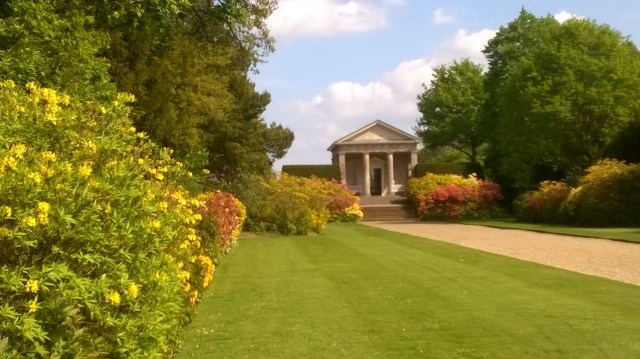
WP_20150521_15_40_07_Pro I think it must be three weeks since I was last at Blickling. I got a chance to look around at the end of my working session and there were several highlights I hadn’t seen before, most notably the Azaleas round the Temple, the wall-trained Wisterias, the masses of Forget-me-Nots and Honesty in the Dell and some of the colour combinations in the double borders; especially the Tulip ‘Queen of Night’ and the black foliage of Mongo Grass and Black Elders.

My fellow volunteers were bit thin on the ground this week, and the gardening team pretty much seemed to be tied up in interviews all day, so we were left to our own devices! But the task was simple, weeding in the rose borders in the main Parterres. I went to work with my hoe (I really enjoy this task) and though the borders were pretty clear, there were a few odd weeds (including patches of Oxalis which the other volunteers dug up) and some edging of the grass to be done.

The session was punctuated with chats to vistors who were very complimentary about the gardens. One couple from Bury St. Edmunds envied us the light soil we have in this area- they have to tackle thick clay.

Head Gardener Paul informed us that the National Trust Gardens advisor had recently visited and was full of praise for the gardens and what the whole team had achieved; that was good to hear.

This slideshow requires JavaScript.

Work in the Walled Garden has continued with the hard core for the main paths being laid and consolidated. The next job is installing 800 metres of metal edging- I don’t envy the Team that job!

Further Information:

Blickling Hall website

Blickling Hall Facebook page

A 360 degree tour of Blickling Hall

Old School Gardener


front garden1A front garden is on view to all, so must look good all year and be functional. Here are a few ideas for making your own ‘entrance’:

Focal points-

  • A statue, pot or some other hard landscape feature can be used to provide a focal point; something to draw the eye and give a sense of unity to the front garden.

  • Alternatively, box topiary shapes or other bold ‘architectural’ plants can fulfil this role and can be relatively easy to maintain. Likewise, planting groups of the same plant can be used to create a series of ‘green’ focal points.

  • Another idea is to create a feature such as a rockery that will be seen from the roadside and combines both hard and soft landscaping elements.

Paths and drives-

  • A path to the front door is a central feature of most front gardens. By laying this diagonally across the plot an illusion of depth can be created. If your plot is relatively small and your path from garden entrance to front door has to be primarily fucntional, they should take the shortest route if they are going to be used by casual visitors. However, they can be made to look more attractive by introducing gentle curves or by by using a mixture of path surfacing materials such as brick and stone. But don’t use more than two or three different materials as this can cretae a fussy, disjointed look.

  • If your plot is larger and you can fit in a second path which has a mainly decorative role, this can be routed to meander through the garden and provide easy access to each part of the plot; it could be a continuous ‘snake’ of paving or stepping stones, or a combination of both.

  • Don’t underlay gravel with different coloured or shaped chippings, as over time these will rise to the surface and the result will look ugly.

  • Try to avoid using impermeable materials for vehicle hard standings (there are now regulations in place about this) and if you do have large hard surfaced areas use planting pockets to break these up- a car can easily pass over low growing plants.

Planting-

  • Drought- tolerant shrubs such as Hebe and Choisya help to squeeze out weeds, so helping to keep the front garden looking tidy.

  • Plant tough plants at the edges of drives such as ornamental grasses, heathers or creeping thymes, which will survive an occasional clipping by a car tyre.

  • Use creeping plants near to the edges of the garden to create a natural look.

Good neighbour-

  • Abide by the law if you are thinking about some more major changes to your front garden e.g. if you are putting up a wall or fence adjoining a public road that is higher than 90cms or hedges in such locations. You need to contact the local authority before putting in solid boundaries and may be asked to cut back hedges that interfere with sight lines.

  • Likewise you need to contact the local authority if you plan to put in a vehicle ‘crossover’ over a public footpath and if you want to cultivate any grass verge outside your house.

front garden2

Source: Short Cuts to Great Gardens- Reader’s Digest

Old School Gardener


What a difference a week makes- double borders in full colour

What a difference a week makes- double borders in full colour

A brief couple of hours at Blickling this week, as I needed to get home to prepare for our journey to Devon. Still, the place looked superb and I managed to sort out a few lines of plants in the walled garden.

My fellow volunteer Jonny and I began the day (which was sunny again!) with Mike in the Walled Garden. Mike wanted to level some soil between a couple of rows of well established Foxgloves and Rudbeckia and to straighten a line of Nepeta. We set to and after this put in a few more lines of flowers- Agapanthus and Phlox.

The session was punctuated with a visit from a senior manager at Broadland Council, coming to see how a grant they’d made to help restore the greenhouse had been spent and to discuss volunteering. After that I hoed along some of the other lines of veg in the Garden and generally tidied up. Meanwhile Rebecca and Pam had been pricking out seedlings ready to put into the restored greenhouse, which is only about a third full at present (with Penstemons).

This slideshow requires JavaScript.

Last week I got my new badge, this week I’ve been offered some National Trust clothing to wear in the gardens- nice to be looked after so well!

Further Information:

Blickling Hall website

Blickling Hall Facebook page

A 360 degree tour of Blickling Hall

Old School Gardener


perennial borderPlanting-

Grow trouble-free and long lived shrubs and perennials instead of annual spring and summer bedding that needs replacing every year. All new plants must be planted carefully into well- prepared soil, so that they establish quickly and are able to resist attacks from pests and diseases.

Further information:

Top 10 all weather perennial plants

Tips for designing perennial beds and borders

Source: ‘Short Cuts to Great Gardens’ (Reader’s Digest 1999)

Old School Gardener


M.

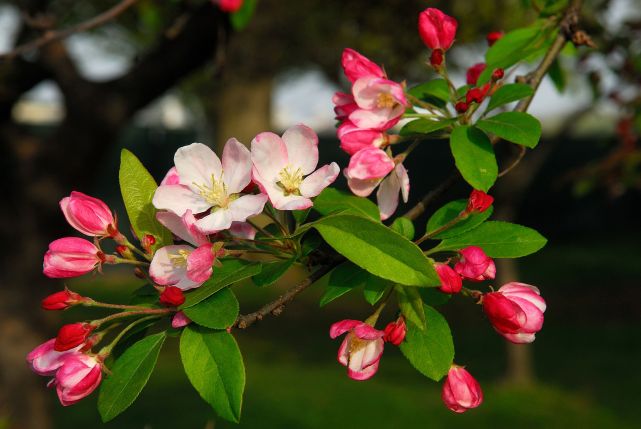
Malus is a genus of about 30–55 species of small deciduous trees, including the domesticated orchard apple (M. domestica) and varieties of crab apple (including the ‘wild apple’, M. sylvestris). This profile focuses in particular on the crab apples. 

Common name:  Non domestic orchard apples are generally known as crabapples, crab apples, crabs, or wild apples.

Native areas: The genus is native to the temperate zone of the Northern Hemisphere.

Historical notes: In the past, M. sylvestris was thought to be an important ancestor of the cultivated orchard apples (M. domestica), but these have now been shown to have been originally derived from the central Asian species M. sieversii. However, another recent DNA analysis showed that M. sylvestris has contributed to the ancestry of modern M. domestica very significantly.

Features: Domestic orchard apple trees are typically 4–12 metres tall at maturity, with a dense, twiggy crown. The leaves are 3–10 cm long, alternate, simple, with a serrated margin. The flowers are borne in corymbs, and have five petals, which may be white, pink or red, usually with red stamens that produce copious pollen. Domestic apple trees are large if grown from seed, but small if grafted onto roots (rootstock). There are more than 7,500 known cultivars of domestic apples, resulting in a range of desired characteristics. Crab apples tend to be smaller than domestic apple trees at around 5 – 7 metres tall, with a rounded profile.

Uses:  Crab apples make ideal specimen trees for small gardens. They are popular as compact ornamental trees, providing blossom in Spring and colourful fruit in Autumn. The fruits often persist throughout Winter. Numerous hybrid cultivars have been selected, of which ‘John Downie’, Evereste’ and ‘Red Sentinel’ have gained The Royal Horticultural Society’s ‘Award of Garden Merit’ (AGM):

Malus sylvestrisarguably, one of the UK’s prettiest native trees, a small crab apple (or ‘wild apple’) with profuse white flowers, tinged pink in bud, and with good yellow autumn colour. Yellow/ green and occasionally red flushed fruit are a bird’s favourite in the autumn. Ideal for native mixed plantings or shelter belts that provide great low cover for wildlife.

Malus floribundathe ‘Japanese Crab’ is most elegant, with early white/pale blush flowers from crimson buds. However, it is prone to apple scab after flowering, resulting in a rather threadbare crown. Because of this it has tended to be superceded by more disease resistant clones such as ‘Rudolph’ and ‘Evereste’.

Malus ‘Evereste’ – introduced in the early 1980’s this rounded tree has profuse flowers that are red in bud before turning white. The small fruit look like miniature ‘Gala’ and are held on until they are taken by birds after Christmas. The orange-yellow autumn foliage also holds well.


 M. ‘John Downie’ – raised in 1875, this is thought by many to be the best fruiting crab. with an irregular oval crown it makes a splendid tree for a small space. White flowers are followed by relatively large, conical-shaped orange-red fruits, which have a food flavour if required for preserves or jelly.

M. x robusta ‘Red Sentinel’– in cultivation since 1959, this profusely fruiting crab is a favourite for gardeners who are looking for winter colour. In some years the clusters of dark red fruits are so numerous that the branches can weigh too heavily so that the crown loses its shape. I have one growing in Old School Garden; it is great alongside other winter interest such as red and orange- stemmed Cornus, and its fruits are useful in Christmas decorations such as front door wreaths. In spring, the red leaves contrast well with its white flowers.

M. x zumi ‘Golden Hornet’ – this well-known crab has been in cultivation for over 60 years and is highly regarded for its profuse display of yellow, marble-sized fruits, which are retained for many weeks. These are preceded by white blossom; a very good ‘all rounder’.

M. ‘Rudolph’ – A Canadian crab developed in the 1950’s, this medium size tree is rather columnar when young, but becomes rounder with maturity. It has leaves which gradually turn from copper-red to bronze-green and rose- pink flowers, which give way to numerous elongated fruits. Autumn leaf colour is clear yellow and it is resistant to scab; a tree which packs a lot of plusses into a small package!

Growing conditions:  Grow Crab apples in moderately fertile soil, though many will thrive on most soils and some are better suited to heavier soils, such as M. sylvestris. They will tolerate partial shade.

Further information:

Wikipedia- Malus

RHS- Malus sylvestris

RHS- Malus ‘Evereste’

RHS- Malus x robusta ‘Red Sentinel’

RHS- Malus x zumi ‘Golden Hornet’

Barcham Trees Directory- Malus ‘Rudolph’

Choosing a Crab apple- Daily Telegraph

Old School Gardener

Twitter7a89209

Old School Gardener

liquidambar-1440-900Liquidambar is a genus of four species of flowering trees; L. alcalycina; L. formosana; L. orientalis; and L. styraciflua.

Common name:  Common names of all of the species include ‘Sweet Gum’, with additions according to their native regions. Other names include ‘Chang’s Sweetgum’ (L. alcalycina),’Redgum’, ‘Satin Walnut’ and ‘American Storax’. Both the scientific and common names refer to the sweet resinous sap (liquid amber) exuded by the trunk when cut.

Native areas: L. alcalycina is native to central and southern China; L. formosana to China and other parts of S.E. Asia; L. orientalis to south-west Turkey, Greece and Rhodes; L. styraciflua to the eastern USA, Mexico and Honduras.

Historical notes: The genus was much more widespread in the Tertiary age, but has disappeared from Europe due to extensive glaciation in the north and the east-west orientated Alps and Pyrenees, which have served as a blockade against southward migration. It has also disappeared from western North America due to climate change, and also from the unglaciated (but nowadays too cold) Russian far east. L. styraciflua is the most common species used in the U.K. and was introduced from its native USA in the 17th century. It was awarded the RHS ‘Award of Garden Merit’ in 1975.

Features: All Liquidambar are large, deciduous trees, most 25–40 metres (82–131 ft) tall, with palmately 3- to 7-lobed leaves arranged spirally on the stems and length of 12.5 to 20 centimetres (4.9 to 7.9 in), having a pleasant aroma when crushed. Mature bark is grayish and vertically grooved. The flowers are small, produced in a dense globular inflorescence around 1-2 centimetres diameter. The fruit is a woody multiple capsule 2–4 centimetres (0.79–1.57 in) in diameter (popularly called a “gumball”), containing numerous seeds and covered in numerous prickly, woody armatures, possibly to attach to fur of animals. In more northerly climates, sweetgum is among the last of trees to leaf out in the spring, and also among the last of trees to drop its leaves in autumn, turning multiple colors. It is sometimes confused with Maple on account of its similar leaves.

Uses: All of the species provide incredible autumn colour. In the U.K. they are predominately used as specimens – against a fresh green lawn, their foliage colour really stands out – and as woodland trees. L. styraciflua makes a large tree with a pyramidal crown if its central leader is retained. Its attractive, corky bark is a feature at all times of the year, but it is at its most magnificent in the autumn, when it seems to burn with crimson and gold. Suitable for streets, avenues, parks and largish domestic gardens

There are now several cultivars of  L. styraciflua available:

‘Lane Roberts’– reliable in Britain, this is a medium-sized tree (10-15 metres mature height), with a tighter conical habit and larger leaves than the species. Good in groups for mass effect.

‘Manon Variegata’ – a must for those that like variegated trees, the foliage is best in summer, providing excellent contrast against darker leaved, evergreen backgrounds. Medium height (15- 20 metres mature height), it has regular pyramidal form with horizontal lateral branches.

‘Stella’ – with deeply cut, star-like leaves it is of medium height (10-15 metres) and has glorious autumn colour. best in larger gardens.

‘Thea’ – a broad -leaved and late to colour variety, ‘Thea’ grows conically to 15-20 metres tall. Similar to ‘Lane Roberts’ but taller. Distinctive purple foliage in the autumn.

‘Worplesden’ – unlike most other clones, this variety will often bear fruit in the U.K. This is the variety most often favoured for its autumn colour and form, growing to a mature height of 20 metres plus. It has deeply lobed leaves which turn yellow in September and then turn to orange before falling, but the outermost leaves gradually turn to magnificent claret red. The choice for large gardens.

Growing conditions:  L. styraciflua does best in fertile, well-drained soils, and is the hardiest species, tolerating down to -15 degrees C.  The other species can all be grown in the U.K. but vary in hardiness; down to -5 degs C. There are also hardy forms such as the L. formosana Monticola Group, which could be considered for colder areas. Liquidambar should be planted in full sun in neutral to acid soil that is moist but well-drained- it does not thrive in chalky soils. The genus resents transplanting, but if this is unavoidable, prepare by root-pruning a year in advance.

Further information:

Wikipedia- Liquidambar

RHS- Liquidambar styraciflua

Horticulture Week- Liquidambar

Gardener’s World- Liquidambar

Barcham Trees Directory- Liquidambar styraciflua ‘Worplesden’

Old School Gardener

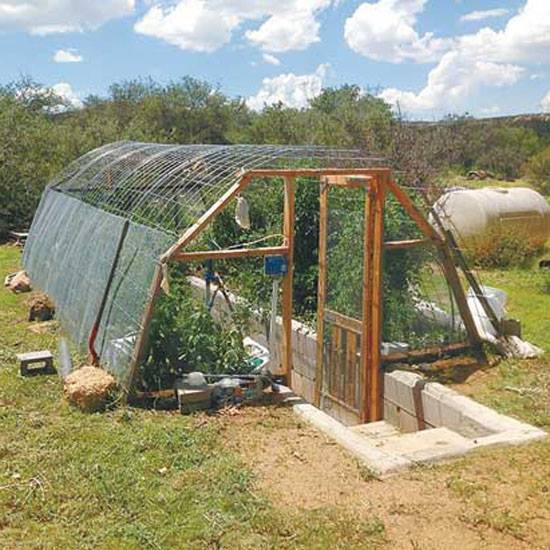
heat sink greenhouseHeat Sink Greenhouse- heat is absorbed by the stone trough during the day and relased at night.

Old School Gardener


topiary montrealMontreal, Canada

Old School Gardener

So, here’s the second in a series of posts about great ways of using pallets and other recycled wood. There are so many different ways to create a planting space, as these examples from 1001 Pallets, demonstrate…

Old School Gardener

Finding Nature

Nature Connectedness Research Blog by Prof. Miles Richardson

Norfolk Green Care Network

Connecting People with Nature

Discover WordPress

A daily selection of the best content published on WordPress, collected for you by humans who love to read.

Susan Rushton

Celebrating gardens, photography and a creative life

Unlocking Landscapes

Writing, photography and more by Daniel Greenwood

Alphabet Ravine

Lydia Rae Bush Poetry

TIME GENTS

Australian Pub Project, Established 2013

Vanha Talo Suomi

The Journey from Finnish Rintamamiestalo to Arboretum & Gardens

Marigolds and Gin

Because even in chaos, there’s always gin and a good story …

Bits & Tidbits

RANDOM BITS & MORE TIDBITS

Rambling in the Garden

.....and nurturing my soul

The Interpretation Game

Cultural Heritage and the Digital Economy

pbmGarden

Sense of place, purpose, rejuvenation and joy

SISSINGHURST GARDEN

Notes from the Gardeners...

Deep Green Permaculture

Connecting People to Nature, Empowering People to Live Sustainably

BloominBootiful

A girl and her garden :)