Tag Archive: norfolk


My mother – in – law is currently on a two week visit to us. A keen gardener (she was until a year ago Chair of the Tavistock Ladies Gardening club), she is not as mobile as she once was (she celebrated her 83rd birthday last week). However, she still enjoys looking at gardens so this is a great excuse (as if I needed one) to get out and about to see some interesting local gardens. The weather has also been kind so we’ve been to a few places that I haven’t been before, or haven’t seen for a good number of  years. Two of them are in Norwich, our local cathedral city, and they are fine examples of gardens developed for very different reasons; the one out of  the passion of a Victorian entrepreneur, the other based on a medieval religious garden.

The Plantation Garden

The Garden in 1897

In 1856, a prosperous upholsterer and cabinet maker living in Norwich, took a long lease on an industrial site just outside the old City walls. His name was Henry Trevor, and for the next forty years, he spent considerable sums of money and much effort transforming a chalk quarry into a magical garden.

Henry Trevor

In many ways, Henry Trevor’s garden was typical of Victorian taste and technology. He built a fountain, terraces with balustrades, rockworks, a Palm House, and a rustic bridge. He planted elaborate carpet beds, woodlands and shrubberies. He designed serpentine paths to conduct the visitor along circular routes, and he built and heated several greenhouses with boilers and hot water pipes.

Henry Trevor, however, was also a man of strong personal tastes. His “Gothic” fountain is unique, and he displayed great enterprise in using the fancy bricks from a local manufacturer to create medieval style walls, ruins and follies. Within less than 3 acres, he established a gentleman’s residence and garden that reflected in miniature the grand country houses of the Victorian period. Visitors were frequently welcomed in the garden by Henry Trevor, for he was always ready to allow his garden to be used for charitable causes.

The Garden in Victorian times- the Palm House no longer exists.

After the 1939-45 war, the garden was virtually abandoned. Fortunately, much of the structure has survived, and is gradually being restored by the The Plantation Garden Preservation Trust. The first task of its members was to clear a forest of sycamores and a blanket of ivy to reveal what had become hidden during the past 40 years. Since then, they have restored the flowerbeds, fountain, balustrading, Italian terrace, rustic bridge and in 2007, the Gothic alcove.

Trevor’s original passion has been matched by this band of volunteers and our visit, on a beautifully sunny afternoon, showed considerable progress in the restoration programme since my last visit some years ago. I was particularly impressed with the enormous amount of work done to stabilise, weed – proof and replant the steeply sloping sides of the garden, which remain topped off with a range of majestic Beech and other trees.

The Bishop’s Garden

Our second visit, on one of it’s open days in aid of local charities, was to the Bishop’s Garden, a four acre green oasis in the centre of Norwich, sitting in the shadow of the Gothic cathedral.

There has been a garden of sorts since around 1100 AD when Bishop de Losinga began to build the cathedral and palace. From the existing garden one can still marvel at the original detailing of Norman stonework on the North Transept of the cathedral which is only visible from the Bishop’s Garden.

In the early 14th century, Bishop John Salmon greatly increased the size of the garden by compulsory purchase of additional land. The general form of the garden was laid down at least 300 years ago. The lower end was cultivated and separated by a wall running straight across the garden. The colossal Old Bishops Palace which still stands was completed in around 1860. In 1959 a major change took place when a new Bishops House built and the Old Palace came to be used by Norwich School. The garden was reduced from 6 and half acres down to the present 4 acres. Records show that in the 1940s up to 15 gardeners were employed reducing to 9 in the 1950’s and today the garden is looked after by 1 fulltime and 1 part time gardener, plus a team of volunteers.

The garden has a range of features typical of many grand gardens developed over the last hundred plus years – large herbaceous borders (which have a persistent ground elder problem and are to be successively dug up and weeds systematically removed in the coming couple of years), a small woodland walk and box – edged rose beds. There is a long shade border with Hostas, Meconopsis and tree ferns, all but the latter looking splendid on our visit. There is also a large wild grass labyrinth, very popular with children (I walked it and contemplated my life as I went…). This is of a size where it can be easily mown using a ride on mower, the gardener told me that he cuts it all down in the autumn and then the path edges are left for the various wild flowers and other species to grow up over the growing season.

There are also extensive shrubberies containing many rare and unusual plants, among these being a Hebe planted from a sprig taken from Queen Victoria’s wedding bouquet in 1840. There is an organic kitchen garden and  ‘bambooserie’. The garden continues to evolve with new plants and features being introduced year by year. The Bishop’s Garden has developed links with Easton College, helping horticulture students gain valuable experience.

Though busy on our visit, including delightful music from a local Youth Orchestra and Choir, one can imagine the garden creating a peaceful mood – one where a succession of Norwich Bishops, stretching back 1000 years, paused to reflect, pray and secure spiritual renewal.

Sources and Links:

The Plantation Garden

The Bishop’s Garden

Old School Gardener

If you’ve enjoyed reading this post and others on this blog, why not comment and join others by signing up for automatic updates via email (see side bar, above right ) or through an RSS feed (see top of page)?

My earlier articles about projects using pallets seem to have been a big hit – they’ve certainly had a lot of visitors. I’ve been working on my own project with local school children to create vertical planters and these are due to be finished off next week, so I’ll do a piece on that project and the lessons I’ve learned. I’m still collecting examples of novel recycled uses of old wooden things and so here are a few more pictures of some other interesting ideas. If you have any ideas or examples of your own, please send me some pictures!

This amazing shed is made out of old fruit trays. you can see that they're from the 'Royal Fruit Farm' at Sandringham, Norfolk! (For those who don't know, Sandringham is one of the grand residences of the Brtish Royal family - about 30 miles away from  Old School Garden and a lovely landscape with some beautiful trees.

This amazing shed is made out of old fruit trays. you can see that they’re from the ‘Royal Fruit Farm’ at Sandringham, Norfolk! (For those who don’t know, Sandringham is one of the grand residences of the British Royal family – about 30 miles away from Old School Garden and a lovely landscape with some beautiful trees)

pallet decking

Here’s a super example of the ways in which pallets can be reused and how they can be finished off to look like an up market product. These pallets have been taken apart, reassembled and sanded off to give a smooth surface. Laid like giant decking tiles they create a pleasing, practical terrace. Note that it uses quite thick planks, an important consideration if the floor is to bear body weight!

vertical planter adam haden

My previous articles on pallet projects can be seen here:

Pallet Power

Pallet Power- the sequel

Raised beds on the cheap

Old School Gardener

If you’ve enjoyed reading this post and others on this blog, why not comment and join others by signing up for automatic updates via email (see side bar, above right ) or through an RSS feed (see top of page)?

Heritage Veg- keeping the old varieties going

Heritage Veg- keeping the old varieties going

I had an interesting delivery in the post yesterday. It was from Garden Organic, the UK charity that promotes organic gardening. Some of you may recall that I’m a volunteer with the ‘Master Gardener’ programme they jointly run in Norfolk and a few other places, providing advice, information and support to people starting to grow their own food. More recently I became a ‘Master Composter’ doing the same thing but focused on recycling green waste into a useful gardening product. Well, it seems that this has enabled me to have free membership of the ‘Heritage Seed Library’ (HSL) run by Garden Organic at their base near Coventry.

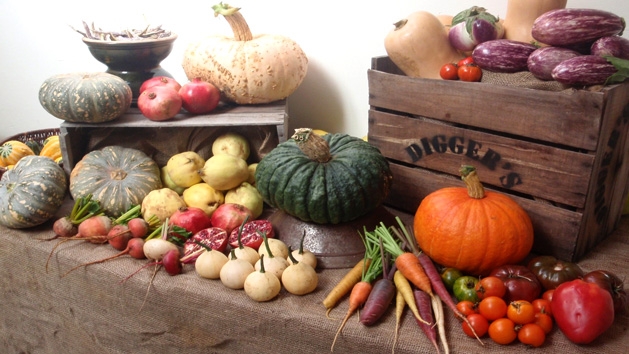
seeds in handThe HSL aims to conserve and make available vegetable varieties that are not widely accessible. It does this by maintaining a collection of vegetables from the UK and Northern Europe that are not readily available in seed catalogues. Some of these varieties were commercially available once but have now disappeared from catalogues and seed lists. Others have never been offered in catalogues but have been developed by gardeners and passed on through the generations until they were donated to the HSL. There are also some varieties that have a special local significance. Many have a story to tell, and HSL collects not only the seed, but also information on their characteristics, methods of use, origins, and what this can tell us about our gardening and culinary heritage. Just flipping through their current catalogue is a journey into the past with varieties carrying evocative names like:

Navy Bean Edmund – a variety of bean first cultivated to sustain Australian forces during WWII and which is the kind used to create ‘baked beans’.

Long Blood Red– an American Beetroot described by Vilmorin in ‘The Vegetable Garden’ (1885) as an ‘American variety with a long, slender, deeply buried root..good, productive, and well-coloured kind’ – a member of HSL describes it as having ‘the best flavour, wonderful for picking’.

Maltese plum – a variety of tomato donated by someone whose friend acquired the seeds on holiday in Malta! Trusses are borne on leaf spurs, so unlike many other varieties you don’t grow it as a cordon or remove the side shoots. This is a late variety that produces a heavy crop of firm, red plum type tomatoes ideal for stuffing.

What varieties of Veg do you grow?

Which varieties of Veg do you grow?

The HSL is not a gene bank, so does not preserve the seeds in cold storage, but grow them and make them available to other gardeners so that they remain alive and able to adapt to new conditions. Any new characteristics then have a good chance of being spotted and made use of. The HSL was created in response to the loss of old vegetable varieties that occurred following European legislation designed to counteract the activities of some unscrupulous seed companies. After the commercialisation  of seeds in the 19th century the traditional practice of farmers and gardeners exchanging seeds declined. European law says that only seed that is listed on a National List (and ultimately the EU Common Catalogue) can be marketed. To be on the list a variety must go through a series of tests, part of which is about ensuring consistency between generations. The tests both cost money and were impractical for many smaller seed companies, so many varieties started to disappear, especially those that are inherently highly variable.

With the costs incurred in breeding and maintaining a variety, a large, profitable market is needed by commercial seed companies. This means that they often decide against maintaining varieties suitable for ‘niche markets’, e.g. gardeners, in favour of those more acceptable to large-scale growers. The varieties available are therefore more likely to ripen at the same time to make harvesting with machinery easier, tough enough to withstand travel and handling in supermarkets, and familiar in visual characteristics so that they are acceptable to the average shopper. Flavour often takes a back seat.

The HSL runs a membership scheme to help to distribute seeds and counteract the costs of the EU legislation. Members pay an annual fee which goes towards the costs of collecting, growing, storing and distributing the seed. HSL produce articles on seed saving, research and the latest developments on the international seed scene in ‘ The Organic Way’, the Garden Organic members’ magazine. Every winter they also send out a Catalogue covering a portion of the collection- members can choose up to six packets  containing a few seeds of different varieties to try out for themselves. HSL is also active in promoting seed exchanges around the country.

The HSL currently looks after 800 varieties of Heritage Veg seeds

The HSL currently looks after 800 varieties of Heritage Veg seeds

Currently HSL looks after over 800 types of seed from open-pollinated varieties (not F1 hybrids), of which around 200 are detailed in their Seed Catalogue. As well as research on the varieties and testing of previously untried varieties that come in from time to time, HSL grow some of the seed used at Garden Organic’s HQ. More seed is grown by Seed Guardians – special members who volunteer their resources to look after and bulk up selected varieties. These are then available for distribution to HSL members.

The collection is still expanding. Every year HSL receive samples of vegetable seed that gardeners have been looking after and keeping alive. They ask a lot of questions about each one to determine its place in our culture and then conduct our trials on it, taking notes and making assessments throughout its growing life to find out as much as possible about it. This gives HSL the opportunity to ensure that it is different to anything else they are looking after, not obviously diseased, has not crossed (and is not a hybrid) and is something gardeners would be interested in growing. If HSL decide it is something they should be keeping they add it to the collection, so there’s always something new coming in. You can find out more about the HSL and download a seed saving guide at their website- see link below.

This is my first exploration of ‘Heritage Veg’ and the inclusion of a small sample of Greek Squash seed will give me a chance to sample an unusual variety for myself – if I can find the room for it in the kitchen garden, that is!

Taylor's SeedsCo-incidentally, last week I was also involved in another aspect of ‘Heritage Seeds’, the opening of a special exhibition at Gressenhall Farm and Workhouse museum, Norfolk. Next to the Museum’s Cherry Tree Cottage Garden (which is designed to be a re-creation of a typical Norfolk cottage garden of the 1930’s), a new space is devoted to displaying various interesting objects from one of Norfolk’s historic seed merchants. R. & A. Taylor, whose Seed Shop in King’s Lynn once provided a wide range of seeds and other ‘horticultural sundries’ to the County’s gardeners.

Over two years of research culminated in the official opening of the new display last week. This captures something of the seed shop as it would have been in the 1930’s and is also home to a significant collection of objects and other material donated to the Museum by the Taylor family in 1982. The present curator, Megan Dennis, and founder curator, Bridget Yates, also wanted the new display to provide a new focus for the museum’s gardening collections. The display was officially opened by James and Bob Taylor, who worked with their father in the family business in Norfolk Street, Kings Lynn. It was a happy day and the new display provides a fascinating range of objects and information for all ages.

I particularly like the material about School Gardening as it used to be carried out in the 1920’s – a solid part of the curriculum, but with a strict gender bias that is true in some households today: the boys grow the vegetables and the girls tend the flowers!

Sources and further information:

Garden Organic Heritage Seed Library and link to pdf on Seed Saving

The Breckland View– article on the Seed Shop display and background

Gressenhall Farm & Workhouse Museum

Master Gardener

Home composting

Old School Gardener

If you’ve enjoyed reading this post and others on this blog, why not comment and join others by signing up for automatic updates via email (see side bar, above right ) or through an RSS feed (see top of page)?
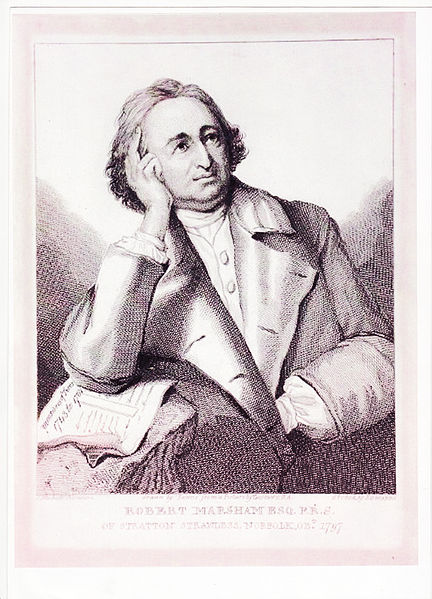
Robert Marsham - portrait by Zofany

Robert Marsham – portrait by Zofany

On a recent walk around my neighbouring village of Stratton Strawless, I visited the church and the exhibition to its most famous inhabitant, Rober Marsham. One of the oldest families in Norfolk, the Marshams held substantial estates in and around Stratton Strawless for about four centuries.

Stratton Strawless Church contains some outstanding tombs and memorials to the Marshams. The Marshams lived at Stratton Strawless Hall (just off the A140 Norwich to Cromer Road) which was completed early in the 19th Century and had extensive landscaped grounds. Humphry Repton, the famous landscape gardener and great admirer of Robert Marsham’s tree planting work, described the estate as: “a gem made out of a common by Robert Marsham”. Apart from this large scale landscaping and an avid interest in trees, Marsham is best known as the ‘father of phenology’.


Stratton Strawless Hall

Stratton Strawless Hall

What is phenology?

Phenology is the study of the times of recurring natural phenomena, especially in relation to climate. Robert Marsham was a meticulous recorder and he was the first to log the effects of nature and seasonal change. In 1736, Robert Marsham commenced this series of records that eventually developed into his 27 ‘Indications of Spring’. These included:

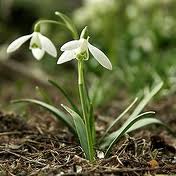
  • The first snowdrops
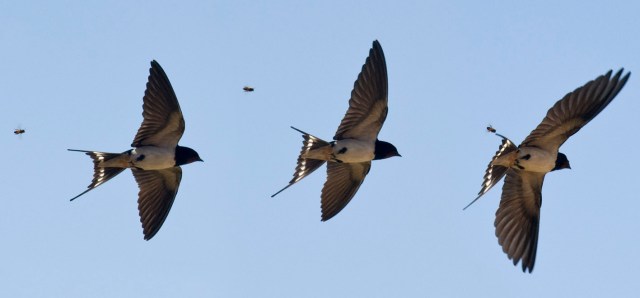
  • The first swallows seen
  • The first songs of migrant birds
  • The first butterflies in Spring
  • The first cuckoo call
  • Leafing dates of trees
The first Swallow an indicator of spring

The first Swallow an indicator of spring

Historically, in Japan and China the time of cherry and peach trees blossoming is associated with ancient festivals and some of these dates can be traced back to the eighth century. In the UK the first individual records that have been found date back to 1684. Robert Marsham was Britain’s first systematic recorder of seasonal events  and recorded his ‘Indications of Spring’ until his death in 1798. His vast database was reported to the Royal Society in 1789, the same year Gilbert White published his Natural History of Selborne.  In 1875 British phenology took a major leap forward when the Royal Meteorological Society established a national recorder network. Annual reports were published up until 1948.

Marsham provided a fascinating insight into the winter of 1739/40, the coldest year on record, when the contents of his chamber pot frequently froze overnight and the turnip crop was completely destroyed! Turnips, a Norfolk speciality, were also monitored by Marsham. He regularly recorded turnip flowering dates (needed when turnips were to produce seed) and he noted one year:

‘My farm produced me a turnip that was 19lbs and 2 oz and 39 and a half inches round.’

Marsham’s great interest in trees resulted in him being elected a Fellow of the Royal Society in 1780. Most of his tree plantings were felled for much needed timber in the First and Second World Wars and other parts of the estate were ploughed over. What is left are a few ancient trees, the remains of his avenue of oaks, and particularly his Giant Cedar (planted in 1747).This Cedrus atlantica was planted as an 18 inch sapling. It stands to the east of Stratton Strawless Hall and when measured in 2000 it measured 102 feet high and had a circumference of 23 feet.

Most of Marsham’s writings haven’t survived. However, there are articles he published in journals, some of his letters to others, and some Victorian transcriptions from his diaries. These present a picture of a man of science with an obsession with trees. James Grigor described him as “an individual who excelled all his contemporaries, in this quarter, in the work of planting, of whom his oaks form the most fitting of all memorials”. His views on planting had a wider impact as they were very influential on Humphry Repton’s landscape designs. He was also one of the first to experiment with root cutting, trenching and bark-scrubbing. He was preoccupied with improving tree growth and continually tested unorthodox methods of pruning and thinning in his forest plantations.

The first snowdrop flower an indicator of spring

The first snowdrop flower an indicator of spring

Following his death in 1797 successive generations of his family continued to record the signs of spring right up to 1958. At the time nobody realised how important these records would become. Today, with concern over climate change and its impact on wildlife and the natural world, these records have become of global importance as one of the longest and best sets of records linking climate and the natural world. A friend and fellow gardener of mine, Mary Manning, has maintained her own set of spring flowering records in Norfolk since the 1960’s.

Marsham’s records can now be compared to temperature records and provide strong evidence of how global warming is leading to earlier springs. His records for Hawthorn show how for each 1°C of temperature rise, leafing can occur up to ten days earlier. Today, a website ‘Natures Calendar’ operated by the Woodland Trust, enables everyone to record their own ‘indications of spring’ data. This website also contains lots of useful information about recent seasonal indications and educational  resources.

Another legacy of the Marsham  family is the Marsham Arms Pub just a couple of miles from my home and a favourite ‘watering hole’ of mine! It was founded by Robert’s grandson, also named Robert, in 1832, as a hostel for homeless farm labourers.marsham-arms

Sources and links:

Wikipedia

Norfolk Wildlife Trust

Robert Marsham tricentenerary

Nature’s Calendar

Woodland Trust

Phenology Wheels

US National Wildlife Federation- phenology

Old School Gardener

If you’ve enjoyed reading this post and others on this blog, why not comment and join others by signing up for automatic updates via email (see side bar, above right ) or through an RSS feed (see top of page)?

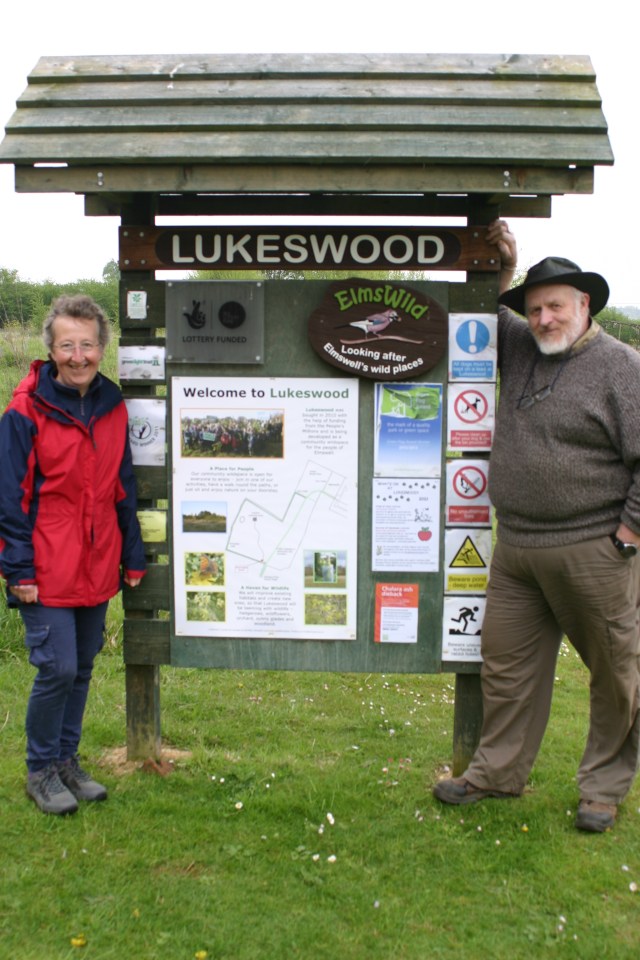
Lukeswood- Chair Mary Feeney and Vice Chair John Ibbetson

Lukeswood- Chair Mary Feeney and Vice Chair John Ibbetson

I’ve been a judge on the UK ‘Green Flag’ scheme for about 5 years now. Over the last week I’ve visited two open spaces to assess their applications so I thought I’d share something about the scheme and the sites I’ve visited, which are interesting examples of the sorts of place that are hoping to secure a ‘Green Flag’.

The Green Flag Award® scheme is the benchmark national standard for parks and green spaces in the UK. Currently run by the ‘Keep Britain Tidy’ organisation, it was first launched in 1996 to recognise and reward the best green spaces in the country. The first awards were given in 1997 and, 16 years later, it continues to provide the benchmark against which UK parks and green spaces are measured. It is also seen as a way of encouraging others to achieve high environmental standards, setting a standard of excellence in recreational green areas. Entries for the Green Flag Award® are open to parks or green spaces located in the UK, though the scheme is also being piloted in The Netherlands and Germany.

Green Flag Award® applications are judged against eight key criteria:

1. A welcoming place – when approaching or entering the park/green space, the overall impression for any member of the community – regardless of the purpose of their visit – should be positive and inviting.

2. Healthy, safe and secure – the park/green space must be a healthy, safe and secure place for all members of the community to use. Any issues that have come to light must be addressed in the management plan and implemented on the ground. New issues that arise must be addressed promptly and appropriately.

3. Clean and well maintained – for aesthetic as well as health and safety reasons, issues of cleanliness and maintenance must be adequately addressed.

4. Sustainability – methods used in maintaining the park/green space and its facilities should be environmentally sound, relying on best practices available according to current knowledge. Management should be aware of the range of techniques available to them, and demonstrate that informed choices have been made and are regularly reviewed. 

5. Conservation and heritage – particular attention should be paid to conservation and appropriate management.

6. Community involvement – the park/green space management should actively pursue the involvement of members of the community who represent as many park/green space user groups as possible.

7. Marketing –  a marketing strategy should be in place, which is being implemented and regularly reviewed; there should be good provision of information to users (e.g. about management strategies, activities, features, ways to get involved),  and the space should be promoted as a community resource.

 8. Management – there needs to be a management plan or strategy which is clear, being actively implemented and reviewed and the park should be financially sound.

There is a main scheme and also schemes for Community run and Heritage Green spaces, which have slightly different sets of assessment criteria. The main scheme usually involves two judges making the assessment, whilst at community spaces a lone judge does this.  In the main scheme a ‘desk assessment’ of the Management Plan for the site is carried out and this is followed up with a ‘field assessment’ which gives the chance to check out questions arising from the desk assessment and to examine other issues on the ground. Applicants have to pass both the desk and field assessments and achieve a minimum score to be awarded a ‘Green Flag’. Judges don’t only give scores to the space but also look at the strengths it has against the different criteria and include recommendations designed to help the site improve, where appropriate. This full feedback is, I think, one of the best features of the scheme.

Yesterday I travelled to Suffolk to judge a community – run green space in the village of Elmswell, called ‘Lukeswood’. I was met by the Chair and Vice Chair of ‘Elmswild’ (the group that runs the wood) and given a tour of their site. Here, a group of volunteers aim to improve existing habitats and create new ones, so as to establish a mosaic of woodland, open grassy rides, hedgerows, pond and a wildflower area. The project is focused on involving and benefiting the local community as well as raising awareness of the rarest habitats and species on the site and educating about how these can be protected. Formerly an area of agricultural ‘set aside’ this space of about 9 acres is at the centre of the village next to allotments and cemeteries. Tree planting began in 2010. Early in 2011, with the help of children from Elmswell Primary School, the 1683rd tree was planted – fulfilling a pledge to plant one tree for every house in the village! Over the years the Group plan to plant many more. Lukeswood was named after the Reverend Luke, Rector of Elmswell in the 1860s – described as a ‘Victorian whizzkid’ who introduced many changes, including building the village school. The group like to think that, were he still here today, he would approve of their plans and would enjoy seeing this new addition to the village develop over the coming years. And thanks to continuing fund raising efforts Elmswild have finally succeeded in securing the remaining few acres of land where they plan to establish an orchard (featuring Suffolk varieties of apple).

Whilst I was in the area I popped over to Bury St. Edmunds, where another long-established Green flag site – the Abbey Gardens in the centre of town- is in it’s spring glory (though I wasn’t there to judge it for the Green Flag). It has a long established tradition of seasonal planting in many formal beds. At this time of year – especially as the spring flowers are blooming rather late – it is a fantastic sight. First laid out as a Botanic Garden in 1831, in addition to the formal layout of the central area, there is are open grass areas surrounding the Abbey ruins and an aviary, bowling green, bird feeding area, water, herb and sensory gardens, and a children’s play area.


Last week, with my co – judge, I visited and judged the woodland area known as ‘Pretty Corner Wood’ in north Norfolk. This is a site managed in two parts, one by the District Council (which was the focus of the green flag assessment) and the other part by the Woodland Trust. The wood sits adjacent to the town of Sheringham and provides a wonderful scene of mixed woodland and some glades and other areas, visited in the main by local residents. Recently the Council has been successful in securing funding to bring about a range of improvements to the wood which included putting in a new pathway suitable for wheelchair users that leads to a splendid view of the sea and wind farms on the horizon, as well as a wooden sculpture trail. The woodland is carefully managed to ensure the right mix and density of species and the Council has also sown a wild flower area close to the open glade that makes a great picnic spot. A privately run Tea Rooms also provides a convenient refreshment stop.

Of course I can’t give away any information about how these two sites have faired in this year’s judging, but suffice it to say that they both provide wonderful natural resources to their local communities and are clearly loved by those involved in running and improving them. Its this sort of commitment that not only creates great open spaces for everyone to enjoy today and into the future, but can generate fantastic community spirit.

Green Flag Award home page

Links:

Green Flag Award Website

Elmswild website

Pretty Corner Wood information

Abbey Gardens

Old School Gardener

If you’ve enjoyed reading this post and others on this blog, why not comment and also join some other people and sign up for automatic updates via email (see side bar, above right ) or through an RSS feed (see top of page)?

IMG_5527We had a very enjoyable walk around one of our local ‘haunts’ on Sunday – Sheringham Park, in north Norfolk. I think we can honestly say that we’ve visited this beautiful landscape in all weathers – I recall the children sledging down some of the steep slopes in the snow and also the time we took some visiting friends there in the pouring rain!  Fortunately the sun was shining and there wasn’t a cloud in the sky on this latest visit.

The Park surrounds Sheringham Hall (privately occupied), but Sheringham Park is in the care of the National Trust and is open for visitors. The Park was designed by the famous Landscape Gardener, Humphry Repton, who presented his proposals in July 1812 in the form of one of his ‘Red Books’ – he showed ‘before and after’ fold – out images to illustrate the differences his design proposals would make. He described Sheringham as his ‘favourite child in Norfolk’ and he is buried in Aylsham Church, about 15 miles to the south. At the time he was in his later years and his star was on the wane, but this Park is described by some as his most successful landscape design. Abbot and Charlotte Upcher bought the Estate in 1811, and successive generations of the Upcher family did much to develop it, as well as the Hall and the park, and also built a school.

The landscape has been moulded to make the most of the natural hills and vales (formed by glacial gravels). Many of the trees are now of a very mature age and there is some evidence of felling or ‘natural topple over’ as they near the end of their normal lifespans. The Trust has done much new planting and maintains the ‘wilderness’ feel of some areas, along with mature woodland with glades and pools, surrounding heathlands (with interesting views towards the restored North Norfolk Railway, the coast and North Sea), plus all the elements of the romantic landscape around the House and its setting.

The woodlands also contain a large variety of rhododendrons and azaleas. In the early 20th century Henry Morris Upcher obtained rhododendron seeds of various types from plantsman ‘Chinese’ Wilson. Many other species of tree and shrub are represented in the park, including fifteen kinds of magnolia, maples, acers,styrax, Eucryphia, Davidia involucrata and a fine example of the ‘Snowdrop Tree’,  Halesia. Several outlook towers and viewpoints provide good views over the park and of the nearby coast and surrounding countryside. Recently a new ‘Bower Garden’ has been created which provides a wonderful den building area, enclosed seating area and widllife pond which had many tadpoles, pond skaters and the like on our visit.

If you visit you’ll also have the benefit of an interesting exhibition about Repton and the development of the estate, a number of marked walks plus all the usual National Trust attractions – I particularly enjoyed some Stem Ginger Ice Cream!

Old School Gardener

If you’ve enjoyed reading this post and others on this blog, why not comment and also join some other people and sign up for automatic updates via email (see side bar, above right ) or through an RSS feed (see top of page)?

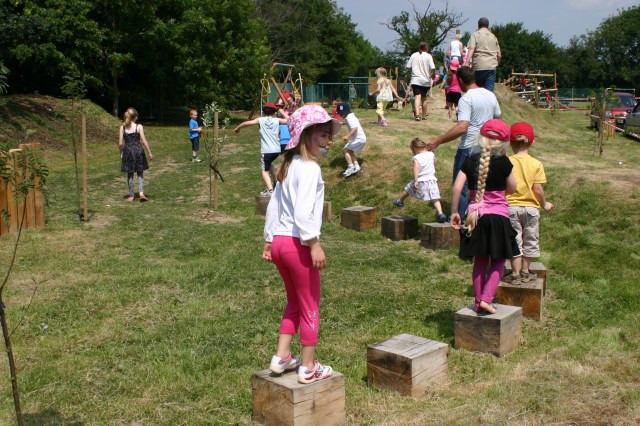
Two projects in the village of Cawston, Norfolk enabled me to ‘cut my teeth’ on designing playful landscapes.

Both were completed about 6 years ago and largely on a voluntary basis. I remain involved at the local Primary School, helping them with their School Gardening activities, but my early involvement was in designing, sourcing planting and organising the creation of an ‘Eco Park’ – basically to try and diversify the habitats and play opportunities in a bland, mown grass playing field with a solitary multi function play unit. The design features a curved mixed native species hedge (which is now over 2 metres high) and a haven for wildlife, several groupings of native trees such as Silver Birch, Hazel, Douglas Fir, Beech, Oak, Feild Maple, Mountain Ash and Black Poplar, and some areas of shallow mounding.

The planting has been used to create several different spaces, and grass within these has been left to grow long both to provide varied habitats and interesting play areas. In addition a ‘Nectar Bar’ of insect – friendly herbaceous and other flowering plants has been created alongside the school, including a painted pergola which both helps to privide shade to the south – facing side of the school and added planting interest.

The second project involved working on commission for the Parish Council and a local charity to design, seek funding, consult local people and supervise the creation of a new play landscape at the ‘Oakes Family Field’ located to one side of the village. The design was constrained by the need to retain areas for cricket and football pitches and to avoid placing play areas close to housing on one side of the field. There is a mix of landscape features including a large mound (with a slide), timber play equipment for balancing and enclosed social areas, as well as a selection of traditional play equipment in two main areas, one for younger, one for older children. Over £100,000 was raised from various sources and so a wide range of play equipment and features has been possible.

Old School Gardener

If you’ve enjoyed reading this post and others on this blog, why not comment and join others by signing up for automatic updates via email (see side bar, above right ) or through an RSS feed (see top of page)?

Steaming up for National Science and Engineering Week

An engineering volunteer at Gressenhall inspecting the steam boilerGressenhall Farm & Workhouse Museum, Norfolk

‘Tomorrow we’ll be warming things up and getting the fire going to steam up our engines! All to celebrate National Science and Engineering Week.

Take a look on our website to find out what a day in the life of an Engineering Volunteer involves.’

127_2786The play landscape in this Norfolk village was created  to partly replace, as well as enhance an existing fenced play area with wooden and other equipment, which was set wide apart and surrounded by grass. This adjoins an area of the local recreation ground and a small area of woodland/hedgerow.

I was commissioned to provide design and specification plus project management advice. There was an initial budget of £50,000, funded by the Government Playbuilder programme plus contributions from local organisations.

The brief focused on three main objectives:

1. Expanding the play space – using the identified budget and the Design Brief as a starting point, expand and link the existing play space so as to utilise the play opportunities offered by the nearby wood/ hedgerow, allowing for future fundraising and community self-build.

 2. Enhancing Play Value –  increase the number and range of play opportunities for all abilities and ages, focusing on 8-13 year olds and with some provision for toddlers.

 3. Creating an attractive community space – create a welcoming, attractive space for children and adults which is coherent, provides interest through varied height and colour, creates a sense of discovery, uses existing/ donated play equipment (where possible), and landscape features to create play value and enhance the appearance of the space.

The resulting design extends the play area into a larger space (requiring the movement of a football pitch) and integrates this with retained, refurbished play equipment. Old fencing was removed and replaced with shrub planting and trees to indicate boundaries, an existing mound and new grass mounds were created to provide play features and to house a tunnel, wide slide with graded wheelchair access and aerial cableway. There is a wooden climbing feature, plus additional play equipment for toddlers and older children, including a simple wood slice spiral with spring bulbs planted to mark this, a log seating area/ social space, basket swing, spinners, and areas of longer grass. The project was substantially completed by June 2010.

Old School Gardener

If you’ve enjoyed reading this post and others on this blog, why not comment and join others by signing up for automatic updates via email (see side bar, above right ) or through an RSS feed (see top of page)?

gressenhallfw's avatarGressenhall Farm and Workhouse

 Over the winter months, the volunteers and the Skills for the Future Library and Archive trainee have been keeping warm by re-organising the newly decorated library at Gressenhall Farm and Workhouse Museum.

The library was originally started in 1976 as a resource to help staff identify objects and object histories donated to the Museum of Rural Life and the library now has a dedicated space in which researchers can have access to these resources.

Library

Some of the items available include:

  • Farm documents including diaries, horse remedy notebooks, stud books, invoices from Norfolk farms; books, journals and magazines relating to farming and livestock


  •  Manuals for engines and farm machinery, Government publications and posters concerning agriculture, health, war and education, retail and agricultural show catalogues


  • Photographs, objects, books and printed documents relating to Agricultural Unions and George Edwards


  • Educational books and objects used in Norfolk schools, class photographs and…
View original post 205 more words

Finding Nature

Nature Connectedness Research Blog by Prof. Miles Richardson

Norfolk Green Care Network

Connecting People with Nature

Discover WordPress

A daily selection of the best content published on WordPress, collected for you by humans who love to read.

Susan Rushton

Celebrating gardens, photography and a creative life

Unlocking Landscapes

Writing, photography and more by Daniel Greenwood

Alphabet Ravine

Lydia Rae Bush Poetry

TIME GENTS

Australian Pub Project, Established 2013

Vanha Talo Suomi

The Journey from Finnish Rintamamiestalo to Arboretum & Gardens

Marigolds and Gin

Because even in chaos, there’s always gin and a good story …

Bits & Tidbits

RANDOM BITS & MORE TIDBITS

Rambling in the Garden

.....and nurturing my soul

The Interpretation Game

Cultural Heritage and the Digital Economy

pbmGarden

Sense of place, purpose, rejuvenation and joy

SISSINGHURST GARDEN

Notes from the Gardeners...

Deep Green Permaculture

Connecting People to Nature, Empowering People to Live Sustainably

BloominBootiful

A girl and her garden :)