Tag Archive: gardening


How to Build a Propagation Bench

How to build a propagation bench

Instructions on how to create your own solar – heated bench for propagating seeds and cuttings and looking after seedlings.

Old School Gardener

rhubarb-growing-l_A2Rhubarb Ted

‘I knew a funny little man

His name was Rhubarb Ted;

They called him that because he wore

Rhubarb on his head.

I’d grown so used to this strange sight,

The cause I did not seek;

But then one day to my surprise,

I saw he wore a leek.

I asked him if he’d please explain,

And let me know the reason;

He said, ‘I’m wearing leek because

Rhubarb’s out of season!’

Ann O’Connor

Flooding- How Permacuture Design can help

from-bottom-of-garden.jpg

An interesting article about one person’s experience of ‘extreme weather events’ and how permaculture design helped to redesign a garden and home. Click on the title for the weblink to the article.

You might also be interested in the series of articles I wrote about Gardening and Climate Change last year- have a look in the ‘Four Seasons in One Day’ category of articles in the right hand column.

Old School Gardener

PicPost: Lunch Box

Container food growing in Berlin

Large Gardens can be broken up into smaller spaces, but these can be held together by features such as water channels, paths and planting, as here in a scheme by Audax Design

Large Gardens can be broken up into smaller spaces, but these can be held together by features such as water channels, paths and planting, as here in a scheme by Audax Design


Garden Design is concerned with creating spaces which both meet the functional needs of their users (relaxing, entertaining, playing, growing food, getting washing dry etc.) and which are appealing to the senses, especially vision.

The latter is about achieving concepts like harmony and unity – the design ‘hangs together’- and using layout and structure (the features, plants and other things which are the visual backbone of the garden) to achieve variety and interest.

Some gardens have shapes which pose particular design challenges, but various approaches can be taken to get the most from them. Here’s a list of some of these and ways to lay out the garden for maximum effect. All the examples assume that you are looking at the garden from the back of the house.

Triangular 

Challenge: These plots typically are wide near the house and the sides taper away to converge to a point and this is exaggerated through perspective, making the garden appear smaller than it is.

Solution: Try to disguise the garden boundaries, especially the narrow point at one end. Focal points can also be used to draw the eye away from the corner, or if a focal point is used near the end make sure it is brought well forward. Another approach is to use sweeping curves and not follow the lines of the boundaries.

triangular garden after

After- showing good use of floorscape at an angle and a pergola to break up the view to the end. Picture- Fiona Edmond. Designed by Fiona Edmond of Green Island Gardens

trianglegardenoverheadsmall

A triangular garden – before Picture-Fiona Edmond


Rectangular

Challenge: The boundaries can dictate the internal layout which can be rather formal and symmetrical – what if you don’t want formal?

Solution: Try to hide the boundaries, especially the horizontal fence line with a mixed planting of trees, shrubs and climbers. You could make use of sweeping curves, especially circles or part circles, or alternatively use a 45 degree/60 degree grid.

L- shaped

Challenge: This is an interesting shape which can potentially allow for the creation of a ‘secret area’. However, like the rectangular plot it can become rather formal if you follow the boundaries in the internal layout.

Solution: Unless you want a formal garden, use either a layout based on a 45 degree grid to the boundaries or sweeping curves to take the eye away from the sides of the plot. Oh, and of course think about varying this in the ‘dog leg’ of the shape to create a diffferent if not ‘secret’ space. Another option is to use the part of the ‘L’ that’s out of the main view from the house to hide things like bin areas, sheds or play spaces (though you might want areas for younger children to remain in sight from the house).

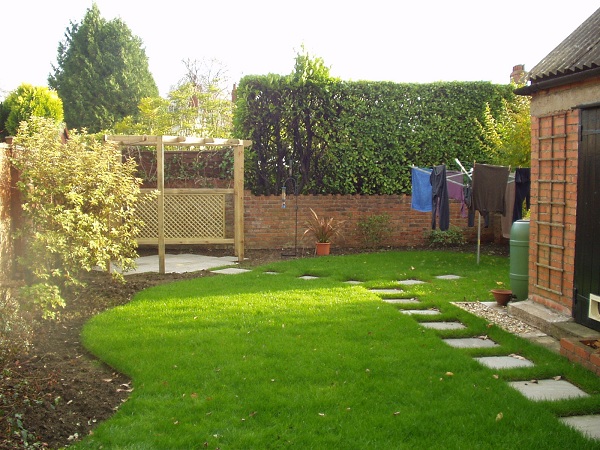
An L shaped garden which has been designed to hide utilities such as washing line and water butt, and at the same time introduced curves and a focal point seating area - designed by Dewin Designs

An L shaped garden which has been designed to hide utilities such as washing line and water butt, and at the same time introduced curves and a focal point seating area – designed by Dewin Designs


Large gardens

Challenge:The scale of the challenge can be overpowering so the designer does very little or nothing; the result is often a plot which lacks interest; large open expanses of grass with thin borders around the edges, for example.

Solution:These give the designer lots of scope for creating a series of smaller spaces within one larger plot. It is quite a common technique to divide the garden into three; first, the area near the house is normally more ‘architectural’ and formal (with hard lanscaping features like terraces, steps, archways); the second is a transitional space; the third is more informal so it blends in with the landscape beyond.

A large garden can be broken up into a series of more interesting spaces using arches, hedges, screens etc.

A large garden can be broken up into a series of more interesting spaces using arches, hedges, borders, screens etc.


Long and narrow

Challenge: These can create a ‘tunnel’ effect, making the space seem claustrophobic.

Solution: One way to rectify this is to divide the garden into two or three smaller spaces, each linked together but with its own theme or function: this then prevents you seeing straight down the garden. Another option is to put in a long serpentine lawn/open gravelled area with certain features on the insides of the bends to block the view, or you could design in a path that zig zags across the garden from left to right and then back again. In this type of plot it is important to screen the boundaries so it is not so obvious how narrow the plot is.

A design for a long and narrow garden which shows paving placed at an angle to the sides, plus a curved path -these help to widen the impression of the space

A design for a long and narrow garden which shows paving placed at an angle to the sides, plus a curved path – these help to widen the view of the space – design by Albert’s Garden


Wide and shallow

Challenge: The view to the end of the garden is foreshortened, so if you see the back boundary you know that the plot is shallow and you see the whole plot at once- pretty uninteresting .

Solution: Avoid using the boundaries as the guide to internal layout as this will emphasise the foreshortening even more. Only use the boundaries if you are creating a formal garden. Try to disguise the far boundary fence/ wall so that you are not aware of how close it is. This can be achieved by introducing a false archway or by using tall planting between the house and the boundary to draw the eye to the middle distance. Use layouts based on the diagonal axis and/or use circles, curves, rectangles, ovals or ellipses to define a strong internal shape that draws the eye. An alternative approach is to use a narrowing shape towards the short end to give a false sense of perspective and so give the impression of greater distance to the rear boundary (e.g. edges of paths/ lawn and a focal point like a statue, structure or feature plant).

A design for a triangular community garden showing how paths and various features draw the eye into the central space.

A design for a triangular community garden showing how paths and various features draw the eye into the central space.

Photo credits: Fiona Edmond, Green Island Gardens (see link below)

Further information:

Albert’s Garden- design examples

Triangle Community Garden

Green Island Gardens- design

Old School Gardener

Using pallets and other recycled materials to create useful garden equipment and features seems to have really taken off in the last year- at least the posts I’ve made to Old School Garden during that time are among my most popular.

My own exploits to date have been limited to a set of vertical planters, shortly to be used as mini raised beds for some young children at my local primary school. Following a bit of a reorganisation of outside stores here at the Old School, I have a redundant wooden bicycle rack which looks perfect as the base for a ‘plant theatre’ so I might get round to doing that as the days lengthen and (hopefully) the air warms up. In the meantime here’s the latest batch of ideas I’ve gleaned from Facebook sites like 1001 pallets, urban gardens, container gardening and the like. Enjoy!

First some sheds, shacks and greenhouses….


Next a few planters…..

And now some serious outdoor building work…..

Finally a few odds and ends…..

Old School Gardener

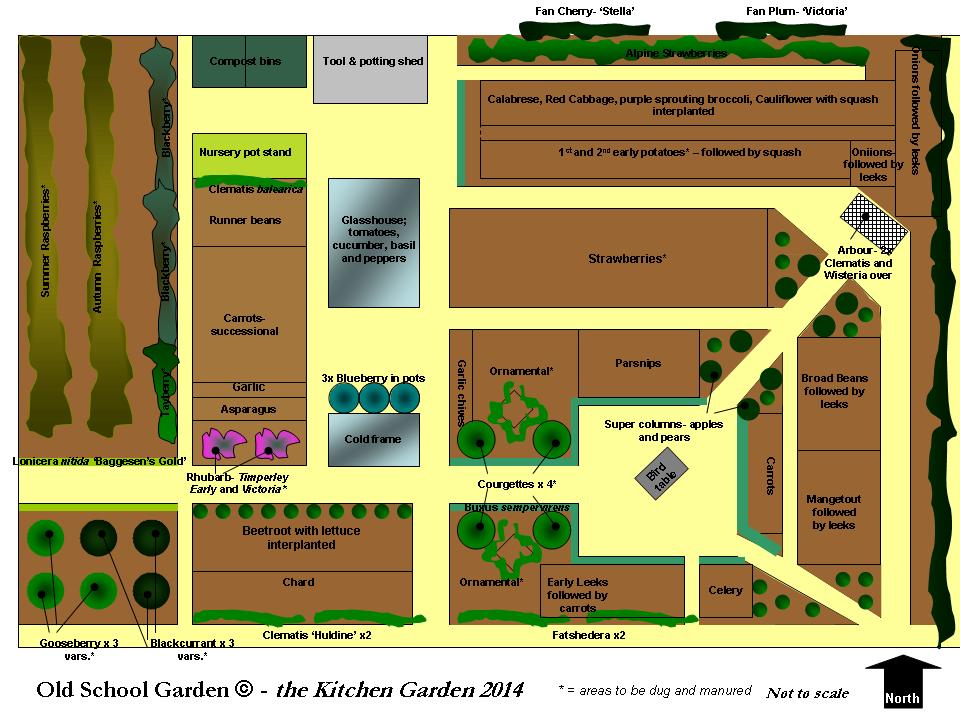
Well here it is, my plan for the kitchen garden here at the Old School. I’ve reviewed last year’s results and have tried to rotate crops as well as introducing more variety and greater successional cropping. This approach will, I hope,  help me to avoid gluts, reduce the overall level of food and waste, while at the same time increasing the range and the ornamental value of the area through introducing more perennial and annual flowers.

I’m also going for some ‘heritage’ varieties- squash, cauliflower, leek, pea, runner beans and beetroot.

What do you think?

kitchen gdn layout 2014

Old School Gardener

A 'sub shrub'- Hypericum calycinum

A ‘sub shrub’- Hypericum calycinum

As spring approaches it’s around now that some shrubs should be pruned. This week’s question, from Celia MacKnyff of Cutaway in Yorkshire, asks:

‘What is a sub shrub and should I treat it differently to an ordinary shrub?’

Celia, a sub shrub is a plant that is woody at the base but has annual stems like those of a herbaceous plant. These stems die back most years to the older woody growth. The ‘Rose of Sharon’ (‘Great  St. John’s Wort’ or Hypericum calycinum) is a good example. The stems should be cut back every spring, not to ground level, but to the new shoots on the woodier stems at the bottom. I’ve been out in Old School Garden doing some pruning of these and other shrubs in the last few days and, not surprisingly as we’ve had such a mild winter to date, many of these stems look pretty healthy and are still carrying lots of green leaves. Nevertheless, if you want to benefit from fresh new growth, now’s the time to prune them.

Lavenders are also treated like sub shrubs

Lavenders are also treated like sub shrubs

Small, low shrubs such as Lavender, Periwinkle and Thyme, and many members of the family Ericaceae, such as Cranberries and small species of Erica, are often classed as sub shrubs. As far as pruning Lavender is concerned there are perhaps two schools of thought on this – either prune back the flowered shoots in autumn or spring. Doing this in the autumn is good in that there’s till time for new growth to be put on before winter, which helps maintain a nice compact shape to the plants over the colder months. However, if the weather is really cold you may suffer from some die back, so some people leave pruning until the spring. Nevertheless, small amounts of frosted growth can be tackled by further light pruning in the spring so that new vibrant growth is stimulated. Take your pick! In both cases pruning should be limited to the sappy top growth and should avoid cutting into the older woody stems.

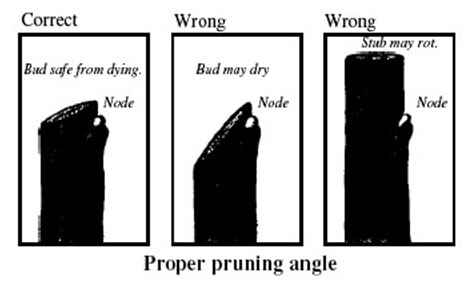
It's important to get the right pruning cut to avoid damaging shrubs and/or letting in disiease

It’s important to get the right pruning cut to avoid damaging shrubs and/or letting in disease

Whilst we’re talking about pruning sub shrubs it’s also worth remembering when to prune different flowering shrubs. There are two basic groups, one which flowers in summer and autumn (‘late flowerers’) on the tips of shoots that grew earlier the same season. This group includes Buddlejas, large flowered and cluster flowered Roses, Caryopteris and some later flowering Clematis hybrids (as well as sub shrubs like Hypericum). These should be pruned back hard to new buds in spring as they appear, so as to encourage development of these into strong new flowering shoots. I’ve tended to prune my Buddlejas a little later than the Hypericum, as late frosts may do damage to the new buds and therefore it’s a good insurance policy to wait until you can see healthy, strong buds to cut back to and the risk of really cold weather has passed. I’ll probaly prune mine later this month or in early March at the same time as I prune back my Dogwoods to encourage new stems that create great winter colour.

Buddlejas are 'Late flowerers' and need hard pruning in the spring

Buddlejas are ‘Late flowerers’ and need hard pruning in the spring

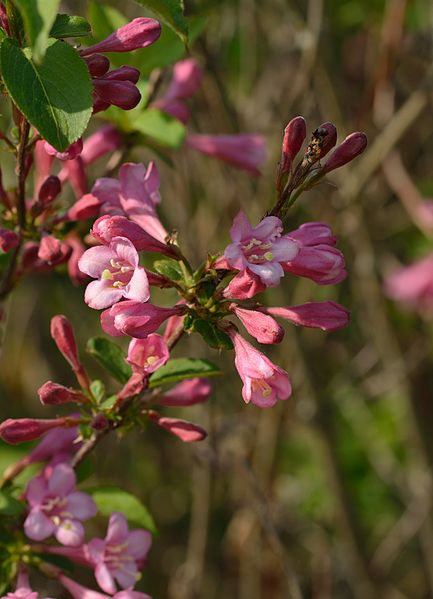
The second group (‘Early flowerers’), includes plants that flower in spring on shoots which grew the previous season and includes Philadelphus (‘Mock Orange’), Forsythias, flowering Currants (Ribes), Weigelas and the ‘Beauty Bush’ (Kolkwitzia). Though its is perhaps less important to prune these, it can be done to tidy up the shrub  immediately after flowering, by removing the branches that carried the flowers. This also encourages new growth to be put on alongside other shoots that have already grown but not flowered – these shoots must be left unpruned and will carry the flowers next season.

'Early flowerers' like Weigela, should be pruned after flowering

‘Early flowerers’ like Weigela, should be pruned after flowering

Old School Gardener

A couple of interesting ideas for recycling tyres into useful garden equipment.

Strips of old tyre rubber used as edgings for grass- hmm...how practical, how aesthetic?

Old tyre rubber re-formed into strips as edgings for grass- hmm… practical? aesthetic?

A neat row of tyre containers- herbs? grass-lined seats?

A neat row of tyre containers- herbs? grass-lined seats?

Just thinking about a new phase in my life...
Just thinking about a new phase in my life…

No, you didn’t misread the title, and no it isn’t a spelling mistake! I find myself ‘celebrating’ my 60th year today, and with a ‘pension event’ happening linked to some of my earlier working life, it has given me pause for thought.

Over the last 12 years  I’ve been self-employed. As the years have wound round and some employed friends have entered that state of ‘early retirement’, I’ve been ranting against the usual view of ‘retirement’, or perhaps that should read MY expectations of what that word brings. I have the slippers, a new TV, comfortable chairs, sound and nicely located house and good sized garden. I’m reasonably healthy, have an income to get by, a loving wife (herself ending full time employment in a few months) and a cat that is talkative to the point of being annoying (almost like having small children around once more).

I’m also, as you might have noticed, into gardening, so I have something to keep me busy during the day (along with household chores, the odd trip out etc.) It could be easy to just let life happen to me and for the days to be pleasant, much the same (but with a bit of variety due to weather etc.) and little to bother me (though I do find I’m getting more frequent attacks of intolerance against various aspects of ‘the world today’, but am thankfully not yet a Daily Mail reader).

Over the past year as 60 approached, I’ve started to form an idea of what I want this new phase of my life to be. And I suppose that’s the most significant part of this reflection- I’m thinking of a new phase of my life, one which is active (health permitting), inspiring, interesting and involves continuing to contribute to life outside my own four walls (both of house and garden).

In short refiring rather than retiring.

Today I begin a part of this new phase, helping the first of three groups of students at a local High School to grow food.

I hope this post hasn’t been too self indulgent. 

Old School Gardener

P.S. I’ll tell you more of my new school gardening experiences in the coming months.

Finding Nature

Nature Connectedness Research Blog by Prof. Miles Richardson

Norfolk Green Care Network

Connecting People with Nature

Discover WordPress

A daily selection of the best content published on WordPress, collected for you by humans who love to read.

Susan Rushton

Celebrating gardens, photography and a creative life

Unlocking Landscapes

Writing, photography and more by Daniel Greenwood

Alphabet Ravine

Lydia Rae Bush Poetry

TIME GENTS

Australian Pub Project, Established 2013

Vanha Talo Suomi

The Journey from Finnish Rintamamiestalo to Arboretum & Gardens

Marigolds and Gin

Because even in chaos, there’s always gin and a good story …

Bits & Tidbits

RANDOM BITS & MORE TIDBITS

Rambling in the Garden

.....and nurturing my soul

The Interpretation Game

Cultural Heritage and the Digital Economy

pbmGarden

Sense of place, purpose, rejuvenation and joy

SISSINGHURST GARDEN

Notes from the Gardeners...

Deep Green Permaculture

Connecting People to Nature, Empowering People to Live Sustainably

BloominBootiful

A girl and her garden :)