Tag Archive: gardening


I recently had a ‘tweet’ from fellow Norfolk resident, Claire in Thetford. She was wondering what the growths on these leaves were.

I must admit to being a bit puzzled at first, but some further research suggested that they are some sort of Gall, which Wikipedia describes as:

‘…abnormal outgrowths of plant tissues and can be caused by various parasites, from fungi and bacteria, to insects and mites. Plant galls are often highly organized structures and because of this the cause of the gall can often be determined without the actual agent being identified. This applies particularly to some insect and mite plant galls.’

My guess from the pictures was that these were galls possibly created by some sort of parasitic wasp (in this case on the leaves of a Lime Tree). Claire’s own research came up with a more precise description: a ‘Nail Gall’ formed by a small mite Eriophyes tiliae. These microscopic mites overwinter in the bark of lime trees and crawl on to the underside of the foliage in spring to feed. The mites secrete chemicals into the leaves causing them to produce the unusual projections into which the mites move to continue feeding during the summer. Infestations of mites and the nail galls they induce don’t appear to affect the health of the trees and there’s no way of controlling or preventing them. The galls caused by this mite are said to be yellow-green or red in colour (see picture below). It may be that the whitish nails in Claire’s picture have been be caused by another mite (Aceria lateannulatus), which affects both the small-leaved lime (Tilia cordata) and the Common Lime (Tilia x europaeus), but not the large-leaved lime (Tilia platyphyllos).
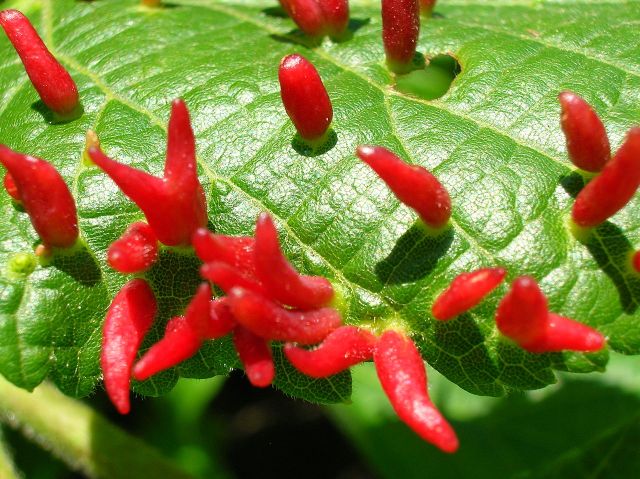
Nail Galls cauised by Eriophyes tiliae

Nail Galls cauised by Eriophyes tiliae

Galls are fascinating phenomena. As Wikipedia continues, those created by insects are:

‘…highly distinctive plant structures formed by some herbivorous insects as their own microhabitats. They are plant tissue which is controlled by the insect. Galls act as both the habitat and food source for the maker of the gall. The interior of a gall can contain edible nutritious starch and other tissues. Some galls act as “physiologic sinks”, concentrating resources in the gall from the surrounding plant parts. Galls may also provide the insect with physical protection from predators.

Insect galls are usually induced by chemicals injected by the larvae or the adults of the insects into the plants, and possibly mechanical damage. After the galls are formed, the larvae develop inside until fully grown, when they leave. In order to form galls, the insects must seize the time when plant cell division occurs quickly: the growing season, usually spring in temperate climates, but which is extended in the tropics.

The meristems, where plant cell division occurs, are the usual sites of galls, though insect galls can be found on other parts of the plant, such as the leaves, stalks,branches, buds, roots and even flowers and fruits. Gall-inducing insects are usually species-specific and sometimes tissue-specific on the plants they gall.’

Galls are also caused by fungi, bacteria, viruses and nematodes. It seems that in many instances these growths do not cause any significant harm to the plants they infest, though in some cases long term harm can be caused to some species, for example by affecting their overall shape and vigour.
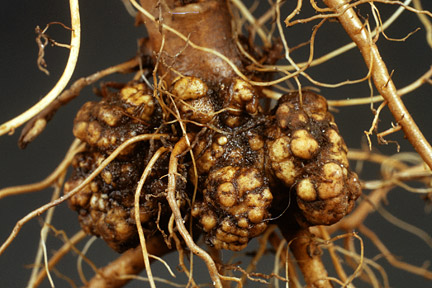
Crown Gall on apple- RHS

Crown Gall on apple- RHS

Crown gall affects a wide array of plants and roses are definitely one of them. It is a plant disorder caused by the bacterium Agrobacterium tumefaciens, that interferes with the plants ability to take up water and nutrients. This results in poor growth and weak plants that are easily stressed and injured- the only remedy in this case is to dig up the plant and dispose of it.

The study of plant galls is called cecidology. While these weird structures have intrigued humans for many years, there is still much that we don’t know about them.
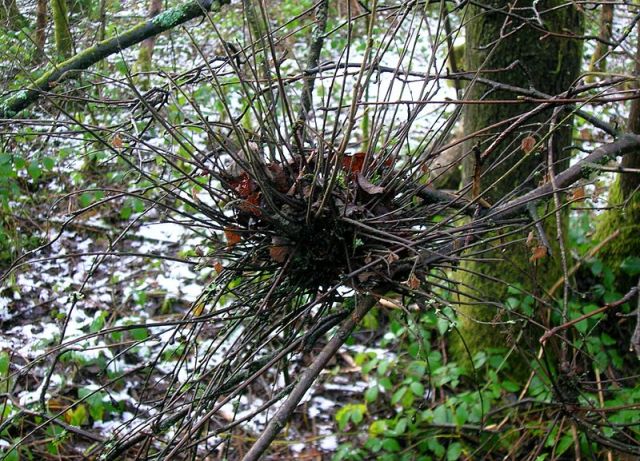
Wiches Broom Gall - picture Rosser1954

Wiches Broom Gall – picture Rosser1954

While some galls are well hidden and hard to spot, others are much more conspicuous. Have you ever looked up into a birch tree (Betula spp.) and noticed what looked like large, dense birds’ nests? In some cases these may well be nests, but very often they are actually galls called ‘witches’ brooms’. These are caused by a fungus (Taphrina betulina), which stimulates the tree to produce numerous extra shoots, resulting in a dense nest-like cluster. The fungus can then feed on the shoots. It was once believed that they were caused by witches flying over the tree!

If you spot an odd-looking growth on a dog rose (Rosa canina) it could well be a Robin’s pincushion gall, caused by a wasp (Diplolepis rosae). There was once a belief in England that these were caused by the woodland sprite, Robin Goodfellow or Puck. It is hardly surprising that people ascribed supernatural causes to some galls – they look pretty strange, and their causes aren’t exactly obvious.
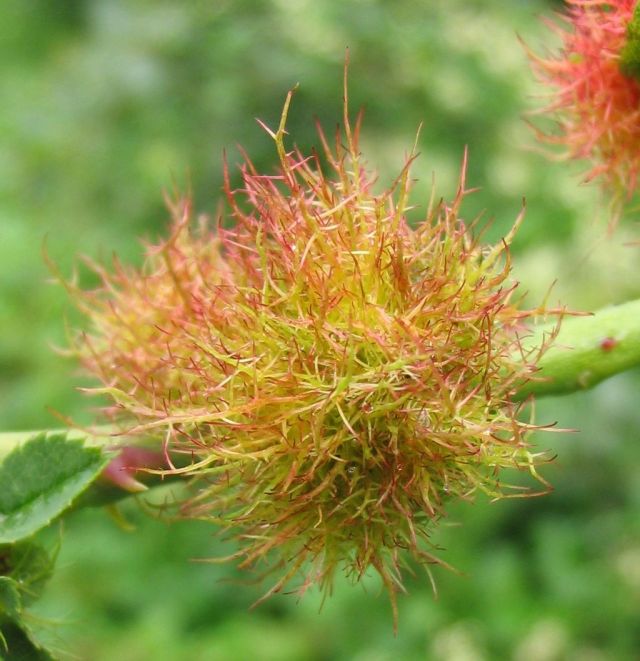
'Robins Pincushion' gall on a Wild rose

‘Robins Pincushion’ gall on a Wild rose

The real gall specialists include gall midges, gall flies and gall wasps. Perhaps one of the most familiar galls is the oak apple, caused by a tiny wasp (Biorhiza pallida).
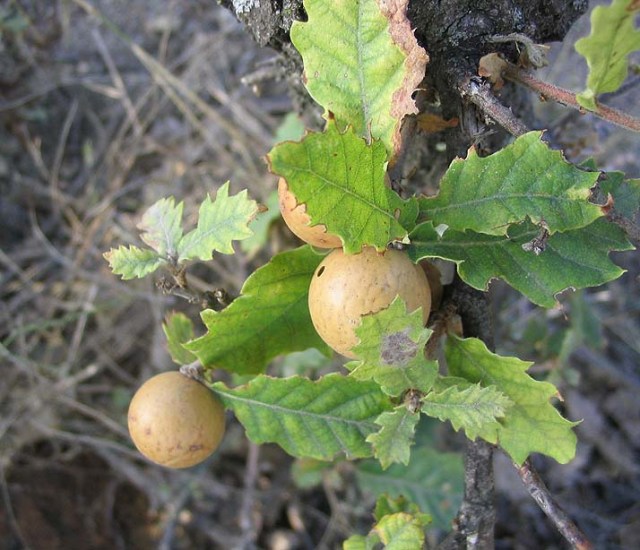
Oak apples

Oak apples

There are actually hundreds of species of oak gall wasps and they cause a fantastic variety of galls on oaks (Quercus spp.). A single oak tree may support many thousands of galls. Each gall wasp species creates its own unique and outlandish structure: some resemble cotton wool or marbles, pineapples or tiny UFOs!

Here’s a gallery of some of the other amazing galls to be found.

This slideshow requires JavaScript.

Sources and further information:

Galls- Wikipedia

Eriphyes tiliae- Wikipedia

British Plant Gall Society

Trees for Life- Galls

RHS- Crown Gall

Old School Gardener

If you’ve enjoyed reading this post and others on this blog, why not comment and join others by signing up for automatic updates via email (see side bar, above right ) or through an RSS feed (see top of page)?
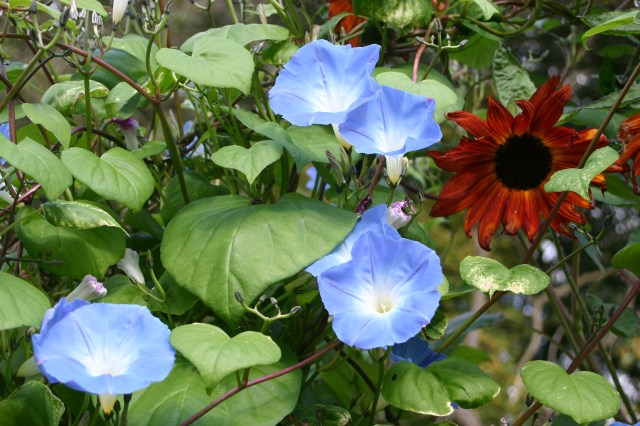
IMG_0972Old School Garden – 3rd October 2014

To Walter Degrasse

Dear Walter,

I’m feeling very guilty. A month has gone by and three weeks out of four we have been away from Old School Garden. So, as you can guess, I’ve not much to report as far as our garden is concerned, well at least in terms of effort, that is. I’m pleased to say, though, that due to the diligent watering of our son and neighbours, we were pleasantly surprised at the state of the garden on our return from foreign climes. Well, mostly.

I thought I’d give you a snapshot of some of the wonderful places we visited whilst away in Spain and Portugal, but first, one of the good things to report is the continued harvest. Here are a few pictures of this month’s offerings. As you’ll see, I’ve cheated a bit and included a bag of almonds donated to us by our hosts in Spain, Michael and Lisa. We sampled some of these, and especially loved the salted ones- I threw a few into a Spaghetti Bolognese we had for supper one day- they added a new dimension!

More generally, the Old School Garden has definitely put on some of its autumn clothes. However, the driest (and possibly the warmest) September on record in the UK has meant that some things you’d associate with high summer have continued to put on a show, or in some cases, a second flowering. I even spotted some new strawberries in our patch! I’m hoping that the weather will be kind enough to encourage the Melianthus major to flower this year; you remember I grew this from a cutting I took whilst working at Peckover House a couple of years ago? It’s the plant with leaves that smell of peanut butter when you rub them and has claret-coloured spikey flowers.

Here’s a selection of pictures of some of the ornamental interest in the garden right now…

This slideshow requires JavaScript.

I said that the previous month had involved little gardening effort on my part. I’d forgotten a few things that I managed to squeeze in between the holidays:

  • I sowed some green manure (Phacelia) which is now beginning to look good

  • I tackled (with our soon to move neighbour) an overgrown, mixed hedge boundary and removed a lot of growth to open up the kitchen garden to more morning sun

  • I did the usual late summer round of hedge clipping (and managed to cut through the hedge clipper’s electric cable too)

  • I took some yew cuttings from the old bushes/trees at Gressenhall, and last, but not least…..

  • I continue to ‘deal with’ the rash of mole hills and runs that have spread right across all the areas of our grass (I don’t any longer call them lawns).

Turning to our trips abroad, these weren’t all about visiting gardens, parks and other lovely places – near the end we did a bit of ‘hands on’ gardening! Our daughter and son-in-law live in Almada, just over the river from Lisbon, Portugal. Their apartment has a rear patio (which I’ve written about before) and also a rather blank piece of ground at the front. This is covered with different layers of concrete and apart from providing a parking place for our son-in-law’s motorbike, does little more than collect wind-swept rubbish and provide a challenging growing space for some tough old weeds which seem to have gradually worked their way into cracks and, once there, swelled these as their roots get a grip.

I don’t know if it was us tiring of being on holiday or the annoyance of looking at this plot every day, but Deborah proposed to do some weeding one morning and so three of us set out ‘armed’ with only our hands and a draw hoe (not usually put into service for this sort of job). You can see the result below. Having begun with limited ambitions, not surprisingly we managed to remove some large chunks of concrete (!) and tilled the rather poor soil in readiness for some planting next year (I suggested some annual poppies and marigolds as good ‘pioneer’ species). Diego, our son-in-law, was obviously inspired by this effort and is now proposing to remove a larger strip of concrete to create some more significant planting areas…watch this space.

I promised you a snapshot of some of the wonderful places we visited whilst in Spain and Portugal, so here’s a selection to whet your appetite for more extensive articles (and pictures) in the next few weeks…

This slideshow requires JavaScript.

I almost forgot to mention my holiday reading. Whilst our travels meant we weren’t able to read that much, I did make a start on ‘Noah’s Children’ by Sara Stein. You may recall that I was pointed in her direction by a fellow blogger? After reading her previous book ‘Noah’s Garden’ (in which she discusses her approach to ecological gardening), the sequel gets into the whole issue of how we do or don’t enable children to build a relationship with their environment. I’ve been saving some thought-provoking extracts from this and will somehow share them with you in the coming weeks. Here’s a starter from the Introduction, where Stein sets out her stall for the rest of the book:

‘Land is nourished or not by humans; humans are nourished or not by land. Place and occupant only seem separable because we have created such a distance between liveliness and livelihood. In creating that distance, we have unwittingly detached the nature of childhood from the sense it ought to make. Childish curiosity is to make connections, to realize the larger picture, to become able in the physical environment our lives depend on. We’ve removed the red from the fruit, the fruit from the tree, the tree from the wood, the wood from all the things a child might make of it, and so left fragments much harder to connect than laces on a shoe.’

To conclude this month’s letter, Walter, I’ve a positive note, not unrelated to the theme of ‘Noah’s Children’. Whilst at Gressenhall Museum on Wednesday, the co-ordinator Lynne, mentioned a comment she’d had from a recent visitor. The visitor said her young children loved coming to the ‘Curiosity Corner’ I and colleagues had created for under 5’s in a small part of the gardens here; to the extent that she’d spent a considerable sum getting her own garden landscaped to make it more ‘child friendly’, to introduce some of the features that can engage the young mind in exploring and learning from their environment. That warmed my heart.

The Kitchen Garden in autumn - 'fulsome'

The Kitchen Garden in autumn – ‘fulsome’

All the best for now, old friend,

Old School Gardener


LogoGardenParty2-1My fourth offering from a book I bought in a charity shop recently…..

Rain-making recipes:

1. Get the lawnmower out.

2. Water the garden.

3. Light the barbeque.

4.Throw a garden party.

Dry-up spells:

1. Go abroad for a holiday.

2. Decorate the lounge.

3.Plant out seedlings.

4. Seed the lawn.

lawn seed

From : ‘Mrs. Murphy’s Laws of Gardening’ – Faith Hines (Temple House books, 1992)

Old School Gardener


Flower of the yellow Tree Peony - can be a long time coming, but worth the wait!

Flower of the yellow Tree Peony – can be a long time coming, but worth the wait!

Nick (from Cheshire), and an old friend of mine, contacted me recently with a sad tale:

‘Found my lovely tree peony snapped off at the base. It had taken about 3 or 4 years to flower and this year produced a massive single bloom, so I was hoping for more next year. We think the window cleaner might be to blame. I’ve planted up a few cuttings and it had produced 4 massive seed pods. Do you think there’s any chance of rearing the cuttings or germinating the seeds?’

Oh dear, I know how long it can take to get a flowering tree peony, having had one (Paeonia delavayi f. lutea), for at least 10 years, and only now getting some blooms. I think you’ve got three approaches to try and resurrect this wonderful deciduous shrub, Nick, but all will probably take a further few years to result in any notable blooms, I’m afraid:

1. You might be lucky and get some re-growth from the base of the plant, so don’t dig it up. Check if the break occurred above or below any graft point(most commercially grown Tree Peonies are grown on the roots of their more vibrant herbaceous cousins). If it’s above, you’ll possibly get another tree peony growing, if below it might turn into an herbaceous variety! You might give it a feed of Blood, Fish and Bone or another ‘balanced’ fertiliser to give it a kick-start (or rather re start) in the current growing season.

2. Your taking of cuttings is a good policy, but again these will be slow to produce much growth, let alone flowers. Hopefully you’ve taken ‘semi ripe’ cuttings of fresh growth, and planted these in the usual way, but I’m afraid the ‘strike rate’ may be low. Another form of vegetative propagation for Tree Peonies is layering but this requires a healthy shoot attached to the plant, an option you probably don’t have, and one which has mixed success too!

3. Yes, it’s worth having a go with seed. Make sure it’s ripe before you sow it (put the seed heads in a paper bag and wait for the seeds to dry a bit and fall out of the head naturally). Then sow these around now (late summer, early autumn) about 1″ deep in a soil-based seed compost, cover lightly with grit and put the pots outside. Make sure that the compost does not dry out and protect the pots from rodents. Tree peony seeds require two periods of cold – known as  ‘double dormancy’- with a warm period in between. After the first cold period the roots will develop, but you’ll see little if any top growth. The second season you should see some top growth and you can pot up the seedlings as they outgrow their pots- unfortunately it will probably be 5 years before they are of flowering size!

The RHS say about flowering problems with established Tree Peonies:

‘Tree peonies can take up to four years to settle in and flower, even though the plant may have been bought in bloom.

However, the lack of flowers can be also caused by shallow planting. If the plant did not produce flowers for several years after planting, try lifting it in the autumn and replanting it deeper.

Though established plants are drought tolerant, prolonged periods of drought may affect the flowering the following season. Mulch around the base and water during prolonged periods of dry weather.

Tree peonies planted in shady position tend to flower less profusely. Cut overhanging branches to allow more light to reach the plant. If this is not possible consider moving it.’

I wonder if you can get some free window cleaning on the back of this accident, Nick?!

Further information:

RHS- Tree Peonies

Plantax 9: Paeonia – physician of the gods

Old School Gardener

If you’ve enjoyed reading this post and others on this blog, why not comment and join others by signing up for automatic updates via email (see side bar, above right ) or through an RSS feed (see top of page)?

-garden-centreMy third offering from a book I bought in a charity shop recently…..

1. Avoid any nursery advertising ‘While Stocks last’

2. ‘Bargain of the Week’: something you cannot possibly use at a price you cannot possibly refuse.

From : ‘Mrs. Murphy’s Laws of Gardening’ – Faith Hines (Temple House books, 1992)

Old School Gardener


Physalis seed pods mark the move into autumn...

Physalis seed pods mark the move into autumn…

Old School Garden – 28th August 2014

To Walter Degrasse

Dear Walter,

The last few weeks have felt more like autumn than summer, here at Old School Garden. The first week of the month was thankfully sunny and warm and coincided with our holiday in Suffolk; you may have seen a couple of articles I’ve posted about some of our visits.

I feel that I’ve been very lazy in the garden over the remaining weeks, just focusing on the ‘ticking over’ tasks of grass cutting, dead heading, watering, feeding and harvesting- and the occasional bit of weeding. Taking it easier seems to have made my back problems disappear, at least for now.

I dug my carrots up the other day and I was relived that this year I seem to have had some success; though a few have been nibbled around the tops and one or two have split or forked, most are what would pass as good specimens for the supermarket (not that this is test of quality of course!). The celery and courgettes and runner beans continue to crop well; I think we’re just about on top of the courgette glut! We’ve discovered a great recipe for ‘Italian style courgette and Parmesan soup’ on the BBC food website– well worth a try if you like a creamy soup with a bit of ‘edge and bite’. cauliflowers and cabbages seem to putting on a lot of leaf, but no heads, so these may be a ‘no show’ this year.

The ‘heritage’ squashes are rampant and I’ve started removing flowers to try to concentrate the energy into fewer fruit; they are colouring up nicely. Cucumbers are exceeding our needs; I must remember to resist the temptation to grow two plants next year. The tomatoes are steady, if not prolific, though recent weather conditions have probably contributed to the re-emergence of blight in the greenhouse. Still,  it seems to be under control, especially as I’ve removed most of the foliage now to try to concentrate the growth into the fruit and to help with ripening.

I’ve also been regularly harvesting plums (including a wonderful crop of cherry plums from a wild tree on our street border), raspberries and more recently blackberries. Both of these berries all seem to be doing well, with good-sized, tasty fruit, though the mystery of my raspberries remains- for the second year now the back half of both the summer and autumn raspberries have not yielded much if any flowers or fruit. I wonder if this is due to some sort of soil deficiency, though many of the summer fruiting plants are old and in need of replacement; but I can’t understand why the back end is so poor, and the otherwise good autumn row is also affected. Yes, they are next to the wood, but they are in full sun  just like the southern end of the rows. Any advice would be welcome! Here are a few pictures of fruit in the garden at present.

This slideshow requires JavaScript.

I’ve also harvested my first pears from the two ‘super column’ plants I put in about four years ago. These (Williams and Conference varieties) are looking great (and the first couple of Williams tasted delicious); I must ensure I get to them before the birds do! As I’ve reported before, the apples this year are disappointing; some large cookers have appeared and been used from one of the ‘super columns’, but more generally in the orchard there are very few fruit developing, due to a combination of pest attack and probably the wet, mild spring causing blossom wilt. I’ve now given all the trees and trained fruit their summer prune, cutting back the ‘water shoots’ to encourage spurs to form (I’ve also done the Wisteria).

Begonias keeping the terrace colourful

Begonias keeping the terrace colourful

The ornamental garden areas are hanging on in there, the late summer performers just coming into their own; sedums, grasses, asters, cannas, helianthemum etc. I’ve grown some autumn pansies from seed and also bought a couple of trays to brighten up the containers on the terrace, which are starting to look tired- apart from those full of ‘non stop’, bright red Begonias.

You remember I said that I was going to experiment with the ‘Chelsea Chop’ this year? I’m pleased with the results. I gave many of the sedums this treatment back in May and the plants are now looking squat, bushy and with lots of flower heads starting to colour up, obviating the need for staking and giving a nicely proportioned show. I shall definitely do this again next year.

Sedums given the 'Chelsea Chop'

Sedums given the ‘Chelsea Chop’

The courtyard fruit is also developing, though the recent lack of sun and warmth has obviously checked this to a degree. Still grapes, figs and possibly olives are all on the way; my miniature peach which suffers from Peach leaf curl has now recovered and put on a good show of healthy new leaves, though the fruit, as before, is disappointing. I must take a closer look at what I need to do with this next year.

I’m afraid the excavating moles are still going about their business, and the main lawn is looking very patchy as a result. I’m in two minds about what to do, if anything about this- do I leave well alone and see the, probably enlarged, mole family wreak even more havoc next year, or do I get a ‘mole man’ in to ‘deal’ with them? Despite reading ‘Noah’s Garden’ and its advocacy of an ecological approach to gardening (so I should convert my lawn to meadow to hide the mole hills), I’m not yet convinced of the case for ‘leaving them be’.

As I mentioned last month my gardening support at the two schools has come to an end, though I’m still puttign in some time at Gressenhall Museum to keep on top of a few areas i’ve been involved with. I shall start to look for other projects once September is done; one might be a new project at our nearby National Trust property, Blickling Hall, where they are intending to restore the large walled garden which is currently largely a ‘blank canvas’. I’ll keep you posted.

I hope that you and Lise enjoyed your holiday in Scotland, though I guess that you didn’t have much good weather in the last couple of weeks, like here? We’re off to Devon next week to do some walking. Now that Deborah has retired she has an ambition to do some ‘open moor’ walking, trying to reach as many Dartmoor tors as we can in four or five days- I may be longing for some work in the garden as light relief after this!

All the best Walter, as we’re away towards the end of September, it’ll probably be early October before you hear from me again. I hope that you enjoy the transition to autumn. We’re looking forward to our visit to you in October.

Old School Gardener


2011-08-17-mowing-the-lawnMy second offering from a book I bought in a charity shop recently…..
1. Whenever you set out to do anything worthwhile in the garden, something else needs doing first.

corollaries:

  • There is never enough time to do it right

  • It’s too late to do it again

  • If there’s enough time and you’re not too late, it will rain.

2. In anything can go wrong in the garden, it will.

corollary:

  • Every solution breeds new blight.

3. Backache is invisible.

corollaries:

  • Backache can be heard but not seen.

  • The one certian thing abotu backache is gardening.

4. You can cultivate the plot until your fingers turn green: if you can get it to weed itself, patent the method quick.

corollary:

If you can get the lawn to mow itself then you’ve got a sure-fire winner.

From : ‘Mrs. Murphy’s Laws of Gardening’ – Faith Hines (Temple House books, 1992)

Old School Gardener


hobbit bonsai via green renaissance

Hobbit Bonsai via Green Renaissance

WP_20140812_002I mentioned the sunflowers in my last update from Old School Garden. I sowed a few different varieties and the big ones are now coming into their own, though the remnants of Hurricane Bertha have done their best to topple them in the last couple of days. In case of disaster I thought I’d better capture them right now, especially so that I can enter the title race(s) for the tallest, largest flower head and thickest stem….

OK, I got it wrong yesterday when I boasted on Twitter that I had a sunflower 20 feet tall! Still the actual measurement is still pretty impressive, if a bit short of that figure; 14 feet to be precise. That and a couple, of others have stems 2″ in diameter, and the largest flower heads are 10 “- 12” diameter.

Here are the pictures as promised….how big are yours?

This slideshow requires JavaScript.

Old School Gardener

happy-manWhilst on holiday in Suffolk recently, I ventured into one of several Charity Shops to look at the books, especially those on gardening. I came across a little paperback which takes a ‘sideways look’ at gardening and bought it (for the princely sum of £1) in order to share some of the best little offerings with you. For a 1990’s book it sounds a little quaint, I think, especially in relation to gender stereotyping in the garden (and elsewhere)! Tell me what you think…

“1. Never plant anything in the garden that can subsequently be held against you.

2. Birds can be fooled once… the family pet, never.

3. A man who helps with the weeding is up to something.

4. Men who have difficulty making a start in the garden have no trouble at all with the motorbike or car.

5. No matter who plants it, you’ll end up peeling it.

6.’Popping down the road to borrow Fred’s tools’  translated means, ‘Popping down the pub, and should I by chance see Fred I’ll ask if I can borrow his tools.’

Corollary

Fred is always in the pub.”

From : ‘Mrs. Murphy’s Laws of Gardening’ – Faith Hines (Temple House books, 1992)

Old School Gardener


Finding Nature

Nature Connectedness Research Blog by Prof. Miles Richardson

Norfolk Green Care Network

Connecting People with Nature

Discover WordPress

A daily selection of the best content published on WordPress, collected for you by humans who love to read.

Susan Rushton

Celebrating gardens, photography and a creative life

Unlocking Landscapes

Writing, photography and more by Daniel Greenwood

Alphabet Ravine

Lydia Rae Bush Poetry

TIME GENTS

Australian Pub Project, Established 2013

Vanha Talo Suomi

The Journey from Finnish Rintamamiestalo to Arboretum & Gardens

Marigolds and Gin

Because even in chaos, there’s always gin and a good story …

Bits & Tidbits

RANDOM BITS & MORE TIDBITS

Rambling in the Garden

.....and nurturing my soul

The Interpretation Game

Cultural Heritage and the Digital Economy

pbmGarden

Sense of place, purpose, rejuvenation and joy

SISSINGHURST GARDEN

Notes from the Gardeners...

Deep Green Permaculture

Connecting People to Nature, Empowering People to Live Sustainably

BloominBootiful

A girl and her garden :)