
‘With flowers, as with all other departments of the garden, you first decide what kind you want to grow and then whittle it down to what kind you can grow in the space. When you have further gone through the list and reduced it to what you can afford to grow and then eliminated the ones which you know from bitter experience will refuse to grow you have saved yourself a very great deal of labour indeed.’
Tag Archive: garden
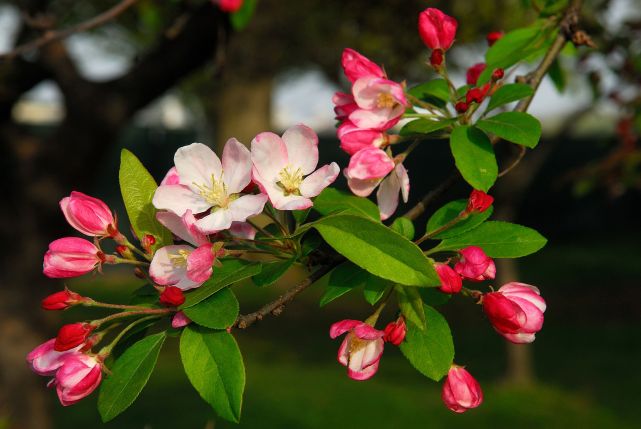
Malus is a genus of about 30–55 species of small deciduous trees, including the domesticated orchard apple (M. domestica) and varieties of crab apple (including the ‘wild apple’, M. sylvestris). This profile focuses in particular on the crab apples.
Common name: Non domestic orchard apples are generally known as crabapples, crab apples, crabs, or wild apples.
Native areas: The genus is native to the temperate zone of the Northern Hemisphere.
Historical notes: In the past, M. sylvestris was thought to be an important ancestor of the cultivated orchard apples (M. domestica), but these have now been shown to have been originally derived from the central Asian species M. sieversii. However, another recent DNA analysis showed that M. sylvestris has contributed to the ancestry of modern M. domestica very significantly.

Malus floribunda

Blackbird and Crab apples

Crab apples in the frost pic by pieway.com

Crab Apples with Tulips
Features: Domestic orchard apple trees are typically 4–12 metres tall at maturity, with a dense, twiggy crown. The leaves are 3–10 cm long, alternate, simple, with a serrated margin. The flowers are borne in corymbs, and have five petals, which may be white, pink or red, usually with red stamens that produce copious pollen. Domestic apple trees are large if grown from seed, but small if grafted onto roots (rootstock). There are more than 7,500 known cultivars of domestic apples, resulting in a range of desired characteristics. Crab apples tend to be smaller than domestic apple trees at around 5 – 7 metres tall, with a rounded profile.

Autumn foliage colour…


Uses: Crab apples make ideal specimen trees for small gardens. They are popular as compact ornamental trees, providing blossom in Spring and colourful fruit in Autumn. The fruits often persist throughout Winter. Numerous hybrid cultivars have been selected, of which ‘John Downie’, Evereste’ and ‘Red Sentinel’ have gained The Royal Horticultural Society’s ‘Award of Garden Merit’ (AGM):
Malus sylvestris – arguably, one of the UK’s prettiest native trees, a small crab apple (or ‘wild apple’) with profuse white flowers, tinged pink in bud, and with good yellow autumn colour. Yellow/ green and occasionally red flushed fruit are a bird’s favourite in the autumn. Ideal for native mixed plantings or shelter belts that provide great low cover for wildlife.
Malus floribunda – the ‘Japanese Crab’ is most elegant, with early white/pale blush flowers from crimson buds. However, it is prone to apple scab after flowering, resulting in a rather threadbare crown. Because of this it has tended to be superceded by more disease resistant clones such as ‘Rudolph’ and ‘Evereste’.
Malus ‘Evereste’ – introduced in the early 1980’s this rounded tree has profuse flowers that are red in bud before turning white. The small fruit look like miniature ‘Gala’ and are held on until they are taken by birds after Christmas. The orange-yellow autumn foliage also holds well.

M. ‘Evereste’

M. floribunda

M. ‘Rudolph’
M. ‘John Downie’ – raised in 1875, this is thought by many to be the best fruiting crab. with an irregular oval crown it makes a splendid tree for a small space. White flowers are followed by relatively large, conical-shaped orange-red fruits, which have a food flavour if required for preserves or jelly.
M. x robusta ‘Red Sentinel’– in cultivation since 1959, this profusely fruiting crab is a favourite for gardeners who are looking for winter colour. In some years the clusters of dark red fruits are so numerous that the branches can weigh too heavily so that the crown loses its shape. I have one growing in Old School Garden; it is great alongside other winter interest such as red and orange- stemmed Cornus, and its fruits are useful in Christmas decorations such as front door wreaths. In spring, the red leaves contrast well with its white flowers.

Malus trunk

M. sylvestris

M. x zumi ‘Golden Hornet’

M. x robusta ‘Red Sentinel’

M. ‘John Downie’
M. x zumi ‘Golden Hornet’ – this well-known crab has been in cultivation for over 60 years and is highly regarded for its profuse display of yellow, marble-sized fruits, which are retained for many weeks. These are preceded by white blossom; a very good ‘all rounder’.
M. ‘Rudolph’ – A Canadian crab developed in the 1950’s, this medium size tree is rather columnar when young, but becomes rounder with maturity. It has leaves which gradually turn from copper-red to bronze-green and rose- pink flowers, which give way to numerous elongated fruits. Autumn leaf colour is clear yellow and it is resistant to scab; a tree which packs a lot of plusses into a small package!
Growing conditions: Grow Crab apples in moderately fertile soil, though many will thrive on most soils and some are better suited to heavier soils, such as M. sylvestris. They will tolerate partial shade.
Further information:
Wikipedia- Malus
RHS- Malus sylvestris
RHS- Malus ‘Evereste’
RHS- Malus x robusta ‘Red Sentinel’
RHS- Malus x zumi ‘Golden Hornet’
Barcham Trees Directory- Malus ‘Rudolph’
Choosing a Crab apple- Daily Telegraph
Old School Gardener
 It’s early January and a perfect time to think about what you’re going to grow in the coming year, putting this down on paper (especially for food crops) look through your seed collection, and plugging any gaps. With not much to do in the garden at present, this is just what I’ve been up to in the last couple of days.
I’ve done what I usually do- slotted the packs of seeds I’m going to use into a weekly organiser so that I know when to sow them (always being prepared to adjust this if the weather doesn’t quite go to expectations where outdoor sowings are concerned), adding in a few more things where I want to grow more succession crops (e.g. carrots) or widen the range (e.g. squashes).
I’ve also bought some additional asparagus crowns to add to the bed I started last year (only a couple of plants came through their first season). As last year, I’ve been collecting seed from some plants and adding to my collection through purchases, including taking advantage of the RHS Members’ Seed Scheme where I can buy packs of 12 different seeds for just £8.50. I placed my order yesterday and look forward to receiving some interesting ornamentals to add to Old School Garden.
As far as food is concerned I’ve prepared a new plan for the Kitchen Garden and showed both early and follow on crops… Changes for this year include:
-
Relocating the three large pots of blueberries – I’m planning to partly sink these into the ground in a spot where I can more easily erect a bird proof cage over them and at the same time release some gravelled space next to the Greenhouse and Cold Frame where I can store pots and trays for ‘hardening off’ new plants.
-
Growing more carrots and parsnips in plastic dustbins, as my experiment last year worked quite well and provides some extra growing space when the rest of the garden is pretty well full.
-
I’ve substituted one Blackcurrant bush with a White currant to improve the balance of the fruit we have and bought ten raspberry canes (two varieties of summer fruiting to plug some gaps in the rows and hopefully improve fruiting).
-
I’m also continuing to install plastic hoops (I’ve used plumbing pipe available from DIY stores) over some more beds to enable me to use plastic/ enviromesh/netting to provide a warm micro climate and protection from pests.
Let’s hope for a productive year!
Old School Gardener
 One more extract from a book I bought in a charity shop in the summer (apologies for the gender stereotyping)…..
The Basic law of Weedlock:
The best training for gardening is marriage.
corollaries;
1. Behind every successful gardener is an astonished woman.
2. About the only way to get a gardener nowadays is to marry one.
3. Gardening is a process by which a man finds out what sort of husband his wife thinks she ought to have married.
Every Wife’s Lament:
Gardening expands to exclude all more interesting possibilities.
Law of The Unwelcome Arrival of Spring:
There is nothing so harrowing to the soul of the average married man as the first growth of lawn grass.
 From : ‘Mrs. Murphy’s Laws of Gardening’ – Faith Hines (Temple House books, 1992)
Old School Gardener

Old School Garden- 31st December 2014
To Walter Degrasse
Dear Walter,
It was great seeing you and Lise just before Christmas, and thanks for the Christmas card, which was a pleasant surprise! I was grateful for your advice about the raspberries, too; I shall be looking out for some new saplings to plug the gaps and hope for a more consistent crop next year.
The mild weather we had just before Christmas has now been replaced by rather colder, though mixed conditions. It’s been quite frosty here in the last few days; I’m glad that I managed, earlier in the month, to get the greenhouse insulated and heated and the tender plants inside.
Apart from that, it’ s been a relatively quiet time doing the usual winter chores; leaf collecting, mole hill clearing (don’t they ever pack up their tunneling?) and tidying away spent stems and foliage where these have flopped or offer nothing to wildlife or the winter garden.

Viburnums in flower

Winter colour- Dogwoods and Mahonia in the background


Cyclamen on the Terrace

Spring planting on the terrace
The colourful stems of the Dogwoods are now looking good, as are the Mahonia and (surprisingly) flowers on some of the Viburnums- a hang over from the mild autumn, I guess. We’ve also got some winter and spring colour in pots on the Terrace.
I pulled my (small) crop of parsnips just before Christmas and we’ve been enjoying these over the holiday – the harvest was pretty good, though I noticed a couple of the roots had been eaten out (I had this problem last year), and one or two of the biggest specimens were a little woody inside. Still they were very tasty!
I did manage to clear one mixed border and replant this using the remaining Box balls from the Terrace planters. You recall seeing these? I had three large balls left after removing three that had Box Blight. The remainders were getting a bit too large for the planters anyway.
The balls now form a neat row that reflects the three large pots we have at the other end of the terrace lawn, and I’ve planted around them with a mix of Allium bulbs and some of the plugs of Canterbury Bells I grew on earlier in the year. I’ve also rearranged the selection of other herbaceous plants that were in this bed and – hopefully – removed all of the Ground Elder and Periwinkle that between them were making the bed a nightmare to keep tidy.

The replanted mixed border with Box Balls- with a frosty sheen!
You remember I told you that the local Vicar had asked me to produce a Management Plan for the churchyard? Well Deborah and I went over earlier in the month and measured up to see what scale the ground plan he’d given me was; luckily it was almost exactly 1:100, so that meant the transfer of information was a straightforward tracing job- it would have been a real hassle if I’d have had to scale off and position every grave and stone! Well, the base plan is done and I’m now thinking about the design and Management Plan. I think this will involve some selective cutting down and cutting back of some of the trees around (and in) the churchyard to allow more light and space, and the gradual cultivation of a wildflower meadow environment across much of the rest of the site- but keeping more recent graves clear and ensuring some mown paths to allow access. As it’s management will almost entirely depend on voluntary labour I’ll need to keep things relatively simple, but perhaps there is limited scope for introducing some greater plant interest in one or two spots.
As you know, Deborah retired from teaching at the local Primary school this year and I took the opportunity of ending my school gardening work there too, especially as they had achieved ‘5 Star’ status with the RHS and are now getting regular advice and input from the RHS Regional Coordinator. However, at our recent Christmas Party the Teacher who coordinates ‘Outdoor Learning’ asked me to prepare a specification for maintenance of the grounds and also to help her prepare some design proposals for the playground, where there are ambitions to get more play and educational value from the space. I’m pleased about helping with both of these issues, as I’ve felt for some time a different, more considered approach to the grounds is needed, including one that is more wildlife-friendly, and also to take into account the maintenance needs of areas that I’ve helped to plant up over the years.
This ‘Desk work’ will be a nice project for the winter months, but I’m also excited about starting to garden at nearby Blickling Hall, where the National Trust is embarking on a project to regenerate its two acre Walled Garden as well as maintaining the extensive and varied gardens in this beautiful place. I met the Head Gardener and Project Manager a few weeks ago and had a tour of the site and explanation of their plans, which are about to kick off with new paths and irrigation systems being installed. I’ve agreed to begin work with them next week, so I’ll probably keep you up to date on this through future letters and other posts.
Oh, and just to finish off, a bit of news about Old School Garden (the blog, that is). As you know I’ve been producing this for two years and I recently had an annual review from the publishers, WordPress. So I thought I’d share a few key findings with you:
-
During 2014 the blog had around 130,00 hits or page views.
-
The most popular topic was recycling in the garden, especially projects using old pallets!
-
The best day for hits was 15th September with nearly 15,000 views.
-
82% of those viewing the site live in the USA, UK and Canada
-
I now have 2647 followers, including all those via Twitter, Linkedin, Facebook etc.

Kitchen Garden cleared and ‘tucked up’ for the winter

Keeping the birds happy
I’m especially grateful to all those who took the time to comment or ‘like’ my posts. I wish you and them a successful 2015 and look forward to another productive year in Old School Garden- both blog and plot!
All the best for now,
Old School Gardener
 Here’s another extract from a book I bought in a charity shop in the summer…..
Mrs. Brown’s All- Encompassing Law of Gardening:
Gardening is like pregnancy: it is nothing like the book.
Mrs. Murphy’s Literary View:
Gardening books should not be set aside lightly: they should be hurled with great force.
Four Laws of Obfuscation:
1. There are no real secrets to cultivation- only plots.
2. For counter-instructions read every good Gardening Authority.
3. For subtle distinctions (pinched from every good Gardening Authority) read the Sunday newspaper supplements.
4. For contrary advice, listen to ‘her indoors’s’ interpretation of the plagiarism in the Sunday supplements.

‘Sunday Supplement’ by Sarah Boardman
From : ‘Mrs. Murphy’s Laws of Gardening’ – Faith Hines (Temple House books, 1992)
Old School Gardener
Beckley Park topiary garden, Oxfordshire
‘I doe not like Images Cut out in Juniper or other Garden stuffes: They be for Children. Little low Hedges, Round, like Welts, with some Pretty Pyramides, I like well.’

Sir Francis Bacon
‘What right have we to deform things given us so perfect and lovely in form? No cramming of Chinese feet into impossible shoes is half so wicked as thwe wilful and brutal distortion of the beautiful forms of trees’
William Robinson- ‘The English Flower Garden’ 1898
Personally, I really enjoy topiary- growing it, trimming it and admiring others’ creativity and skill in producing the rather more fantastic forms it can take; oh, and they also make me smile!
OK, so you are cutting back natural growth, but aren’t we doing that when we prune things anyway? What do you think?

Cat by Tim Bushe

Could be me and the wife….
Old School Gardener

Old School Gardener

The view from Old School Garden, Norfolk at sunset today, the shortest day of the year…
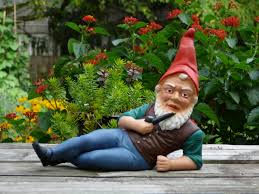 Here’s yet another extract from a book I bought in a charity shop in the summer…..
Gnomic Pondering:
The astonishing anthropomorphic success of garden gnomes is based on the simple British proposition that dirty old men are lovable if they wear red hats.
Another Couple of Inches Law:
Any fool who thinks a pool is simply a hole in the ground, filled with water, has never tried to make water level with the surrounding ground.
Corollary- No pool looks aslant until it has been filled with water.
 Kite’s Fundamentals Relating to the Preservation of Fences:
1. If the paint or preservative is harmless to plants, it will kill the goldfish.
2. If it is clean, quick and simple to use, the large-sized brush recommended won’t fit the pot.
3. If the brush fits the pot and the paint doesn’t write off the goldfish, the plants will probably die anyway.
 From : ‘Mrs. Murphy’s Laws of Gardening’ – Faith Hines (Temple House books, 1992)
Old School Gardener


 Old School Garden