Category: This and that


MartineauGardens_homepage

The Green Flag Award® scheme is the benchmark national standard for parks and green spaces in the UK. It was first launched in 1996 to recognise and reward the best green spaces in the country.

The first awards were given in 1997 and, many years later, it continues to provide the benchmark against which our parks and green spaces are measured. It is also seen as a way of encouraging others to achieve high environmental standards, setting a benchmark of excellence in recreational green areas.

Entries for the Green Flag Award® are open to parks/green spaces located in the UK. We are also currently piloting the scheme in The Netherlands and Germany.

To apply go to Green Flag Award website


Old School Gardener

Twitter / ChannelCasting: NEW BBC2 GARDENING SERIES LOOKING … – Mozilla Firefox http://ow.ly/hv4hz

gressenhallfw's avatarGressenhall Farm and Workhouse

Winter on the Farm

Hannah and I have finally thawed out from the freezing cold and are enjoy the somewhat tropical temperature of 10 degrees down at Gressenhall farm. As I didn’t last time, I shall take a few words to introduce myself, my name is Tom Watson and I am the other half of the Heritage Landscape Management trainee team. We are now four months through the scheme and are still thoroughly enjoying it! Like Hannah, I am an Environmental Science graduate from the University of East Anglia and I have a keen interest in the history of the UK’s landscape and the environment. I have previously worked on a farm and my most of family are linked to agriculture in some way. And so when this traineeship at Gressenhall Farm and Workhouse became available it seemed like the perfect opportunity for me to gain skills to help me…

View original post 600 more words

sethsnap's avatarsethsnap

I started this blog this past September with a goal of sharing my everyday scenes and random thoughts.  I wasn’t sure if anyone would be interested in what I saw or had to say.  I have been extremely happy with the direction that this blog has taken.  I have loved meeting each and everyone of you and look forward to continuing to share my sights and sounds.

I thought now, since it’s too cold for any real good picture taking, that I’d reflect back on 2012 and share with you what I feel is the best of those three and a half months.

My favorite shots from September and October:

Ohio trees

From: Fall is near. on 9/19/2012

Mr. tree poses for camera.

From: Photo Scavenger Hunton 9/20/2012

Krohn Observatory

From: Essence of Eden on 9/21/2012

From: Cold Cox Arboretum kind of morning. on 9/24/2012

From: Ault Parkon 9/27/2012

Another view of a flower.

From: Up close: front yardon 9/30/2012

View original post 88 more words

oscarGressenhall Farm and Workhouse Museum and the Museum of East Anglian life have been awarded £1.1 million from the Heritage Lottery Fund’s Skills for the Future programme to deliver a training project between 2011 and 2015.

Two new traineeships are now on offer:

Public Events traineeship – working with staff and volunteers at the museum to assist with the development and delivery of family and adult leisure learning opportunities.

Heritage Learning traineeship working as part of a successful learning team at Gressenhall Farm and Workhouse helping to deliver high quality schools learning events to young people of all ages and abilities, also assisting with the museum’s informal learning programme

This project provides an opportunity for young people and adults from any background to develop skills and knowledge in a specific area of traditional skills. Where possible, learning will be tied to accredited qualifications. This will give the trainees both work experience and training, and will be a good stepping stone for further opportunities in the heritage or historic environment sector.

Gressenhall Farm and Workhouse is offering a number of formal apprenticeships in such areas as traditional farming and horticulture in partnership with Easton College.

They will also be offering 6-12 month traineeships that will be targeted at both young people and ‘second careerers’. These will be based around areas such as heritage gardening, woodland & heritage land management, rural collections management and interpretation, and managing historic buildings.

Trainees work alongside staff and volunteers under the supervision of a project officer. Mentoring and career development support is also provided. For people not sure what area they wish to specialise in there is a yearly programme of 3 month traditional skills “taster” courses running at the Museum of East Anglian Life.

If you would like more information on the work taking place at the Museum of East Anglian Life, please see the Skills for the Future page on their website.

Further information:

Skills for the Future – general leaflet

For further information on these two new posts see the Website 

Old School Gardener

PIC00026Gardens of Court and Country: English design 1640–1730

Dr David Jacques, Garden Historian

6.30 pm, Wednesday 30 January, The Gallery, 70 Cowcross Street

Most traditional histories of the English garden treat formal gardens as a single and unvaried period, filling the gap between the Elizabethan and the landscape garden, but David Jacques’s forthcoming book demonstrates that, by contrast, each generation made huge changes in the design of its gardens. The emergence of the landscape garden is shown in proper context, and connections are made to politics, religion, men’s fashion, gastronomy, the development of carriages, the symbolism of parks, foreign influence, and many other aspects of seventeenth and early eighteenth century life.

Led by the Land

Kim Wilkie, Landscape Architect

11th Annual GHS Lecture at the RHS

6.30 pm, Wednesday 20 February, Royal Horticultural Halls & Conference Centre

Kim Wilkie will explore the future of landscape architecture as set out in his new book, Led by the Land, covering projects such as Transylvania, Longwood Gardens and Boughton Park to illustrate his ideas. He will show how the ancient tradition of sculpting the land can inspire new forms and meanings, merging innovative landscapes with revered historic ones. Mavis Batey has said in interview: “All over the world people want to know how he does it”. This will be your chance to learn.

‘Harmony Compleat’ —
Music in the Garden from Renaissance Italy to Georgian England

Judy Tarling, Specialist in Historical Performance (music and gardens)

6.30 pm Wednesday 27 February, The Gallery, 70 Cowcross Street

Judy Tarling will talk about how music was performed and experienced in gardens from renaissance Italy to Georgian England, illustrated with musical example and images. She will investigate who played which instruments, where, the nature of the audience if there was one, and the repertoire. Judy will show how music, from the sound of water and bird-song to fully staged dramatic performances, was an essential part of the historical garden from the 16th to 18th centuries.

A little bit of Surrey in the sun?
A hundred years of the national botanic gardens of Burma

Dr David Marsh, Garden History Researcher/Lecturer

6.30 pm, Wednesday 6 March, The Gallery, 70 Cowcross Street

Maymyo was a poor relation in the family of Kew-inspired tropical botanic gardens. Established late in colonial rule by ‘amateurs’, it quickly suffered from staff turnover and uncertainty as to its role. After the war and independence it fell further into decline but has recently been ‘privatized’ by the government. Uncovering its story has been difficult but offers a different perspective on the history and political role of botanic gardens and their possible future in the developing world.

Passion, Plants and Patronage:
Three Hundred Years of the Bute Family Landscapes

Robert Peel, Vice Chair of GHS, Kristina Taylor, Vice Chair of GHSS

6.30 pm, Wednesday 20 March, The Gallery, 70 Cowcross Street

Several generations of the Bute family have been intimately involved in the development and maintenance of landscapes in Scotland, England and Wales. This talk will link the personalities and landscapes, with particular reference to the two most prominent family members in the field of parks and gardens, the 3rd Earl in C18 and the 3rd Marquess in C19, and discuss the happy condition of these landscapes today.

Contact:

The Garden History Society

Email: events@gardenhistorysociety.org

Office (information and press enquiries): 020 7608 2409

Website: http://www.gardenhistorysociety.org

Website for press information: www.gardenhistorysociety.org/press

Venues and Times 2013:

11TH Annual GHS Lecture at the RHS

Lecture by Kim Wilkie (20 Feb)

Royal Horticultural Society Halls and Conference Centre.

Greycoat Street, London SW1P 2QD (Victoria, St James’s and Pimlico Stations).

Doors open at 5.45 pm, lecture starts at 6.30 pm.

Lectures by Dr David Jacques (30 Jan), Judy Tarling (27 Feb),
Dr David Marsh (6 Mar), Robert Peel (20 Mar) at

The Gallery, 70 Cowcross St, London EC1M 6EJ (Farringdon Station).

Doors open at 6.00 pm, lectures start at 6.30 pm


Tickets

RHS: £15.00 in advance for members of the GHS and RHS, £18.00 for all tickets purchased at the door.

The Gallery, Cowcross Street: £8.00 in advance for members of the GHS, £10 for all tickets purchased at the door (one glass of wine included).

SEASON TICKET FOR ALL LECTURES: £43.00 members, £54.00 non-members.

A booking form can be downloaded from http://www.gardenhistorysociety.org/events

THE GARDEN HISTORY SOCIETY is widely recognised for its expertise and advice. In its role as statutory consultee, its professionally qualified conservation officers are consulted by government agencies and local authorities on a wide range of issues affecting historic parks and gardens. The Garden History Society also

  • promotes the study of the history of gardening and horticulture in all its aspects
  • promotes the conservation of historic parks, gardens and designed landscapes, and advises on their restoration
  • encourages the creation of new parks, gardens and designed landscapes.

 The events at The Gallery are supported by Alan Baxter & Associates

The event at The Royal Horticultural Hall and Conference Centre is supported by

The Royal Horticultural Society


The Garden History Society

70 Cowcross Street, London EC1M 6EJ

020 7608 2409

events@gardenhistorysociety.org

http://www.gardenhistorysociety.org

Old School Gardener

The Maze at Longleat House, England

The Maze at Longleat House, England

I must admit I’m a bit of a fan of labyrinths and mazes.

As a play landscape designer I’ve tried to find ways of incorporating them in my designs as they are especially attractive to children. Usually they are one of the first design ideas to be dropped, generally on grounds of maintenance requirements. I’ve tried to suggest simple materials like grasses to mark out a pattern, rather like the one in the Cambridge Botanic Garden, but again they do take some looking after. The best I’ve managed is a wooden stepping stone and daffodil spiral. One day I’ll find a client with the imagination and deep(ish) pockets to give a bigger one a real go.

Labyrinths and mazes – what’s the difference between them?

Well, the answer is  ‘it rather depends…’.  There is one school of thought that sees labyrinths as different to mazes and another that sees labyrinths as one type of maze. Labyrinths have just one route– so there’s no danger of getting lost – whereas mazes are rather more cunning in that they have dead ends, twists and turns which are set out to puzzle and confuse. Sir Walter Scott’s ‘O, what a tangled web we weave, when first we practise to deceive!’ comes to mind.

Labyrinths (remember the single route or ‘unicursal’ one) are found in many cultures, some as old as 3,500 years. They all have an entrance or mouth, one route to follow and a central destination, sometimes marked with some sort of stone/statue/ feature. A further detail is how many concentric circuits or paths they contain and they can vary from the small to the huge – several hundred feet across. They have traditionally been seen as spiritually symbolic, meditative paths as well as just entertaining and can be found in many religious buildings such as Chartres and Ely cathedrals.

The Labyrinth pattern in Chartres Cathedral

The Labyrinth pattern in Chartres Cathedral

Humankind has been fascinated by patterns in the land for millennia and some of the earliest were forms of spiral (some multiple spirals). These later developed into the sorts of maze-like patterns we’re more familiar with, including the Cretan maze (or labyrinth as its usually called!). Of course the famous one was that in classical mythology where Theseus found his way to the centre and killed the Minotaur to ensure he freed his fellow Athenians. He used a length of thread to trace his way in and so find his way out. Which rather suggests that this ‘labyrinth was in  fact a more complicated maze as it would have been easy to retrace his steps in a one-route labyrinth! This all goes to support the case that the words labyrinth and maze are interchangeable, and certainly common usage suggests this- e.g the turf ‘mazes’ in some English gardens are in fact labyrinths (i.e. one routers).

A-maz-ing Gardens

Mazes as multi – choice routes really developed in gardens out of the parterre and knot gardens which used lines of plants (usually Box) to create patterns within which other plants, gravel, grass or sometimes coloured powders created a contrast in colour and level. You can wander around these hedges in some gardens and it isn’t difficult to imagine how (either deliberately or perhaps through lack of maintenance!) these hedges grew taller. This both made it difficult to grow anything successfully within them and also added a touch of mystery to the experience of walking round the garden. A book by Daniel Loris –  ‘Le Thresor des Parterres de l’univers‘ – written in 1629, seems to capture the developing fashion for such mazes (though most of it is concerned with the traditional parterre).

Hampton Court Maze, England

Hampton Court Maze, England

Britain’s oldest surviving hedge maze is at Hampton Court – created by George London and Henry Wise in 1690 and also thought to be the oldest hedge maze in the world in continuous use. Originally planted with Hornbeam and having two trees at the centre the hedging is now Yew, the hedging used in many traditional hedge mazes.

Labyrinth of Horta, Barcelona

Labyrinth of Horta, Barcelona

The Labyrinth Park of Horta in Barcelona, Spain, was created around 1794 as part of a neoclassical ‘makeover’ of the garden by its Marquis owner. In recent years the garden and maze have been restored and I have had the good fortune to almost stumble across it.

A simple bulb labyrinth at Cornell University, USA

A simple bulb labyrinth at Cornell University, USA

Today there are many different types of maze to be found in gardens, parks and estates around the world, some using hedges or walls (for your truly ‘puzzling maze’), others using turf, other grasses, low-growing plants or materials to mark out the (usually labyrinthine) route. In Britain temporary  ‘Maize mazes’ created in agricultural fields have become a popular summer visitor attraction.

There is something magical about these labyrinth and maze ‘puzzles on the land’ and I hope that one day I can create one in a park or garden…maybe you have scope for one in your garden?

Sources and further information:

Garden Mazes

Mazes and labyrinths

Design your own maze

History

Wikipedia- labyrinths

Wikipedia- mazes

Labyrynthos- resource centre

Labyrinth.org

Maze photos

Quizzicals (thanks to Les Palmer for these):

answers to the last two-

  • Has had too much already Sycamore
  • A country full of automobiles – Carnation

and a couple of gardening ditties

Big in Japonica’

‘You picked a fine time to leave me lucerne’

Old School Gardener
If you’ve enjoyed reading this post and others on this blog, why not comment and also join some other people and sign up for automatic updates via email (see side bar, above right ) or through an RSS feed (see top of page)?

ImageGarden Design Course in Norfolk

Following the successful pilot of ‘Your Garden- by Design’ last autumn, I’m pleased that Reepham Learning Community have agreed to run an extended version of this course beginning at the end of the month. 8 two-hour sessions (including one garden visit) will use a variety of methods and materials to help those who want to improve their own gardens through design.

Based at Reepham College in central Norfolk, the course is a step-by-step walk through the design process, showing how to apply this to your own garden (big or small) from basic surveying and appraisal techniques, forming ideas about what the garden is for and how it might look, to outline plans and 3-D visions of  different ideas as well as the important things needed to ensure successful delivery of attractive, practical plans.

Group review and discussion of the evolving designs will enable participants to develop a critical and creative approach to garden design and a large number of reference books will be on hand as well as links to other sources of information. Case studies and in-class exercises will help participants to develop their skills.

Green (and its many shades) is one of the most important colours in garden design (arguably it’s a more important feature than the ‘white’ in Vita Sackville-West’s garden at Sissinghurst). Gardens which feature plants with bold, contrasting foliage can be really effective and the Course will introduce colour, texture and form as three key ideas in planting design. The contribution that ‘hard’ landscaping (paths, walls, furniture and built structures) makes to successful garden design will also be covered.

Participants don’t need to have any particular skills- the course and associated support should lead to practical ideas which can be put into action. The eight sessions will cover:

  • Starting out- what do I want from my garden?IMG_4931
  • Surveying and appraising your garden and functional layouts
  • Garden Styles and Forms
  • Structure in your Garden- the third dimension
  • Planting- the fourth dimension
  • Garden visit (day time)
  • Final designs
  • Delivering your Design

Check out the link to the Reepham Learning Community for more information- I’m looking forward to meeting a new group of enthusiastic garden makers!

Quizzicals- answers to the last two:

  • Morrisey’s mother’s mother- Granny Smith
  • Someone who is out get you – Anemone

A couple of gardening ditties for you:

‘Livin’ Dill’

‘Juke Box Chive’

(note to self= must move away from herbs and spices for a while…)

Old School Gardener
IMG_5157

So you know how it goes… a good friend says something post-Christmas about a gift they’ve given you, how they hope you liked it etc. and you think-

‘don’t remember getting that…’

It happened to me at the weekend. Friends who had kindly given me a couple of nice garden-related presents referred to some carrot seeds called ‘Nigel’ (my name for those who don’t know me). Somehow I must have missed them (let’s face it a packet of seeds can easily go missing when you’re eagerly ripping off the wrapping paper…).

So, as we missed this week’s bin collection (which happened to be the recycling one with the Christmas wrapping paper in it), I tipped out the (nearly full) contents to see if I could ‘find Nigel’. Well, suffice it to say that I was unsuccessful and came close to serious injury on can edges and other stuff in the process.

So that’s why ‘Nigel’ is plotless on at least two counts for 2013…

More successfully,  I spent a couple of hours yesterday using another cherished Christmas pressy-a pair of Felco No. 2 secateurs (a joy to use) on the grapevine and a rather overgrown Jasminum beesianum in the Old School courtyard. Here are some  images of that to accompany some of other plants looking good in the garden at present. Also the answers to the last Quizzicals and a couple of new ones…

IMG_5155

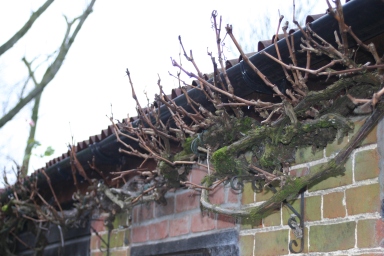
The grapevine grows round the top of three walls in the Old School Garden courtyard. A black variety, it gives a reasonable yield , but lack of sun/ warmth in 2012 led to a dissapointing crop. Let’s hope for better this year…

IMG_5152

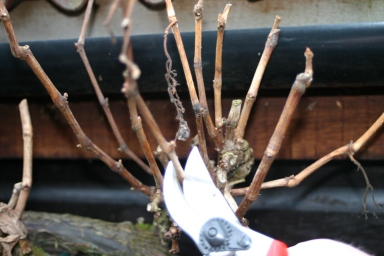
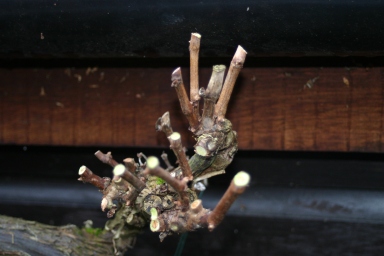
Grapevine before pruning- new secateurs poised for action…

IMG_5154

After pruning- stems cut back to one or two buds above the node.

IMG_5158

Quizzical answers

The last two were:

Someone who stalks a 1970s Wimbledon champion-  Virginia Creeper

Four times faster than Roger Bannister- ‘Mile a Minute’

Two more to entertain you (thanks Les):

  • Private part of an old crooner
  • The organ that enables you to say ‘2 plus 2 = 4’

IMG_4906

Hello – thanks for reading this, my first blog! I hope that you’ll want to return to read more. The various background pages on the site tell you a little more about me, the blog and my interests.I hope to bring you a diary of my gardening activities in the Old School Garden and elsewhere; a regular monthly ‘top tips’ for garden activities;  interesting information and ideas about gardening issues, plants and techniques as well as a couple of lighter items:

  • Quizzicals– horticultural brain teasers
  • Plantax– the stories behind particular plant names

To get you started here are a couple of ‘dingbats’ with plant, fruit or veggie connections (thanks to my good friend Les Palmer)- see  how you get on…

cQUe (clue- think jelly)

miZEROst (clue- think Wimbledon)

Have fun and I hope you’ll come back for more!!

Old School Gardener
Finding Nature

Nature Connectedness Research Blog by Prof. Miles Richardson

Norfolk Green Care Network

Connecting People with Nature

Discover WordPress

A daily selection of the best content published on WordPress, collected for you by humans who love to read.

Susan Rushton

Celebrating gardens, photography and a creative life

Unlocking Landscapes

Writing, photography and more by Daniel Greenwood

Alphabet Ravine

Lydia Rae Bush Poetry

TIME GENTS

Australian Pub Project, Established 2013

Vanha Talo Suomi

The Journey from Finnish Rintamamiestalo to Arboretum & Gardens

Marigolds and Gin

Because even in chaos, there’s always gin and a good story …

Bits & Tidbits

RANDOM BITS & MORE TIDBITS

Rambling in the Garden

.....and nurturing my soul

The Interpretation Game

Cultural Heritage and the Digital Economy

pbmGarden

Sense of place, purpose, rejuvenation and joy

SISSINGHURST GARDEN

Notes from the Gardeners...

Deep Green Permaculture

Connecting People to Nature, Empowering People to Live Sustainably

BloominBootiful

A girl and her garden :)