Category: This and that


Jardin's avatarJardin

Julius Caesar probably strolled in villa gardens filled with it. Henry VIII may well have wooed one, (or more), of his wives behind hedges of it. Louis XIV made it into a stunning art form. The Dutch excelled at it.
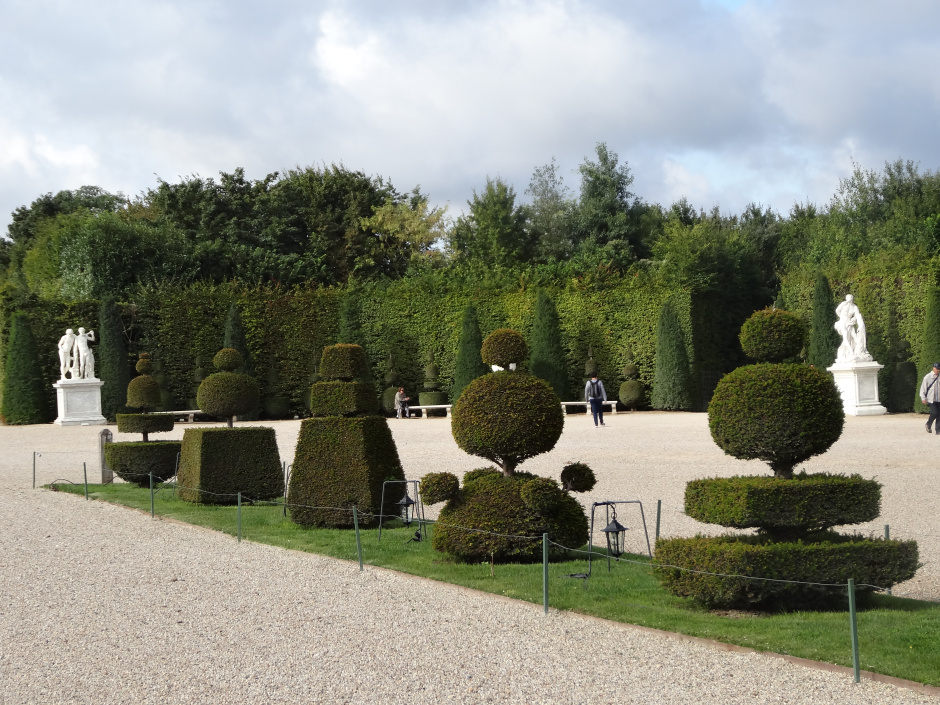
Topiary at Versailles Topiary at Versailles

Topiary : the art of trimming and training plants to create geometric or natural shapes , often called ” the art of living sculptures”.
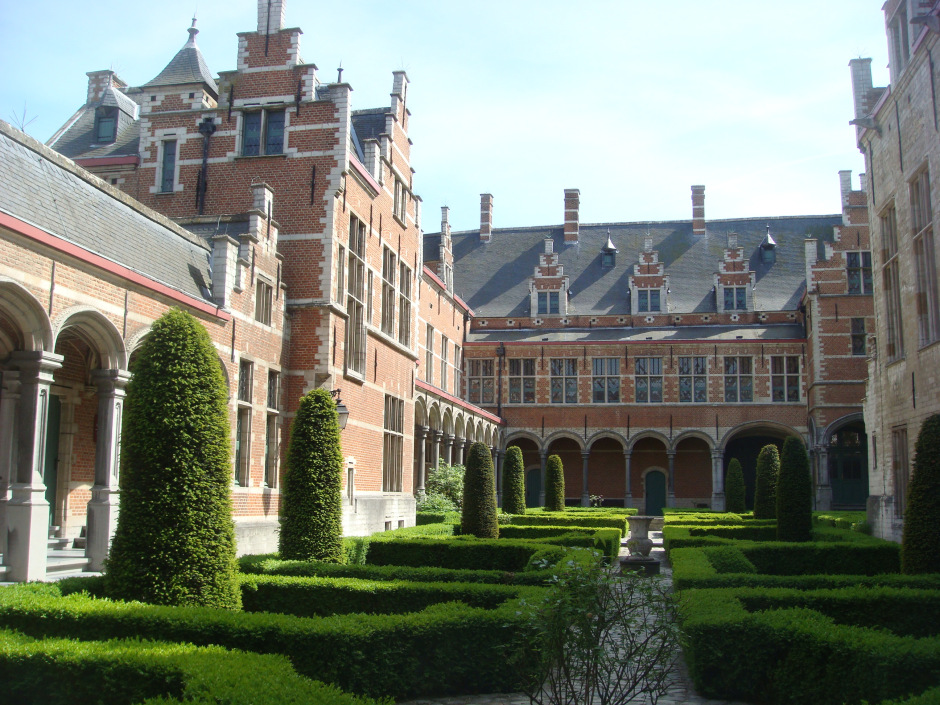
Topiary in a Flemish garden in Mechelen. Topiary in a Flemish garden in Mechelen.

Cultivation : For year round structure, yew (Taxus baccata) and box (Buxus sempervirens) are the usual evergreens used, although other species such as privet and holly can be  suitable too. If you are establishing a box-hedged garden, keep an eye out for any bare or brown patches which might be the result of a fungal disease, box blight (Cylindrocladium buxicola), and destroy affected plants. Pruning in northern hemispheres is generally done in early June…

View original post 233 more words

greenbenchramblings's avatargreenbenchramblings

Saltaire is a place with a special atmosphere and a special place in British history, but also a place which very few people have ever heard of. We visited last year but then because of time and terribly wet weather we did not have time to look around the village itself. At that time we spent the day exploring the Salts gallery, where you can see so many pieces of art work from David Hockney, as well as galleries of furniture and beautiful craftwork.

Saltaire is a World Heritage Site and is recognised for the part it played in the development of the society we live in today. When you visit it is hard to believe it was the creation of one man, Titus Salt, a true visionary. He began as a successful business man, indeed one of England’s most eminent Victorian industrialists. He began by building a mill where he…

View original post 643 more words

Specifier Review's avatarArchitecture, Design & Innovation

Many cities throughout the world are looking for ways in which to cope with population growth, whilst curbing energy consumption and environmental impact.  And the unlikely focus of international interest currently is the historic city of Heidelberg, in south-west Germany.   Residentially it is very popular and commercially it is very successful, but Heidelberg has an expansion problem.  There is barely any property to be had in the city’s picturesque old town, or along the banks of the River Neckar, and if anything does become available, the prices are on a par with those of Munich, in the region of €5,000 or more per square metre.

The spectacular solution is to build a completely new district – the Bahnstadt – on a 286 acre area that was once home to Heidelberg’s now defunct rail freight and marshalling yards.  The €2 billion initiative is claimed to be the largest single passivhaus development…

View original post 819 more words

canwefeedtheworld's avatarOne Billion Hungry: Can We Feed the World?

Farmers discuss climate and weather changes. Photo C. Schubert (CCAFS) Farmers discuss climate and weather changes. Photo C. Schubert (CCAFS)

This week sees the annual Chatham House conference on food security. This year’s theme is around the risks to food security that come from greater globalisation of the food system. The conference focuses/focused on the “geopolitical, supply-side and market-based threats” to the global food system, in particular generating discussion with senior policy-makers and business leaders on identifying risks and priorities for action to mitigate them in the hope of building a more resilient food system.

Many organisations aim to identify and map risks to the food industry and food security, climate change and its impact on agricultural production being a prominent one. Maplecroft, a horizon scanning, risk analytics organisation that supports global organisations in identifying, monitoring, forecasting and mitigating financial and other risks to their operations, investments and supply chains, recently published their Climate Change and Environmental Risk Atlas…

View original post 484 more words

Sophie's avatarPlant Heritage

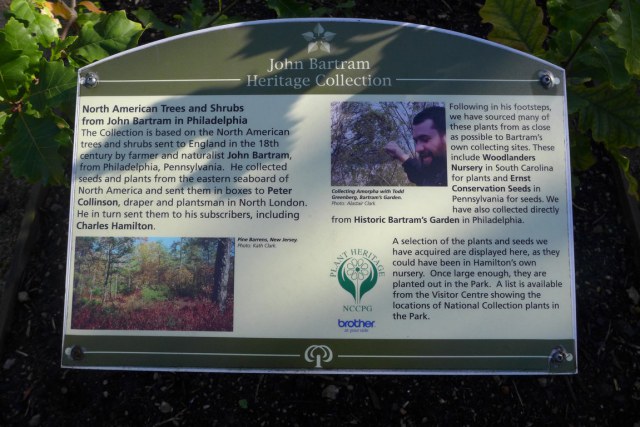
Tucked between the busy M25 and A3 motorways in Surrey, Painshill Park was created in the 18th century by the Hon. Charles Hamilton, as a fine example of naturalistic landscape.
Hamilton was among the first plant enthusiasts to introduce new species and hybrids from the USA, some of which are still present at Painshill today. He obtained many of his plants from renowned American nurseryman John Bartram (Pennsylvania).

John Bartram Collection (c)

The Gardens were restored in the 1980s using 18th century plans and illustrations, and John Bartram’s plants have been carefully researched and added to the garden since then. The Collection was awarded full status in 2006, and displays over 100 taxa of North American plants. Here are just a few which were beginning to show their autumn colours last month:

In addition to these rather interesting plants, there are information panels explaining how plants and seeds were transported during long boat journeys…

View original post 89 more words

Municipal Dreams's avatarMunicipal Dreams

Wolverhampton was another council controlled by the Conservative Party between the wars and yet, with over 8000 council homes built in the period, it was one of the biggest providers of council housing in the country. Its largest estate, Low Hill, in particular captures well the mix of municipal pride and relative affluence that would shape this new, council-housed, working class.

Dickinson Avenue on the Low Hill Estate Dickinson Avenue on the Low Hill Estate

Before 1914, the Corporation had built just 50 homes – rather grim so-called cottage flats; in fact tenements in an austere barracks-like building (since demolished) erected in 1903 on Birmingham Road.  The War, you don’t need to be told, changed everything and when the Government-mandated survey of housing needs in 1919 revealed an immediate demand for 5659 new homes, the Council resolved to build them all. It was reckoned that over one in five existing homes in the borough were unfit or overcrowded. (1)

The…

View original post 1,298 more words

Continue reading

Gardening With Children's avatarGardening with Children

National Tree Week (29 Nov – 7 Dec) begins on Saturday and with it the start of the tree planting season, it was launched in 1975 and is the UK’s largest annual tree celebration inspiring upward of a quarter of a million people to get their hands dirty and plant a million trees.

Trees make an attractive focal point in any garden, they are havens for wildlife too, providing homes and food for caterpillars (leaves), insects (flowers, leaves), beetles and larvae (trunk, rotting wood) these in turn are food for animals and birds especially newly fledged youngsters or hungry chicks still in the nest, in Autumn and Winter their fruits/berries and seeds provide a welcome meal for birds and animals, trees really are a very important part of the wild food chain.

If you are thinking of planting a tree you will need to consider where you are going to…

View original post 275 more words

shinealightproject's avatarShine A Light

By Sophie Towne

Some time ago at The Norfolk Museums Collection Centre we unearthed a carved bracket in the shape of a horse. At first we were unsure of his species and a popular Twitter and Facebook guessing game commenced where you gave suggestions as to whether he was a lion, a horse, a dog, a lamb or a mythical hybrid. He’s a rather sweet little thing with a curly mane and fringe as well as a long swishy tail and furry legs.

Picture 024

Picture 013

We updated his records and found out that he was indeed a horse and what is more we managed to track down his original location. So the detective work began again…

From a bit of research, and some help from our Curatorial Consultant, Helen Renton, we found out that he once graced the top of a staircase at Strangers’ Hall in Norwich. We have actual proof of…

View original post 158 more words

Finding Nature

Nature Connectedness Research Blog by Prof. Miles Richardson

Norfolk Green Care Network

Connecting People with Nature

Discover WordPress

A daily selection of the best content published on WordPress, collected for you by humans who love to read.

Susan Rushton

Celebrating gardens, photography and a creative life

Unlocking Landscapes

Writing, photography and more by Daniel Greenwood

Alphabet Ravine

Lydia Rae Bush Poetry

TIME GENTS

Australian Pub Project, Established 2013

Vanha Talo Suomi

The Journey from Finnish Rintamamiestalo to Arboretum & Gardens

Marigolds and Gin

Because even in chaos, there’s always gin and a good story …

Bits & Tidbits

RANDOM BITS & MORE TIDBITS

Rambling in the Garden

.....and nurturing my soul

The Interpretation Game

Cultural Heritage and the Digital Economy

pbmGarden

Sense of place, purpose, rejuvenation and joy

SISSINGHURST GARDEN

Notes from the Gardeners...

Deep Green Permaculture

Connecting People to Nature, Empowering People to Live Sustainably

BloominBootiful

A girl and her garden :)