Category: Gardening techniques


Trefoil - good for under sowing sweet corn and will fix nitrogen in the soil

Trefoil – good for under sowing sweet corn and will fix nitrogen in the soil

My first article in this series covered the 7 reasons to use green manures – any plants that are grown to benefit the soil. Today I’ll cover where and when to use them.

Vegetable Garden

Green manures can be grown as a ‘catch crop’ – something to fill a gap in the growing plan for any particular border, bed or growing area. For example, after lifting potatoes don’t leave the soil bare but pop in something like Grazing Rye or Winter Tares which can be sown quite late and will keep the soil covered in the winter months.

You can also sow fast growing green manures in areas where you plan to plant frost tender crops such as courgettes or runner beans, while you’re waiting for the weather to warm up. Some green manures will germinate in early spring and will keep the ground free of weeds. A few weeks before you’re ready to put in your frost tender plants dig in the green manure (leaves and roots) and this will be a good source of organic matter for greedy, moisture-loving crops like runner beans. However, don’t do this if you’re planning to sow any small seeded crops like carrots or parsnips as the green manure will inhibit seed germination.

Where you have a tall growing crop such as sweetcorn, you can sow a green manure between the plants to help reduce weed problems. A low growing plant such as Trefoil will keep the ground covered and this can be left to grow over winter once the sweetcorn has been harvested.

If you know your soil has been ‘over worked’ by previous gardeners (say in an allotment) and little bulky organic material has been added, it’s a good idea to grow a green manure in the first season.

Tares

Tares – great for releasing nitrogen quickly in the spring after digging in

Ornamental Garden

A fast maturing green manure can be used to fill bare patches as spring flowers die down but before summer bedding can be planted. Green manures can also be used to revitalise tired soils where old shrubs or roses have been removed and a new planting scheme is planned. The area can be left to recuperate under a green manure for a few months or a year. Attractive green manures can be used to fill gaps around summer bedding or other plants – a low growing variety will help to smother weeds and retain moisture.

Fruit garden

Blackcurrants are ‘greedy feeders’ and can benefit from a green manure which helps to take nitrogen from the air and fixes this in the soil for plants to use. A green manure such as Tares can be grown around the fruit bushes after fruiting and then incorporated into the soil just before the next growing season – just hoeing off the tops in the spring and leaving these to decompose on the surface should do the job.

Winter – hardy green manures can be grown around the bases of fruit trees in the autumn. Helping to keep down weeds these can be cut down and left to decompose in the spring which will once again provide a valuable source of organic material for the tree. A long-term green manure, such as Clover, could also be grown around the tree – this will provide weed cover and also be a rich haven for pest – eating wildlife.

Hungarian Grazing Rye - the best gareen manure for soil improvement, especially on clay soils

Hungarian Grazing Rye – the best green manure for soil improvement, especially on clay soils

My next ‘Green Gold’ article will give some examples of different green manures and their strengths and weaknesses.

Source: ‘Green Manures’- Garden Organic Guide. September 2010

Other articles in this series: Green Gold- 7 reasons to use green manures

Old School Gardener

If you’ve enjoyed reading this post and others on this blog, why not comment and join others by signing up for automatic updates via email (see side bar, above right ) or through an RSS feed (see top of page)?

The Kitchen Garden at Old School Garden

The Kitchen Garden at Old School Garden

To Walter Degrasse

Dear Walter,

As I write to you on midsummer day it’s cloudy and rain threatens. We have had some warm spells and even some sunshine, but you get the feeling that ‘proper summer’ has yet to find its way to Norfolk. I know that you’ve had pretty similar weather in your neck of the woods and no doubt you’re as curious as me as to the way the ‘late’ (read almost non-existent) spring has had an impact on the plants. A few pointers from Old School Garden as I write:

  • the Magnolia is still in flower as are the Siberian Wallflowers, Pansies and Violas
  • Sweet Williams are just about coming into flower but the pink Peonies, though with huge fat flower buds, have yet to fully unfurl (having said that the earlier, red varieties have been and gone)
  • Irises are looking good (though last year’s Iris Rust problem has retuned to some)
  • Carrots and Broad beans probably need a further week or two to be fully ready for harvesting
  • Second early (but not first early) potatoes are flowering
  • Lettuces are ready to crop

So it’s a story of some things flowering late and running into other things which is making for some interesting combinations and a few weeks of intense colour; certainly the best show at this time of year I can remember for some time!

Rather than spend a lot of words telling you about my gardening activities in the last month I thought that I’d let ‘the pictures do the talking’ so I’ve included three photo galleries and will give you a few guiding comments for each. The first one is a few pictures of the Gardens at Gressenhall Farm and Workhouse Museum, where the Education Garden I redesigned and with volunteer support, replanted last year is looking superb. A mass of pink and orange oriental poppies along with Salvia ‘Mainacht’  with the billowing leaves of Macleaya in the background, are putting on a wonderful show, remarked on by many visitors, it appears.

There’s a call for me to provide some information on the plants included in the borders, so I’ll have to dig out my original design and plant lists and put together some sort of illustrated guide. Likewise, after a clean out and weed, the Wildlife Garden, and especially the pond and bog areas, are filling out nicely, though there doesn’t appear to be much wildlife evident to date. Monday is going to be something special here as BBC Radio 4’s ‘Gardeners’ Question Time’ is being recorded at the Museum and I’ll be on hand to help guide the audience and provide some information on the gardens. I’m not sure when this is broadcast but I’ll let you know when I’m sure, though I know that you’re a regular listener like me.

My voluntary work at the local Primary school continues with a regular weekly slot working with groups of children of different ages in the School Garden. You may have seen my recent post on the vertical planters we’ve made out of old wooden pallets – these are looking very colourful alongside the playground and I’m pleased to say that the children are being diligent in their watering duties. I’m going over there later today so will have a quick look to see that they’re holding up – I’m not sure the compost will hold in place especially if it gets at all dry. At yesterday’s session we weeded around the various veg beds and cracked open the first pods of Broad Beans which the children eagerly popped into their mouths – once I’d assured them that they would be deliciously sweet and tender – there came  a predictable ‘hmmm, yummy’ in response!

The other crops are all coming along well, and the attention to regular weeding and watering has really paid off this year, so we should be cropping potatoes, onions, cabbages, calabrese, peas, runner and broad beans, turnips and carrots soon! The other big  job was to empty out the wooden compost bins which have been clogged up with grass, sticks and soil over the years and are in real need of starting over once more. Hopefully, we’ll get this finished off today and we can then get more of a systematic approach to adding food peelings etc. from the kitchen as well as ‘green waste’ from the school lunches. The wormery seems to be going well, and the School Cook is pleased that the refuse collectors are now collecting food waste for composting at a local centre, too.

My other Master Gardener activity is picking up a bit. I’m doing stints at the Norfolk Show next week and also an event in a nearby village where some Lottery cash looks like it’s going to make some new adult education classes possible, including something from me on growing your own food or maybe design, depending on the level of interest. I’m going along to an open day on this to gauge interest and promote both Master Gardener and the idea of the courses, so we’ll see if anything comes of that.

As far as Old School Garden goes, I’ve mentioned the great show we’ve had recently so will let the photographs give you the details! Its been a month of systematic weeding around the different borders, finishing off staking the herbaceous perennials, dead heading and recently planting out the many annuals I’ve een raising from seed to plug gaps etc. I must say I’m pleased with the result, and after visiting a few gardens recently we’ve decided to open ours for charity in mid July. I’ll let you have details in due course, but we hope to make this a lively afternoon with advice from  my friends in the Master Gardener and Master Composter projects and of course plant sales and some delicious tea and cakes!

I hope that you enjoy the picture gallery which shows a few shots of different parts of the garden taken yesterday. As I was walking around I spotted a female blackbird raiding my cold frame and carrying off some poppy seedlings (and compost) in her beak! Having seen her later in the courtyard garden I suspect she’s gathering material for a new nest! We do seem to have had a lot of Blackbirds this year and they seem intent on disturbing the wood chip mulch I put on the long borders in search of food, with the result that sweeping the paths is rapidly becoming a daily chore!

Well,  matey, I hope this little update finds you and your good lady in the best of health. It’s great that you’re now well on the road to recovery and no doubt pleased that you can get outside and dig your patch once more. Did you manage to find any paid garden help? I know that the grass cutting is your biggest nightmare and this is one thing you could do with some help on. Or maybe you might think about turning some of that grass into flowering meadow? I’ve seen some lovely examples of mown paths through long grass recently that must be less maintenance heavy and more wildlife friendly too – worth a thought.

Well, bye for now and I’ll give you a further update next month, though in the mean time I’ll do a post next week about how the recording of ‘GQT’ goes and my experiences at the Norfolk Show.

all the best

Old School Gardener

Other posts in this series:

Dear Walter….letter from Old School Garden, 20th May 2013

Dear Walter….letter from Old School Garden, 18th April May 2013

Dear Walter….letter from Old School Garden, 11th March 2013

Dear Walter… letter from Old School Garden: 15th February 2013

If you’ve enjoyed reading this post and others on this blog, why not comment and join others by signing up for automatic updates via email (see side bar, above right ) or through an RSS feed (see top of page)?

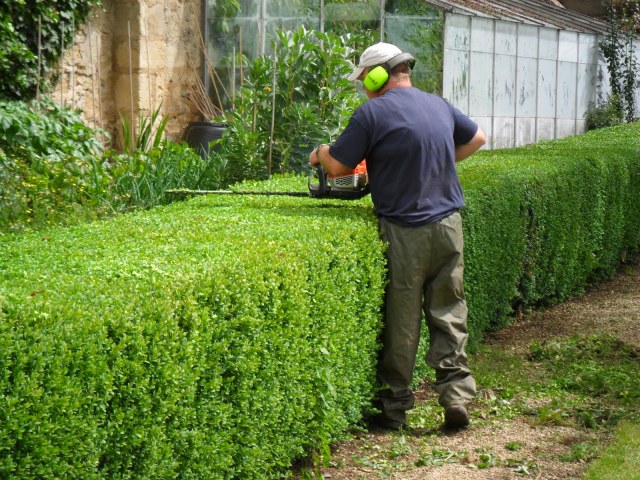
hedge archwayThis week’s Gardeners’ Question Time looks at how and when to trim hedges. The question comes from Anne Elk who lives in West Devon:

‘I never seem to be able to get an even, level cut on my hedge when I give it its annual trim. How can I achieve a really neat appearance?’

Well Anne, first you need to check on whether in fact your hedge is of a variety that does just need only one clip, or whether it should have several (see below). If it’s the latter, it will be difficult with only one cut to keep it smooth and sharp as so much material will have to be removed, so you should perhaps be trimming it more frequently.

In general though, to get a sharp, level shape when cutting, stretch a string line tightly between two posts along the top, at the height you want the hedge to be, and clip exactly to this level – however, be prepared to repair any accidental cutting of the string! For the sides, put in canes vertically at intervals along the hedge, and sight along these as you cut. Alternatively some people can do this by eye and achieve a satisfactory result, especially if the hedge is fairly low.

Lowish hedges can eb trimmed by eye as long as a good original line has been established

Lowish hedges can be trimmed by eye as long as a good original line has been established

So how and when should you cut different types of hedge?

Established deciduous hedges that are moderately fast growing (e.g. Beech, Hornbeam, Hazel and Tamarisk) should be trimmed once in August – however, if they are growing particularly well, they might need two trims – one in late July the other (lighter trim) in early October.

Deciduous hedges which tend to be fast growing (e.g. Blackthorn, Myrobalan Plum, Hawthorn) will need about three clippings at about six weekly intervals during the summer- this also applies to some fast growing evergreen hedges such as Lonicera and Gorse.

Some slower growing evergeen hedges such as the various Laurels, Elaegnus and Sweet Bay require just one cut in early autumn, though faster growing evergreens such as confiers are best trimmed once in August – or possibly twice if particularly vigourous (once in July and then again in early October). For Yew, trim once a year in the summer.

For slow growing, smaller – leaved evergreen hedges such as Box, you should be cutting in early summer (June- July) and again in late summer/early autumn (including topiarised shapes).  Box hedges should be cut in overcast weather as if they are cut in the hot and dry their half cut leaves will desiccate and turn brown. For Privet (Ligustrum) you will need at least two and possibly more cuts in a season to maintain its shape.

Mazes are often created from Yew hedging - usually an annual cut will keep it looking trim

Mazes are often created from Yew hedging – usually an annual cut will keep it looking trim

If you have an informal flowering hedge, in general this should be pruned rather than generally cut over. This is best done in spring if it flowers in between mid summer and autumn and in mid summer if it flowers in the spring or early summer. In both cases take off the shoots which have flowered, thin out the growth if it is crowded and remove completely any old growth which is straggly and flowering badly.

For most hedges try to establish sloping sides with a taper inwards towards the top (known as a ‘batter’) – this encourages growth lower down the hedge which if the sides were vertical (or even worse sloping inwards towards the bottom), would result in thin growth at the base where less light reaches the leaves.

Not all hedges are meant to be level and straight- 'cloud pruned' forms such as this are more a work of art than a geometric challenge!

Not all hedges are meant to be level and straight- ‘cloud pruned’ forms such as this are more a work of art than a geometric challenge!

I hope that you find this of help, and if you have any gardening questions that you think I might help with, then please email me at nbold@btinternet.com

Old School Gardener

If you’ve enjoyed reading this post and others on this blog, why not comment and join others by signing up for automatic updates via email (see side bar, above right ) or through an RSS feed (see top of page)?
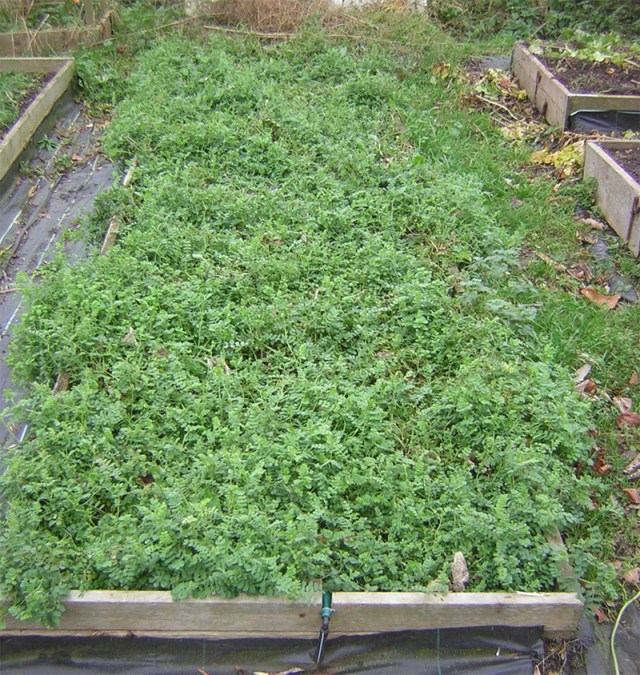
My previous articles and pictures on projects in the garden using wooden pallets or other recycled wood have featured some wonderful ideas. I’ve been amazed by the response and the articles seem to have also stimulated projects, not only in my own gardening activities, but for other gardeners, some of whom have sent me pictures of their creations. So here is the latest batch of Pallet Projects for you to look at, think about and maybe emulate!

Keep your ideas and pictures coming in!

A play teepee made out of natural wood and recycled pallets

A play teepee made out of natural wood and recycled pallets


A compost bin made out of pallets by Katherine Jacobs. The front fits snuggly into the sides and is removable. Kathereien isn't sure abotu the bag- itm was suggested as a way of keeping the compost warm and preventing 'too much' air getting in- I'm not convinced its a benefit.

A compost bin made out of pallets by Katherine Jacobs. The front fits snuggly into the sides and is removable. Katherine isn’t sure about the bag- it was suggested as a way of keeping the compost warm and preventing ‘too much’ air getting in- I’m not convinced its a benefit.

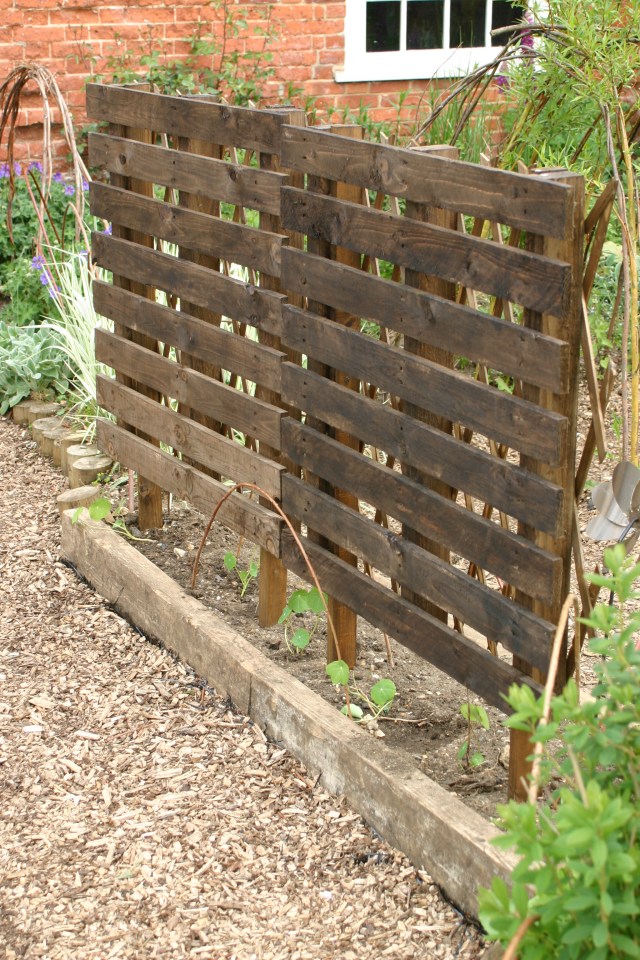
My own attempt at a Trellis screen made from two pallets fixed to posts in a public garden for under fives. The screen has diamond trellis fitted to the back, has been stained and will have climbing Nasturtums growing up it.

My own attempt at a Trellis screen made from two pallets fixed to posts in a public garden for under fives. The screen has diamond trellis fitted to the back, has been stained and will have climbing Nasturtums growing up it.


Other articles about using pallets in the garden:

Polished Primary Pallet Planters

Pallets Plus –  more examples of recycled wood in the garden

Pallet Power- the sequel

Pallet Power

Raised beds on the cheap

Old School Gardener

If you’ve enjoyed reading this post and others on this blog, why not comment and join others by signing up for automatic updates via email (see side bar, above right ) or through an RSS feed (see top of page)?


Phacelia tanacetifolia, a  'green manure' that's good to look at and attractive to beneficial insects.

Phacelia tanacetifolia, a ‘green manure’ that’s good to look at and attractive to beneficial insects.

I’ve just been reading about green manures, from a small prize I won at my induction training as a ‘Master Composter’. The prize is a slim booklet produced by Garden Organic and it focuses on the use of green or ‘living’ manure in the garden. So, what is a green manure?

‘a plant which is grown to benefit the soil, not, as some might suppose, under-ripe animal dung!’

I’ve had a couple of tries with green manure (mainly because I like the flowers of Phacelia), but have not been totally convinced of its value – it’s hard to check what benefits it brings unless you conduct some sort of rigourous trial, of course. Anyway, this booklet is giving me the confidence to do more and so I thought I’d share its contents with you in a short series of ‘bite sized’ articles over the next few weeks.

Apparently green manures have been used by farmers for centuries to improve their land and gardeners have begun to realise their value too. Seed companies have begun to stock green manure seeds in packets sized for the average garden. They are most often used in the vegetable plot, but can also be used in other areas. In later articles I’ll cover where and when to use them; some of the plants and their benefits; how to choose and grow the right plants and what to do when you’re ready to use them. Today I’m focusing on seven reasons why to use green manure.

1.To feed the soil – green manure crops ‘mop up’ and hold onto soil nutrients and some deep-rooted types can actually gather nutrients from depths that other plants cannot access. By absorbing nutrients the roots prevent it being washed down into sub soil. Once green manures are turned into the soil the nutrients are ready to be taken up by the next crop.

2. To protect and improve soil structure – green manures help to protect the soil surface from the effects of heavy rain (mainly soil compaction and surface ‘panning’). This is a benefit for both clay and sand – dominated soils where organic matter reduces compaction in the former and helps water and nutrient retention in the latter.

3. To stimulate soil micro organisms – when dug in green manures feed and stimulate microscopic creatures that in the process of decomposing this organic matter boost soil health, which in turn helps to develop strong plants.

4. To prevent weed invasion – nature abhors a vacuum/ bare soil – as soon as plants are removed new ones will try to move in and these can often be weeds. Green manures tend to germinate quickly so can be a quick way of covering bare soil and smothering young weed seedlings, also eliminating the need for constant hoeing to remove the weeds.

5. To control pests – some beneficial crittters (like frogs and beetles) love the shady, damp ground under a green manure. Some green manures can be planted to distract flying insects away from crops you want to protect; e.g. underplanting Brassicas with Trefoil disguises the outline of the crop and seems to deter cabbage root fly. Likewise a small patch of Phacelia tanacetifolia or Clover, if allowed to flower, will attract insects that prey on many garden pests.

6. To improve the look of the garden – a green manure or ‘cover crop’ will not ony help to prevent weeds but can look attractive of itself. Some also help to fix nitrogen in the soil which will help plant growth.

7. To ‘rest’ your soil – after a period of intensive cultivation, soil can benefit from lying fallow for a season. Most usual in the vegetable garden, it’s a technique that can be useful in the ornamental garden especially where a new border is to be planted up.

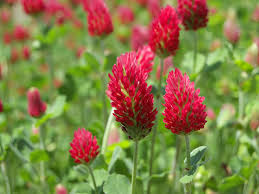
Crimson Clover - another green manure that looks good and helps to 'fix' ntrogen in the soil

Crimson Clover – another green manure that looks good and helps to ‘fix’ ntrogen in the soil

So, on paper the case for using green manures is a strong one. My kitchen garden is currently straining under the weight of the many different crops I have growing in every available patch of soil (and some containers too). But in a month or two, once some crops have been harvested, and where I haven’t planned for any new crops, I’m going to put in a green manure. In next week’s article I’ll cover just where and when to use these valuable plants.

Source: ‘Green Manures’- Garden Organic Guide. September 2010

Old School Gardener

If you’ve enjoyed reading this post and others on this blog, why not comment and join others by signing up for automatic updates via email (see side bar, above right ) or through an RSS feed (see top of page)?

 Close up of strong wind break netting

Close up of strong wind break netting

No, not a reference to too many sprouts, but a serious question from L. Onerf in Somerset:

‘Vegetables are not growing well in my windy garden, but I am reluctant to plant windbreaks of trees or hedges, as they will create shade and take moisture from the soil. What alternatives are there?’

If you want to avoid the costs of installing a fence/trellis with openings to allow the wind to percolate through at an acceptable speed, I think the answer lies in putting in a screen of synthetic wind break material, obtainable from most garden centres or online. The strength and quality of this varies and some is fairly costly, but a 1.5- 1.8 metre high wind break around your plot would give dramatic results. I found a 50 metre x 2 metre roll of knitted net on offer online for around £170 or much the same on Ebay for about £40, and £13 for a 10 metre length. Make sure the posts are anchored firmly in the ground (corner posts may need to be reinforced and they should ideally be bedded in concrete), as the netting takes a tremendous strain in high winds.

On the subject of vegetable or kitchen gardens, is yours laid out for maximum efficiency and growing space?

Traditionally vegetables were grown in large plots, often 6-9 metres wide and as long as the garden allowed. The vegetables were arranged with a lot of wasted space between rows. Today we know that vegetables can be grown far closer together without any adverse effects; indeed, there is a a trend towards abandoning rows and growing vegetables with equal spacing between the plants in each direction, in blocks or patches.

Narrow beds in the Kitchen Garden at Old school Garden

Narrow beds in the Kitchen Garden at Old School Garden

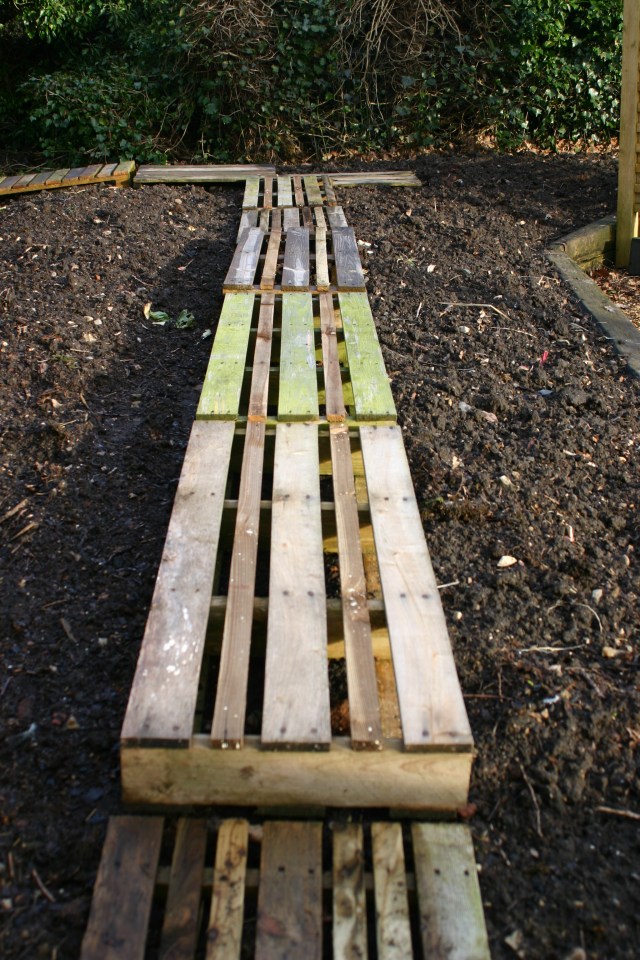
This compactness lends itself to smaller, narrower beds, say 0.9 – 1.5m wide, which can be any length you like. These narrower beds are easier to manage from either side (so avoiding walking on the bed itself and opening up the possibility and benefits of ‘no dig’ cultivation) and the denser planting also helps to crowd out weeds. here at Old School Garden, my kitchen garden ahs been laid out along these lines, though I still have a one large bed which I’ve effectively split into two by creating a ‘boardwalk’ path out of old pallets.

New boardwalk made of old wooden pallets

Boardwalk made of old wooden pallets, used to split a large veg bed into two

Do you have any gardening questions I might help you with? If so, please email me: nbold@btinternet.com

Old School Gardener

If you’ve enjoyed reading this post and others on this blog, why not comment and join others by signing up for automatic updates via email (see side bar, above right ) or through an RSS feed (see top of page)?
Spring-lawnA grass -free ‘Floral Lawn’ has been opened today in Avondale Park, West London. It’s plants, which include daisies, red-flowering clover, thyme, chamomile, pennyroyal and Corsican mint, create a “pollinator-friendly patchwork” – with 25% more insect life than that found in “traditionally managed grass lawns”.

The Royal Borough of Kensington and Chelsea commissioned the biodiverse floral lawn from Lionel Smith, a Royal Horticultural Society (RHS) sponsored PhD student, and RBKC’s gardening team. It is the first time that a public park has featured this new form of lawn.

Planting a public space with specially selected and researched plants will give Lionel a valuable insight into how the public will react to this non-traditional lawn. Previously all his research has been on experimental plots at Reading University. The idea has prompted questions about ‘just what makes a lawn a lawn’. Lionel says:

“Lawns are normally associated with closely trimmed grass but mine are, I believe, entitled to be called that too. They are not only beautiful and easy to maintain but also environmentally friendly. It will be interesting to see how visitors to Avondale Park, where this public trial sward is to be being planted, will react. I hope to get some feedback as part of my research.”

Traditional grass lawns, if regularly mown,  might look good, but have you thought about:

  • how they provide a pretty sterile living environment for insects and other critters?
  • how demanding they can be in terms of water, fertiliser, weedkiller, and energy use?

What do you think about this? Have you got a traditional grass lawn in your garden or have you turned it (or some of it) over to wild flowers or other uses? Should we turn over more areas of traditional grass lawn in public parks and spaces into grass- free or more diverse habitats? I’d love to hear your views!

Further information:

BBC News report and video

‘Rethinking the traditional grass lawn’ -blog article by Lionel Smith

Old School Gardener

If you’ve enjoyed reading this post and others on this blog, why not comment and join others by signing up for automatic updates via email (see side bar, above right ) or through an RSS feed (see top of page)?

Photo0126

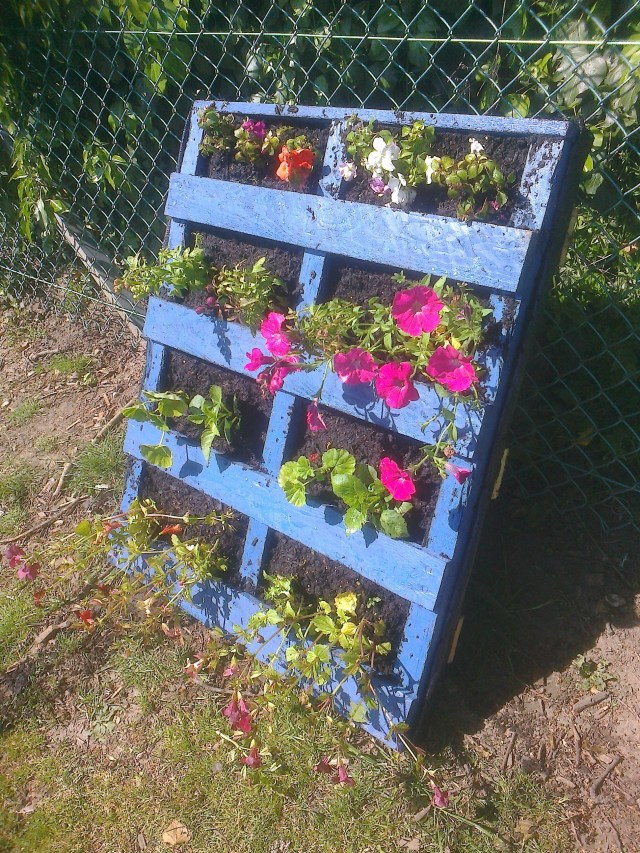
One of the finished planters standing alongside the Playground

My examples of using pallets and other old timber for garden projects seem to have been very popular (see links below). I’m experimenting myself with some ideas, including vertical pallet planters, made with a group of children (aged 7-10)at my local Primary school as part of a Gardening Club there. This has been great fun and a good learning experience for me as well as the children! We used pallets I was given by a builder at the Museum where I volunteer – they were relatively small pallets used for stacking bricks, so were a manageable size for the children.

I followed the guide produced by Garden Designer Mike Rendell (you can access a pdf of this here). It was fairly straightforward and with some help, the children managed to do most of the tasks needed to achieve some pretty flowering planters which now adorn the edge of their playground.

What we did:

1. Sawed off the ends of the slats so that there were solid timber sides to the planter – the children coped with this with a bit of help now and again (it didn’t help that my saws weren’t that sharp!).

2. Removed every other slat to provide space for planting – this proved to be difficult, especially for the children, as it involved a lot of strength and using claw hammers and the like.

3. Nailing two of the spare slats, one to the top, the other to the bottom of the planter – the children enjoyed using hammers and nails (it was helpful being able to use the nails and pre set holes already in the removed slats).

4. Painting the planters – we chose a rich blue paint suitable for outdoor furniture and the children enjoyed painting, though some of the younger ones had to be encouraged to ensure every bit of wood was properly covered!

5. Stapling some spare landscaping fabric to the back of the planter. I’d pre cut the size needed (allowing for a double layer joined in the middle and overlapping it around the sides and top of the planter). The children found it very difficult using the staple gun, which was designed for bigger hands, so I had to do this for them, whilst they held the fabric in place.

6. After this the children nailed the remaining spare slats to the back of the planter to provide reinforcement. Again, with a bit of basic ‘hammer tuiton’ the children managed this pretty well, though we did use some spare nails where some of the old ones got bent in the process.

7. The children then filled and compacted the compost into the planters, starting at the bottom and planting up as they went. We used about 40 litres of peat free compost per planter, a little loose, but with compaction and wetting seemed to hold together reasonably well. The children tired a bit towards the end, so I made sure the compost was properly compacted and roots covered. Once tidied up, the planters were thoroughly watere. Incidentally the plants were kindly donated by a local nursery woman who had held a plant sale at the school a few weeks before. We have a mix of Petunias, Antirrhinums, Dahlias, Geraniums and Impatiens- quite a mix and it will be interesting to see how some of the larger varieties fare in this vertical world!

8. I had fixed some cup hooks to the top and rear of each planter so that they can eventually be hooked into the fence to avoid them falling over, though for now the planters are at an angle to allow the compost and plants to become firmer.

Having  just seen a TV programme about the ‘Pallet Garden’ competition at the ‘Gardening Scotland’ show, I might try to introduce some sort of competition next year within the school (or maybe even between local schools?) …watch this space!

Other articles on pallets and other recycled wood in the garden:

Pallets Plus –  more examples of recycled wood in the garden

Pallet Power

Pallet Power- the sequel

Raised beds on the cheap

Old School Gardener

If you’ve enjoyed reading this post and others on this blog, why not comment and join others by signing up for automatic updates via email (see side bar, above right ) or through an RSS feed (see top of page)?

My earlier articles about projects using pallets seem to have been a big hit – they’ve certainly had a lot of visitors. I’ve been working on my own project with local school children to create vertical planters and these are due to be finished off next week, so I’ll do a piece on that project and the lessons I’ve learned. I’m still collecting examples of novel recycled uses of old wooden things and so here are a few more pictures of some other interesting ideas. If you have any ideas or examples of your own, please send me some pictures!

This amazing shed is made out of old fruit trays. you can see that they're from the 'Royal Fruit Farm' at Sandringham, Norfolk! (For those who don't know, Sandringham is one of the grand residences of the Brtish Royal family - about 30 miles away from  Old School Garden and a lovely landscape with some beautiful trees.

This amazing shed is made out of old fruit trays. you can see that they’re from the ‘Royal Fruit Farm’ at Sandringham, Norfolk! (For those who don’t know, Sandringham is one of the grand residences of the British Royal family – about 30 miles away from Old School Garden and a lovely landscape with some beautiful trees)

pallet decking

Here’s a super example of the ways in which pallets can be reused and how they can be finished off to look like an up market product. These pallets have been taken apart, reassembled and sanded off to give a smooth surface. Laid like giant decking tiles they create a pleasing, practical terrace. Note that it uses quite thick planks, an important consideration if the floor is to bear body weight!

vertical planter adam haden

My previous articles on pallet projects can be seen here:

Pallet Power

Pallet Power- the sequel

Raised beds on the cheap

Old School Gardener

If you’ve enjoyed reading this post and others on this blog, why not comment and join others by signing up for automatic updates via email (see side bar, above right ) or through an RSS feed (see top of page)?

Finding Nature

Nature Connectedness Research Blog by Prof. Miles Richardson

Norfolk Green Care Network

Connecting People with Nature

Discover WordPress

A daily selection of the best content published on WordPress, collected for you by humans who love to read.

Susan Rushton

Celebrating gardens, photography and a creative life

Unlocking Landscapes

Writing, photography and more by Daniel Greenwood

Alphabet Ravine

Lydia Rae Bush Poetry

TIME GENTS

Australian Pub Project, Established 2013

Vanha Talo Suomi

The Journey from Finnish Rintamamiestalo to Arboretum & Gardens

Marigolds and Gin

Because even in chaos, there’s always gin and a good story …

Bits & Tidbits

RANDOM BITS & MORE TIDBITS

Rambling in the Garden

.....and nurturing my soul

The Interpretation Game

Cultural Heritage and the Digital Economy

pbmGarden

Sense of place, purpose, rejuvenation and joy

SISSINGHURST GARDEN

Notes from the Gardeners...

Deep Green Permaculture

Connecting People to Nature, Empowering People to Live Sustainably

BloominBootiful

A girl and her garden :)