Tag Archive: spring


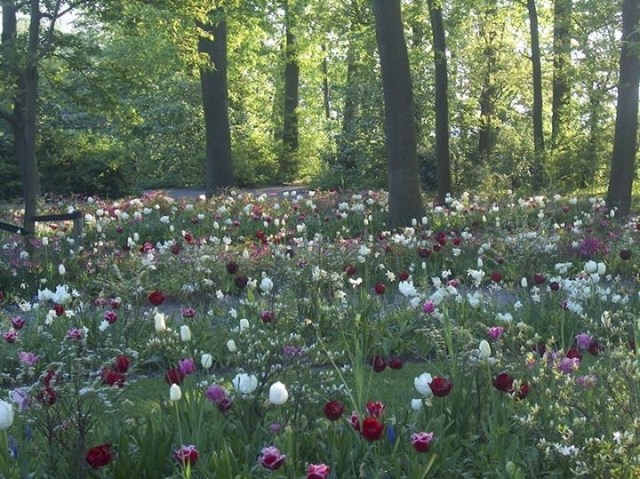
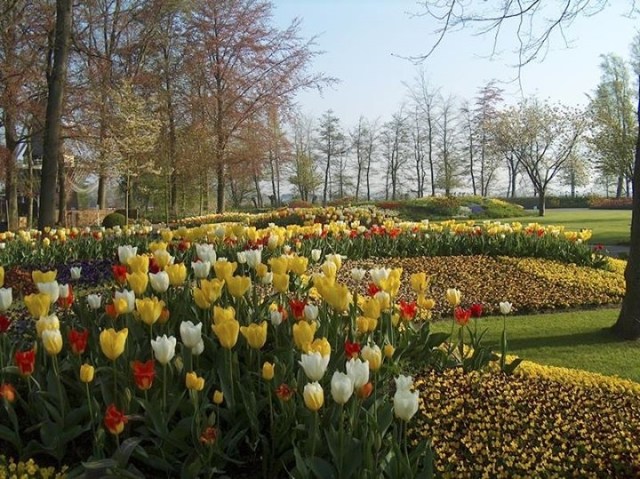
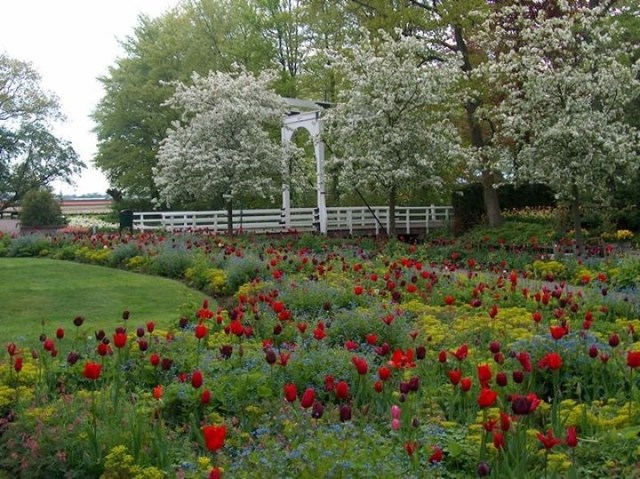
Pictures of Keukenhof, Holland via RHSI

This is the life- our cat enjoying a bask in the sun...
This is the life- our cat enjoying a bask in the sun…

 To Walter Degrasse

28th May 2014

Dear Walter

It’s been a busy May, Walter- ‘as usual’ I suppose you  might say! The last couple of days have seen heavy rain, but thankfully I managed to get out for a full day in Old School Garden on Monday, anticipating the rain by planting out lots of seedlings. This stage of the year also coincides with the cleaning of the (now empty) greenhouse and getting in the 12 different varieties of tomato and chillies my friend Steve has given me – plus a cucumber.

Today, as the weather is clearing up I’ll be out putting in a cane framework up which to train them. Or rather, most of them, as this year Steve has given me two varieties of tomato which don’t require tying in and training as cordons. Roma is a ‘determinate’ variety so should be grown as a bush (it doesn’t need it’s side shoots pinching out), and Marmande is ‘semi determinate’ which means limited pinching out is required. He’s also given me a ‘ridge’ cucumber which I’m going to try to grow outside in a pot.

I’m also feeling quite pleased that I managed to find a good use for the old compost I removed from the greenhouse. I grow my tomatoes in bottomless pots sunk into the ground (the so-called ‘ring culture’ method), so a dozen holes need to be dug to make way for the pots which are then filled with growbag and other compost. I’ve used the old compost in a plastic bin that once ‘graced’  the courtyard – you may remember I’d bought some rather nice large terracotta pots to replace the utilitarian plastic dustbin and pots that previously contained the peach and an olive bush? Any way, I thought I’d have a go at growing some carrots in the dustbin and the old compost. This is very friable and lacks any stones, so seems the perfect medium for this. So the bin is full and I’ll hopefully get round to sowing the carrots later today – they’re a variety called ‘Nigel’ given to me at Christmas by Steve and his wife!

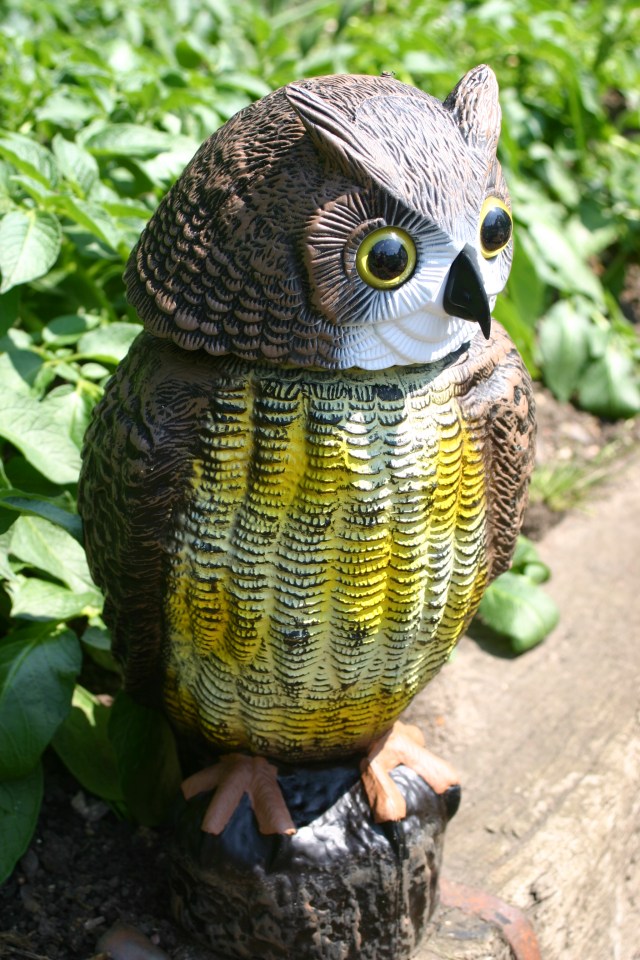
The rest of the kitchen garden is also looking pretty full- potatoes have been earthed up a couple of times and the first flowers are forming on the first earlies. The Brassica cage is also looking increasingly full with Cauliflowers, Calabrese, Spinach and Broccoli. Rainbow Chard and Leeks are bulking up and the first Broad Beans look like they’ll be ready to pick very soon. My sowings of Parsnip, Carrot and Beetroot are also coming along nicely. We’ve had plenty of Lettuce in the last couple of weeks. The Strawberry bed has been mulched with straw and as a bit of fun I’ve bought a plastic owl with a swiveling head to see if I can deter pigeons and other birds from the swelling fruit and other goodies in the garden (they usually go for my raspberries which are also looking promising this year)!

I’ve just about managed to catch up with the major weeding- just one area of the woodland edge to do and then I think I’ll mulch this with wood chippings to try to keep the weeds down. I’m hoping to do the same in the fruit cage once I’ve been through with the hoe later today. Oh, and some good news. You remember we had that extension put on about ten years ago that created Deborah’s Study? Well, I had to move a rather old Philadelphus bush and so put it in the main mixed border as a back drop to other things. It’s never flowered since, despite some careful successive pruning out of old wood, and encouragement of new growth. Well, it may be weather-related, but its covered with flower buds this year – I’ll post a pic when it comes out!

I’ve still got some half-hardy annuals coming through (I spent a couple of hours inside the shed potting these up while it poured down outside, yesterday). However,  I’ve managed to plant out most of these and especially the front bed which is my ‘homage’ to Victorian bedding and one or two other spots to add complementary colour or texture to perennials that will flower later- e.g. putting some golden-yellow looking Amaranthus in with the blue Agapanthus.

Several things are looking good here, including the rapidly filling mixed borders, so here’s a slide show of some of the highlights.

This slideshow requires JavaScript.

Unfortunately I didn’t manage to get the number of takers necessary to run the various gardening courses I’d planned for May and June, but I’ll try again the autumn, which seems the time most people do an evening class, especially if it’s garden -related. My work in other gardens has also been rather hectic. The sessions at Fakenham Academy have really begun to take off. The children seem more focused and interested and are starting to ‘own’ their plots, which are fast filling up with all sorts of food crops and some annual flowers to add colour and scent as well as attracting the pollinators of course. Unfortunately an assortment of pests is also posing a challenge- rabbits, mice and pigeons in the main. So remedial action has been necessary to try to prevent further damage- we had great fun last week trying to erect a pigeon-proof cage over the brassicas!

We’ve also got some tomatoes, cucumber and aubergines growing in the greenhouse. Also in Fakenham the project at the Community Centre to clear and plant a border next to the two hundred year old ‘crinkle crankle’ wall, has gone well. I, together with volunteers and children from the local primary school, planted this up last week. Now we wait for the plants – which I’ve positioned in repeating drifts of different colours, textures and forms to reflect the wave of the wall -to get hold and push on to do their stuff. I’ll post some pictures of this next week.

Another pest controller- I hope!

Another pest controller- I hope!

I was also pleased to be positively mentioned by one of the Inspectors at a recent Ofsted Inspection at the local primary school, where I was showing the children how to weed and earth up potatoes and explaining why we do this. This school (which now has level 5 of the RHS Campaign for School Gardening award), is shortly to host a training session for other local schools interested in school gardening activities. I’ll let you know how it goes.

How is your garden looking, Walter? I expect your orchard has  finished flowering by now, but I have fond memories of visiting you and Lise one spring and seeing all the beautiful blossom there. From my own garden, it looks like we’ll have another good year for fruit- there certainly seem to be a lot of plums forming on the tree and I can even seen some (and cherries) on the young fan- trained plants in the kitchen garden.

So, I think its getting to that time of year when we can take the foot off the accelerator a little and begin to enjoy the fruits of our labours! Hopefully that last major bit of weeding will be done by the end of the week and I can then get the remaining flowers planted out, as well as hoeing here and there to keep the weeds down. And maybe then a bit more sitting in the sun!

Having said that, I do think there’s something very satisfying about forking into a light, damp soil and pulling whole strands of Ground Elder root out (and of course trying not to breaking any of it off in the ground)!

Old School Gardener


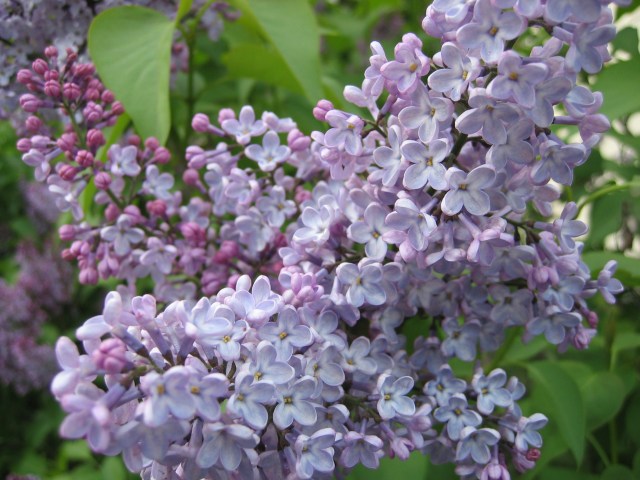
Stockholm-lilac‘The bright and busy days of May are here;

The countryside’s ablaze with colours rare

In sun and shower. There’s cricket on the green,

And lilies in the wood, and now are seen

Laburnums pouring gold, tall chestnuts decked

With spires of pink and white, where bees collect

A precious harvest, then away go winging

Past lovely lilacs where a blackbird’s singing.

Old gardeners now their long experience bring

To battle with the weeds; the lawns are neat.

A worried thrush scolds by the garden seat

Her wandering, gaping brood. House-martins cling,

Pied master-builders, on the weathered walls,

And from the woods all day the cuckoo calls.’

John (Jack) Kett

from ‘A Late Lark Singing’ (Minerva press 1997)

Gardening With Children's avatarGardening with Children

My front garden is at its best at the moment it is packed full of Bluebells, not an inch of soil can be seen, it looks stunning and the heady sweet perfume that greets me when I open the front door is wonderful the Bees love the Bluebells too.
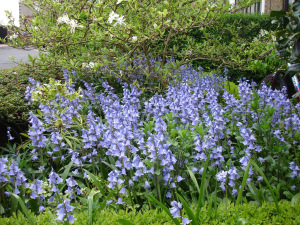
Bluebells in front garden

Hybrid Bluebells in my garden

There are actually 3 types of Bluebell in the UK

The English (native) Bluebell

The narrow bell shaped flowers are violet-blue with straight-sided petals which curl deeply back at the tips, they hang from the same side of the stem which droops over to form an arch, their pollen is creamy white and their leaves are narrow (0.7-2cm wide).

The Spanish Bluebell

Originally from Spain and Portugal their larger flowers open wider with the petal tips curling back only slightly, most flowers are arranged all around the stem which is straight and does not hang over…

View original post 254 more words

 To Walter Degrasse

28th April 2014

Dear Walter

I hope all’s well with you and Lise and that you’re managing to get out and about in your garden at this busy time. I’m certainly behind where I should be here at Old School Garden. I’ve weeded and dug over about two-thirds of the borders here and managed to mulch the fruit with a mix of horse manure and compost. I edged the lawns for the first time the other day and then cut the grass – all in all it took me about 4 hours! Still it does look the better for it.

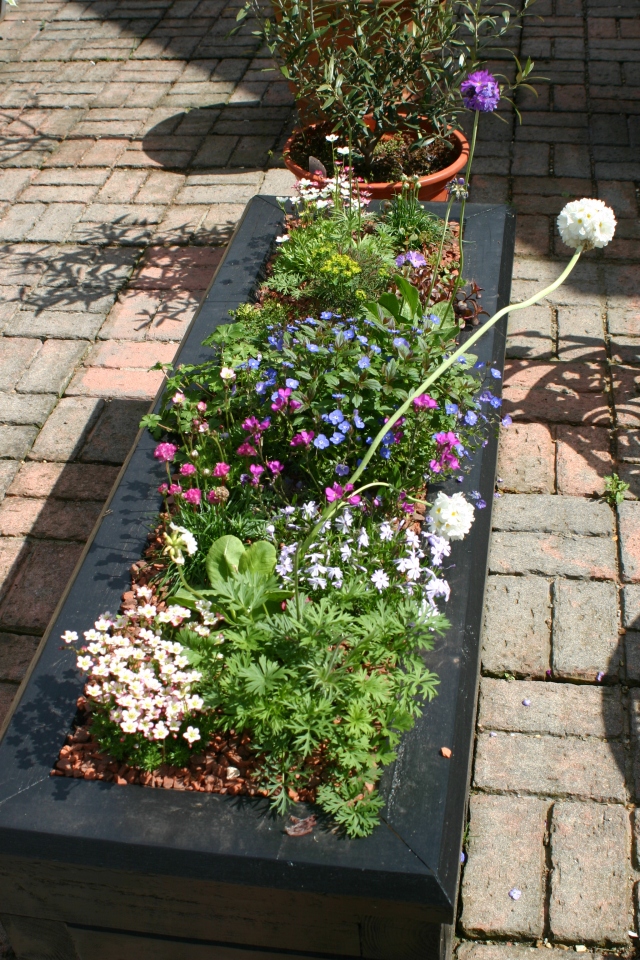
The alpine planter I made from 'Woodblocx' and planted up a few weeks ago- delightful if getting bit overcrowded...

The alpine planter I made from ‘Woodblocx’ and planted up a few weeks ago- delightful if getting a  bit overcrowded…

Apart from being behind with the weeding etc. everything elses is pretty much on track. The greenhouse and cold frame (as well as the lunge window sill) are packed full of seed trays and seedlings at various stages of growth. I’ve tried experimenting with a mix of multi purpose compost as a base layer and then some John Innes seed compost on top to get the seeds started; I’m still not very happy with the John Innes, as it seems to get water sodden and so not very healthy, quite quickly, whereas the multi purpose is not really fine enough for the really small seeds. I shall have to try further mixes.

The flower borders are starting to fill out very nicely, and I’m just about to mulch these with old wood chips and put in staking for the larger perennials. The bulbs and other spring flowering plants are also making a good show at present, though I’ve been disappointed with the tulip bulbs I bought in Amsterdam last November. Only one of the three packs I bought has come up as expected, the other two being nowhere close to the blue or violet colours promised on the packaging. So, the best laid colour mixing plans have gone out of the window and I’ll have to rearrange these in the autumn. The other, more established tulips are looking grand; I’m especially pleased with the way some old cast offs from Peckover House, planted 18 months ago, have responded to their new situation. They are flowering very well in the sandier soil here,  perhaps evidence that you can leave tulips in this sort of soil, but in heavier soils they tend to shrivel up and rot- the soil here is a lot more sandy than the siltier, clayey material in Wisbech.

This slideshow requires JavaScript.

Food crops are coming along, and I managed to spot the stem of an artichoke the other day (just one!), so the roots I put in last autumn may have not been a complete write off. I obviously miscalculated the amount of seed potatoes I needed, as I’ve ended up with s ix rows instead of the planned two! So, the kitchen garden plan has already had to be amended! Anyway, most of the beds are full of growth now; broad beans, mangetout peas, chard, lettuce,chives, calabrese, cauliflower, red cabbage, spinach, carrots, onions and garlic as well as the potatoes and more permanent beds of fruit. So far so good (and pests seem to be under control)!

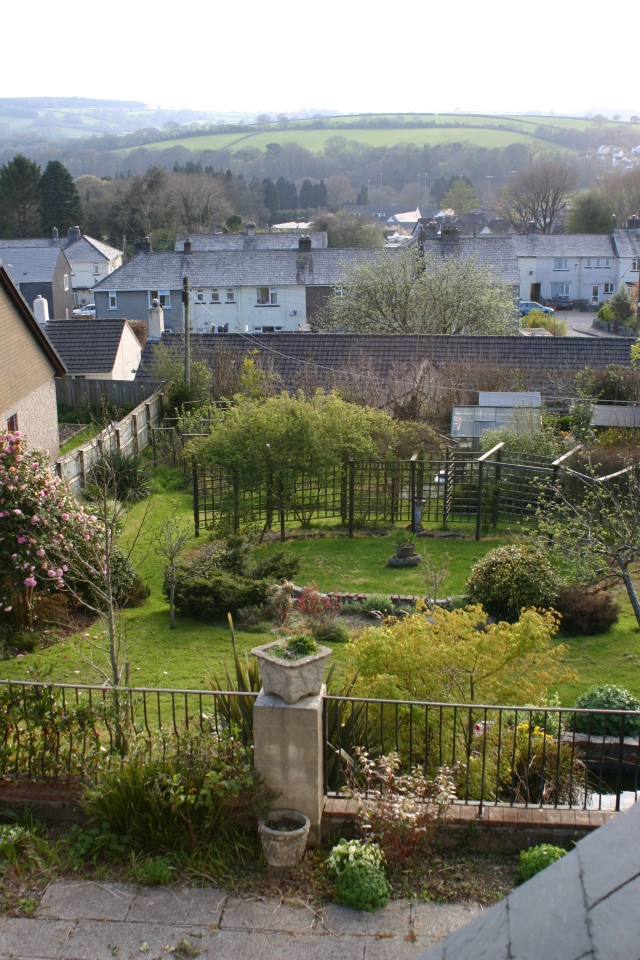
We recently visited my mother-in-law in Devon and I spent a good day or two pruning back a number of over grown shrubs. The cuttings amounted to about 10 big bags, so I must have made an impact! As you will recall, her garden is on a steep slope overlooking the edge of Tavistock and farmland beyond. A lovely setting, but a garden that is just too much for her to cope with now. She does get some gardening help, but this seems to amount to grass cutting and not much more. You may have gathered that whilst there we managed to visit several lovely gardens and other places, so keep an eye out for more articles and photographs in the next couple of weeks.

My Mother-in-Law's garden in Devon
My Mother-in-Law’s garden in Devon

I’ve continued with my work with the three groups of students at Fakenham Academy and am pleased to say that the three plots are now starting to fill up- we’ve planted a lot of potatoes, some beetroot (grown by the students from seed) and in the next couple of weeks we’ll be sowing and planting a lot more. Hopefully this activity will start to generate more enthusiasm in the students who, to be fair have had not much more than digging to keep them occupied up to now. On Thursday I also begin work on a planting scheme for a border in the grounds of the community centre at Fakenham. This is backed by a lovely old ‘crinkle crankle’ wall which is over 200 years old. The first job- with volunteers assisting I hope – is to clear the majority of the borders of an invasion of Borage and other plants and then to measure up and start to consider a planting plan. The local primary school is also getting involved and we hope to complete the project by the end of May. I’ll do some articles and pictures about this as it progresses.

The Cawston School garden is also looking full, though I haven’t been there for a few weeks, so it must be in dire need of weeding! I think I may have told you that the School has now not only achieved the highest grading in the RHS Campaign for School Gardening (level 5) but has also achieved a gold standard in the broader ‘learning outside the classroom’ that they do. On that note I’m giving a presentation about education for sustainability at a national network of early years landscape professionals tomorrow, and hope to cover a wide range of projects that I’m involved with. I’ll let you know how it goes- I’m particularly looking forward to seeing the outside environment at the Earlham Early Years Centre in Norwich where the meeting is taking place- must remember my camera!

Work to promote my forthcoming courses  has been progressing and I’m going along to Gressenhall Farm and Workhouse Museum for its ‘Going Wild’ event on 5th May to conduct a couple of garden tours and promote the Wild life Gardening course there on 18th May. I’m not yet sure about the numbers signed up for this or the other two courses that are scheduled to begin in early May. Both of these are in the evening at Reepham High School and College and once again I’m covering garden design and growing your own food. Fingers crossed I get the numbers that mean they’ll go ahead.

Well, this is obviously a busy time and so far today I’ve spent the morning on the computer and occasionally looking out at the weeding still to be done and all the other jobs in the garden, so I must get moving! Bye for now, old friend, and all the best until I write again in a few weeks time.

Old School Gardener


Planting Patterns #5

Spring in the step

Old School Gardener

Planting Patterns #3

High ranking Hyacinths at Blickling Hall, Norfolk

Celandine_Sward‘The lively breezes fleecy flocks are chasing

Across the sky; from field to field go racing

Cloud shadows, hurrying on beneath the sun.

On every side man’s work is being done,

To profit by his time when all around

The life renewed is springing from the ground.

Dawn’s chorus swells; at dusk the blackthorn’s glowing,

Hedges grow green, and chattering children stray

Along the banks where primroses are growing

With daffodils. And on this first warm day

A butterfly with sunlit, yellow wings

Goes gaily gliding by; a robin sings,

And celandines among the mosses gleam,

Casting their gold upon the busy stream.’

John (Jack) Kett,  from ‘A Late Lark Singing’ (Minerva press, 1997)

Old School Gardener

An early show from Euphorbia characias in Old School Garden

To Walter Degrasse – 27th February 2014

Dear Walter,

Mild weather has continued here and so I’ve taken the opportunity to start lightly turning over the soil, cutting back dead stems on herbaceous perennials and grasses and recently pruned back some shrubs such as Cornus and Buddleja to channel the new growth that’s starting to emerge.

In the last couple of weeks, the basal growths of new leaves around many plants have started to push upwards and the pattern of planting in the mixed borders is slowly taking shape – a very satisfying sight too.

I was surprised at how easily my kitchen garden soil responded to a light forking over, which included turning in some green manures and removal of a few weeds. With all the rain we’ve had I was expecting it to be rather claggy, but then again my sandy loam is always a joy to work with, so I should have known better. It’s also been perfect weather for dividing and moving some herbaceous perennials I didn’t get around to doing last year.

Having repaired the little storm damage we’ve had (a few bent hinges on one of the garage doors and a fence post needing to be replaced), I’ve also finally taken apart my wooden planters built about 7 years ago, but unfortunately not with pressure treated timber, so that all the money and effort has not lasted as long as I’d hoped. Still, I’ve been pleasantly surprised at an offer from a Scottish Raised bed manufacturer (‘Woodblockx’).

They’ve kindly donated me a new planter  and I’m finalising my plans about where best to use this, possibly as a feature in the courtyard with alpines  or maybe somewhere in the kitchen garden for food growing. The system they use looks both very strong and relatively easy to build, but I’ll do a review on the blog as I get to grips with the build in the next few weeks.

Having completed all the pruning and clearing of spent stems and foliage, I’ll also be turning my attention to further spring soil turning in the next few weeks. My first batches of seeds have germinated pretty well and I’ll be potting up some french marigolds and moving on some early food crops (Calabrese, Cauliflower and Leeks). To date the new bed of asparagus I planted last  autumn doesn’t appear to have made any growth above ground, but it’s still bit early for that, perhaps.

Next door the garlic bulbs and most of the broad beans I sowed last autumn are now doing well, as are the patches of onion sets (Red and white) and some Red cabbage and spinach. Mole activity seems to have subsided a little of late – hopefully it will tail off further as I get to give the lawn its first cut – and new grass will come up where the mole hills once lay.

Further afield, I’ve continued my new support at Fakenham Academy (a local high School), helping three groups of students prepare a food growing plot each in their school garden; in fact three plots of 12m x 6m, all of which have either been covered with weeds or grass.

Getting these ready for sowing is proving to be a tough job, the weather requiring us to turn over the clumps of grass/weeds and soil to allow for some drying out, so that we can remove most of the soil before piling up the weeds and turves in separate heaps for rotting down. Still, it does look like we’re making progress.

However, I discovered the other day that due to there being some asbestos in the better of two greenhouses  there, we will have to wait longer for a propagation space. This is unfortunate as I’d hoped to have broken up the hard physical toil with some lighter seed sowing activity especially as I have now bought the seeds and seed potatoes in line with the crops the students say that they want to grow. It’s fun working with these students, though not surprisingly they can get tired and bored of digging and so behaviour standards can sometimes drop!

Yesterday I returned to Gressenhall Farm and Workhouse Museum (where I volunteer) and was pleased to commence a tidy up of the gardens I’m responsible for. It was also encouraging to meet two new volunteers, Jonathan and Mike, as well as two new Heritage Gardening trainees, Sam and Sonny.

This new injection of person power will make it a lot easier to keep on top of the maintenance of the gardens and may even allow us some scope for further improvement projects.

It was a lovely day too, which makes garden tidying a real joy! The museum opens to the public again on 9th March, so next week no doubt we’ll all be trying to get the gardens looking presentable. The tubs of pansies and spring bulbs I planted in the autumn are looking good and along with other spring interest should give the gardens a splash of early colour- the pinky blushed Hellebores in the Education Garden are looking good for example.

I’m just back from a morning at my local primary school (first visit since early winter) to help with their ‘outdoor learning’, focusing on the garden. The morning began rather wet but we managed to spend a couple of hours with two groups of children turning over soil and weeding as well as moving a pile of wood chips around the fire pit- these had come from a fallen hawthorn tree that toppled over in the main drive during the recent storms. Some of the children also worked out how many potatioes they’d need for one of the raised beds and I took in a few fruit boxes with moulded paper liners to help with ‘chitting’.

The children seemed to have a great time and were especially interested in the warmth that had built up in the pile of wood chippings – a great opportunity to explain the rudiments of composting!

I’m also pleased that we have some extra help in the garden, in the form of Ann, one of the students on the GYO course I did last autumn and a parent of one of the children at the school. And our current house guest, Lisa, also helped out with groups spotting the ‘first signs of spring’. Lisa is staying with us for a few months to experience British school life and brush up her English before commencing her own university career with a view to teaching. She’s from Muenster in Germany – and we are also eagerly anticipating the arrival of her mother, Anne tomorrow for a weekend stay.

Seems like this is the time for important germans to visit the UK, as their Chancellor, Angela Merkel is in London today, addressing the Houses of Parliament and taking tea with the Queen!

The Garden Design course that I’m running at Reepham seems to be progressing well, with 9 enthusiastic participants. They have all pretty much surveyed and drawn up a scale base plan of their gardens and are now exploring functional and form layouts as well as developing sketch designs incorporating ideas for creating structure in their designs. Next week we turn our attention to planting design as the ‘fourth dimension’ (seasonal variations) adding to the 2D and 3D views of the garden we’ve covered to date.

Tonight I’m off to County Hall in Norwich to attend an event for the Norfolk Master Composters, featuring a talk by well known Norfolk organic gardener, Bob Flowerdew – and there’s a buffet too!

I hope you and Lise are well and getting stuck into your plot once more – remember to take it easy and limber up before you do anything strenuous – you don’t want that back problem again!

all the best,

Old School Gardener

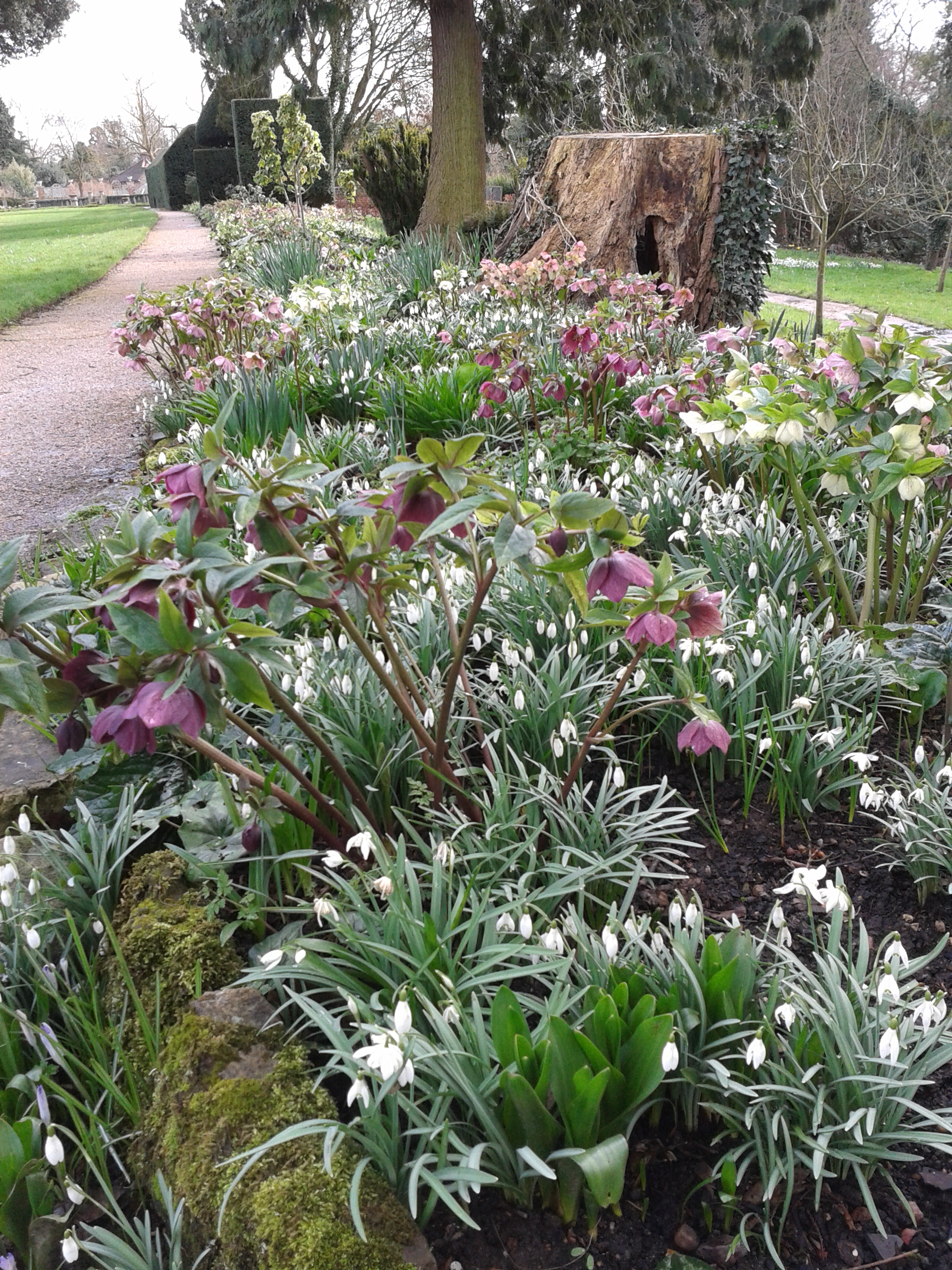
20140225_123456My friend Jennifer sent me these lovely pictures of the spring flowers at Myddelton House, Enfield today.

This slideshow requires JavaScript.

This was the home of E.A. Bowles who transformed the garden at Myddelton and, as a keen traveller, especially to Europe and North Africa, brought home with him many specimens of plant. Such was his collecting zeal that, by the turn of the 20th century, he was growing over 130 species of colchicum and Crocus- very much the ‘Crocus King’.

If you’d like to see something of the gardens in summer here’s a link to an article I wrote last August.

Old School Gardener


Finding Nature

Nature Connectedness Research Blog by Prof. Miles Richardson

Norfolk Green Care Network

Connecting People with Nature

Discover WordPress

A daily selection of the best content published on WordPress, collected for you by humans who love to read.

Susan Rushton

Celebrating gardens, photography and a creative life

Unlocking Landscapes

Writing, photography and more by Daniel Greenwood

Alphabet Ravine

Lydia Rae Bush Poetry

TIME GENTS

Australian Pub Project, Established 2013

Vanha Talo Suomi

The Journey from Finnish Rintamamiestalo to Arboretum & Gardens

Marigolds and Gin

Because even in chaos, there’s always gin and a good story …

Bits & Tidbits

RANDOM BITS & MORE TIDBITS

Rambling in the Garden

.....and nurturing my soul

The Interpretation Game

Cultural Heritage and the Digital Economy

pbmGarden

Sense of place, purpose, rejuvenation and joy

SISSINGHURST GARDEN

Notes from the Gardeners...

Deep Green Permaculture

Connecting People to Nature, Empowering People to Live Sustainably

BloominBootiful

A girl and her garden :)