Tag Archive: spain
The slow trickle of water from a fountain added to the ambience, quite a contrast to the rushing of the arched fountains in the Generalife (I’ll post a couple of videos comparing them in the next day or two). Here are some pictures of the outer Alhambra and the Nasrid Palace…
Well, I got my ‘fix’. Our drive home was a little more eventful than our outward one, as we had both darkness and rain to contend with. But we rolled safely into the Cortijo and managed a late night supper (I think it must have been 11pm before we ate) round the pool. A quieter day tomorrow, perhaps?

It was late September and we had travelled to Spain for a week’s break in a farmhouse home in a remote mountainous region of innner Andalucia. Having settled in, done our first food shop and enjoyed our first evening meal by the pool we decided to make a short trip out on our first full day to the nearby village and lake of Iznajar.

- Felicity enjoying our lunchtime view
Andalucia.com describes the village and area:
‘This small town of some six thousand inhabitants was transformed some years ago by the creation of an ’embalse’, or reservoir, below the promontory on which Iznajar sits in the River Genil valley. Today, to all intents and purposes, Iznajar now has a waterfront, overlooking an inland sea some thirty kilometres long, and containing an estimated 900 million cubic metres of water destined for domestic consumption…
Iznajar itself escaped the submersion that often visits towns and villages in the region of Andalucía’s controversial programme to construct more and more dams and reservoirs to serve this increasingly thirsty region. If anything, the lake below has given further resonance to its unofficial title as the Mirador (viewpoint) del Genil. Surrounding countryside and communications have been radically altered, not least by a bridge built across the reservoir near Iznajar in order to continue to carry traffic on the Archidona/Priego de Córdoba road…
The village was originally a prehistoric Iberian settlement, but flourished in the eighth century when Arab settlers, in the wake of the 711AD invasion by Tariq ibn Zayid and his Moorish armies, built a castle on the promontory and called it ‘Hins Ashar’ (hence the modern Spanish name). It became the focus of battles between various north African factions, finally being taken by the army of Abderramán III. After the fall of the Caliphate of Córdoba, then the capital of Al-Andalus, it fell under the rule of the dependency of Granada. In 1431, in the reign of Catholic monarch Juan II, it was taken back by the Christian rulers, some sixty years before Granada was to fall in 1492. Iznajar gained brief notoriety in 1861 when the town supported an uprising against the monarchy, led by Rafael Perez del Alamo, with grimly predictable consequences…
The ruins of the 1,200-year-old castle are the obvious key attraction for the visitor… Parts of the fortified town walls can also be seen in the upper reaches of the town. Inside the town walls, a small square called the Patio de las Comedias suggests that, despite its defensive position, Iznajar once had a theatre culture that probably tracks back millennia… the Iglesia de Santiago church, (was) built over time during the fifteenth and sixteenth centuries, with a remarkable late addition in the form of a Baroque altar piece. The cemetery next to the church only dates back to 1806…
The most interesting barrio, district, of Iznajar is the Barrio del Coso, a labyrinth of typical whitewashed Andalucían houses dotted around a labyrinth of narrow lanes that criss-cross the promontory. As if often the case in these hill towns, the ‘lower’ part is also the newer part of town…..’
I loved the majestic setting of this lovely village and the obvious care the residents take in looking after their private and public spaces. Having ‘mooched’ around the village in the morning and had a light tapas lunch with a splendid balcony view across the village, we moved off to the nearby ‘beach’, where we had the place almost to ourselves (that’s wife Deborah and friends Nick and Felicity). The beautiful setting, warm sunshine and water (I actually swam!) made for a relaxing beginning to our week’s adventure…
Old School Gardener
Old School Garden – 3rd October 2014
To Walter Degrasse
Dear Walter,
I’m feeling very guilty. A month has gone by and three weeks out of four we have been away from Old School Garden. So, as you can guess, I’ve not much to report as far as our garden is concerned, well at least in terms of effort, that is. I’m pleased to say, though, that due to the diligent watering of our son and neighbours, we were pleasantly surprised at the state of the garden on our return from foreign climes. Well, mostly.
I thought I’d give you a snapshot of some of the wonderful places we visited whilst away in Spain and Portugal, but first, one of the good things to report is the continued harvest. Here are a few pictures of this month’s offerings. As you’ll see, I’ve cheated a bit and included a bag of almonds donated to us by our hosts in Spain, Michael and Lisa. We sampled some of these, and especially loved the salted ones- I threw a few into a Spaghetti Bolognese we had for supper one day- they added a new dimension!
More generally, the Old School Garden has definitely put on some of its autumn clothes. However, the driest (and possibly the warmest) September on record in the UK has meant that some things you’d associate with high summer have continued to put on a show, or in some cases, a second flowering. I even spotted some new strawberries in our patch! I’m hoping that the weather will be kind enough to encourage the Melianthus major to flower this year; you remember I grew this from a cutting I took whilst working at Peckover House a couple of years ago? It’s the plant with leaves that smell of peanut butter when you rub them and has claret-coloured spikey flowers.
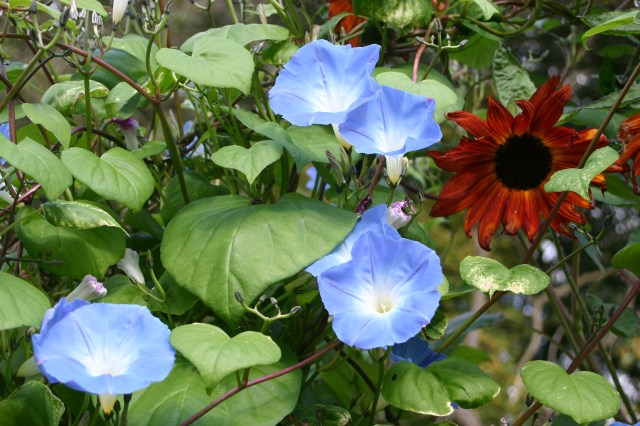
Here’s a selection of pictures of some of the ornamental interest in the garden right now…
I said that the previous month had involved little gardening effort on my part. I’d forgotten a few things that I managed to squeeze in between the holidays:
-
I sowed some green manure (Phacelia) which is now beginning to look good
-
I tackled (with our soon to move neighbour) an overgrown, mixed hedge boundary and removed a lot of growth to open up the kitchen garden to more morning sun
-
I did the usual late summer round of hedge clipping (and managed to cut through the hedge clipper’s electric cable too)
-
I took some yew cuttings from the old bushes/trees at Gressenhall, and last, but not least…..
-
I continue to ‘deal with’ the rash of mole hills and runs that have spread right across all the areas of our grass (I don’t any longer call them lawns).
Turning to our trips abroad, these weren’t all about visiting gardens, parks and other lovely places – near the end we did a bit of ‘hands on’ gardening! Our daughter and son-in-law live in Almada, just over the river from Lisbon, Portugal. Their apartment has a rear patio (which I’ve written about before) and also a rather blank piece of ground at the front. This is covered with different layers of concrete and apart from providing a parking place for our son-in-law’s motorbike, does little more than collect wind-swept rubbish and provide a challenging growing space for some tough old weeds which seem to have gradually worked their way into cracks and, once there, swelled these as their roots get a grip.
I don’t know if it was us tiring of being on holiday or the annoyance of looking at this plot every day, but Deborah proposed to do some weeding one morning and so three of us set out ‘armed’ with only our hands and a draw hoe (not usually put into service for this sort of job). You can see the result below. Having begun with limited ambitions, not surprisingly we managed to remove some large chunks of concrete (!) and tilled the rather poor soil in readiness for some planting next year (I suggested some annual poppies and marigolds as good ‘pioneer’ species). Diego, our son-in-law, was obviously inspired by this effort and is now proposing to remove a larger strip of concrete to create some more significant planting areas…watch this space.
I promised you a snapshot of some of the wonderful places we visited whilst in Spain and Portugal, so here’s a selection to whet your appetite for more extensive articles (and pictures) in the next few weeks…
I almost forgot to mention my holiday reading. Whilst our travels meant we weren’t able to read that much, I did make a start on ‘Noah’s Children’ by Sara Stein. You may recall that I was pointed in her direction by a fellow blogger? After reading her previous book ‘Noah’s Garden’ (in which she discusses her approach to ecological gardening), the sequel gets into the whole issue of how we do or don’t enable children to build a relationship with their environment. I’ve been saving some thought-provoking extracts from this and will somehow share them with you in the coming weeks. Here’s a starter from the Introduction, where Stein sets out her stall for the rest of the book:
‘Land is nourished or not by humans; humans are nourished or not by land. Place and occupant only seem separable because we have created such a distance between liveliness and livelihood. In creating that distance, we have unwittingly detached the nature of childhood from the sense it ought to make. Childish curiosity is to make connections, to realize the larger picture, to become able in the physical environment our lives depend on. We’ve removed the red from the fruit, the fruit from the tree, the tree from the wood, the wood from all the things a child might make of it, and so left fragments much harder to connect than laces on a shoe.’
To conclude this month’s letter, Walter, I’ve a positive note, not unrelated to the theme of ‘Noah’s Children’. Whilst at Gressenhall Museum on Wednesday, the co-ordinator Lynne, mentioned a comment she’d had from a recent visitor. The visitor said her young children loved coming to the ‘Curiosity Corner’ I and colleagues had created for under 5’s in a small part of the gardens here; to the extent that she’d spent a considerable sum getting her own garden landscaped to make it more ‘child friendly’, to introduce some of the features that can engage the young mind in exploring and learning from their environment. That warmed my heart.

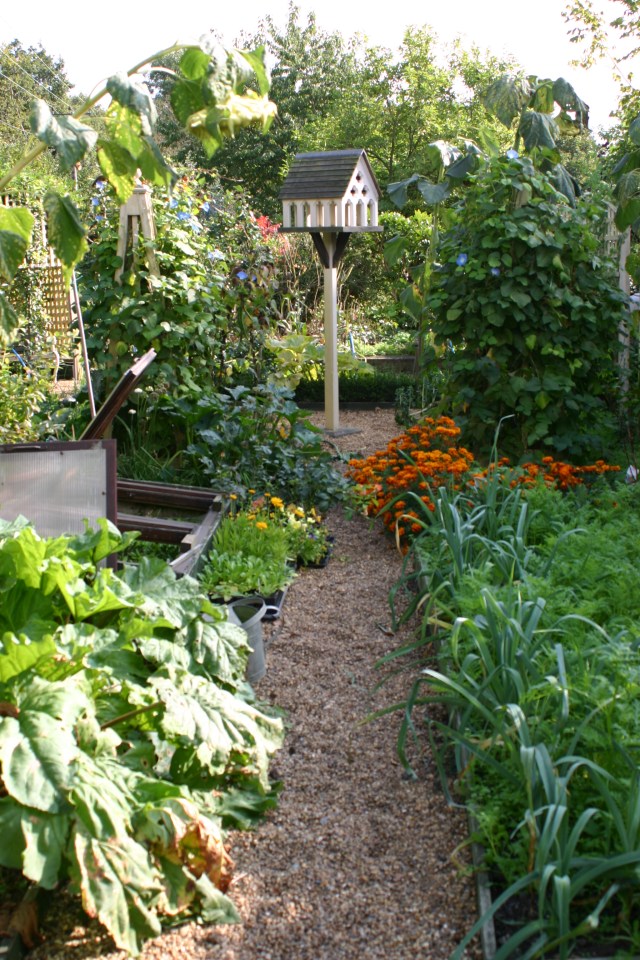
The Kitchen Garden in autumn – ‘fulsome’
All the best for now, old friend,
Old School Gardener