Tag Archive: portugal
Our 2014 September visit to Portugal featured some interesting new places, including three wonderful gardens. The first I’m featuring was a visit to the home of wealthy ex pat Brits when it was established over a century ago. Monserrate sits in the mountains north-west of Lisbon in the regal suburb of Sintra.
The website which covers many of the Sintra garden gems describes Monserrate gardens and its palace as:
‘..one of the most beautiful architectural and landscape Romantic creations in Portugal… unique representatives of 19th century eclecticism.The Palace combines gothic and Indian influences as well as Moorish suggestions together with exotic and plant motifs which are harmoniously extended to the exterior. The gardens have received species from all corners of the world, which were planted according to their geographical origin. The front lawn of the Palace provides a well-deserved rest, while discovering one of the richest Portuguese botanical gardens.’
It was built in 1858 for Sir Francis Cook, an English baronet who had amassed a fortune as a trader and textile baron and was created Visconde de Monserrate by King Luis. Cook turned to an English architect, James Knowles jr. for the house design. He took inspiration from the many countries Cook had dealings with and also the flamboyantly oriental Royal Pavilion in Brighton, England, built for the Prince Regent, later Goeorge IV over 50 years earlier. I loved the round tower and proportions of the palac, the use of reflected light under the wide eaves with subtle creamy and terracotta hues to create a lovely warm glow. The rich decoration is a generally successful blending of eastern, moorish and gothic revival styles. Here are some pics of the house….
Cook hired William Nevil as Botanical expert and landscaper. The project was completed within 5 years and was Cook’s summer residence. The entire estate was put up for sale in the 1920s by Cook’s great-grandson, and after many years of neglect was purchased by the state in 1949. Since then it has been open to the public as a national monument.
The English influence emanates throughout the gardens which have a romantic feel, especially as you wind your way along rough paths through shaded glades with waterfalls, pockets of sunlight and mock ruins, and eventually up to the rather more manicured lawn (the first laid in Portugal) that stretches away from the house down to the grounds. These also include specialist and exotic gardens with non-native plants from Cook’s personal collection. Here are some pics of the gardens and grounds…
The Monserrate Palace is the smallest of Sintra’s three palaces but it is by far the most decorative – and beautiful- and certainly captivated me, as did the winding and varied gardens – especially the Mexican Garden, some pics of which follow…
It has taken 20 years to restore the gardens and the result was recognised in 2013 when they were voted the winner of the European Garden Awards in the category for “Historical parks”. In 1995 the park was recognised by the UNESCO as a World Heritage Site as a part of several palaces and parks in Sintra. The citation for its latest award says:
‘Light and shadow, exotic and rare plants, winding paths and breath-taking views, but even new garden sections, such as the rose garden that was opened in the year 2011 by the Prince of Wales, make a visit to Monserrate, in spite of the many other wonderful parks in Portugal, a unique, fascinating and therefore “prize worthy” event.’
Old School Gardener
….or:
‘OK, so I’ve germinated… what’s next?’
Seedling seen on the beach at Arrabida, Portugal
Old School Gardener
Old School Garden – 3rd October 2014
To Walter Degrasse
Dear Walter,
I’m feeling very guilty. A month has gone by and three weeks out of four we have been away from Old School Garden. So, as you can guess, I’ve not much to report as far as our garden is concerned, well at least in terms of effort, that is. I’m pleased to say, though, that due to the diligent watering of our son and neighbours, we were pleasantly surprised at the state of the garden on our return from foreign climes. Well, mostly.
I thought I’d give you a snapshot of some of the wonderful places we visited whilst away in Spain and Portugal, but first, one of the good things to report is the continued harvest. Here are a few pictures of this month’s offerings. As you’ll see, I’ve cheated a bit and included a bag of almonds donated to us by our hosts in Spain, Michael and Lisa. We sampled some of these, and especially loved the salted ones- I threw a few into a Spaghetti Bolognese we had for supper one day- they added a new dimension!
More generally, the Old School Garden has definitely put on some of its autumn clothes. However, the driest (and possibly the warmest) September on record in the UK has meant that some things you’d associate with high summer have continued to put on a show, or in some cases, a second flowering. I even spotted some new strawberries in our patch! I’m hoping that the weather will be kind enough to encourage the Melianthus major to flower this year; you remember I grew this from a cutting I took whilst working at Peckover House a couple of years ago? It’s the plant with leaves that smell of peanut butter when you rub them and has claret-coloured spikey flowers.
Here’s a selection of pictures of some of the ornamental interest in the garden right now…
I said that the previous month had involved little gardening effort on my part. I’d forgotten a few things that I managed to squeeze in between the holidays:
-
I sowed some green manure (Phacelia) which is now beginning to look good
-
I tackled (with our soon to move neighbour) an overgrown, mixed hedge boundary and removed a lot of growth to open up the kitchen garden to more morning sun
-
I did the usual late summer round of hedge clipping (and managed to cut through the hedge clipper’s electric cable too)
-
I took some yew cuttings from the old bushes/trees at Gressenhall, and last, but not least…..
-
I continue to ‘deal with’ the rash of mole hills and runs that have spread right across all the areas of our grass (I don’t any longer call them lawns).
Turning to our trips abroad, these weren’t all about visiting gardens, parks and other lovely places – near the end we did a bit of ‘hands on’ gardening! Our daughter and son-in-law live in Almada, just over the river from Lisbon, Portugal. Their apartment has a rear patio (which I’ve written about before) and also a rather blank piece of ground at the front. This is covered with different layers of concrete and apart from providing a parking place for our son-in-law’s motorbike, does little more than collect wind-swept rubbish and provide a challenging growing space for some tough old weeds which seem to have gradually worked their way into cracks and, once there, swelled these as their roots get a grip.
I don’t know if it was us tiring of being on holiday or the annoyance of looking at this plot every day, but Deborah proposed to do some weeding one morning and so three of us set out ‘armed’ with only our hands and a draw hoe (not usually put into service for this sort of job). You can see the result below. Having begun with limited ambitions, not surprisingly we managed to remove some large chunks of concrete (!) and tilled the rather poor soil in readiness for some planting next year (I suggested some annual poppies and marigolds as good ‘pioneer’ species). Diego, our son-in-law, was obviously inspired by this effort and is now proposing to remove a larger strip of concrete to create some more significant planting areas…watch this space.
I promised you a snapshot of some of the wonderful places we visited whilst in Spain and Portugal, so here’s a selection to whet your appetite for more extensive articles (and pictures) in the next few weeks…
I almost forgot to mention my holiday reading. Whilst our travels meant we weren’t able to read that much, I did make a start on ‘Noah’s Children’ by Sara Stein. You may recall that I was pointed in her direction by a fellow blogger? After reading her previous book ‘Noah’s Garden’ (in which she discusses her approach to ecological gardening), the sequel gets into the whole issue of how we do or don’t enable children to build a relationship with their environment. I’ve been saving some thought-provoking extracts from this and will somehow share them with you in the coming weeks. Here’s a starter from the Introduction, where Stein sets out her stall for the rest of the book:
‘Land is nourished or not by humans; humans are nourished or not by land. Place and occupant only seem separable because we have created such a distance between liveliness and livelihood. In creating that distance, we have unwittingly detached the nature of childhood from the sense it ought to make. Childish curiosity is to make connections, to realize the larger picture, to become able in the physical environment our lives depend on. We’ve removed the red from the fruit, the fruit from the tree, the tree from the wood, the wood from all the things a child might make of it, and so left fragments much harder to connect than laces on a shoe.’
To conclude this month’s letter, Walter, I’ve a positive note, not unrelated to the theme of ‘Noah’s Children’. Whilst at Gressenhall Museum on Wednesday, the co-ordinator Lynne, mentioned a comment she’d had from a recent visitor. The visitor said her young children loved coming to the ‘Curiosity Corner’ I and colleagues had created for under 5’s in a small part of the gardens here; to the extent that she’d spent a considerable sum getting her own garden landscaped to make it more ‘child friendly’, to introduce some of the features that can engage the young mind in exploring and learning from their environment. That warmed my heart.

The Kitchen Garden in autumn – ‘fulsome’
All the best for now, old friend,
Old School Gardener
So, this is it, the final stop on our final day in Portugal (well, at least this visit). The Quinta da Regaleira is one a group of grand palaces with grand gardens and estates in the mountain top resort of Sintra, a few miles from Lisbon, and famous as the retreat of the royals and the rich.
It consists of a romantic palace and chapel, and a luxurious park featuring lakes, grottoes, wells, benches, fountains, and a vast array of exquisite constructions. The palace is also known as “Palace of Monteiro the Millionaire”, from the nickname of its first owner, Antonio Augusto Carvalho Monteiro. The estate has had many owners through time, but in 1892 it was purchased by Carvalho Monteiro who then set about creating a place where he could gather symbols that would reflect his interests and ideologies. With the assistance of the Italian architect Luigi Manini, he installed in the 4-hectare estate a range of enigmatic buildings, believed to hide symbols related to Alchemy, Masonry, the Knights Templar and the Rosicrucians. The architecture is an eclectic mix of styles, constructed in the first few years of the 1900’s and completed in 1910.
After a number of other owners, and a period in which it fell into disrepair, the estate was bought by Sintra Council in 1997. Extensive restoration was undertaken, and the palace and surroundings were opened to the public one year later.
Most of the estate consists of a dense woodland park crossed by many roads and footpaths. The woods are neatly arranged in the lower parts of the estate, but left wild and disorganized in the upper parts, reflecting Carvalho Monteiro’s belief in primitivism. Decorative, symbolic and leisure structures are dotted aorund the park and there is also a mysterious system of tunnels, which have multiple accesses including via grottoes, Chapel, Waterfall Lake, and “Leda’s Cave” beneath the Regaleira Tower. Their symbolism has been interpreted as a trip between darkness and light, death and resurrection.
The “Initiation Well” or “Initiatic Well” (sometimes referred to as the “Inverted Tower”) is a 27 metre staircase that leads straight down underground and connects with other tunnels via underground walkways.Water is a frequent element with two artificial lakes and several fountains and the Aquarium, built as if it were naturally embedded in a rock.
I loved the playfulness of the park and children of course love its quirky touches, secret passages and tall towers. Quite a place and a fitting end to our latest Portuguese trip.
Source: Wikipedia
Old School Gardener
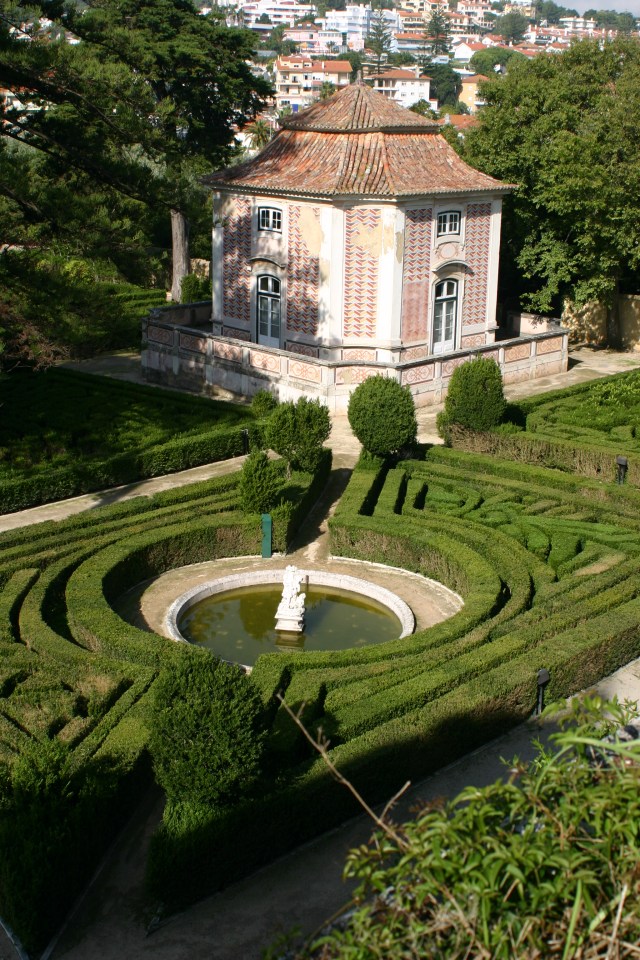
It was our last full day in Portugal and having visited two grand Baroque gardens in Caxias and Oleiras we stopped off in stylish Cascais for lunch. It was also a chance to take a look at a very different garden, one very much more domestic in size and with a more informal air.
Casa da Pergola (‘The Pergola House’) is a mediterranean – style mansion or Manor House, near the centre of Cascais. I viewed the charming and well kept front garden from outside the locked entrance gates, not having the time (or courage) to ask if I might be let in to look around. Still, I could see enough to be impressed.
The hotel website shows pictures of elegant white marble floors and staircases, beautifully decorated bedrooms with “bas relief” stucco ceilings. The house has been owned by the same family for over a century and its beautiful facade, adorned with hand painted tiles, has been the delight of both amateur and professional photographers. Here’s my take on it!
Further Information: Pergola House website
Old School Gardener
Thanks for reading this, my 1000th post on Old School Garden. I’ll do a fuller review of my blogging experience on my first anniversary on 17th December. But for now I hope that you enjoy my review of an interesting garden in Portugal.
A little off the beaten track in one of Lisbon’s northern suburbs (Lumiar), sit the Gardens of Monteiro Mor (this translates as ‘the High Huntsman of the Royal House’ refering to one of the former grand residents).They come with not one, but two bonuses – small, but fascinating museums, one focusing on Portuguese Theatre and the other Costume.
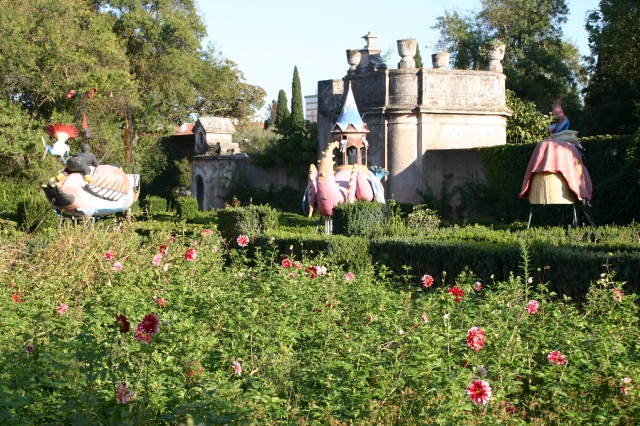
The surrounding gardens are a very engaging mix of formal, botanical display and wilder woodland walks – all very pleasant on a warm autumn day. And there are a number of curious sculptures to see en route too, along meandering paths and steps which take you to a variety of water features and through glades of mixed, mature trees and shrubs.
Interestingly, a communal food growing area seems to have been created on the edge of the parkland, and we also were lucky enough to see a wide range of flowers on display when we visited.
The museums, housed in two former grand houses a few paces from each other, are very well laid out. The Theatre Museum comes stocked with a huge array of printed and pictorial material along with theatre models, sculpture and theatrical props (including some lovely puppets and larger costume displays).
No need for much in the way of interpretation here as the visual richness speaks for itself!
The Costume Museum is an altogether more restrained affair, with displays of clothes and accessories from different periods set off wonderfully in the elegantly decorated rooms of the former palace. Varied lighting levels and effects and a nicely uncluttered feel all contributed to a beautiful wander though time.
This became especially interesting when we reached the 1960’s and more recent displays, which brought back some long-lost memories!

Our recent visit to Portugal included a longer trip 1 hour north from Lisbon to a fascinating park (it is too big to be called a garden)- in fact it is billed as the biggest oriental park in Europe, stretching to around 35 hectares.


Our October visit to Portugal concluded with a day packed with garden visits to the west of Lisbon and in the regal suburb of Sintra to the north- home to many a splendid palace and garden.