

Tag Archive: portugal
 As you may have picked up, I’ve been in Portugal again recently. As well as visiting some old favourites, we ventured north to the old capital of the country, Coimbra (more on this in later posts), and on our way back to Lisbon stopped off at a wonderful historical site called Conimbriga. This site, a few miles south of Coimbra, was the Romans’ capital while they were here in Portugal, some two millenia ago.

OK, I know that this blog is supposed to be about gardens and gardening. But I occasionally feature something that is only loosely connected (if at all), just to add a bit of variety. And in truth, there is a link to gardening here, as you’ll see later.
This extensive site displays the bones of an important Roman settlement and includes some sensitive reconstruction to help you get the scale and proportions of the place- the recreation of the Forum is particularly impressive.

The space of the ancient Forum recreated on site..


A model of how the Forum might have really looked


And the other immediately remarkable thing is the wealth of mosaic floors on show, some open to the air, others carefully protected under a large sheltering canopy.


But the really noteworthy feature- well I think so- is the re-creation of the Fountain Gardens, including (for 50 cents a go) the chance to see the way the fountains might have embellished this calm, sheltered space set amid the bustle of the wider settlement.

The Fountain Garden…


Complete with Fountains…

A plan and description of the garden and the huge villa it was housed within

A modern day take on water gardens
After touring the open site, it was something of a relief (from the sun) to get inside the nearby Museum, which helps add further interpretation to the site and houses a range of beautiful artefacts discovered here.


Old School Gardener

Fountain in front of the Monastery Geronimos, Belem, Lisbon, Portugal. A place I’ve been several times, but can’t remember the fountain ever being in operation!
 On my latest trip to Portugal, I was thinking there must be another classic garden to visit in the mountain hideaway of Sintra. But having checked, it seems I’ve been to all of them, and if you’re interested you can see them in my series ‘Portuguese Gardens’.
But there remained a lingering doubt (or was it hope?), that there must be an historic garden somewhere close. Looking at the Lisbon map, and planning our days out, it stood out in that large green lung that is the Monsanto Park: the Palace of the Marquesas Fronteira.


This classic house, originally built in 1670 as a hunting lodge in what was then the rolling, wooded hills of northern Lisbon, is still lived in by the current Marquis and his family, so the house is only partly open to visitors (via a very informative 45 minute guided tour). Today, the views are of the sprawling Lisbon suburb of Benfica, including the red-arched Estadio da Luz, home to that famous football team of the district. About 100 years after its inception, after the infamous Lisbon earthquake had destroyed his main home, the then Marquis decided to extend his hunting lodge and make this palace home.
After being asked if we’re mind waiting for a later house tour (to enable the rest of the party to benefit from the French version), I had a little wander into this compact, but interest-filled garden. And I went round again after hearing about and seeing some sumptuous interiors.


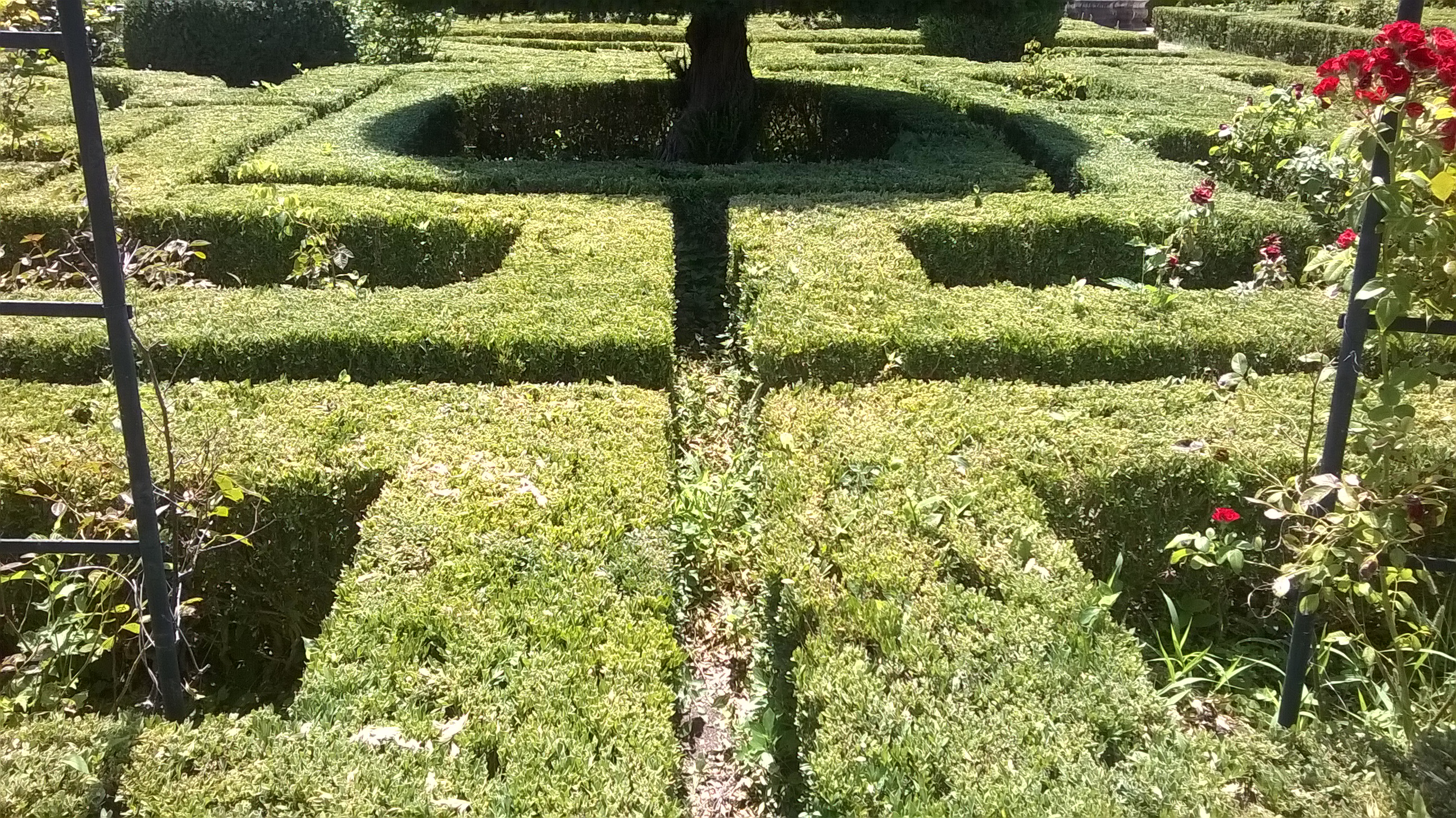
The centre-piece, especially as viewed from the upstairs rooms of the house as well as the high terrace overlooking the formal pool, is a rather intricate box parterre, where the shapes are closely edged, leaving what seems to be an impossibly narrow gap between the bushes: still the gardener seems to manage somehow.
This impressive feature was only partly filled with a selection of roses, and though traditional, I find the combination of close-clipped box and rather more unruly roses not as satisfying as when the enclosed beds contain slightly shorter plants that themselves have a rather more symmetrical form, e.g. lavender or perhaps catmint.


The elevated terrace with its display of sculptures of Portuguese kings surrounded by metallic-glazed tiles, is also very satisfying to walk along and gaze from, including downwards to a well-stocked carp and goldfish pool, with a lone, and rather aggressive black swan! I could picture this pool being the centre of 18th century fun and games, with rowing boats taking important guests from one little grotto to another, deftly avoiding the fountains of water (which today at least, were not in operation).
Nearby is a rather more naturalistic garden with tall trees and what must be at other times beautiful borders of hydrangea and agapanthus (I took the opportunity of gathering some seed heads of the latter). The walls of this area and indeed the rest of the garden, are beautifully tiled with traditional, if rather simply designed tiles, or azulejos, plus a vivid blue paint, the latter beautifully setting off fresh green foliage.
There is also a rather lovely terrace with immediate access to and from the first floor of the palace, with another impressive array of classically-inspired sculpture, leading to another large grotto, this one covered inside with the broken pieces of crockery and other shattered ceramics, apparently some coming from the plates used at the Palace’s inauguration, and smashed to commemorate the event!
Similar in style to other Portuguese palaces and gardens of the time, Fronteira is nonetheless well worth a trip, especially for the way our guide brought it to life.
Further information:
Fronteira Palace website
Gardens and Landscapes of Portugal
Old School Gardener

I’m in Portugal at present, so you can expect some unusual posts in the next week or so. Yesterday we stumbled across an Alladin’s cave in nearby Cacilhas.
A wonderful gent called Eduardo Dinis Henriques invited us into his home to view his collection of art created using coins: mostly redundant from around the Euro zone, but featuring some currently circulating British coins.


He’s been creating these for many years and his house has been overtaken by these pictures, which are a mix of natural subjects and historical scenes or references from Portugal’s past.
He proudly told us about the collection, one of which holds the Guinness Record for the largest picture created from coins: he used over 37,000!


Further information: www.artcoins.wordPress.com
Old School Gardener
 This last ‘garden’ from our recent trip to Portugal, is a bit of a cheat. The main attraction is the gothic splendour of the monastery and associated cathedral, but there are some wonderful outdoor spaces too, so I think its worth sharing.
The monastery was founded by the first Portuguese King, Afonso Henriques, in 1153, and has maintained a close association with the Kings and Queens of Portugal throughout its history, housing several royal tombs and the national pantheon.


The church and monastery were the first gothic buildings in Portugal, and, due to its artistic and historical importance, was listed by UNESCO as a World Heritage Site in 1989. The Cathedral is the largest church building in Portugal and has a relatively simple undecorated interior- I was fully expecting golden baroque splendour on entering, but was pleasantly surprised.


The Cathedral is perhaps most famous for housing the tombs of King Pedro I and his mistress, Ines de Castro, assassinated, in 1355, under the orders of Peter’s father, King Afonso IV. After becoming King, Pedro ordered the remains of his beloved to be transferred to her tomb in Alcobaça and, according to a popular legend, had her crowned as Queen of Portugal and ordered court members to pay her homage by kissing her decomposing hand.
This pair of Royal tombs, of unknown authorship, are among the best works of gothic sculpture in Portugal. The tombs are supported by lions, in the case of the King, and half-men half-beasts, in the case of Ines, and both carry the recumbent figures of the deceased assisted by a group of angels. The sides of Pedro’s tomb are magnificently decorated with reliefs showing scenes from Saint Batholomew’s life, as well as scenes from Pedro and Ines’ life. Her tomb is decorated with scenes from the life of Christ.


The monastery complex provides an interesting, and, as expected, relatively simple series of rooms and spaces where the monks went about their everyday business.
Outside, the cloister is a most inspiring space, simply furnished (and with some sympathetic conservation) with a few trees and close-cut box bushes- I was fortunate to capture it in the afternoon sun. The monastic gardens- not open to the public- are a fine example of box-edged parterres enclosing a series of beds that once were used for growing food and herbs. This important site lies about an hour’s drive north of Lisbon and is an area I hope to visit again as there are other landscapes and historical sites nearby, that we didn’t have time to visit.


Source and further information: Wikipedia
Old School Gardener

Lisbon, Portugal
Old School Gardener

We’ve been to Lisbon, Portugal quite a few times, but only on our most recent trip did we discover a beautful little restaurant/club/social centre/cultural hub close to the restaurant quarter- Casa do Alentejo.
While the outside of the former Palacio Alverca is unspectacular, its true beauty lies inside: moorish design including beautiful tiles and a huge patio. It was created 85 years ago, as a meeting place for people from Portugal’s historical province Alentejo (além Tejo means beyond the Tagus) and to cultivate its unique culture. At that time many people from this region left home in search for a better life in Lisbon.
The palace dates from the last quarter of the 17th C., but its current appearance is a result of considerable alterations carried out in 1918. Nowadays it’s the headquarters of the association of the Alentejo people. Many activities take place here: on Saturdays there are ‘Alentejo afternoons’ (tardes Alentejanas), with choral groups. On Sundays, dancing begins at 3;30 pm. Mostly elderly people come here to socialize. There’s also a library and a handicraft shop of typical products of the Alentejo region.
The dining rooms are picturesque, with open fireplaces and decorated with beautiful tiles (azulejos). The azulejo is a form of Portuguese painted, tin-glazed, ceramic tilework (Azulejo comes from the Arabic word az-zulayj, meaning polished stone).


Old School Gardener




 Old School Garden