
Tag Archive: plants
 Recently, I was attending a meeting at a museum in Luton and in the lunch break had the chance to see the travelling exhibition of photographs from the International Garden Photographer of the Year competition (the eighth in the series to date). I was enthralled by the many wonderful images on show. Unfortunately the lighting in the room made taking photographs of these difficult without them being affected by reflections. However, I’ve put together a gallery of a few that seem less affected by this- I hope that you enjoy them.
I’ve surprised myself. I think I’ve managed to track down the six remaining plant pictures my friend Jen sent me from Vietnam. So here’s the next three wonderful pictures in this ‘select flora’…
First the evergreen shrub, Ixora coccinea or the ‘Jungle Geranium’ or ‘Flame of the Woods’.

Ixora coccinea
Second, the national flower of Laos, the Champon flower, or Plumeria rubra. This fragrant relative of Oleander is also known as ‘Frangipani’.

Plumeria rubra
Finally, a rather spiky Euphorbia originally from Madagascar, named after a former Governor of the Island of Reunion (Baron Milius) who introduced it to France in 1821, Euphorbia milii, or the ‘Crown of Thorns’.
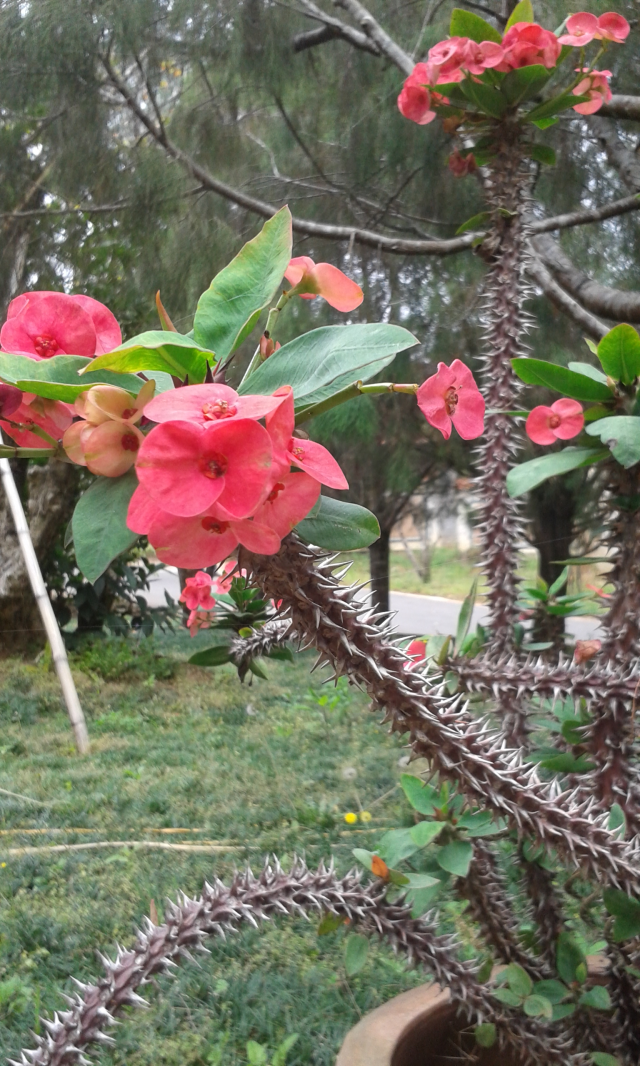
Euphorbia milii
My final three plants in a few days time…
Old School Gardener
Euphorbia milii

Some of this year’s squash harvest- should keep us going for a few weeks.
Old School Garden – 29th November 2015
Dear Walter,
As we move towards winter, this month has been one of small steps forward, old friend. We had our first frost last week, and I managed to get the tenderest plants under cover in the greenhouse.

Tucked away from the frost…
I’ve noticed that the leaves on the Cannas have started to brown so it won’t be long until they and the Dahlias are also brought in. I won’t be cutting down or removing much else as I like to see the grasses and many herbaceous stems stand over winter- I think this is also good for wildlife.

Cannas on the turn- soon to be dug up and replanted in the greenhouse
The piles of leaves continue to grow, and though many have fallen, there’s still a lot of oak to float down and then be gathered up. I’ve already cut back and placed most of the Pelargoniums into trays for over wintering and once the remaining pots on the terrace are empty, I’ll plant out the four or five packs of tulips I have in the shed.

Tulips ready to go in some of the other terrace containers and borders
In the kitchen garden I’ve pulled the remaining carrots- they are a well-sized and tasty crop. The parsnips and a few leeks are all that remains for winter vegetables, with the promise of Purple Sprouting Broccoli to come in spring. As I reported last month, I’ve used my latest batch of compost to mulch the fruit bushes, strawberries and raspberries and added some manure over the rhubarb and asparagus bed, which hopefully might give us a few spears next year.
I dug up one of the remaining two blackcurrant bushes the other day and took this in to the local Primary School, where I was helped by 7 pupils to divide it and plant it out in their developing fruit garden. It was fun to be back among some familiar (if older) faces and they were very responsive and involved in the hour we spent talking about roots, stems, water and so on.
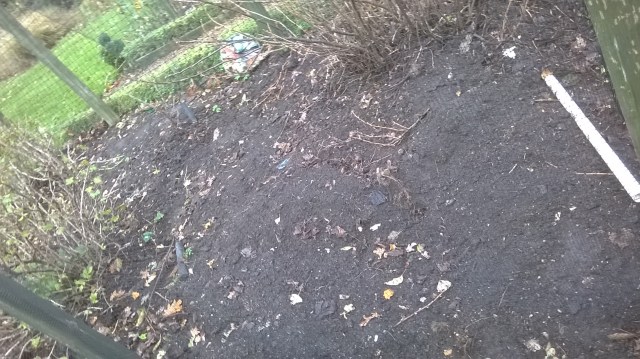
Awaiitng a Redcurrant, to go alongside White and Black!
So, here we’re left with one large blackcurrant bush (after having three for several years – the freezer is still bulging with the last few year’s crops). I’m now waiting on the arrival of some bare root red currant and raspberry canes at the local nursery, so that I can fill out the summer fruiting raspberries and replace the blackcurrant, which will give us one each of Red, White and Black currants.
Looking ahead, my friend Steve volunteered to order me some seed potatoes, so I’ve gone for some first and second earlies which should be here for ‘chitting’ in January. I also recently ordered some seeds from the RHS scheme for members, which is good value for money. With the seeds I purchased on my visit to Wallington Gardens in September (as well as some harvesting at other gardens we’ve visited), I can see that February will be a busy time (as usual), propagating a new range of interesting flowers for the borders; including one ‘long wanted’ variety, Cephalaria gigantea.

Some heavy flagstones awaiting re-use in the Pond Garden

The Pond Garden design starts to evolve…
My Pond garden project is moving ahead slowly, with the reclamation of some large York stone flags from one of our outside sheds (we’ve had a new concrete floor put in here to replace the stones) and the use of the stony soil from under these to build up the surrounds of the pond area. Before going much further outside on this I want to firm up my design on paper, so the drawing board is out again and I’m sketching out some ideas, including a stepping stone bridge (this is what some of the flagstones will be used for), boggy borders and a ‘beach’. My collection of plants for this area is growing nicely so I’m factoring these into the design too.

Nerine bowdenii

Onions sets starting to go..

Crab apple well laden

Cornus beginning to reveal its colurful stems with Mahonia in flower

Oops! These Red Delicious apples fell before they could be harvested…I’ve not been diligent enough this year!

Table planter starting to fill out with garlic, shallots and Broad Beans
On a broader front, I went over to Gressenhall the other day and began to clear up for winter (including some overdue shearing of the lavender and leaf clearing) and planted out some Catmint I took out of the courtyard planters at Old School Garden. Together with the new plants I purchased recently these will make a good show in a number of half barrel planters we have there.
You’ll have also seen something of my regular visits to Blickling Hall, where the winter clear up and preparation for next season is well underway. Did I tell you that I’m hoping to run a new Garden Design course at Blickling? Based on the one I’ve run in the past at Reepham, it will be slightly extended but will still focus on helping participants to design their own garden or area. I hope for a good level of interest, especially as we shall be able to use the gardens at Blickling as a showcase for many of the ideas and concepts I’ll be covering. If I get the numbers I need this will begin in early February.
Having just replaced the broken glass in our wood burner I think its time to light it and get something to drink!
Very best wishes,
Old School Gardener
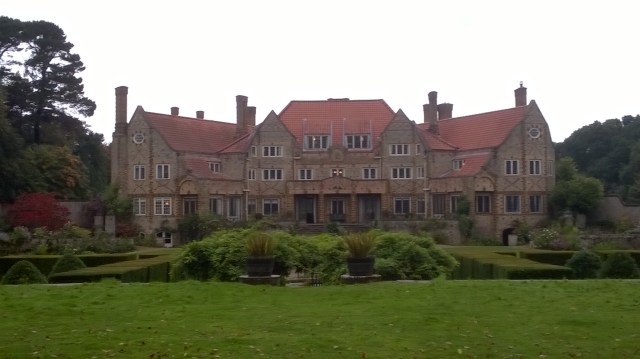 I finally got round to visiting a place I’d wanted to see for some time- Voewood, an arts and crafts masterpiece in north Norfolk.

Taking advantage of the ‘Invitation to View’ scheme we set off on a rather wet and windy day a week or two ago to High Kelling, near Holt.
Our tour of this private house was full of surprises and curiosities. Owned by a rare books and art dealer Simon Finch (who now lives in one of the coach houses) it has been decorated over the years in a very individual style with plenty of personal mementoes and artworks, many hailing from the 1960’s and 70’s. The house with its fourteen bedrooms can be hired out and it also acts as a centre piece for an arts festival.
The house was designed (1903-5) by Edward S. Prior. Voewood is perhaps one of the greatest achievements of house design of the Arts and Crafts movement. More than almost any other building of the period the house fulfils the ideals for architecture developed by William Ruskin and William Morris. In the designing and building of Voewood many of Prior’s philosophical ideas found physical expression.
Its design and construction were characterised by the use of radical planning and forms, innovative technologies, such as the use of reinforced concrete, extensive external decoration, a distinct building philosophy involving craftsmanship and the use of quality local materials and the integration of the building and its interiors with the garden and its surroundings.


The house is based on a butterfly plan. The three storey central portion of the house is flanked by splayed two-storey wings. The plan enabled Prior to maximise views out and to give the best orientation to a range of rooms. He could also relate the external spaces to the internal areas. The area contained within the splay faced the gardens, with the northern of the wings acting as the entrance, with a two storey porch and daylight basement. This wing also contained the library and billiard room at ground floor level. The wing opposite contained the kitchen and service accommodation together with the dining room. The fruit and vegetable garden lay adjacent. The entrance, through oak doors, leads into a six-sided hall up a straight flight of Hoptonwood stone stairs into an octagonal lobby.
Though never lived in by its original owners (there seem to be various theories as to why, including its proximity to a then T.B. hospital), the house was turned into an old people’s home and has also been a hotel. And despite some alterations (e.g. the closing in of two flanking loggias), it has retained most of its original features. I was especially impressed by the construction which used concrete formwork on a (then) extensive scale, resulting in nicely rounded corners to walls and window openings and some chunky concrete beams which provide an interesting, simple decorative feature to many ceilings. However, I was a little disappointed with the window and other ironmongery which, in contrast to many other houses of this style and period (see, for example my recent post on Goddards, York), was rather plain. Perhaps this is further evidence of the alterations carried out in the 1930’s.
Though visiting on a damp October afternoon when there was not much floral interest to be seen, the gardens still managed to impress. The main layout from the back of the house appears to follow its original stepped, symmetrical design, whereas the former kitchen garden to the side has been skillfully turned over to a rather more ornamental layout, though retaining many good examples of wall-trained fruit.
The original gardens were of great renown and highly regarded. Voewood was perhaps Prior’s greatest garden design. Garden making was a preoccupation of his middle period. Terraces extend from the wings of the house and end in steps leading down to the garden level. The garden is also reached from the terrace by a double flight of steps leading to two stone paths, separated by a water feature in the form of a stepped stone tank containing water-lilies, iris and forget-me-not. The central feature of the garden is a large basin. Pergolas with masonry walls lead east and west.


The garden at Voewood (then called Home Place) was admired by Gertrude Jekyll and Sir Lawrence Weaver, who described and illustrated it in their book Gardens for Small Country Houses;
“The stepped scheme at Home Place, Holt, designed by Professor E.S. Prior will be a counsel of perfection to most people”.
Further information: Voewood website
Old School Gardener
 Old School Garden – 30th October 2015

Dear Walter,
Well, this month I can say that I’ve just about caught up with the routine jobs that Old School Garden needs at this time of year, though my bigger projects of pond and shed still await some serious attention.
I’ve spread a large pile of leaf mould in the new woodland garden I’m creating and mixed this with the topsoil and ashes from the old bonfire site I’d deposited there a few months ago. The soil is at least starting to deepen and hold some moisture. Into this mix I’ve planted a lot of ground cover and slightly larger perennials from around the garden as well as many spring bulbs – in waves that should hopefully make a bit of an impact next March and April.

The new woodland garden…promise of things to come.

Rhubarb mulched with manure…

Strawberries, and other fruit, with compost
I’ve also dug over the main kitchen garden beds and added some leaf mould and compost; the latter around the various fruit bushes. It all looks nice and tidy and should help to enrich the soil as well as cover it over the winter. I also finally got around to cleaning up the greenhouse and am about to add its winter insulation before putting in the various tender plants that I try to over winter.

Greenhouse cleaned, ready to insulate and fill..

..with things like these Echeveria.
I also plan to buy some bare root summer fruiting raspberries and a redcurrant bush- I’ve decided to reduce further our stock of blackcurrant bushes to one and donate the other to the local Primary School; how we ever dealt with three bushes I don’t know! (the first one went to Gressenhall Museum last year).
The table planter I created this year has also been stocked with a mix of garlic, shallots and broad beans that should get going and give me a chance of early crops next year. And a mix of white and red onions have also been planted out for the same reason.

Leaves, leaves everywhere
Elsewhere in the garden its been leaf collecting time, and having cleared last year’s leaf mould pile, I’m slightly reorganising the storage areas to accommodate a new supply of firewood (yet to be cut and collected) from our near neighbours. In doing this I’ve opened up a new vista towards the church..maybe a spot for another bench methinks?
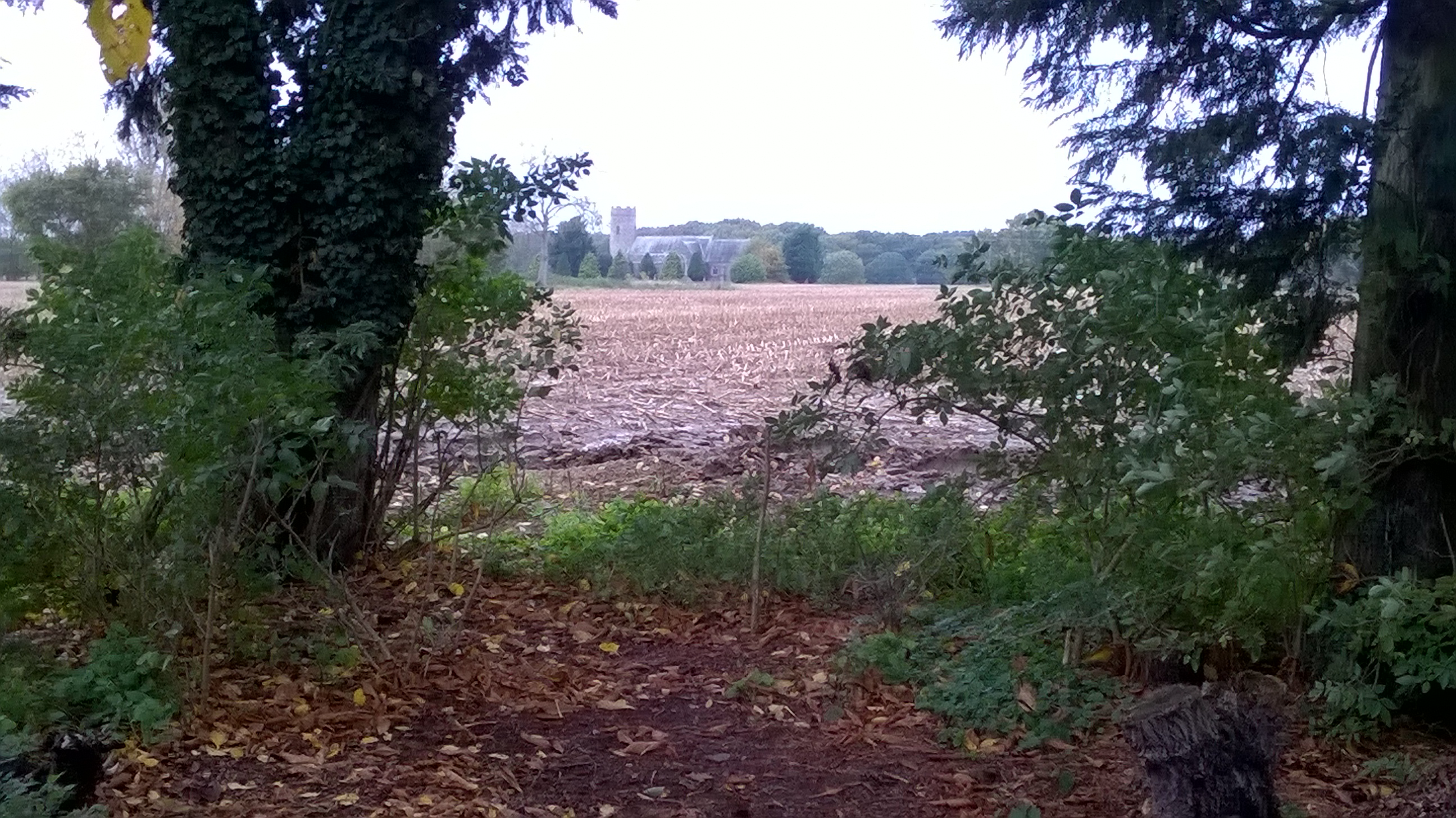
New view…one to take advantage of with a new seat?
I had hoped to have shown you some pictures of the beautiful leaves on the Sumachs, but once again a little breeze and they soon disappear! It’s also been a time of hedge cutting and I’m pleased that this big job- with the added task of reshaping the big Laurel hedge in the main garden- has now been completed, as has fence painting. I spent one morning spreading 7.5 tonnes of shingle we had delivered which certainly improves the look of the drive, though in places it’s rather like Sheringham beach!

Autumn colour…Sedums, Cornus…

Malus ‘Red Sentinel’

Cooking apples…

Chinese lanterns
I recently made start on some plant moving, specifically a large white rose bush that was being crowded out by a vibrant Choisya and Viburnum. This helps to plug a gap in one of the mixed borders. I’ve also been mentally logging which other plants need to be shifted, including a Myrtle (which I’ll leave until early spring) and some other shrubs I’ve earmarked for the new pond garden. The plants I now have for this area – including some purchases earlier in the year – are now making a nice little collection and I can’t wait to finalise my design and get on with the pond and its surrounds.

Some of the plants I’ve been collecting for the new pond garden
I also have a big bag of tulips of various kinds as well as some Alliums I want to get into some of the containers we have and some in the borders. A job for next month.
As you’ll read in my other posts I’ve been putting in some sessions at Blickling Hall and also went over to Gressenhall museum last week to plant up some tubs with some drought tolerant perennials; two varieties of Cistus and a compact Buddleja, to be precise, with a few small ivies to add ‘edge interest’.
I gave a talk to a local gardening group the other night on the basics of garden design. This went well and I took the opportunity to plug my new garden design course (‘Your Garden- your Design’) I’m hoping to run at Blickling Hall from February next year.

The switchover has begun…the tender plants formerly in these pots are on their way to the greenhouse..to be replaced by Carex elata aureum (‘Bowles Golden Grass’) and tulips to come..
I do hope you and Lise are in good health as the days shorten and the temperatures drop. No doubt you’re enjoying watching someone else do the autumn tasks now that you’re getting some extra gardening help!
All the best old friend,
Old School Gardener

Old School Garden – 29th September 2015
To Walter Degrasse
Dear Walter,
I’ve looked back at what I wrote to you at this time last year and it began ‘I’m feeling very guilty’. Once more I find myself confessing to not much happening in the garden, well until the last few days at any rate.
As you know we went on a two week trip to the Hebrides (Mull and Arran) and Northumberland in late August-early September and this, coupled with an earlier spell away in Portugal has meant that the garden has been sorely neglected; but for the harvesting and watering efforts of our daughter, Lindsey and friends Steve and Joan, that is.
My other excuse, and you’ll be bored at me banging on about this, has been decorating, decorating, decorating…and still one more room to go plus some finishing details.
Enough of the excuses, what have I been up to in the garden? Well of late hedge cutting, including an overdue trim of the neighbours’ side of a mixed hedge that forms one of our boundaries. And today I am going to do drastic work on that laurel hedge that backs the main lawn (or should I say ‘Mole patch’). You might recall my plans to create a wildlife pond on the northern side of this and how my plans for the hedge are to:
-
let more sunlight into the pond area
-
reduce the height of the hedge to make it easier to maintain
-
create a sweeping curved profile to add visual interest.

Hedge cutting time…

The laurel hedge, side- trimmed below head height in preparation for a more major cut.
Well, I’ve made a start with hedgecutter and loppers and today I will try to tackle the thicker stems using the wonderful battery-powered chainsaw I was given to trial by it’s makers Ego. And I mustn’t forget to mention Deborah’s efforts in weeding paths and beds, which has certainly made things look a lot tidier.
Despite the neglect nature seems to find a way of surviving and so there’s still plenty of ornamental interest in the garden at present, including a lovely Hydrangea paniculata, Sedums, and of course the various grasses which are now starting to put out their feathery flowers.

Cimicifuga

Stipa gigantea and friends

rose tunnel putting on another flush with Aconitum alongside

Macleya and Aconitum

Amaranthus ‘Fox Tail’

Asters

Rudbeckia

Sedum- the ‘Chelsea chop’ worked well on these

Agastache rugosa- grown from seed thsi eyarand abig favourite with bees… and me

Begonia in hanging basket

Rose

Hydrangea paniculata

Sun flowers in the kitchen garden

Nicotiana, Sedum and Stipa tennuissima combining well
There seems to be a good crop of apples on the way to add to those already picked. It’s also been a good year for figs and we are just about coming to the end of the cucumbers, peppers (which were decimated by an attack of caterpillars) and tomatoes (the shortening days and contrasting night time and daytime temperatures are having their effect on what remain on the plants). I’m also rather pleased with the crop of squashes this year, largely planted to provide ground cover while we were away, and they seem to have done this and rewarded us with a winter’s supply!
Returning to the house renovation side of things, I finally bit the bullet and chopped off the stems of the ivy growing up the front of the house, which had been encouraged to cover up some rather unsightly painting over flintwork (sacrilege). I now plan to remove the dead stems with crow bars etc and then get the builders in to sandblast the front and repoint the stones. Quite an undertaking, but I think it will be worth it in improved appearance alone.

The front of the house with its, now dead, ivy- removing this, sandblasting and repointing the flintwork will be a major undertaking, possibly before winter really sets in
I’ve also been splashing out on some bulbs and spring bedding in the form of violas and pansies, which I’ve started to use in some of the containers that were beginning to look a bit sad. They will hopefully provide a good splash of colour during the dark winter months. Oh, and I came across a plant on a visit to Wallington Hall in Northumberland (more on this visit in due course) which I couldn’t resist; a Crocosmia called ‘Norwich Canary’- as a season ticket holder at Carrow Road it just had to come home with me!
 Pansies and violas will give us some winter colour
 ‘Norwich Canary’- a lone flower hints at what will come in profusion …next year
It’s also that time of year when I put out the bird feeders and I was immediately rewarded with the usual crowd of Blue and Great Tits plus a few other species. It is lovely watching them have their breakfast while we have ours.
 On the wider gardening front I’ve re-engaged with my voluntary input at Gressenhall and Blickling. I’ll be posting about the latter in the next few days, and for the former I’m pleasantly surprised at how well my areas of responsibility have come through the summer and into autumn. I went in last week and felt that not much tidying was required so I turned my hand to mowing the grass and edging this. The front entrance border with its mix of grasses, lavenders and shrubs was looking great.

Oh, and I may well be running my garden design course once more. you might remember that the Reepham Learning Community is no longer functioning so my venue at the High School is no longer available. So I’m making enquiries about running a day time course in the New Year using accommodation at Blickling. This looks promising, and it might be especially helpful to use the gardens here as a way of illustrating elements of the course. I’ve also been invited by a former student to give a talk on the basics of garden design to her gardening group near Fakenham soon, so that will help me to keep my hand in on the teaching front.

Crab apple ‘Red Sentinel’ starting to colour up

Well- red berries on Cotoneaster
Well I think that just about wraps up my recent gardening life. How is your garden looking just now? I bet it’s a picture with the weather helping to bring out those lovely autumn leaf colours in your wonderful collection of trees.
All the best to Ferdy Lise and we hope to see you soon, old friend,
Old School Gardener
 Another day in Portugal, another visit, this time after we’d been to the airport to drop off our daughter. We’d been to the ‘Park of Nations’ (Parque das Nacoes), some years ago, but hadn’t managed to see everything at this site of the 1998 Expo.

For one, we hadn’t ventured into the large park which sits on the River to the north of the many exhibition and conference buildings that dominate the place, so that’s where we began. It was worth it. The park, beautifully landscaped in a series of wave-like mounds which afford a rich variety of settings, is a contemporary design which seems to work- as playground (kids love hills), performance space, running route and chillout zone. The riverside setting is especially impressive, with views towards (and under) the long Vasco da Gama bridge. Even the seats carry through the wave theme and the planting is subtle and mainly naturalistic, giving the feeling that you’re in the country, despite the ‘designed’ nature of the place. It looked pretty well looked after, too, which couldn’t be said of some of the other places later in our visit.
After some tea and cake (how very British), we walked back along the riverside and then took the cable car that takes you along the riverside, harbour and to the aquarium. The views were great and took us over some gardens we would look at later.


After landing we discovered another couple of gardens we’d not seen before, beginning with the exciting water gardens: the long cascade was superb.


Taking in a space dominated by tall palm trees, a lovely rill and curious camel (only a full size replica), we ventured to a terraced garden that seemed promising. How disappointing to see the lack of maintenance on this splendid location especially the water gardens at its very top, which were empty and obviously neglected. The rest of the gardens looked reasonably tidy, but once the whole ensemble must have been brilliant. Maybe this is one example of how austerity has hit the country? Unfortunately, we found further evidence of this, such a shame for what was once a great emblem of the country’s investment in its future.
For our next and final visit was to those gardens we’d seen from above, along the the riverside. I remember these gardens being a series of themed spaces, all I think, with some water features. Again we were initially disappointed to see the wooden bridge entrance closed due to safety risks and other areas, though accessible, were decidedly run down with hard landscaping in need of repair in various spots. The planting, however, seemed to be lush and varied, and passing the area a day or two later I saw piles of timber and other materials stacked, ready for use, so maybe some (overdue) repairs were about to happen.
Despite the disappointment, I tried to understand the public investment challenges facing the country and overall, feel this modern day playground- apparently hugely popular with Lisbon livers- is still a great addition to the city’s green spaces.
Old School Gardener

An extract from a rather lovely painting in the Gulbenkian museum, Lisbon
A further day out in Lisbon on our recent trip to Portugal saw us making the most of ‘free entry’ day (Sunday), to museums and other places of interest.
To the north of the capital there is a cluster of places that are well worth a visit. We emerged from the metro at ‘Parque’ station to tumble into the splendid ‘Edward VII Park’ (named in honour of the former British monarch), with its long sloping parterre giving fabulous views of downtown Lisbon and the River Tagus beyond. This is the place- specifically the balcony by the tumbledown fountain’s where tourists come for a memorable shot of the city. And on our latest trip there were plenty of ‘selfie’ snappers in evidence, along with the long-standing row of market stalls selling all manner of cheap souvenirs. This is also the place that newly-weds come for their wedding shots, and it reminded me of when our daughter and her new husband did just that 5 years ago.


I’d discovered that nearby there were supposed to be some ‘estufas’ (hot houses), so we moved on. Sure enough, we came upon the massive shaded roof (of the cooler house) and then the expanse of glass that presumably housed the heat-loving collection.


What a find! Some parts of the hottest house were closed, but we managed to see some amazing cacti and other succulents. But the cool house, with its range of mature planting, all set within the walls of an old quarry, was truly superb. There was some floral colour, as well as some fun sculptures placed among the plants, but the real joy were the range and combinations of lush foliage beautifully laid out around pools and other water features.
From here were rose further up the slope from the main park to another news place for us- an interesting, more contemporary park laid out in honour of the great Portuguese fado singer, Amalia Rodriguez. Curving grass terraces give way to a round, fountained pool surrounded by bog planting over which a boardwalk allows you to get up close and personal.


From here we fell once more, this time towards an old favourite, the Gulbenkian Foundation with its lovely surrounding gardens.


Stopping off at the Modern Art Centre for a quick lunch (very good value) and look at the exhibits, we then strode through the gardens. These are notable for the unified design which hinges on the movement through a series of small-scale spaces, with contrasting light and shade afforded by the many mature trees and shrubs. The other notable feature is the use of simple rectangles of (mainly) concrete to create a route which both moves you through the gardens (including subtle changes in level) and invites you to pause and sit or just people-watch. A clever design whichI found very pleasing to be within once more. And this time we also discovered the building which contains a cafe and some interpretation of the garden, including a fun interactive ‘design’ game where you can colour in different views of the gardens and then email these to yourself or anyone else, for that matter!


Of course, no visit here would be complete without a tour through the main museum, which houses the Armenian oil-tycoon’s collection of historic and artistic objects from around the world. I was especially pleased to see examples of art works by J.M.W.Turner and the French craftsman Lalique as well as some amazing illuminated books and oriental ceramics. Here are some pictures of some of my favourite things…
All in all, a fantastic no low cost day out!
Old School Gardener
 Coimbra, the second capital of Portugal (succeeded by Lisbon), is a fascinating place. Apart from some lovely river side parks and an historic centre, it has Portugal’s oldest University, which is perched on top of the steep hill at the centre of the old town, from where it dominates both the skyline and overall impression of the town. It also has university students who, as elsewhere in Portugal, wear long black cloaks over black suits and white shirts; very much in the style of Harry Potter and Co. (or should that be the other way around?).

We paid an interesting visit to the University, especially its OTT baroque library and other grand rooms (no photography allowed), which testify to its ancient past. We also had a lovely evening meal overlooking the river and paced our way through the city streets, including falling on an unusual fountain garden which was originally part of an adjacent religious centre and put together by one of Portugal’s’ most famous sculptors…

On the morning of our last day we also paid the Botanical Gardens a visit and these, like others I’ve visited elsewhere in the country, have an impressive range of mature trees, shrubs and other plants.

I found this tree fascinating; not sure of what it is, but it has developed a useful technique of growing its own buttresses as it extends its branches…
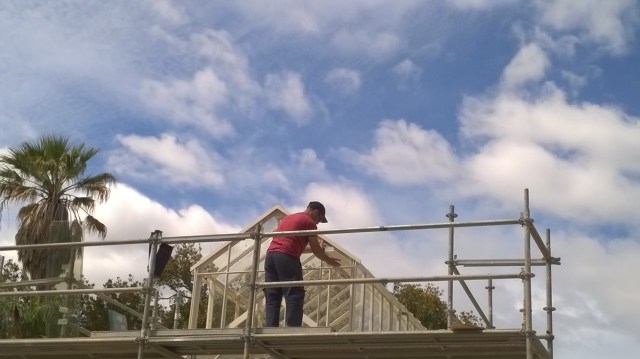
It was encouraging to see the major glasshouse in the course of regeneration and the novel introduction of an adventure trail with close supervision as you (not me!) slide your way around and between the many very tall trees.
Old School Gardener

Saw this collection of tomatoes growing along side the street in Trafaria, Portugal. Pick your own…






 Old School Garden