Tag Archive: old school garden


Grasses and autumn leaves are looking good in Old School Garden

Grasses and autumn leaves are looking good in Old School Garden

28th October 2013

To Walter Degrasse

Dear Walter,

I hope you and Lise are well. I guess you’ve been experiencing the warm autumn like us over the last few weeks? This has done wonders for prolonging the flowers and colour in Old School Garden and the combination of these with the golden glow of grasses in the mixed borders looks super- especially in that low October sun.

But it’s also meant that I’ve been hanging on and waiting for things to finish their show so that the ‘autumn clear up’ can truly begin (though I do like to leave some plants whose stems, seed heads or shape survive to provide eye catching winter interest). I’ve just started to get tender things inside for over wintering as well as replacing summer annual displays with something to give us winter and spring colour. The main annuals beds and containers have been cleared and planted up with a combination of spring bulbs, along with Pansies, Violas and Bellis. I’ve also cleared out the greenhouse of the remaining cucumbers and (mostly green) tomatoes, the latter are now resting in a fruit bowl along with a banana to encourage ripening! The harvest has continued with lots of delicious apples, some very good black grapes and runner beans, chard and the last of the courgettes. It’s also been a busy sowing and planting time- crops of Broad Beans, yellow and red Onions, Garlic as well as green manures have all been put in, and I’m having another go at growing Asparagus.

Scabious still looking good in the courtyard garden

Scabious still flowering in the courtyard garden

As you read this we’ll be away visiting our daughter Madeleine and our son-in-law, Diego, in Portugal. So, many other things – bringing in the dahlias, pruning the climbing roses, keeping on top of the leaves, selective cutting back of perennials and dividing and moving some – will all have to await our return. A little late perhaps, but hopefully the mild weather will continue for a couple of weeks!

I’m still helping at the local School with their ‘outdoor learning’ (specifically in the School Garden). I think virtually every child (apart from the very young), has learned about tools and tool safety and harvesting (the School cook had a lovely supply of Red Cabbage, Courgettes, Runner Beans and Carrots to weave into her daily menu). It’s been inspiring to hear their enthusiasm as they open up a runner bean pod and discover the little pink and purple jewels that can become next year’s seeds and how they love to find worms and other critters in the soil! One mum told me the other day how excited her son had been when he brought home the bean I’d let him take away!

They have also learned about the different types of seed and their dispersal, what we do in the Autumn to prepare the soil, and sow and plant certain things, as well as the importance of composting, including looking after the school wormery. The other day this half term’s efforts culminated in an open day focusing on ‘outdoor learning’. Parents linked with their children and took part in a range of activities around the school site including den building and bug hunting. I was mainly involved in fuelling the fire pit where we did some ‘campfire cooking’ (bread and marshmallows on hazel sticks), and helping with:

  • some gardening (the boys particularly like a bit of digging),

  • weather monitoring (we managed to reach 19 degrees C on a beautiful sunny day)

  • making ‘elf houses’ and furniture (and a few elves too),

  • making recycled paper pots and sowing broad beans in them.

I think this event has helped to raise awareness of the good work being done in the ‘outside classroom’ at the school and may even encourage some parents to volunteer to help out at one of the regular ‘garden gang’ days or in other ways. Here are some pictures I took to give you a flavour of what was a  fun and successful day.


The other major activity I’ve been involved with recently is teaching.

As you know from my last letter, I’ve been running a second Garden Design course at the local High School and this is now in its last couple of weeks. The eight participants, have a wide range of different garden design challenges in front of them. They are an enthusiastic group who it’s been a pleasure working with. They are now firming up their design ideas and creating scale drawings of what they want to achieve, and the final evening will focus on how to go about realising these on the ground.

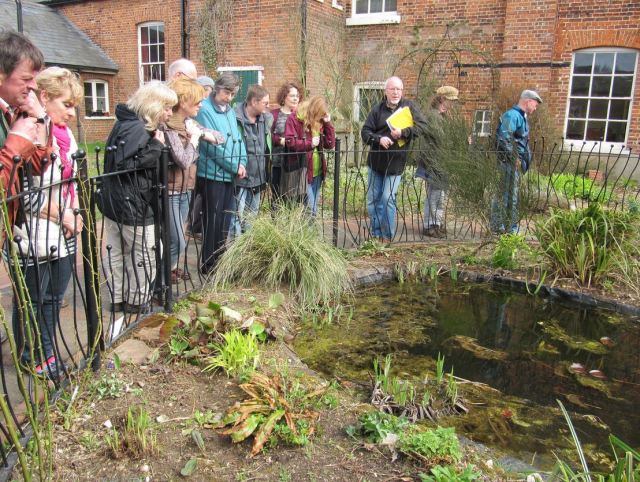
I’m also pleased to say that my first ‘Grow Your Own Food’ course for beginners and novices is running locally, too. Tuesday mornings in a nearby village hall (Foulsham), sees 6 relatively new food growers coming together and both sharing experiences and exploring the ‘keys to success’ in food growing. The second week involved a visit to Old School Garden where I shared (‘warts and all’) my own experiences of food growing, some of the ideas and tips I’ve used and some of the issues confronting me – not least being the need to ‘downsize’ my food production to avoid gluts and surpluses! I shall be introducing a greater level of ornamental planting in the kitchen garden to achieve this, so reducing the productive areas by about a third.

My blog continues to grow both in terms of followers and also in the feedback and ‘conversations’ its enabling around the world. I’ve recently topped 1500 followers on all ‘social media platforms’ and since starting it back in December last year have had over 33,000 views of pages on the site. These are currently averaging about 800-1000 per month at present. Its been especially pleasing to have positive feedback from people who have enjoyed particular articles or items (recycling in the garden seems to be especially popular). Continue reading

IMG_7431To Walter Degrasse

30th September 2013

Dear Walter,

September has been a month of relative quiet in Old School Garden. Summer has tipped into Autumn and the garden hasn’t needed (?wishful thinking) full throttle attention. The odd weed pulled up, flowers dead headed or staked, hedges trimmed, grass mown (less frequently and less closely). A typical September then, apart from the relatively cold spell we had earlier on which sent me to the wood shed and led to lighting of fires – albeit only once or twice. Still I resisted the temptation to switch on the central heating! Since then we seem to have had something of a mini ‘Indian summer’.

I’ve been pleasantly surprised at how some annuals I planted earlier on have at last come good – Cleome, Cosmos, Nicotiana and Tithonia in particular. A slow start, but they seem to have gone for a sprint finish so to speak! They are looking very good alongside some other late summer perennial colours – Asters, Sedums and Aconitum. And I’m pleased to say that last year’s sowings of Phalaris (‘Chinese Lanterns’) have now turned into beefier plants, just starting to show off their wonderful papery orange ‘lanterns’.

I’ve continued to harvest  various fruit and veg – Chard is now reaching maturity, Tomatoes, Lettuces and Cucumbers have done really well, and some late sowings of Carrots and Mangetout are looking promising. You may recall that I sowed three seeds of ‘Greek Squash’ sent to me by the Garden Organic Heritage Seed Library – two of these have gone on to produce four or five good-sized squashes, which are now hardening off in the autumn sunshine. Oh, and remember my caterpillar disaster with the Calabrese and Broccoli plants last month? Well, I’ve cleared the bed, and managed to get hold of some young plants of Chinese Broccoli and Spinach, so along with some of my own Red Cabbage seedlings we now have that area once more in production – hopefully they’ll all put on good growth before the onset of winter.

The first windfall apples have been falling in some strong breezes recently. We’ve been collecting some of these as well as early pickings directly from the trees, and very tasty they are too! I can see that the next couple of weeks will be consumed with apple harvesting, and that of course raises the question of where to store them! Our larder could soon be a lot fuller.

Further afield in my gardening life, I’m pleased to say that the six week Garden Design course I put on last year is once again up and running, with 8 enthusiastic students with a wide range of garden sizes and ideas that I hope to help them develop in the coming weeks. I’ve also planned a one day workshop at nearby Gressenhall Farm and Workhouse where I hope to show people how to get more from their garden through using some of the key elements of garden design. It will also be fun using the gardens at the Museum to illustrate some of these, as i designed some and help to maintain them as a volunteer. As I speak I’m hopeful, too, that the six week beginners course on ‘Growing Your Own’ at nearby Foulsham, will also be viable, but we’ll have to wait and see on that one.

I’ve also started back with my support of gardening and ‘learning outside the classroom’ at the local primary school. I’ve been encouraged by the way the school – and particularly their LOTC Coordinator, is building on the progress we made last year. Over the first half term I’m taking a series of small groups from most classes through some of the basics such as introducing different types of tool and how to use them safely; the importance of clearing and preparing the soil during the autumn; harvesting some of the produce we planted last season (there are some seriously impressive carrots that seem to have thrived on neglect!); gathering different types of seed for next year; how different plants propagate themselves and sowing broad beans, garlic and onions as well as some green manures.  The School is also carrying out an international project on composting and organic gardening to which I’m contributing. So a busy half term! It’s always great working with such enthusiastic youngsters, reawakening my own sense of wonder at nature as they dig over the soil and are delighted to discover worms, grubs and creepy crawlies!

On Saturday I went to Garden Organic’s HQ at Ryton, near Coventry, for their annual conference for Master Gardeners and Composters. Around 30 of my colleagues from Norfolk went along and were joined by over 200 other Master Gardeners and Composters from a number of other areas around the country. It was a very interesting and inspiring day. I attended some workshops on community composting, reaching ‘hard to reach’ communities and ‘love your bugs’- all about the goodies and baddies in the garden. Most inspiring was a talk by veteran naturalist Chris Baines, looking at ‘The Nature of the Future’. I’ll do a fuller article on this event later in the week, but here are a couple of pics from the ‘Naturalistic’ area of the gardens, which looked wonderful – as did the many other different gardens which demonstrate a range of gardening techniques and planting arrangements.

So, old friend, that just about brings you up to date for the last few weeks in my gardening life at Old School Garden and beyond. A mellow and measured time when its been possible to enjoy the late summer colour and reap the fruits (and veg) of my labours earlier in the year! No doubt you’re well ahead of me with your autumn garden jobs, but in case you’re not and need some ideas, I’ll be posting my regular monthly item on tasks in the garden for the new month tomorrow, so I hope that proves useful. Happy Gardening!

Old School Gardener

If you’ve enjoyed reading this post and others on this blog, why not comment and join others by signing up for automatic updates via email (see side bar, above right ) or through an RSS feed (see top of page)?

redcurrantsIt’s the time of year to harvest red currants around here and this week’s question comes from Frew T. Bunn of Oldham:

‘Our red currant bushes always lose their leaf colour in July or August, but the ribs of the leaves always stay green – are they suffering from some sort of disease?’

By the summer months red currant bushes are starting to lose their lustre, but the fact that the leaf ribs of yours remain green suggests a shortage of Magnesium, one of the ‘trace elements’ of importance to plant health. Commercial ‘Epsom Salts’ applied in the spring at around 65 grammes per square metre should improve matters, so try this next year.

My blackcurrants look like they'll give a good crop again this year

My blackcurrants look like they’ll give a good crop again this year

On the subject of currants, my black currants are dripping off the three bushes I have here in Old School Garden, and the family of blackbirds nesting in the courtyard is relieving us of some – literally pecking them through the netting of my too – small fruit cage!

Have you ever thought of growing white currants?

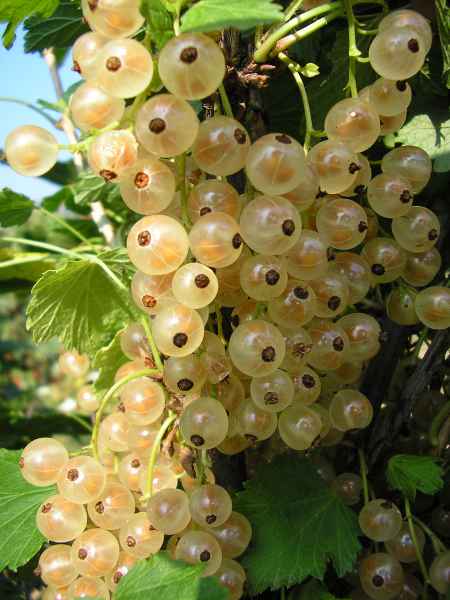
They are apparently not difficult to grow and seem to have returned to favour in recent years. Like red currants (and black currants) they fruit on old wood. ‘White Versailles’ is a popular and reliable early variety, the first white currant to crop. It produces a heavy crop of large, shiny, soft pale yellow/white berries in long heavy trusses during mid-late summer. The fruit is deliciously sweet, not as acidic as red currant, so is great for eating fresh or using for a wide range of culinary purposes. White Versailles has a vigorous, upright bushy growth habit with attractive arching canes and serrated three lobed pale green leaves. It is a very reliable cropper year after year, is self fertile so you only have to grow one bush if you want to – eventual height and spread: 1.5m (5ft).

I’m thinking that I might reorganise my bush fruit cage and substitute one of the three blackcurrant bushes with a white currant, just to get a bit more variety and perhaps less of a storage problem, with the glut of black currants we’ve had in the last couple of years!

'White Versailles' - I thinki I'll try to get hold of one of these to replace one of the blackcurrant bushes

‘White Versailles’

Old School Gardener

If you’ve enjoyed reading this post and others on this blog, why not comment and join others by signing up for automatic updates via email (see side bar, above right ) or through an RSS feed (see top of page)?

IMG_6139It’s over. My first garden opening has left feelings of satisfaction, pride, friendship and aching limbs.

We had about 70 visitors yesterday, not bad for our first opening. Several came by bike and all seem to have had a good time, soaking up the heat, the garden and some delicious tea and cakes. Many made positive noises about the garden and the Courtyard seems to have been a particular hit. It was particularly interesting to meet a former pupil at the School- back in 1937 – and a new neighbour. Friends,colleagues and neighbours helped to make the event a success:

  • Keith Broughton brought along his restored 1969 Saab car – it was fascinating hearing about the hours of skillful work he’d put into this project
  • Michaela Boggis and colleagues from Jelly Cottage Nursery brought along a fantastic range of very healthy looking plants and many visitors were seen clutching their purchases as they left
  • Steve Mosley and John Nicholson from Master Garden and Composter respectively put on a display and gave out helpful advice on growing your own food and making your own soil
  • Sharon Brett from Cawston Primary School was selling plants and mugs to mark the school’s 60th birthday and was telling people about the work on outdoor learning, including gardening that she and I have been doing at the School
  • My wife, Deborah and friend Joan Mosley did sterling work as the ‘refreshment ladies’ serving afternoon teas and cakes.

So a very big THANK YOU to all of them and most of all to mother Nature who put on a wonderful display for all to enjoy (including blackbird nest and mole hill)!

I’m now planning a few days of rather less frenetic activity. But first a trip to the bank to pay in the proceeds of the day and to then write three cheques for around £100 to each of the three ‘good causes’ we were supporting:

  • Norfolk Master Gardeners
  • Cawston School Gardening
  • St. Peter’s Church

Here are a few pictures from the day to give you a sense of the atmosphere – if you were one of the visitors, then thank you for your support and maybe we’ll see you again!

Old School Gardener

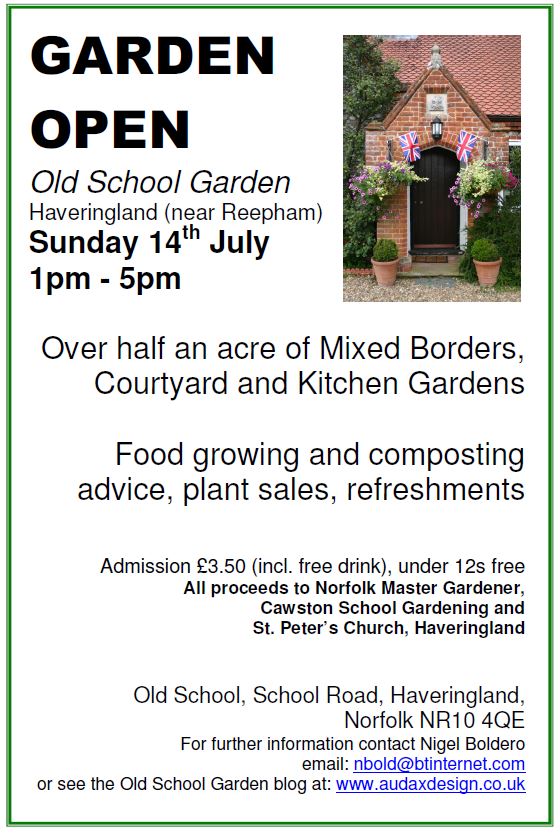
Visit Old School Garden this Sunday!

I’m looking forward to welcoming visitors – including you? – to the first opening of Old School Garden. I’ll do a post about this next week for those that can’t make it.

Old School Gardener

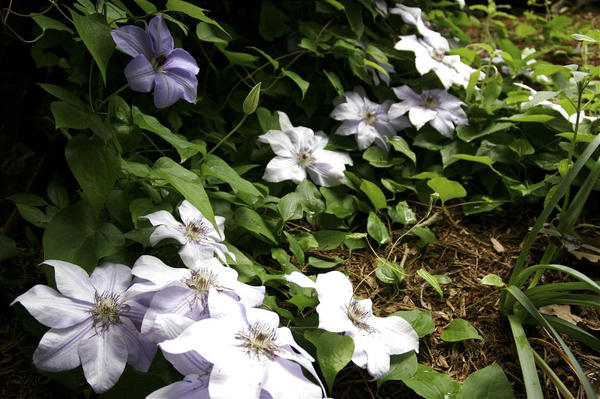
clematis ground coverAn interesting question this week, from a Trevor Arzan of Nether Wallop:

‘Some of the stems on my Clematis have fallen down and are growing along the ground, where they seem to be doing quite well. Can this or any other climber be used as ground cover?’

Clematis make very good ground cover plants as do the yellow-veined honeysuckle (Lonicera japonica ‘Aureo -reticulata’) and the climbing hydrangea (Hydrangea petiolaris). Many roses, especially ramblers, can also be used in this way.

So turn what you might use as climbers into creepers!

And climbers are also useful for covering ugly tree stumps. The less vigourous ivies are ideal for this job. Choose one of the varieties of common ivy (Hedera helix) with prettily marked leaves, such as ‘Glacier’ in grey and white, ‘Buttercup’ with young leaves entirely yellow, or ‘Adam’ with white-margined green leaves. I’ve used this approach ona tallish Cherry Tree stump in Old School Garden and the ivies can even look attractive climbing up living tree trunks. And I’ve also used ivy as ground cover with mixed results- if ground elder is present it’s a devil to get this out without completely destroying the ivy, still Ivy is pretty tough and will re-establish.

It’s also worth trying ‘Dutchman’s Pipe’ (Aristolochia macrophylla), with enormous leaves and yellow and purple pipe-shaped flowers. Schizophragma hydrangeoides, with it hydrangea-like  flowers in creamy white, does very well on old stumps and is self clinging.

ivy cherry tree

Ivy growing up from ground cover to girdle the trunk of a cherry tree in Old School Garden

Old School Gardener

If you’ve enjoyed reading this post and others on this blog, why not comment and join others by signing up for automatic updates via email (see side bar, above right ) or through an RSS feed (see top of page)?


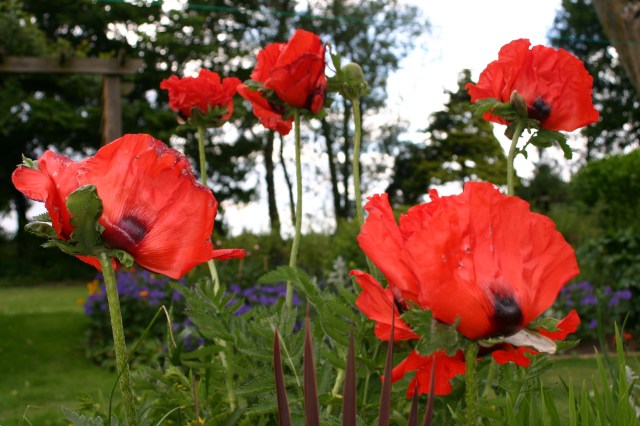
PicPost: Thanks Vermillion

Oriental poppies in Old School Garden today

The Kitchen Garden at Old School Garden

The Kitchen Garden at Old School Garden

To Walter Degrasse

Dear Walter,

As I write to you on midsummer day it’s cloudy and rain threatens. We have had some warm spells and even some sunshine, but you get the feeling that ‘proper summer’ has yet to find its way to Norfolk. I know that you’ve had pretty similar weather in your neck of the woods and no doubt you’re as curious as me as to the way the ‘late’ (read almost non-existent) spring has had an impact on the plants. A few pointers from Old School Garden as I write:

  • the Magnolia is still in flower as are the Siberian Wallflowers, Pansies and Violas
  • Sweet Williams are just about coming into flower but the pink Peonies, though with huge fat flower buds, have yet to fully unfurl (having said that the earlier, red varieties have been and gone)
  • Irises are looking good (though last year’s Iris Rust problem has retuned to some)
  • Carrots and Broad beans probably need a further week or two to be fully ready for harvesting
  • Second early (but not first early) potatoes are flowering
  • Lettuces are ready to crop

So it’s a story of some things flowering late and running into other things which is making for some interesting combinations and a few weeks of intense colour; certainly the best show at this time of year I can remember for some time!

Rather than spend a lot of words telling you about my gardening activities in the last month I thought that I’d let ‘the pictures do the talking’ so I’ve included three photo galleries and will give you a few guiding comments for each. The first one is a few pictures of the Gardens at Gressenhall Farm and Workhouse Museum, where the Education Garden I redesigned and with volunteer support, replanted last year is looking superb. A mass of pink and orange oriental poppies along with Salvia ‘Mainacht’  with the billowing leaves of Macleaya in the background, are putting on a wonderful show, remarked on by many visitors, it appears.

There’s a call for me to provide some information on the plants included in the borders, so I’ll have to dig out my original design and plant lists and put together some sort of illustrated guide. Likewise, after a clean out and weed, the Wildlife Garden, and especially the pond and bog areas, are filling out nicely, though there doesn’t appear to be much wildlife evident to date. Monday is going to be something special here as BBC Radio 4’s ‘Gardeners’ Question Time’ is being recorded at the Museum and I’ll be on hand to help guide the audience and provide some information on the gardens. I’m not sure when this is broadcast but I’ll let you know when I’m sure, though I know that you’re a regular listener like me.

My voluntary work at the local Primary school continues with a regular weekly slot working with groups of children of different ages in the School Garden. You may have seen my recent post on the vertical planters we’ve made out of old wooden pallets – these are looking very colourful alongside the playground and I’m pleased to say that the children are being diligent in their watering duties. I’m going over there later today so will have a quick look to see that they’re holding up – I’m not sure the compost will hold in place especially if it gets at all dry. At yesterday’s session we weeded around the various veg beds and cracked open the first pods of Broad Beans which the children eagerly popped into their mouths – once I’d assured them that they would be deliciously sweet and tender – there came  a predictable ‘hmmm, yummy’ in response!

The other crops are all coming along well, and the attention to regular weeding and watering has really paid off this year, so we should be cropping potatoes, onions, cabbages, calabrese, peas, runner and broad beans, turnips and carrots soon! The other big  job was to empty out the wooden compost bins which have been clogged up with grass, sticks and soil over the years and are in real need of starting over once more. Hopefully, we’ll get this finished off today and we can then get more of a systematic approach to adding food peelings etc. from the kitchen as well as ‘green waste’ from the school lunches. The wormery seems to be going well, and the School Cook is pleased that the refuse collectors are now collecting food waste for composting at a local centre, too.

My other Master Gardener activity is picking up a bit. I’m doing stints at the Norfolk Show next week and also an event in a nearby village where some Lottery cash looks like it’s going to make some new adult education classes possible, including something from me on growing your own food or maybe design, depending on the level of interest. I’m going along to an open day on this to gauge interest and promote both Master Gardener and the idea of the courses, so we’ll see if anything comes of that.

As far as Old School Garden goes, I’ve mentioned the great show we’ve had recently so will let the photographs give you the details! Its been a month of systematic weeding around the different borders, finishing off staking the herbaceous perennials, dead heading and recently planting out the many annuals I’ve een raising from seed to plug gaps etc. I must say I’m pleased with the result, and after visiting a few gardens recently we’ve decided to open ours for charity in mid July. I’ll let you have details in due course, but we hope to make this a lively afternoon with advice from  my friends in the Master Gardener and Master Composter projects and of course plant sales and some delicious tea and cakes!

I hope that you enjoy the picture gallery which shows a few shots of different parts of the garden taken yesterday. As I was walking around I spotted a female blackbird raiding my cold frame and carrying off some poppy seedlings (and compost) in her beak! Having seen her later in the courtyard garden I suspect she’s gathering material for a new nest! We do seem to have had a lot of Blackbirds this year and they seem intent on disturbing the wood chip mulch I put on the long borders in search of food, with the result that sweeping the paths is rapidly becoming a daily chore!

Well,  matey, I hope this little update finds you and your good lady in the best of health. It’s great that you’re now well on the road to recovery and no doubt pleased that you can get outside and dig your patch once more. Did you manage to find any paid garden help? I know that the grass cutting is your biggest nightmare and this is one thing you could do with some help on. Or maybe you might think about turning some of that grass into flowering meadow? I’ve seen some lovely examples of mown paths through long grass recently that must be less maintenance heavy and more wildlife friendly too – worth a thought.

Well, bye for now and I’ll give you a further update next month, though in the mean time I’ll do a post next week about how the recording of ‘GQT’ goes and my experiences at the Norfolk Show.

all the best

Old School Gardener

Other posts in this series:

Dear Walter….letter from Old School Garden, 20th May 2013

Dear Walter….letter from Old School Garden, 18th April May 2013

Dear Walter….letter from Old School Garden, 11th March 2013

Dear Walter… letter from Old School Garden: 15th February 2013

If you’ve enjoyed reading this post and others on this blog, why not comment and join others by signing up for automatic updates via email (see side bar, above right ) or through an RSS feed (see top of page)?

PicPost: Eskimo

Viburnum ‘Eskimo’ standards in Old School Garden, 20th May 2013

Me showing 20 new Master Gardeners around the Wildlife Garden at Gressenhall Farm and Workhouse Museum

Me showing 20 new Master Gardeners around the Wildlife Garden at Gressenhall Farm and Workhouse Museum

18th April 2013

To Walter Degrasse

Dear Walter,

How time flies – four weeks since I last wrote and I’m pleased to say that at last the weather has meant a more active time in the garden!

Where to start? well as I write this I’m about to set off for some induction training as a ‘Master Composter’ – a voluntary scheme that provides advice and support to households and communities in ways of recycling green waste. It’s run by Garden Organic and Norfolk County Council, the same partnership that runs the local Master Gardener scheme in which I’m involved. I’ll do a post next week about my experiences on the training.

Coincidentally I was asked to contribute to the latest Master Gardener foundation training that took place at Gressenhall Farm and Workhouse Museum last weekend. I did a similar session  last year about my experiences of recruiting households and other food growing projects and the sort of things I do to support them. Initially I took this group of 20 enthusiastic new Master Gardeners on a brief tour of the gardens at Gressenhall (you remember that I’m a garden volunteer there?). They seemed to enjoy this and a ‘site analysis ‘ of one of the gardens with the Scheme Manager Philip Turvil. The classroom session also went well, I think. It was fun telling of  my experiences and ideas and some ‘do’s and don’ts’ for the new recruits.

Earlier in the week I called round to one of my Master Gardener households in the next village, a young Mum with a couple  of pre school children, who is an enthusiastic food grower, though needs some advice and discussion of her ideas. We talked about her plans for the coming year, including different ways of growing tomatoes in a Greenhouse, putting potatoes in a front garden border, moving some fruit bushes and what to grow in the six raised beds her husband made last year. Even though some of her crops last year suffered from pests, and perhaps insufficient attention due to her other commitments, she remains up beat and keen to be more self sufficient in food. I must say I came away re – energised myself and what with the final arrival of spring – like weather, I’ve been wading in (or should it be ‘catching up’) with jobs in Old School Garden.

Most of my recent effort in my own garden has gone on ‘cleaning up’ – terrace pavings and pathways, fences, wooden buildings etc. It does seem like I’ve had a good few days of ‘pressure washing’ , but everything does look better for it (along with the cutting of new edges to the borders and grass mown for the first time). I spent a few hours yesterday repainting/staining fences, door frames, gates, shed, compost bins, wooden edges to my raised beds as well as the garage and outbuilding doors. The next thing will be the greenhouse, where the milder weather has meant that I can start moving things out (some tender potted plants that over – wintered plus some seedlings, via the cold frame). I can then remove the insulation and heater and give everything a good wash. I think I’ll remove the top few inches of soil in there too, given I had such a problem with tomato blight last year.

Unfortunately the frosty weather has finally near- demolished a couple of terracotta pots. These have done good service over the years, but (as the picture shows) they are literally being held together by ‘belt and braces’! Once the spring display of bulbs and wall flowers is over, these can be recycled as crocks for drainage in other pots.

One of two Terracotta pots that have just about 'given up the ghost' as a result of frosty weather

One of two Terracotta pots that have just about ‘given up the ghost’ as a result of frosty weather

Though the windowsills are still creaking with the amount of seedlings I’ve started off, again the warmer weather is allowing me to pot up and move things on – I’ve got a pretty good ‘conveyor belt’ of heated propagators/covered trays inside – uncovered trays inside – greenhouse – cold frame – plant out under cloches/fleece- reveal all! As you appreciate it’s important to gradually acclimatise the seedlings to outside conditions and at the same time keep potting on before the young plants grow to fill their containers.

The last few days have seen spring flowering getting underway (at last) and there are now good shows of Daffodils, some early Tulips , Forsythia, Cherry blossom as well as Primulas and one or two other things that seem intent on getting their flower show done and dusted before summer arrives (so I guess that some will not last as long as in previous springs). The weather has also meant that I’ve been able to plant my potatoes (on April 5th to be precise – supposedly a good day, astronomically speaking!). I used fleece to warm the trenches (which I’d previously filled with manure) for a couple of weeks beforehand and have replaced this over the planted potato rows to keep the warming process going. I’ve got a few spare ‘Charlotte’ tubers which are a bit of insurance against furtehr bad weather in the next week or so. It will be interesting to compare how they do with the earlier planting.


A few days ago I planted out a few Broad Beans plants under a cloche – I’d raised these in a couple of pots in the greenhouse as my direct autumn sowings were nowhere to be seen. I suspect the seeds either rotted in the very wet weather or the young seedings didn’t withstand the frosty January weather. I now have Calabrese, Cauliflower, Leeks, Celery and Cabbage plants nearing a size where they can be put outside, but we’ll just have to pot these on and keep them protected for a couple of weeks yet, I think, though some could probably go out under cloches.


I’ve also experimented with starting off carrots in an 80 plug modular tray this year. I tried this last year, but I think the weather and poor ultimate planting position made for a pretty dismal crop – like many people, I think. Hopefully this year I can plant out the carrot modules once they get to a decent size – they have at least germinated and the plants seem to be coming along well in the cold frame. The idea is to avoid the need to thin directly sown carrots (the traditional method) and enable me to plant out individual carrot plants into neat and efficient rows – we’ll see how succesful this proves to be, as you know that carrots don’t like to be moved around!

Lots of seedlings now ready for potting up- these are Nicotiana

Lots of seedlings now ready for potting up- these are Nicotiana

Apart from activity in Old School Garden, I’ve continued to support the local Primary School’s gardening programme. You may recall that I mentioned some ‘tool use and safety’ and digging sessions I’d held with small groups of children, and these continued up to the Easter break. I’m returning to help them every Thursday from next week, the early jobs being to plant out their broad bean and courgette plants (grown from seed in the last few weeks), potatoes (which have been ‘chitting’ in the classrooms), and sow some wild flower borders.  I was successful in getting some free seeds from the RHS as part of ‘National Gardening Week’ (this week!) and added to some seeds the school already has we should be able to do an area of about 10 m2 close to the raised beds and pond. Oh, and some good news on the pond, too. You remember that I designed and supervised the construction of this with much community help? The School Gardening Coordinator tells me that the project has won first prize in a competition run by the Aylsham and District Wildlife Trust! The prize of £100 will help to support further gardening activity at the School.

Well, I guess that about brings you up to date with my gardening activities of late. I’m glad to hear that you’re getting back into your lovely garden and I look forward to visiting you over the summer to see those superb herbaceous borders of yours!

All the best for now.

Old School Gardener

Other posts in this series:

Dear Walter….letter from Old School Garden, 11th March 2013

Dear Walter… letter from Old School Garden: 15th February 2013

If you’ve enjoyed reading this post and others on this blog, why not comment and join others by signing up for automatic updates via email (see side bar, above right ) or through an RSS feed (see top of page)?

Finding Nature

Nature Connectedness Research Blog by Prof. Miles Richardson

Norfolk Green Care Network

Connecting People with Nature

Discover WordPress

A daily selection of the best content published on WordPress, collected for you by humans who love to read.

Susan Rushton

Celebrating gardens, photography and a creative life

Unlocking Landscapes

Writing, photography and more by Daniel Greenwood

Alphabet Ravine

Lydia Rae Bush Poetry

TIME GENTS

Australian Pub Project, Established 2013

Vanha Talo Suomi

The Journey from Finnish Rintamamiestalo to Arboretum & Gardens

Marigolds and Gin

Because even in chaos, there’s always gin and a good story …

Bits & Tidbits

RANDOM BITS & MORE TIDBITS

Rambling in the Garden

.....and nurturing my soul

The Interpretation Game

Cultural Heritage and the Digital Economy

pbmGarden

Sense of place, purpose, rejuvenation and joy

SISSINGHURST GARDEN

Notes from the Gardeners...

Deep Green Permaculture

Connecting People to Nature, Empowering People to Live Sustainably

BloominBootiful

A girl and her garden :)