
Tag Archive: norwich
 On Tuesday I attended the latest meeting of the national Landscapes for Early Childhood Network, at the Earlham Early Years Centre in Norwich. The Network, which I joined last year, brings together professionals working with young children and those concerned with designing and creating play and other landscapes for them. It provides a powerful creative forum for discussion of ideas and approaches to early years spaces and activities and also gives a wonderful opportunity to visit excellent examples of these landscapes, sometimes in schools or nurseries, sometimes in public open spaces.
I was pleased to speak at this week’s meeting on the topic of ‘learning for sustainability’ (or as I termed it ‘Nurturing Nurture’) – how we encourage children (and adults for that matter), to understand the way the world works, how mankind’s activities affect this and what can be done to live more sustainably. I talked about the word ‘sustainability’ and how this has become rather diluted and misused in modern language, but is really about maintaining an ecological balance in the world where non renewable natural resources are used (and reused) carefully, if at all.
I featured some of my own work in this field, especially working with youngsters in school gardening activities as well as creating play landscapes and other spaces which inspire younger children to develop their curiosity, imagination and understanding of the natural world. I focused in particular on the importance of engaging children in food growing as a way of contributing towards food production and security.
Presentations were also given by other network members on their work, but the main event was to see and hear about the very special ‘garden’ at the Earlham EYC. Felicity Thomas, the original head teacher and her colleagues gave us a wonderful guided tour of the garden (it was great seeing the children busy in it as we went around), and told us about why and how it had been developed. The brief for the original design (which has since evolved over the last ten years), is worth sharing, so I repeat it below along with a slide show of pictures I took (which for security reasons do not include the children). I hope you enjoy them.
‘To create a unique environment for children and others using the Centre which demonstrates sustainable principles in practice, where children can:-
-
access a varied topography in scale, contour and texture, incorporating dramatic changes in level, big mounds, large areas of sand in which to prospect.
-
plant, grow, harvest and cook food.
-
hide and not be seen, find and create places for refuge and reflection; read, share stories and use their imagination.
-
go on expeditions and journeys; develop an understanding of positional words by having places to be in, under, behind, below and above.
-
experience and understand the elements; interact with moving water, solar power and wind, be protected from the sun.
-
explore their senses through plants, materials and elements which provide a myriad of colour, shape, sound, texture and smell.
-
independently access equipment and loose materials.
-
learn to care and take responsibility for themselves, each other and the environment.
-
be happy, be fulfilled.’
Old School Gardener
UEA research reveals four new man-made gases in the atmosphere
 ‘
‘
‘Scientists at the University of East Anglia have identified four new man-made gases in the atmosphere – all of which are contributing to the destruction of the ozone layer.
New research published today in the journal Nature Geoscience reveals that more than 74,000 tonnes of three new chlorofluorocarbons (CFCs) and one new hydrochlorofluorocarbon (HCFC) have been released into the atmosphere.
Scientists made the discovery by comparing today’s air samples with air trapped in polar firn snow – which provides a century-old natural archive of the atmosphere. They also looked at air collected between 1978 and 2012 in unpolluted Tasmania…….’
click on the title link for the full article
Old School Gardener
Cuba and Cake in Norfolk

Norfolk Master Gardeners heard about Permaculture in Cuba, celebrated achievements in helping communities, schools and families in growing their own food and planned for the future at a recent event in Norwich. If you’re growing your own food and live in the Breckland area of Norfolk, you could join the team!
Find out more by clicking the title link.
Old School Gardener
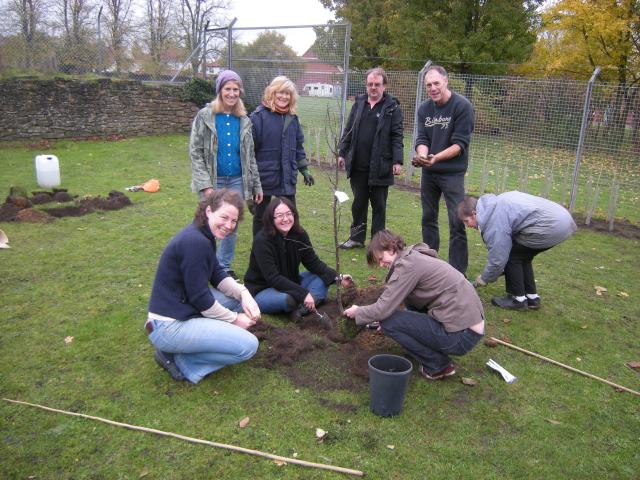
Getting to grips with fruit tree planting- the group at Wensum View Park
You may remember that we opened Old School Garden to the public for the first time back in July. Apart from the fun (and worry!) of sharing the garden and getting people’s feedback, it was a chance to raise some money for some local ‘good causes’. The £300 raised was divided equally between gardening projects at Cawston V.C. Primary School (where I help out as a volunteer), towards the upkeep of the fabric of St. Peter’s Church, Haveringland- the ‘Church in the Fields’ you can see from our garden- and to support small – scale projects in the Norfolk Master Gardener programme.
One of the latter involved funding some new fruit trees for a Community Garden in Norwich and the Master Gardener supporting that project, Jeremy Bartlett, has written a piece about the planting event yesterday. I’m so pleased that our little fundraising effort has achieved something worthwhile- I’ll report on other projects funded in due course, but for now here’s Jeremy’s article.
‘Volunteers spent the morning of Sunday 17th November 2013 planting fruit trees and an edible hedge at Wensum View Park in Norwich, thanks in part to a Norfolk Master Gardener Grant .
The park, at the back of Turner Road in Norwich, is owned by Norwich City Council and contains a small children’s playground and a large area of grass used for games and by dog walkers. Local residents wanted to do more with the park and set up Wensum View Park Community Garden Group in early 2012. Following a public consultation by Norwich City Council earlier this year (http://www.norwich.gov.uk/Environment/ParksAndOpenSpaces/Parks/ParksImprovements/Pages/WensumViewPlayArea.aspx) work to transform the space began this autumn.
So far there have been two gardening tasks, led by Master Gardener Jeremy Bartlett, who has had previous experience setting up and maintaining Norwich’s Grapes Hill Community Garden (http://www.grapeshillcommunitygarden.org/).
In early October we created a herb bed and planted crocus bulbs. This was followed by a task on the morning of Sunday 17th November 2013 when about twenty-five volunteers planted fruit trees and an edible hedge. A Norfolk Master Gardener Grant for £45 went towards the cost of the fruit trees and the 105 small saplings for the edible hedge were supplied by the Woodland Trust.

Digging the pits for the new fruit trees

Tough work…

The second row of whips going in for the edible hedge

The finished product – just give it a few years and a little TLC…
We planted nine fruit trees: single trees of Apples “Golden Noble” and “Discovery”, Figs “Brunswick” and “Brown Turkey”, Medlar “Nottingham” and Quince “Champion”, two Plums “River’s Early Prolific” and an unnamed variety of Plum, which was donated by a local resident. The hedge consists of Elder, Dog Rose, Blackthorn, Hazel and Crab Apple and will add to the edible harvest once it is established.
Our next task, planned for January or February 2014, will be to build a raised bed for planting herbs and vegetables.
Wensum View Park Community Garden Group have now signed up as a Master Gardener household and Jeremy will continue to provide free growing advice during the next twelve months.
Wensum View Park (also known as “Wensum View play area”) is located on Dereham Road in Norwich. Its entrance is between numbers 319 and 321 Dereham Road and it is open to all, free of charge, every day during daylight hours.’
Old School Gardener

All about the leaves- Fatsia japonica
This latest ‘snippet on style’ focuses on leaves. You might think that gardens designed around leaves would be boring. Not a bit of it. Foliage comes in all shapes, sizes and many colours (or shades of green). With the occasional splash of floral colour and other focal points thay can provide a wonderfully soothing, and sometimes exotic air. Foliage gardens are typified by the use of leaf and plant texture and shapes as well as subtle variations in leaf colour to provide interest, rather than floral display at different times of the year, which tends to drive other garden styles or at least their planting plans.
Sometimes the whole garden is about foliage, punctuated with flower or other colour (for example The Exotic Garden in Norwich – see link below). Sometimes specific areas in a larger garden are devoted to foliage, with the emphasis on contrasting varieties and plant forms. These gardens are typically organic in shape, with no hard edges and informal in layout and feel. They can also feature items such as sculpture or garden furniture made out of rustic materials and used as focal points set off against the foliage. Other key features of foliage gardens include:
-
Bold foliage
-
Colourful highlights
-
Pools and reflections
-
Containers
-
Locally sourced, rough materials
-
Height and structure

Shades of green and varied leaf shape and texture with splashes of colour at The Exotic Garden, Norwich

Broad leaves contrast with strappy leaf shapes and create a sense of enclosure

Informal path among the ‘leafscape’

Tree house – The Exotic Garden, Norwich

Ccontrasting colour and texture from bamboo canes atThe Exotic Garden, Norwich

Tetrapanax at The Exotic Garden, Norwich

Oriental sculpture provides a focus among the foliage at The Exotic Garden, Norwich

Canna musifolia at The Exotic Garden, Norwich

Vitis cognitiae autumn colour at The Exotic Garden, Norwich
Links:
Other articles in the ‘Style Counsel’ series:
Old School Gardener
If you’ve enjoyed reading this post and others on this blog, why not comment and join others by signing up for automatic updates via email (see side bar, above right ) or through an RSS feed (see top of page)?
My mother – in – law is currently on a two week visit to us. A keen gardener (she was until a year ago Chair of the Tavistock Ladies Gardening club), she is not as mobile as she once was (she celebrated her 83rd birthday last week). However, she still enjoys looking at gardens so this is a great excuse (as if I needed one) to get out and about to see some interesting local gardens. The weather has also been kind so we’ve been to a few places that I haven’t been before, or haven’t seen for a good number of years. Two of them are in Norwich, our local cathedral city, and they are fine examples of gardens developed for very different reasons; the one out of the passion of a Victorian entrepreneur, the other based on a medieval religious garden.
The Plantation Garden

The Garden in 1897
In 1856, a prosperous upholsterer and cabinet maker living in Norwich, took a long lease on an industrial site just outside the old City walls. His name was Henry Trevor, and for the next forty years, he spent considerable sums of money and much effort transforming a chalk quarry into a magical garden.

Henry Trevor
In many ways, Henry Trevor’s garden was typical of Victorian taste and technology. He built a fountain, terraces with balustrades, rockworks, a Palm House, and a rustic bridge. He planted elaborate carpet beds, woodlands and shrubberies. He designed serpentine paths to conduct the visitor along circular routes, and he built and heated several greenhouses with boilers and hot water pipes.
Henry Trevor, however, was also a man of strong personal tastes. His “Gothic” fountain is unique, and he displayed great enterprise in using the fancy bricks from a local manufacturer to create medieval style walls, ruins and follies. Within less than 3 acres, he established a gentleman’s residence and garden that reflected in miniature the grand country houses of the Victorian period. Visitors were frequently welcomed in the garden by Henry Trevor, for he was always ready to allow his garden to be used for charitable causes.

The Garden in Victorian times- the Palm House no longer exists.
After the 1939-45 war, the garden was virtually abandoned. Fortunately, much of the structure has survived, and is gradually being restored by the The Plantation Garden Preservation Trust. The first task of its members was to clear a forest of sycamores and a blanket of ivy to reveal what had become hidden during the past 40 years. Since then, they have restored the flowerbeds, fountain, balustrading, Italian terrace, rustic bridge and in 2007, the Gothic alcove.
Trevor’s original passion has been matched by this band of volunteers and our visit, on a beautifully sunny afternoon, showed considerable progress in the restoration programme since my last visit some years ago. I was particularly impressed with the enormous amount of work done to stabilise, weed – proof and replant the steeply sloping sides of the garden, which remain topped off with a range of majestic Beech and other trees.

The fountain

View from the upper terrace


Ivy alcoves

All about the leaves- Fatsia japonica

Fernery

Stairway and replanted slope


church window

Re created bedding


‘gothic’ detailing

Plan
The Bishop’s Garden
Our second visit, on one of it’s open days in aid of local charities, was to the Bishop’s Garden, a four acre green oasis in the centre of Norwich, sitting in the shadow of the Gothic cathedral.
There has been a garden of sorts since around 1100 AD when Bishop de Losinga began to build the cathedral and palace. From the existing garden one can still marvel at the original detailing of Norman stonework on the North Transept of the cathedral which is only visible from the Bishop’s Garden.
In the early 14th century, Bishop John Salmon greatly increased the size of the garden by compulsory purchase of additional land. The general form of the garden was laid down at least 300 years ago. The lower end was cultivated and separated by a wall running straight across the garden. The colossal Old Bishops Palace which still stands was completed in around 1860. In 1959 a major change took place when a new Bishops House built and the Old Palace came to be used by Norwich School. The garden was reduced from 6 and half acres down to the present 4 acres. Records show that in the 1940s up to 15 gardeners were employed reducing to 9 in the 1950’s and today the garden is looked after by 1 fulltime and 1 part time gardener, plus a team of volunteers.
The garden has a range of features typical of many grand gardens developed over the last hundred plus years – large herbaceous borders (which have a persistent ground elder problem and are to be successively dug up and weeds systematically removed in the coming couple of years), a small woodland walk and box – edged rose beds. There is a long shade border with Hostas, Meconopsis and tree ferns, all but the latter looking splendid on our visit. There is also a large wild grass labyrinth, very popular with children (I walked it and contemplated my life as I went…). This is of a size where it can be easily mown using a ride on mower, the gardener told me that he cuts it all down in the autumn and then the path edges are left for the various wild flowers and other species to grow up over the growing season.
There are also extensive shrubberies containing many rare and unusual plants, among these being a Hebe planted from a sprig taken from Queen Victoria’s wedding bouquet in 1840. There is an organic kitchen garden and ‘bambooserie’. The garden continues to evolve with new plants and features being introduced year by year. The Bishop’s Garden has developed links with Easton College, helping horticulture students gain valuable experience.
Though busy on our visit, including delightful music from a local Youth Orchestra and Choir, one can imagine the garden creating a peaceful mood – one where a succession of Norwich Bishops, stretching back 1000 years, paused to reflect, pray and secure spiritual renewal.

The Cathedral

rose garden

Meconopsis

‘Bambooserie’


Banana


Herbaceuous borders

View to St. Heeln’s Church

‘Knapped’ flint walls

The grass labyrinth

alcoves typical of the ancient surrounding walls

Resting between performances- some of the choir

Choir in full flow
Sources and Links:
Old School Gardener
If you’ve enjoyed reading this post and others on this blog, why not comment and join others by signing up for automatic updates via email (see side bar, above right ) or through an RSS feed (see top of page)?


Photo from The Exotic Garden, Norwich







 Old School Garden