
 I’ve mentioned recently that I’m commencing a stint as a volunteer gardener with the National Trust at Blickling Hall, a wonderful Jacobean House and estate just outside Aylsham, about 8 miles from home.
I’m particularly interested in helping with a project to regenerate a two acre walled garden that once supplied the household with an array of vegetables and fruit. Like many walled gardens of its time this was domestic food growing on a huge scale- almost like operating a mini farm.
I was reminded of this near agricultural scale of operation on my first day as the whole space has been deep ploughed (using an implement called a ‘sub soiler’ pulled behind a conventional tractor) to try to break up the compacted soil.
One of my first jobs involved marking out the main pathway structure using canes, so that plentiful supplies of farmyard manure can be tipped and spread on the growing areas and not wasted on areas which will soon be hard-surfaced. Fortunately the Project Manager, Mike Owers, had already set out some marker pegs around the periphery of the garden from which we could run lines and so get our bearings over the rough terrain. Other members of the gardening team then trailered in what seemed like a never-ending stream of manure (it was still being delivered as I left at dusk). Mike, Rebecca (one of the gardeners) and I then started the task of spreading this lovely stuff over the ground so that the worms can get to work incorporating it into the newly turned soil- a Rotatator may be used in due course to fully integrate this material.

Marking out the paths with lines and canes

Manure a plenty

The ‘field’ of a walled garden looking towards the Hall

Mike and Rebecca (and me) spreading the muck
My other main job on my first day was to work out the materials needed to restore the walled fruit support system around three walls (the fourth side of the garden is hedged). Many old espalier trained fruit bushes remain, though over the years, as the garden was not in commission, these have not been regularly pruned, so some careful renovation is called for. In some cases, the bushes may be beyond recovery, but a good basic structure exists on two out of three walls. Mike had been researching different ways of supporting these bushes and come up with a system used at another of the Trust’s properties, Scotney Castle in Kent. Here oak battens provide vertical supports for stretched wires which run along a series of vine eyes (and incorporate straining bolts at the ends of each run to ensure the wires are kept taut).

Some of the espalier fruit will need careful renovation

Two walls have a good range of espaliers; the plan is to put up new wooden battens and wires to support them anda completely new range along the west facing wall
This avoids screwing the vine eyes themselves into the ancient walls, which I must say, as you’d expect, look a little fragile in places. The battens will be placed at roughly 4 metre intervals, which more or less corresponds to the spaces between the existing bushes. I did a quick sketch diagram of each wall showing the rough placement of the battens, straining bolts etc. and finished off with some basic calculations of the materials required- interestingly my estimate on the wire (which will be in 7 rows spaced around each 5 brick courses) at 1324 metres was close to Mike’s early estimate, so hopefully the figure is more or less on target!
I’m due back at the Gardens this week and will post a brief update as this work unfolds. The next few months are promising to be especially interesting as the basic structure of the garden- paths, irrigation, greenhouses etc – are put in place and the garden is readied for its first season of growth for many years.

The main glasshouse awaiting its new wooden and glass top

The smaller glasshouse which will, for now, be retained as it is
Further information:
Blickling Hall website
Blickling Hall Facebook page
Old School Gardener

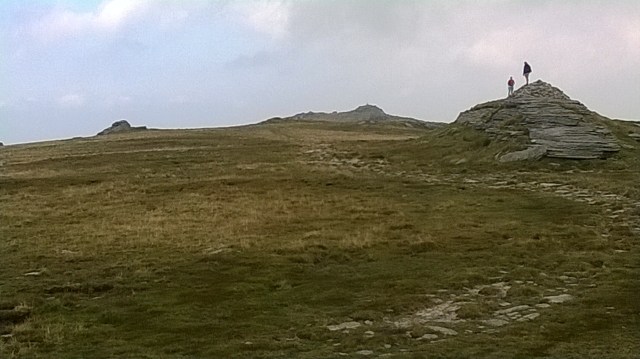 We’re just back from a week in Dartmoor, Devon, walking between some of the well-known, usually prominent rocky features of this beautiful landscape, known as tors.
  The Moor
 Varying climatic conditions occurring over millions of years, along with the cooling of the molten and other materials were the first, mainly chemical factors in the formation of the tors. Most recently, cold conditions in the Ice Age (between 2 million to 10,000 years ago), have caused major mechanical forces to shape the landscape we see today. Of these the most important is the expansion of freezing water. The deeply weathered granite was forced apart and broken up into blocks by being subjected to frequent freezing and thawing during the cold periods of the Ice Age, and gravity was also important, moving the loose material downhill.
 ‘Awe-inspiring Anglo-Saxon royal burial site’ is how the National Trust describes Sutton Hoo. I can’t argue with that. I think this must have been my third visit to the site of one of the most important archaeological excavations in Britain. The visit began with the beautifully laid out and richly furnished exhibition building, complete with exquisite reproduction Anglo-Saxon jewelry and a concise, but gripping story of Anglo-Saxon Britain and the discovery of the site in the 1930’s. We went from there (following a light lunch) to explore the mounds which covered burial ships and other graves…..


 On the way home from our recent break in Devon, we took the opportunity to visit a couple of National Trust houses and gardens just off the A303, a road that’s conveniently ‘lined’ with some great gardens. First stop was Barrington Court, Somerset.

 Another trip out whilst in Devon recently, involved a rather tortuous journey (and the need to pre book parking) at the former home of Agatha Christie, Greenway, near Brixham. We were a little limited in what we could see of the gardens, and we didn’t get to some of the feature areas like the walled garden and rhododendrons. Another day perhaps….What we did see was a fascinating house (and contents too) and some beautiful riverside sloping gardens full of interesting plants, typical of so many ‘sub tropical’ gardens along this south west coastline.







 Old School Garden