Tag Archive: grass


Where trees for climbing aren't readily available these wooden climbing structures provide a great alternative

Where trees for climbing aren’t readily available these wooden climbing structures provide a great alternative

“I prefer climbing trees than climbing frames because they are quite different and there are many ways to climb. I can climb up quite high. My mum is worried but I’m not. I’m quite good at it. I’ve never fallen off a tree because I climb in the quite safe places of trees. It’s quite thrilling being up there. My clothes get messy though.” Christina (aged 11)

So, where did you play and what were your favourite sorts of play places? I bet that some of you (most perhaps) will mention bits of wasteland, parks, on riverbanks, in other people’s derelict gardens and up trees…

It’s likely that most outdoor play happens in ‘natural’ places, but that’s not to say that this is any better than playing on play equipment or in conventional, designed playgrounds. These defined ‘children’s spaces’ make children feel they have permission to be themselves, have fun and are valued – however, they are usually adult- created places. Equally we don’t need to think that every aspect of the playground needs to be ‘manufactured’ or protected; sand or bark are as effective as rubber safety surfacing. And perhaps we don’t need to fence everything in – though this probably gives a sense of security to parents of the youngest children.
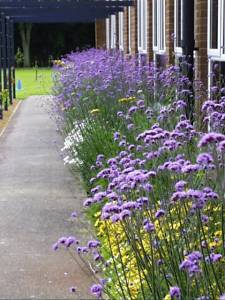
A 'Nectar bar' of insect- attracting plants

A ‘Nectar bar’ of insect- attracting plants

There is now a wealth of evidence to suggest that children benefit from being outdoors and in ‘natural’ places – especially if we want them to grow up with an understanding of the natural environment and take a responsible attitude towards it. In 2006, Playday focused on Play in the Natural Environment. Key findings were:

  • Children will naturally gravitate to natural places to play; they are seen as more likely to be free from an adult agenda, free – creative – self-directed.
  • Natural places create a sense of wonder and awe
  • These places link to an appreciation of the natural world as adults
  • Barriers to play in the natural environment include adult worry of danger – fear of strangers – bullies – quality – and the sheer lack of them in towns and cities
  • ‘Nature deficit disorder’ = a disconnection or aversion to nature
  • We need to understand the importance of the natural environment and be prepared to protect, expand, leave it alone and ensure variety. There is a need for specialised/dedicated training.
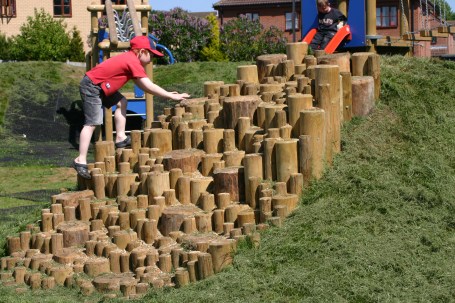
A 'Giant's Causeway' provides a challenging ascent

A ‘Giant’s Causeway’ provides a challenging ascent

So, can designed play spaces be in any way ‘natural’? There is scope for bringing together the best of  ‘off the shelf’ play equipment and those which use natural materials, objects and environments – or perhaps are an artful interpretation of these.
The best play spaces are unique and valued by their community. A design -led approach which combines play features custom-built for their location, with ‘off the shelf’ play items like slides, climbing frames, swings and zip wires is a key interest of mine. I’ve included a few pictures of some of my own work in creating these  ‘play landscapes’.

Some of the ‘natural’ ingredients which can feature in designed ‘play landscapes’ are:

1. Making the most of natural features– fallen trees to climb, clumps of tough plants for building dens, slopes to roll down, small things like piles of grass clippings and places that encourage insects and other critters (e.g. the ‘nectar bar’ shown in one of the photos).

Earth sculpting

Earth sculpting

2. Land sculpting – do you live in a pretty flat landscape? Introducing some variation in the play area by sculpting the land into ditches and hills provides endless fun for children of all ages.

3. Boulders – these are becoming a feature of many play areas, but often lack the size and careful placing to make them a good play feature (as stepping-stones, or for clambering up for example). Ideally they need to be of a smooth granite for ease of climbing and to avoid dangerous sharp edges.

4. Sand – there is an ‘urban myth’ that sand pits attract cats and other animals who use it as a toilet. Though there are examples of this as an issue (and possibly also from vandals leaving cans, bottles and other rubbish in them)- the benefits of sand as a play medium usually far outweigh the possible risks, especially if they are inspected daily to remove any offending items. Sand can be used as a safety surface also though not where rubber or other matting is more practical or where children playing in the sand risk being knocked over by those using some equipment (e.g in the area at the end of a slide). And why not go one stage further and create/designate a muddy/digging area?
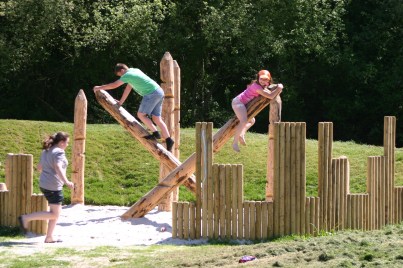
A notched pole climber with sand under

A notched pole climber with sand under

5. Trees– either naturally fallen or imported, dead trunks provide great climbing, sitting and ‘hang out’ areas. Some larger living trees are suitable for climbing or having rope swings attached.Planting groups of new trees is also a good idea, but these should be out-of-the-way of key play features, in areas where the temptation to uproot them is minimised! Where you can’t have natural trees, it’s possible to create tree-like structures to climb (see pics).

Long grass and hedges create places to hide

Long grass and hedges create places to hide

6. Hedges– mixed native species hedges are, once established, a wonderful habitat for many different insects, birds etc. and can include blackberries etc. as a fun source of food in the autumn! Don’t worry about thorns and prickles – once ‘bitten’ children, like adults, will be careful what they touch…

A woodland pond and climbing tower

A woodland pond and climbing tower

7. Water– surely a no go for children’s play? Well, once more it’s easy to over react and miss what can be a wonderful play opportunity. Rather than ban any water we should think about how it can be safely included in a play landscape – from a hand pump combined with sand play/mud perhaps (see pic), or in a shallow canal or stream….

8. Grass– introduce areas where the grass is not cut as frequently so as to vary the play landscape. Children love long grass –  it seems more  ‘jungly’ as one youngster commented to me!
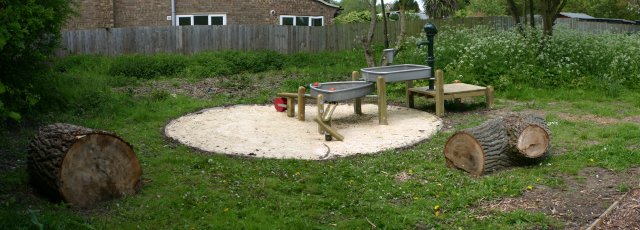
A sand and water play feature aimed at younger children

A sand and water play feature aimed at younger children

So there are practical ways of creating interesting, naturalistic ‘play landscapes’ which avoid the one size fits all mentality so often applied to play areas (or ‘KFC’ = Kit – Fencing – Carpet).

In tomorrow’s post – how to secure more natural play for your children- ten tips for parents.

Further information: Play again film

Old School Gardener

If you’ve enjoyed reading this post and others on this blog, why not comment and also join some other people and sign up for automatic updates via email (see side bar, above right ) or through an RSS feed (see top of page)?


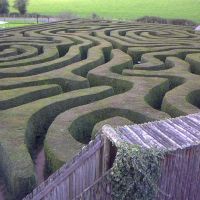
The Maze at Longleat House, England

The Maze at Longleat House, England

I must admit I’m a bit of a fan of labyrinths and mazes.

As a play landscape designer I’ve tried to find ways of incorporating them in my designs as they are especially attractive to children. Usually they are one of the first design ideas to be dropped, generally on grounds of maintenance requirements. I’ve tried to suggest simple materials like grasses to mark out a pattern, rather like the one in the Cambridge Botanic Garden, but again they do take some looking after. The best I’ve managed is a wooden stepping stone and daffodil spiral. One day I’ll find a client with the imagination and deep(ish) pockets to give a bigger one a real go.

Labyrinths and mazes – what’s the difference between them?

Well, the answer is  ‘it rather depends…’.  There is one school of thought that sees labyrinths as different to mazes and another that sees labyrinths as one type of maze. Labyrinths have just one route– so there’s no danger of getting lost – whereas mazes are rather more cunning in that they have dead ends, twists and turns which are set out to puzzle and confuse. Sir Walter Scott’s ‘O, what a tangled web we weave, when first we practise to deceive!’ comes to mind.

Labyrinths (remember the single route or ‘unicursal’ one) are found in many cultures, some as old as 3,500 years. They all have an entrance or mouth, one route to follow and a central destination, sometimes marked with some sort of stone/statue/ feature. A further detail is how many concentric circuits or paths they contain and they can vary from the small to the huge – several hundred feet across. They have traditionally been seen as spiritually symbolic, meditative paths as well as just entertaining and can be found in many religious buildings such as Chartres and Ely cathedrals.

The Labyrinth pattern in Chartres Cathedral

The Labyrinth pattern in Chartres Cathedral

Humankind has been fascinated by patterns in the land for millennia and some of the earliest were forms of spiral (some multiple spirals). These later developed into the sorts of maze-like patterns we’re more familiar with, including the Cretan maze (or labyrinth as its usually called!). Of course the famous one was that in classical mythology where Theseus found his way to the centre and killed the Minotaur to ensure he freed his fellow Athenians. He used a length of thread to trace his way in and so find his way out. Which rather suggests that this ‘labyrinth was in  fact a more complicated maze as it would have been easy to retrace his steps in a one-route labyrinth! This all goes to support the case that the words labyrinth and maze are interchangeable, and certainly common usage suggests this- e.g the turf ‘mazes’ in some English gardens are in fact labyrinths (i.e. one routers).

A-maz-ing Gardens

Mazes as multi – choice routes really developed in gardens out of the parterre and knot gardens which used lines of plants (usually Box) to create patterns within which other plants, gravel, grass or sometimes coloured powders created a contrast in colour and level. You can wander around these hedges in some gardens and it isn’t difficult to imagine how (either deliberately or perhaps through lack of maintenance!) these hedges grew taller. This both made it difficult to grow anything successfully within them and also added a touch of mystery to the experience of walking round the garden. A book by Daniel Loris –  ‘Le Thresor des Parterres de l’univers‘ – written in 1629, seems to capture the developing fashion for such mazes (though most of it is concerned with the traditional parterre).

Hampton Court Maze, England

Hampton Court Maze, England

Britain’s oldest surviving hedge maze is at Hampton Court – created by George London and Henry Wise in 1690 and also thought to be the oldest hedge maze in the world in continuous use. Originally planted with Hornbeam and having two trees at the centre the hedging is now Yew, the hedging used in many traditional hedge mazes.

Labyrinth of Horta, Barcelona

Labyrinth of Horta, Barcelona

The Labyrinth Park of Horta in Barcelona, Spain, was created around 1794 as part of a neoclassical ‘makeover’ of the garden by its Marquis owner. In recent years the garden and maze have been restored and I have had the good fortune to almost stumble across it.

A simple bulb labyrinth at Cornell University, USA

A simple bulb labyrinth at Cornell University, USA

Today there are many different types of maze to be found in gardens, parks and estates around the world, some using hedges or walls (for your truly ‘puzzling maze’), others using turf, other grasses, low-growing plants or materials to mark out the (usually labyrinthine) route. In Britain temporary  ‘Maize mazes’ created in agricultural fields have become a popular summer visitor attraction.

There is something magical about these labyrinth and maze ‘puzzles on the land’ and I hope that one day I can create one in a park or garden…maybe you have scope for one in your garden?

Sources and further information:

Garden Mazes

Mazes and labyrinths

Design your own maze

History

Wikipedia- labyrinths

Wikipedia- mazes

Labyrynthos- resource centre

Labyrinth.org

Maze photos

Quizzicals (thanks to Les Palmer for these):

answers to the last two-

  • Has had too much already Sycamore
  • A country full of automobiles – Carnation

and a couple of gardening ditties

Big in Japonica’

‘You picked a fine time to leave me lucerne’

Old School Gardener

If you’ve enjoyed reading this post and others on this blog, why not comment and also join some other people and sign up for automatic updates via email (see side bar, above right ) or through an RSS feed (see top of page)?

The Small Tortoiseshell- under threat

The Small Tortoiseshell- under threat

The latest ‘Wider Countryside Butterfly Survey’ reveals that some butterfly species- notably the Meadow Brown- seem to have benefitted from last year’s wet summer, whereas others- such as the Common Blue and Small Tortoiseshell– were around 50% down on the previous year.

The Small Tortoiseshell was once prolific in Britain’s gardens, but it seems to have been one of the big losers in 2012. Last year’s weather  is only partly to blame, as wider agricultural policies and practices are a key driver behind a longer term decline in butterfly species and numbers and parasitic flies may also be part of the story. Around three quarters of the 59 native British species are now in decline.

So what can gardeners do to arrest this trend?

1. Think about providing year- round sources of food for emerging and mature butterflies. Examples of plants which feed butterfly caterpillars are: Dill, Antirrhinum, Columbine, Berberis, Marigold, Ceanothus, Cercis, Cornus, Foxglove, Wallflower, Ivy, Hop, Holly, Jasmine, Honesty, Ragged Robin, Crab Apple, Oregano, Cowslip, Rudbeckia, Thyme, Nasturtium, Verbascum and Pansy.

Species which are food sources for mature butterflies are: Achillea, Anthemis tinctoria, Bergamot, Buddleja, Columbine, Coreopsis lanceolata, Red Valerian, Ceanothus, Marigold, Echinacea, Globe Thistle, Knautia, Lavender, Tobacco plant and Hop.

2. Try to plant butterfly-attracting plants in groups– butterflies prefer to visit stands of brightly coloured flowers.

3. If you have room, choose a quiet but sunny area of lawn where the grass can be left to grow long – some butterflies such as the Meadow Brown prefer to lay eggs in long grass.

4. Allow a small patch of nettles (Urtica dioica) to grow unfettered– these will provide food for some of the more common butterflies such as Red Admiral, Painted Lady and Milbert’s Tortoiseshell.

5. If you have fruit trees, don’t be too tidy about windfalls– leave some rotting fruit as a source of food for some butterflies.

6. Try to provide a shallow, muddy puddle in a sunny spot– many butterflies love to drink from these and they also provide essential minerals and salts.

7. Avoid using chemical sprays to deal with insect pests and weeds– many will harm beneficial insects and butterflies as well as the pests.

Groups of butterfly- friendly plants such as Bergamot are better than single specimens

Groups of butterfly- friendly plants such as Bergamot are better than single specimens

Sources and further information:

Guardian online

Butterfly Conservation

UK butterflies

‘Wildlife Friendly Plants’- Rosemary Cresser

Quizzicals- two more cryptic clues to plant, fruit or veg names:

  • Our monarch continues to work hard
  • Nasty spot causing urination problems

Old School Gardener

Finding Nature

Nature Connectedness Research Blog by Prof. Miles Richardson

Norfolk Green Care Network

Connecting People with Nature

Discover WordPress

A daily selection of the best content published on WordPress, collected for you by humans who love to read.

Susan Rushton

Celebrating gardens, photography and a creative life

Unlocking Landscapes

Writing, photography and more by Daniel Greenwood

Alphabet Ravine

Lydia Rae Bush Poetry

TIME GENTS

Australian Pub Project, Established 2013

Vanha Talo Suomi

The Journey from Finnish Rintamamiestalo to Arboretum & Gardens

Marigolds and Gin

Because even in chaos, there’s always gin and a good story …

Bits & Tidbits

RANDOM BITS & MORE TIDBITS

Rambling in the Garden

.....and nurturing my soul

The Interpretation Game

Cultural Heritage and the Digital Economy

pbmGarden

Sense of place, purpose, rejuvenation and joy

SISSINGHURST GARDEN

Notes from the Gardeners...

Deep Green Permaculture

Connecting People to Nature, Empowering People to Live Sustainably

BloominBootiful

A girl and her garden :)