Tag Archive: gardens


Euphorbias putting on a show at Old School Garden

Euphorbias putting on a show at Old School Garden

To Walter Degrasse

Dear Walter,

I looked back at my letter to you written at the same time last year and it is interesting to see how flowers and growth generally were more advanced then. Still, there’s starting to be the first signs of real growth in Old School Garden; such an uplifting time.

As you know, we have the builders in, so my time is pretty divided ; I’m conscious of not getting on top of the borders soon enough, though it is good that Deborah is able to lend a hand this year. Still, progress is being made on most fronts and despite a general air of untidiness, some parts of the garden are starting to fill out and green up.

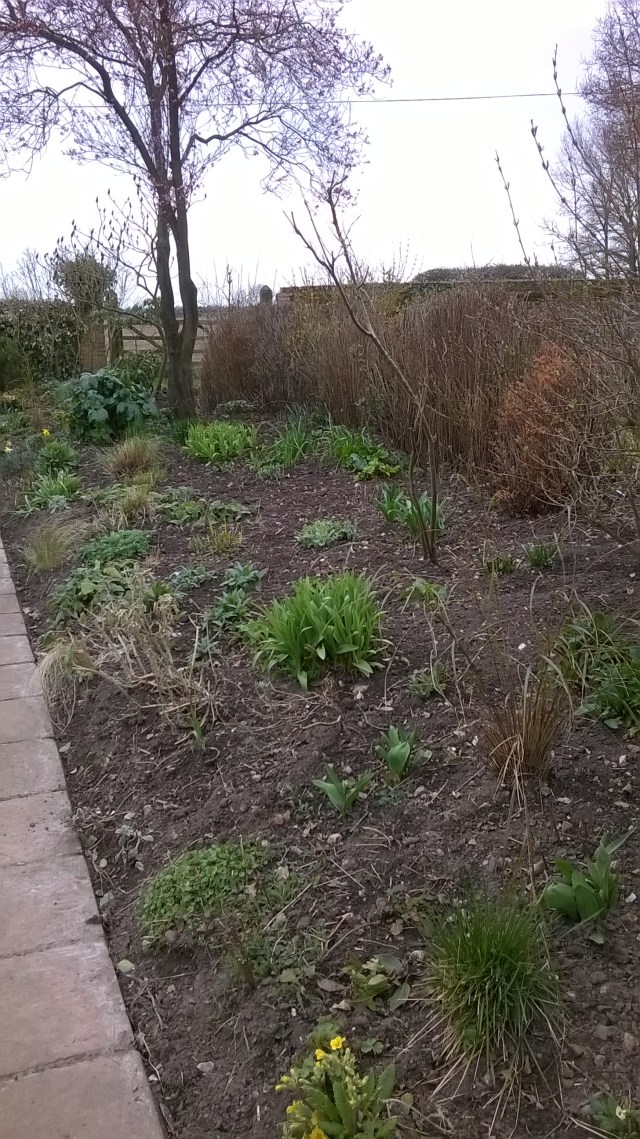
One of the Terrace Mixed borders, newly 'tickled' and starting to green up

One of the Terrace Mixed borders, newly ‘tickled’ and starting to green up

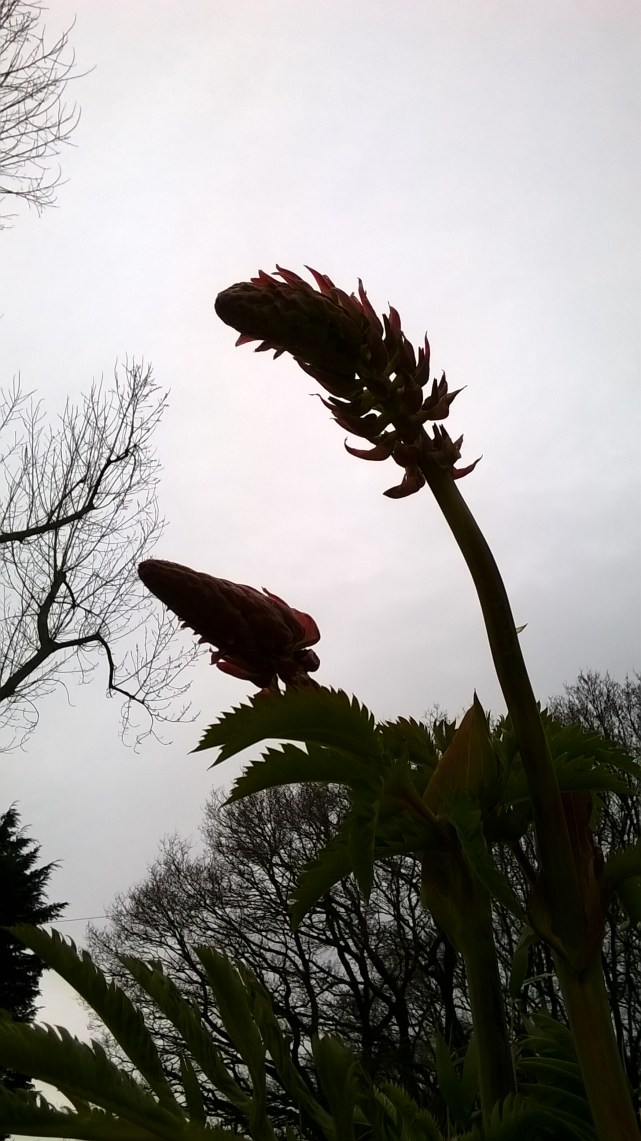
I’ve also got a range of seedlings underway, and last week took the insulation out of the greenhouse and the more tender plants too, so now there’s a light, warmish place for the new plants to put on growth; and by and large they are. The Melianthus tale continues; see the picture below which shows that the plant now has two flower spikes and it could be that a real flower will appear in the next week or two, if the temperature and sunshine are sufficient. The whole plant, whilst looking a bit bare lower down, isn’t quite the tatty specimen I thought it might be. Hopefully, once the flowering has finished I can cut it to ground level and we’ll have a new flush of large, peanut-butter smelling foliage.

Meianthus flower heads- to flower or not to flower?

Meianthus flower heads- to flower or not to flower?

I’ve put in my first early potatoes (‘Foremost’) and plan to do the ‘seconds’ in a day or two (once more I’m growing ‘Charlotte’). The early veg seems to have survived the winter pretty well; onions and broad beans are getting on nicely and I’ve also planted out some more asparagus in an attempt to get a decent row in a year or two’s time. And I’m going to experiment with a ‘table bed’ given to me by our new neighbours, who won’t have the time to grow their own food. This was built by their predecessors and had a large compost- filled bottom with concrete slab sides. Probably a little deeper than is needed for most things, so I’m going to adapt the basic shape and add a wooden slatted bottom along with a plastic lining. I thnk I’ll try a mix of salad leaves in it for starters. More pictures to come of this new recycling project!

Progress on the wildlife pond area is pretty slow; it’s taking a long time to redistribute the ash and soil from the old bonfire heap and my latest obstacle is a large Birch tree stump that I’m trying to dig out. Still, this area of the garden is starting to a bit more organised and hopefully, in due course, will add to the variety of spaces here. As part of the building work I’m having a new shed put in to hold mowers, other powered garden equipment and no doubt some general storage too.

The site for this new shed that I originally cleared proved to be too tight, so not to be put off, I’ve decided to turn this area – which sits under a mix of evergreen and deciduous trees- into a spring garden. So here is a convenient spot right next to the old bonfire area where some of the spare soil can be spread to deepen the base for this new garden. It will be fun planting this up in the Autumn with a mixture of bulbs and other things.

I mentioned last month that I’d begun a creative writing course at Gressenhall Museum. This has proved to be very enjoyable, focusing on characters from the place when it was a Workhouse and exploring different modes fo writing to tell their stories. I have a final piece to write up about one William Rush, a pauper inmate who when  he as 13 years old volunteered to stand in for the Schoolmaster when the latter was off sick; he seems to have done an exemplary job and became one of the first ‘pupil teachers’ that formed part of the new approach to public education here in the latter part of the 19th century. If it seems of a reasonable quality I may even put this short story on the blog for all to see!

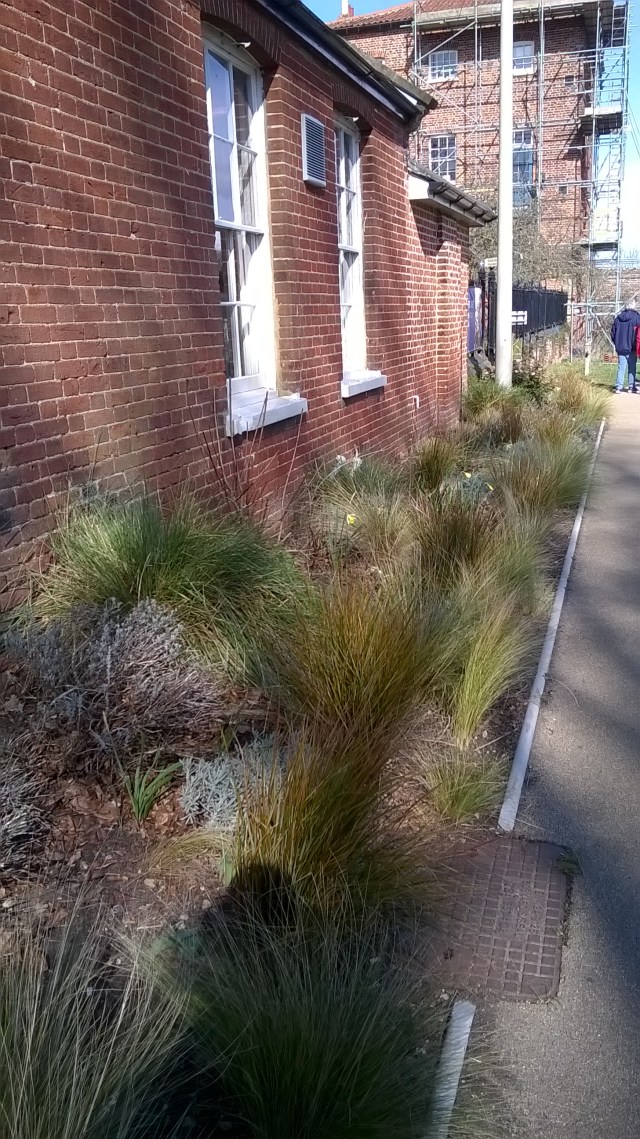
The entrance border at Gressenhall- grasses have really taken hold and will sonn be joined by 'Mount Hood' Narcissus and pink Tulips

The entrance border at Gressenhall- grasses have really taken hold and will sonn be joined by ‘Mount Hood’ Narcissus and pink Tulips

Whilst at Gressenhall for the course I’ve spent a few hours in the gardens getting things pruned and tidied up. i completed most fo the rose pruning there last week (and I’ve also spent quite a time doing the climbers and ramblers at Old School Garden) and done a bit of weeding. As you may have read, I’ve also put in some time at Blickling. The setting out of the walled garden seems to be going well, with the irrigation system now in place and a long length fo metal edging ready for installation in the next couple of weeks. This, along with the restored greenhouse, should really give the area some definition and we can see the scale of the planting task that confronts us!

So that’s about it for this month. Hopefully, you and Lise are well ahead in your own garden preparations, but if not, don’t lose heart; a little bit of untidiness is a good thing!

All the best old friend,

Old School Gardener

Continue reading

WP_20141117_15_07_28_Pro

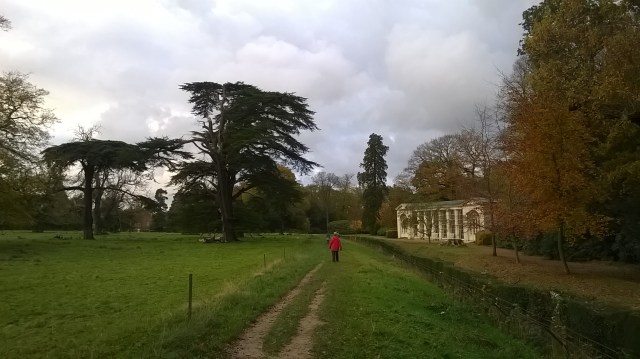
Cedars and the Orangery at Blickling Hall, Norfolk this week

Old School Gardener

IMG_0323

By now we had settled into our week-long home in the mountains of Andalucia. We were even getting used to driving on the ‘wrong side’ of the road.

Today’s trip was to be our furthest afield, taking a couple of hours by motorway. It is a place I’ve wanted to visit for some time, principally because of the Mezquita (the former mosque) now the city’s  Cathedral- Cordoba.

Having found some parking we made our way into the city, even going past one of the old gates in the city walls, which said ‘you’ve arrived’. We stumbled upon a horse show in the buildings originally used to train up horses for the Spanish Royal family. After winding our way through the narrow streets we came out onto the banks of the River Guadalquivir and the stately old bridge which arrives at the edge of the Mezquita and other notable buildings. Later in the day we had a delightful ‘mooch’ around the old jewish quarter of the city and even found a couple of stylish patios (courtyards) which whetted my appetite for the spring festival that celebrates these – that will have to wait for another visit…..

This slideshow requires JavaScript.

Andalucia.com describes the City:

‘Cordoba was founded by the Romans and due to its strategic importance as the highest navigable point of the Guadalquivir River, it became a port city of great importance, used for shipping Spanish olive oil, wine and wheat back to Ancient Rome. The Romans built the mighty bridge crossing the river, now called “El Puente Romano”. But Cordoba’s hour of greatest glory was when it became the capital of the Moorish kingdom of El-Andalus, and this was when work began on the Great Mosque, or “Mezquita”, which – after several centuries of additions and enlargements – became one of the largest in all of Islam.

When the city was reconquered by the Christians in 1236, the new rulers of the city were so awed by its beauty that they left it standing, building their cathedral in the midst of its rows of arches and columns, and creating the extraordinary church-mosque we see today.

As well as the unique mosque-cathedral, Cordoba’s treasures include the Alcazar, or Fortress, built by the Christians in 1328; the Calahorra Fort, originally built by the Arabs, which guards the Roman Bridge, on the far side of the river from the Mezquita, and the ancient Jewish Synagogue, now a museum. Cordoba’s medieval quarter, once the home of the Jewish community, is called “La Judería” (The Jewry), a labyrinth of winding, narrow streets, shady flower-filled courtyards and picturesque squares such as La Plaza del Potro. In early May, homeowners proudly festoon their patios with flowers to compete for the city’s “most beautiful courtyard” contest.’

 The Mezquita was undoubtedly the highlight of the day, its sheer size (both outside and in) taking my breath away. The inside was a fascinating and beautiful mix of Islamic and Christian symbols and art. The contrast between the relatively simple Islamic decoration and the gold-leaf splendour of the cathedral created within it was startling; and also evidence of the rather brutal way in which the Catholic church muscled in and sought to out do the evidence of Islam. This even extends into the large paved space outside- the original mosque wash basins set into the surface have been filled in and orange trees now fill them with their roots. It was the simpler, but exquisite architecture of the mosque that somehow left the most powerful impression on me, and which also probably appealed more to my own artistic taste…


This slideshow requires JavaScript.

After this we took a tour around the royal palace (the Alcázar de los Reyes Cristianos), that sits nearby and is one of Cordoba’s major landmarks. Originally built in the 8th century as a caliphate residence, this complex of buildings and gardens reached major significance during the Middle Ages, when the Catholic Monarchs Ferdinand and Isabella lived there.

The Alcázar is a composition of massive fortress and royal palace and has some impressive water gardens; complete with statuary, topiarised Box and Yew, a series of arched fountains reminiscent of the Generalife in Granada, and some curious red flowers. I think they were some sort of Celosia but were quite tall and showing distinct evidence of fasciation– when a fault in the growing tip of the plant causes the stems and the flowers to flatten and become fan-like. Apparently some varieties of Celosia are raised especially for their dependably fasciated flower heads, for which they are called “cockscomb” …

This slideshow requires JavaScript.

Rather numbed by the day’s series of wonderful sights, we made our way back along the motorway and mountain tracks and once more to another late night supper by the pool. Could we manage any more beauty on this scale?

Old School Gardener

IMG_0972Old School Garden – 3rd October 2014

To Walter Degrasse

Dear Walter,

I’m feeling very guilty. A month has gone by and three weeks out of four we have been away from Old School Garden. So, as you can guess, I’ve not much to report as far as our garden is concerned, well at least in terms of effort, that is. I’m pleased to say, though, that due to the diligent watering of our son and neighbours, we were pleasantly surprised at the state of the garden on our return from foreign climes. Well, mostly.

I thought I’d give you a snapshot of some of the wonderful places we visited whilst away in Spain and Portugal, but first, one of the good things to report is the continued harvest. Here are a few pictures of this month’s offerings. As you’ll see, I’ve cheated a bit and included a bag of almonds donated to us by our hosts in Spain, Michael and Lisa. We sampled some of these, and especially loved the salted ones- I threw a few into a Spaghetti Bolognese we had for supper one day- they added a new dimension!

More generally, the Old School Garden has definitely put on some of its autumn clothes. However, the driest (and possibly the warmest) September on record in the UK has meant that some things you’d associate with high summer have continued to put on a show, or in some cases, a second flowering. I even spotted some new strawberries in our patch! I’m hoping that the weather will be kind enough to encourage the Melianthus major to flower this year; you remember I grew this from a cutting I took whilst working at Peckover House a couple of years ago? It’s the plant with leaves that smell of peanut butter when you rub them and has claret-coloured spikey flowers.

Here’s a selection of pictures of some of the ornamental interest in the garden right now…

This slideshow requires JavaScript.

I said that the previous month had involved little gardening effort on my part. I’d forgotten a few things that I managed to squeeze in between the holidays:

  • I sowed some green manure (Phacelia) which is now beginning to look good

  • I tackled (with our soon to move neighbour) an overgrown, mixed hedge boundary and removed a lot of growth to open up the kitchen garden to more morning sun

  • I did the usual late summer round of hedge clipping (and managed to cut through the hedge clipper’s electric cable too)

  • I took some yew cuttings from the old bushes/trees at Gressenhall, and last, but not least…..

  • I continue to ‘deal with’ the rash of mole hills and runs that have spread right across all the areas of our grass (I don’t any longer call them lawns).

Turning to our trips abroad, these weren’t all about visiting gardens, parks and other lovely places – near the end we did a bit of ‘hands on’ gardening! Our daughter and son-in-law live in Almada, just over the river from Lisbon, Portugal. Their apartment has a rear patio (which I’ve written about before) and also a rather blank piece of ground at the front. This is covered with different layers of concrete and apart from providing a parking place for our son-in-law’s motorbike, does little more than collect wind-swept rubbish and provide a challenging growing space for some tough old weeds which seem to have gradually worked their way into cracks and, once there, swelled these as their roots get a grip.

I don’t know if it was us tiring of being on holiday or the annoyance of looking at this plot every day, but Deborah proposed to do some weeding one morning and so three of us set out ‘armed’ with only our hands and a draw hoe (not usually put into service for this sort of job). You can see the result below. Having begun with limited ambitions, not surprisingly we managed to remove some large chunks of concrete (!) and tilled the rather poor soil in readiness for some planting next year (I suggested some annual poppies and marigolds as good ‘pioneer’ species). Diego, our son-in-law, was obviously inspired by this effort and is now proposing to remove a larger strip of concrete to create some more significant planting areas…watch this space.

I promised you a snapshot of some of the wonderful places we visited whilst in Spain and Portugal, so here’s a selection to whet your appetite for more extensive articles (and pictures) in the next few weeks…

This slideshow requires JavaScript.

I almost forgot to mention my holiday reading. Whilst our travels meant we weren’t able to read that much, I did make a start on ‘Noah’s Children’ by Sara Stein. You may recall that I was pointed in her direction by a fellow blogger? After reading her previous book ‘Noah’s Garden’ (in which she discusses her approach to ecological gardening), the sequel gets into the whole issue of how we do or don’t enable children to build a relationship with their environment. I’ve been saving some thought-provoking extracts from this and will somehow share them with you in the coming weeks. Here’s a starter from the Introduction, where Stein sets out her stall for the rest of the book:

‘Land is nourished or not by humans; humans are nourished or not by land. Place and occupant only seem separable because we have created such a distance between liveliness and livelihood. In creating that distance, we have unwittingly detached the nature of childhood from the sense it ought to make. Childish curiosity is to make connections, to realize the larger picture, to become able in the physical environment our lives depend on. We’ve removed the red from the fruit, the fruit from the tree, the tree from the wood, the wood from all the things a child might make of it, and so left fragments much harder to connect than laces on a shoe.’

To conclude this month’s letter, Walter, I’ve a positive note, not unrelated to the theme of ‘Noah’s Children’. Whilst at Gressenhall Museum on Wednesday, the co-ordinator Lynne, mentioned a comment she’d had from a recent visitor. The visitor said her young children loved coming to the ‘Curiosity Corner’ I and colleagues had created for under 5’s in a small part of the gardens here; to the extent that she’d spent a considerable sum getting her own garden landscaped to make it more ‘child friendly’, to introduce some of the features that can engage the young mind in exploring and learning from their environment. That warmed my heart.

The Kitchen Garden in autumn - 'fulsome'

The Kitchen Garden in autumn – ‘fulsome’

All the best for now, old friend,

Old School Gardener


HACO

Help pick the UK’s favourite park in an online vote. A record breaking 1482 parks and green spaces this year received a Green Flag Award and people are now urged to vote for their favourite. The annual People’s Choice Award is now open – giving the public the power to decide which one of the 1482 Green Flag Award sites should be named Park of the Year in an online vote.

To vote:
• Visit www.greenflagaward.org
• Select your country/region on the interactive map
• Find your favourite park or green space
• Click the ‘vote for this site’ button

Paul Todd, Green Flag Award Scheme manager, said:

“Following a record breaking year for the Green Flag Award we are now asking the public to decide which of the 1482 parks and green spaces deserves the coveted People’s Choice Award 2014.”

The vote will close at noon on 30 September and the winner of the 2014 People’s Choice will be announced on 16 October.

Green Flag Award home page

The Green Flag Award was first launched in 1996 to recognise and reward the UK’s best green spaces. It is the standard for parks and recognises well-managed, high-quality sites that meet the needs of the community.

All Green Flag Award winning parks and green spaces are entered into the annual People’s Choice Award vote, which last year saw thousands of votes recorded and resulted in the crowning of Margam Park in Neath Port Talbot as the People’s Choice.

Old School Gardener

green flag stratfordI’m one of 700 volunteer judges for the ‘Green Flag’ Award scheme in the U.K. This involves inspecting parks and open spaces, meeting staff and volunteers and looking at Management Plans and other documents, with the aim of assessing each space against eight strict criteria, including horticultural standards, cleanliness, sustainability and community involvement.

The winners for this year have recently been announced and more parks and green spaces than ever will be flying the Green Flag Award in 2014/15. In total, 1482 parks, cemeteries, universities, shopping centres and community gardens have met the high standard needed to receive the Award.

Among this year’s recipients of the Award are, for the first time, Queen Elizabeth Olympic Park in east London (picture above) and Eaton Park in Norwich. I was a judge for Elmhurst Park in Woodbridge, Suffolk, which has won an award for several years.

Green Flag Award scheme manager Paul Todd said:

‘It’s another record-breaking year for the scheme. This is something well worth celebrating and testament to the efforts of the thousands of men and women, supported by some amazing volunteers, who work tirelessly to maintain the high standards demanded by the Green Flag Award. ‘The parks sector is facing some tough challenges so it is heartening to see that they are committed to maintaining and improving standards. We know how passionate people are about our parks and green spaces and the recent Heritage Lottery Fund report, State of UK Public Parks, highlighted the need for everyone to work together to ensure they are maintained for future generations.’

A full list of the award winning spaces can  be found here.

flag

Old School Gardener

Specifier Review's avatarArchitecture, Design & Innovation

Staffordshire University, Stoke-on-Trent

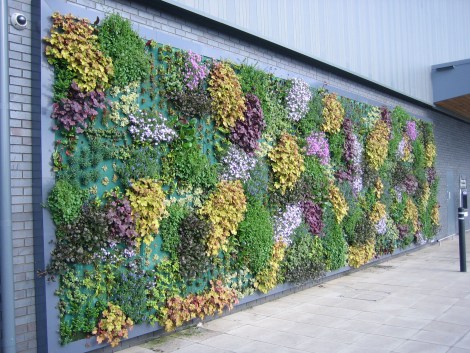
Meeting the Challenge of a Sustainable Urban Future: the contribution of green walls

Anyone concerned with the quality of life in urban areas will find the conference of interest.

Green walls are an important component of Green Infrastructure – possibly the only cost-effective approach to coping with some of the immense challenges currently facing urban areas:

  • Climate change (coping with extreme events, e.g. heat waves, flooding),
  • Pollution (including health impacts),
  • Lack of wildlife habitat,
  • Social problems (including mental health) resulting from high-density urban living.

Green walls are easier to retrofit than many alternatives, take up less space, and can be rapidly deployed.

12th May 12_1 email

The Green Wall Centre

At Staffordshire University researchers have been studying the environmental and biodiversity values of green facades and different living wall systems in Stoke-on-Trent, Newcastle-under-Lyme, Birmingham, London and the Greater London area.

Taking advantage of this expertise, and experience with different commercial…

View original post 262 more words

Contemplation/ garden of Gethsemane- by Jenny Meehan
Contemplation/ Garden of Gethsemane by Jenny Meehan

‘..Gardening has always been regarded as a peculiarly English activity: indeed, it has assumed a key role in English identity. There are two main reasons for this..first…the weather….But there are also cultural reasons why gardening became the favoured activity of the English….English Gardens were seen as having curative powers for the English malady of melancholy….English people, unlike their continental counterparts, for whom it was a place for parade and social intercourse, went into the garden for a very different purpose- contemplation. I believe it was the Reformation which gave Englishmen their green fingers. In Catholic countries meditation took place in churches, monasteries and nunneries. In England the setting for contemplation became the garden….’

Sir Roy Strong: ‘Visions of England’ (Random House, 2011)

Old School Gardener

Finding Nature

Nature Connectedness Research Blog by Prof. Miles Richardson

Norfolk Green Care Network

Connecting People with Nature

Discover WordPress

A daily selection of the best content published on WordPress, collected for you by humans who love to read.

Susan Rushton

Celebrating gardens, photography and a creative life

Unlocking Landscapes

Writing, photography and more by Daniel Greenwood

Alphabet Ravine

Lydia Rae Bush Poetry

TIME GENTS

Australian Pub Project, Established 2013

Vanha Talo Suomi

The Journey from Finnish Rintamamiestalo to Arboretum & Gardens

Marigolds and Gin

Because even in chaos, there’s always gin and a good story …

Bits & Tidbits

RANDOM BITS & MORE TIDBITS

Rambling in the Garden

.....and nurturing my soul

The Interpretation Game

Cultural Heritage and the Digital Economy

pbmGarden

Sense of place, purpose, rejuvenation and joy

SISSINGHURST GARDEN

Notes from the Gardeners...

Deep Green Permaculture

Connecting People to Nature, Empowering People to Live Sustainably

BloominBootiful

A girl and her garden :)