Tag Archive: garden


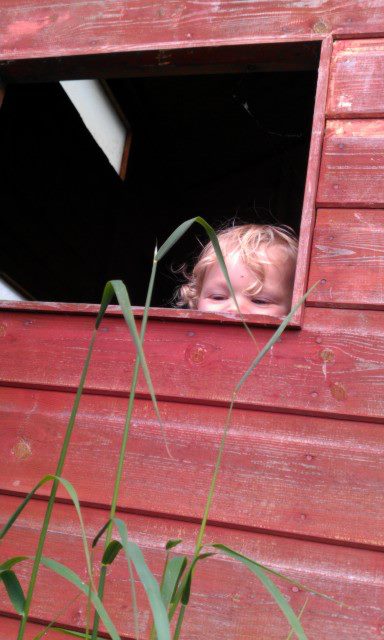
PicPost: Child's eye view

450px-Tulip_-_floriade_canberraTulipa (Tulips) is a genus of some 100 species of hardy, bulbous perennials from Europe, asia and the middle east- especially Central Asia. They prefer sun but will take light shade, and must have a well-drained soil, though seem to prefer heavier soils than lighter ones. Tulips are grown for their showy flowers, which are usually at the end of a stem and upright, with six tepals. They vary from cup- or bowl-shaped to goblet-shaped, some with long, very narrow tepals, or lily-like or star-shaped- some are fringed.

There is a wide range of colours and bi colours. Depending on the species, tulip plants can grow as short as 4 inches (10 cm) or as high as 28 inches (71 cm). The leaves are usually grown from the base of the main stems, are broadly ovate in shape and sometimes are wavy-edged or channelled.

Tulips can be planted in groups among other plants in a border, in pots or ‘naturalised’ in grass. They tend to be later flowering than Narcissus and crocus so growing these together can produce a flowering display lasting up to three or four months.

The bulbs should be planted 15cm deep in the autumn. Cultivars benefit from being lifted and ripened every year once the leaves have died down. Most of the Darwin hybrids (such as ‘Apeldoorn’), the Greigii and Kaufmanniana groups  and the species tulips can be left in the ground for a number of years; mark the position to avoid damaging the bulbs with other planting. The size of flowers will diminish over time and they will also benefit from being lifted and divided every few years – this should be done as soon as the foliage dies down.

Mice love tulip bulbs, so store lifted bulbs out of reach and protect newly planted bulbs from disturbance. Some people have an allergic reaction  to any part of the plant which may cause skin irritation, and all parts can be mildly poisonous if eaten (though the flower petals can apparently be eaten – see link below).

Although tulips are often associated with the Netherlands, commercial cultivation of the flower began in early Persia probably somewhere in the 10th century. Early cultivars must have emerged from hybridisation in gardens from wild collected plants, which were then favoured, possibly due to flower size or growth vigour. During the Ottoman Empire, numerous tulips were cultivated and bred. 

Bulbs fields in Holland

The word tulip, which earlier appeared in English in forms such as tulipa or tulipant, entered the language by way of the French tulipe and its obsolete form tulipan or by way of Modern Latin. The word derives from the Persian word for ‘turban’ chosen because of a perceived resemblance of the shape of a tulip flower to that of a turban This may have been due to a translation error in early times, when it was fashion in the Ottoman Empire to wear tulips on their turbans. The translator possibly confused the flower for the turban.

Between 1634 and 1637, the early enthusiasm for the new flowers in the Netherlands triggered a speculative frenzy now known as Tulip Mania. Tulips became so expensive that they were treated as a form of currency.  To this day, tulips are associated with the Netherlands, and the cultivated forms of the tulip are often called “Dutch tulips.” In addition to the tulip industry and tulip festivals, the Netherlands has the world’s largest permanent display of tulips at Keukenhof, although the display is only open to the public seasonally.

In horticulture, tulips are divided up into fifteen groups (Divisions) mostly based on flower characteristics and plant size.

  • Div. 1: Single early with cup-shaped single flowers, no larger than 8 cm across (3 inches). They bloom early to mid season. Growing 15 to 45 cm tall.

  • Div. 2: Double early with fully double flowers, bowl-shaped to 8 cm across. Plants typically grow from 30–40 cm tall.

  • Div. 3: Triumph single, cup-shaped flowers up to 6 cm wide. Plants grow 35–60 cm tall and bloom mid to late season.

  • Div. 4: Darwin hybrid single flowers are ovoid in shape and up to 8 cm wide. Plants grow 50–70 cm tall and bloom mid to late season. This group should not be confused with older Darwin tulips, which belong in the Single Late Group below.

  • Div. 5: Single late cup or goblet-shaded flowers up to 8 cm wide, some plants produce multi-flowering stems. Plants grow 45–75 cm tall and bloom late season.

  • Div. 6: Lily-flowered the flowers possess a distinct narrow ‘waist’ with pointed and reflexed petals. Previously included with the old Darwins, only becoming a group in their own right in 1958.

  • Div. 7: Fringed (Crispa)

  • Div. 8: Viridiflora

  • Div. 9: Rembrandt

  • Div. 10: Parrot

  • Div. 11: Double late Large, heavy blooms. They range from 18 to 22 in. tall

  • Div. 12: Kaufmanniana Waterlily tulip. Medium-large creamy yellow flowers marked red on the outside and yellow at the center. Stems 6 in. tall.

  • Div. 13: Fosteriana (Emperor)

  • Div. 14: Greigii Scarlet flowers 6 in. across, on 10 in. stems. Foliage mottled with brown.

  • Div. 15: Species (Botanical)

  • Div. 16: Multiflowering not an official division, these tulips belong in the first 15 divisions but are often listed separately because they have multiple blooms per bulb.

They may also be classified by their flowering season:

  • Early flowering: Single Early Tulips, Double Early Tulips, Greigii Tulips, Kaufmanniana Tulips, Fosteriana Tulips, Species Tulips

  • Mid-season flowering: Darwin Hybrid Tulips, Triumph Tulips, Parrot Tulips

  • Late season flowering: Single Late Tulips, Double Late Tulips, Viridiflora Tulips, Lily-flowering Tulips, Fringed Tulips, Rembrandt Tulips

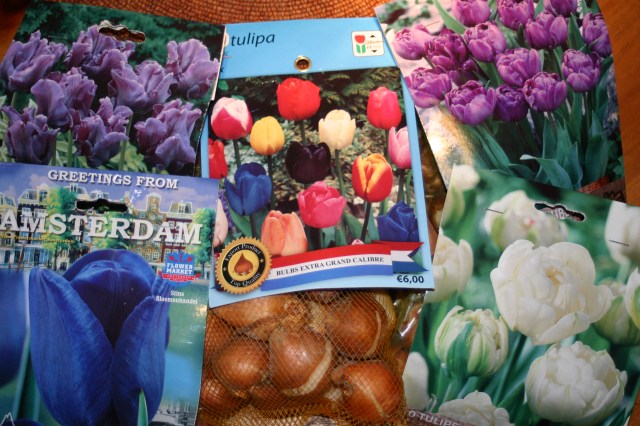
I mentioned my visit to the Amsterdam Flower Market recenrtly and here’s the 70 tulips I have for adding to the many groups that I already have in borders and pots at Old School Garden.

Tulips from Amsterdam...
Tulips from Amsterdam…

Sources and further information:

Wikipedia

Growing Tulips- RHS

How to grow Tulips- Bunny Guinness

Tulips and Holland

Tulip Mania

Eating Tulip flowers

Related articles:

It’s Time to Talk Tulipsage

PicPost: Tulip Mania

Tip Toe Through the Tulips

Tulip mania and Bitcoin

Bloemen Marvellous

November in the Garden: 10 Top Tips

A-Z of Perennials: Q is for Quamash

GQT: Grow-bag Bulbs

Pleasing Planters

May in the Garden- Top 10 Tips

Plants to die for…

Old School Gardener

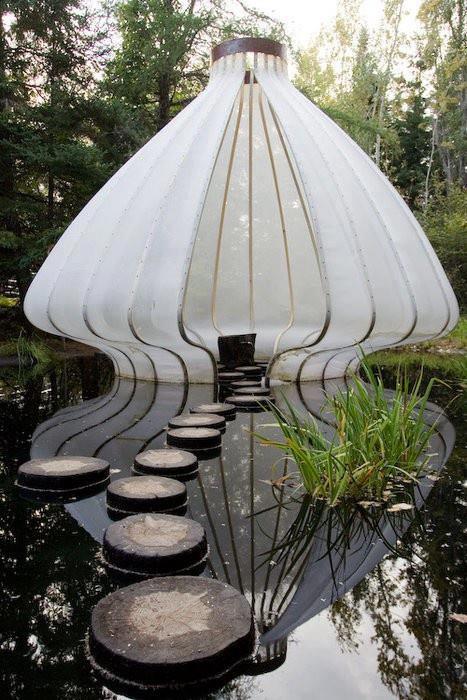
PicPost: Imagine

Old School Gardener

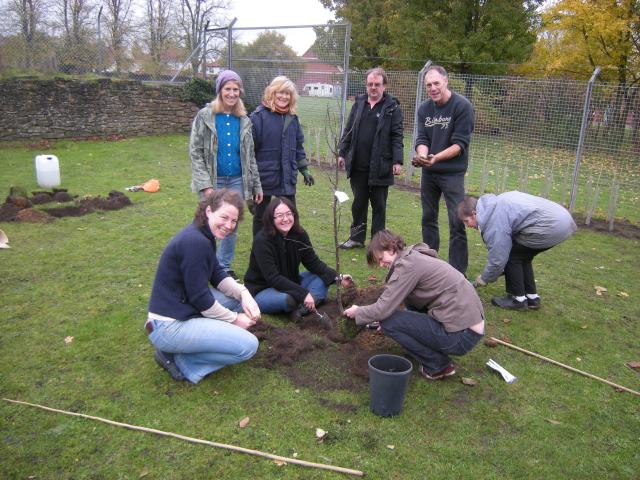
Getting to grips with fruit tree planting- the group at Wensum View Park

Getting to grips with fruit tree planting- the group at Wensum View Park

You may remember that we opened Old School Garden to the public for the first time back in July. Apart from the fun (and worry!) of sharing the garden and getting people’s feedback, it was a chance to raise some money for some local ‘good causes’. The £300 raised was divided equally between gardening projects at Cawston V.C. Primary School (where I help out as a volunteer), towards the upkeep of the fabric of St. Peter’s Church, Haveringland- the ‘Church in the Fields’ you can see from our garden-  and to support small – scale projects in the Norfolk Master Gardener programme.

One of the latter involved funding some new fruit trees for a Community Garden in Norwich and the Master Gardener supporting that project, Jeremy Bartlett, has written a piece about the planting event yesterday. I’m so pleased that our little fundraising effort has achieved something worthwhile- I’ll report on other projects funded in due course, but for now here’s Jeremy’s article.

‘Volunteers spent the morning of Sunday 17th November 2013 planting fruit trees and an edible hedge at Wensum View Park in Norwich, thanks in part to a Norfolk Master Gardener Grant .

The park, at the back of Turner Road in Norwich, is owned by Norwich City Council and contains a small children’s playground and a large area of grass used for games and by dog walkers. Local residents wanted to do more with the park and set up Wensum View Park Community Garden Group in early 2012. Following a public consultation by Norwich City Council earlier this year (http://www.norwich.gov.uk/Environment/ParksAndOpenSpaces/Parks/ParksImprovements/Pages/WensumViewPlayArea.aspx) work to transform the space began this autumn.

So far there have been two gardening tasks, led by Master Gardener Jeremy Bartlett, who has had previous experience setting up and maintaining Norwich’s Grapes Hill Community Garden (http://www.grapeshillcommunitygarden.org/).

In early October we created a herb bed and planted crocus bulbs. This was followed by a task on the morning of Sunday 17th November 2013 when about twenty-five volunteers planted fruit trees and an edible hedge. A Norfolk Master Gardener Grant for £45 went towards the cost of the fruit trees and the 105 small saplings for the edible hedge were supplied by the Woodland Trust.

We planted nine fruit trees: single trees of Apples “Golden Noble” and “Discovery”, Figs “Brunswick” and “Brown Turkey”, Medlar “Nottingham” and Quince “Champion”, two Plums “River’s Early Prolific” and an unnamed variety of Plum, which was donated by a local resident. The hedge consists of Elder, Dog Rose, Blackthorn, Hazel and Crab Apple and will add to the edible harvest once it is established.

Our next task, planned for January or February 2014, will be to build a raised bed for planting herbs and vegetables.

Wensum View Park Community Garden Group have now signed up as a Master Gardener household and Jeremy will continue to provide free growing advice during the next twelve months.

Wensum View Park (also known as “Wensum View play area”) is located on Dereham Road in Norwich. Its entrance is between numbers 319 and 321 Dereham Road and it is open to all, free of charge, every day during daylight hours.’

Old School Gardener

IMG_6950

Our last, late summer visit to a west country garden, Killerton, did not disappoint. We enjoyed a very informative tour in a golf buggy and strolled around the grounds on a sunny afternoon. Lying just outside Exeter, Killerton is a massive estate and we had a little trouble actually finding the entrance (road signs and sat nav conspired against us!). Nevertheless we had a warm welcome.

Killerton is notable as the ‘home given away’. It’s last private owner,  Sir Richard Acland did just this with the whole estate of over 2,500 hectares (including 20 farms and 200-plus cottages), one of the largest acquired by the National Trust. Acland held a strong belief in the common ownership of land and was a founder member of the British Common Wealth Party, formed in 1942 to oppose the wartime coalition and to advocate a co-operative form of socialism, in contrast to the state-led approach of the Labour Party. However, the group never achieved an electoral break through and Acland joined the Labour Party in 1945. He was also one of the founders of the Campaign for Nuclear Disarmament (CND).

The original gardens at Killerton were designed in the late 18th century by John Veitch, one of the leading landscape designers of the time. It features rhododendrons, magnolias, herbaceous borders and rare trees surrounded by rolling Devon countryside. Many of the trees and the views of the surrounding countryside are very impressive – here are some pictures.

The grounds also house – typically for the 19th century – an Ice House and a curious Summer House which is of a rather gothic design and features a strange assortment of decorative materials – including animal bones, hides and fir cones! Here’s a second set of pictures.

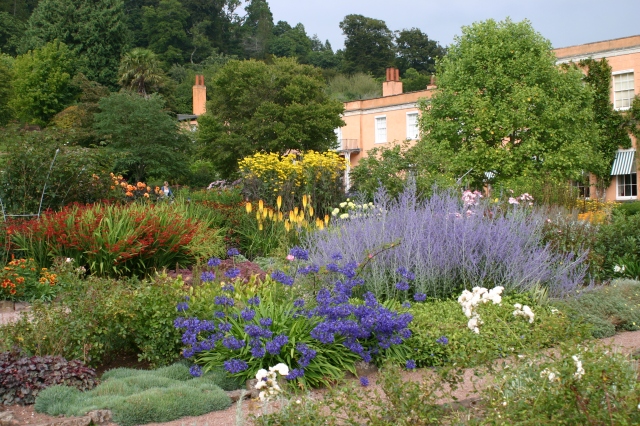
However, the ‘parterres’ or mixed herbaceous borders, full of late summer colour when we visited, stand out as my most significant memory of Killerton. These were designed by the late 19th century gardener, garden writer and designer William Robinson. They have some classic plant combinations and bold drifts, typical of the mixed herbaceous borders coming into vogue around this time, and which have been influential in English garden design up to the present day. This area features a central path and secondary paths with Coade stone urns as focal points. The layout of the borders is perhaps curious given Robinson’s advocacy of  ‘wild gardens’ – a more naturalistic approach to garden design. But even these semi formal designs, with their ‘loose planting’, were seen as revolutionary.  Apparently, Killerton’s head gardener at the time said:

‘it of course spoilt the park, starting as it does and ending nowhere, I got into bad odour condemning it’.

Robinson’s ideas about ‘wild gardening’ spurred the movement that evolved into the English cottage garden, a parallel to the search for honest simplicity and vernacular style of the British Arts and Crafts movement. Robinson is credited as an early practitioner of the mixed herbaceous border of hardy perennial plants, a ‘naturalistic’ look in stark contrast to the high Victorian ‘pattern garden’ of planted-out bedding schemes. Here is a gallery that, hopefully captures the best of these glorious borders.

Further information:

National Trust website

William Robinson- Wikipedia

Old School Gardener

With the first real ‘icy blast’ due in the UK this week, here’s a useful video reminder of some key jobs to do before winter really takes hold! (Thanks to Grow Veg)

Old School Gardener

PicPost: Hay Bale Garden

Flower and Hay Bale Garden by Carol Leigh Thomas

PicPost: Maxing out

Garden Museum: Visits Programme 2014

lavendar

New programme just announced!

  1. Suffolk Study Day with Tom Hoblyn – Re-Scheduled for Spring 2014

  2. A Garden of Surprises at Burghley House, 12/03/14

  3. Design Study Day with Cleve West, 07/04/14

  4. Syde and Frampton Manor Gardens and Pan Global Plants, 25/06/14

  5. Longstock Park Water Garden & Houghton Lodge, Hants, 14/05/14

  6. Walking London Squares with Todd-Longstaffe-Gowan, 22/05/14

  7. Traditional Splendour in Cambridgeshire gardens, 05/06/14

  8. The Old Rectory with Dan Pearson and Rockcliffe House, Glouc,02/07/14

Old School Gardener

Tiered Box hedging in the lower garden

My recent trip to Lisbon, Portugal, was very much a ‘Garden Fest’ (even though it was really about seeing our Daughter and Son-in-law who live there). I seem to have found several more superb gardens and parks to add to those old favourites covered in earlier articles in the category ‘Portuguese Gardens’. The Jardim Botânico d’Ajuda (Ajuda Botanical Garden) was the first we visited, after an interesting tour of the nearby Royal Palace of Ajuda – richly decorated and with some ‘garden’ interest of its own- (more on that in a later article!).

History

The Ajuda Botanical Garden was a real find. The first and oldest botanical garden in Portugal, it is also without doubt one of the most beautiful I’ve visited in Lisbon. It was created in the 18th century for the Portuguese royal family.When the earthquake of 1755 hit Lisbon, the royal family was living in the palace of Belém (just down the hill next to the River Tagus), and which sustained relatively little damage. However, fearing more tremors, they camped in tents outside the palace for some time, and later, as the king refused to live in a brick building, the Marquis of Pombal (a powerful statesman who led the reconstruction efforts after the earthquake), had a wooden residence built for the royal family furtehr up the valley side. However (and how unlucky must the King have felt), a fire destroyed this building in 1791. So it was later replaced with the Palace of Ajuda.

In 1765, the King ordered naturalist Domingos Vandelli to create a botanical garden near the, then wooden, residence of the royal family. The king wanted to create a garden for his grandchildren, where they could play and learn about horticulture. Vandelli constructed the garden over the course of the following three years with the help of Júlio Mattiazi, who was master gardener of Europe’s oldest botanical garden in Padua, Italy.

About 25 years later Domingos Vandelli was appointed director of the Royal Botanic Gardens and in this position he collected some 5.000 different plant seeds from all over the world. During the 18th until the late 20th century, the garden was maintained by a number of different institutions, and more often than not it was neglected. In 1993, with the support of funds from the EU and the Lisbon Tourist Association, a reconstruction effort started, and the garden regained its earlier glory in 1997.


The Design

The garden is designed in Baroque style with a strict geometric layout and decorated with monuments. Occupying some 3.5 hectares on the side of the river valley, the garden is divided into two terraces connected with each other by a monumental Baroque staircase, the Escadaria Central.

The lower, bottom terrace, has an Italianesque layout with a geometric pattern of paths and long hedges of boxwood arranged around flower beds. Plenty of tall trees provide some welcome shade. At the center of the lower level stands a monumental fountain, the Fonte das Quarenta Bicas (Fountain of the Forty Spouts). The 18th century fountain actually has 41 water spouts, disguised as serpents, fish, sea horses. Other statues of frogs, shells and ducks decorate the fountain that is placed at the center of a large basin with water plants.

At the western end of the lower level there are some exotic plants as well as a small rock garden, but the most interesting exotic plants are housed on the upper level where there are some remarkable specimens, most notably a 400 year old dragon tree and an equally large Schotia Afra. There is also a fair number of smaller plants such as the colorful Tecoma Capensis and the Japanese Camellia.

As a bonus, there are not just plants in the botanical gardens; plenty of peacocks strut around the gardens, doing their best to ignore the visitors!

I also had a pleasant time chatting to one of the gardeners, who was setting out leaf cuttings in one of the large glasshouses, this one devoted to a wide ranging collection of succulents, many beautifully arranged in naturalistic table top settings. This gardener was hugely complimentary of Kew Gardens, where she had worked and  was, she said, trying to recreate something of that wonderful exotic collection here. She was doing a grand job, and I told her so.


Look out for the next instalment in this latest ‘Gardens Tour of Lisbon’!

Source: A View on Cities

Related articles:

Oranges and Azulejos: Portuguese Heritage Gardens

PicPost: Great Garden @ Pena Palace Park

PicPost: Great Garden @ Praça do Império Garden, Belem, Portugal

PicPost: Great Garden @ Buddha Eden, Portugal

Portuguese Gardens: Tropical Botanical Gardens, Belem

Portuguese Gardens: Braga

Portuguese Gardens: Estrela Garden, Lisbon

Old School Gardener

Finding Nature

Nature Connectedness Research Blog by Prof. Miles Richardson

Norfolk Green Care Network

Connecting People with Nature

Discover WordPress

A daily selection of the best content published on WordPress, collected for you by humans who love to read.

Susan Rushton

Celebrating gardens, photography and a creative life

Unlocking Landscapes

Writing, photography and more by Daniel Greenwood

Alphabet Ravine

Lydia Rae Bush Poetry

TIME GENTS

Australian Pub Project, Established 2013

Vanha Talo Suomi

The Journey from Finnish Rintamamiestalo to Arboretum & Gardens

Marigolds and Gin

Because even in chaos, there’s always gin and a good story …

Bits & Tidbits

RANDOM BITS & MORE TIDBITS

Rambling in the Garden

.....and nurturing my soul

The Interpretation Game

Cultural Heritage and the Digital Economy

pbmGarden

Sense of place, purpose, rejuvenation and joy

SISSINGHURST GARDEN

Notes from the Gardeners...

Deep Green Permaculture

Connecting People to Nature, Empowering People to Live Sustainably

BloominBootiful

A girl and her garden :)