Tag Archive: garden
‘Sow Lettuce, Alaternus, phillyrea seedes, Kirnels &c. and now begin to secure & by little & little, as the season proves, withdraw your choicer & tender Greenes & prepare them for the Greene house.’
John Evelyn 1686 (published 1932)
Notes:
‘Alaternus’ refers to Rhamnus alaternus, an evergreen shrub favoured by Evelyn in hedging, but which fell out of favour years later as being too labour intensive to maintain.
‘Phillyrea’ was another evergreen shrub of which Mary Keen says:
‘Gardeners of the 17th and 18th centuries, who were less spoilt than those of today, loved any tree or shrub that kept its leaves through winter. John Evelyn referred to evergreens as “Verdures, Perennial Greens and Perpetuall Springs”. Among the most highly regarded of these, and a front- rank treasure in the Georgian shrubbery, was phillyrea, often described as “of incomparable verdure”.
It is rarely seen now, which is a pity. Phillyrea may no longer rate superstar treatment but it is both useful and attractive, making neat hedges, trees full of character and elegant backgrounds.
A member of the olive family, phillyrea is sometimes known as evergreen privet. It is, however, both more distinguished than privet and less gloomy than conifers at this time of year because its leaves reflect rather than absorb light. Unlike a currently popular evergreen, box, it does not seem to be susceptible to blight and it has tiny, scented, greeny-white flowers, which appear in spring. (It is reminiscent of the popular shrub osmanthus, which also comes from the olive family.)…’
3. Evelyn’s use of the words ‘Greene house’ appears to refer to its early use in protecting tender green(e)s. The first use of the words appears in the 1660’s and many other terms were used to refer to similar glazed constructions: conservatories, orangeries, botanical gardens etc.
Old School Gardener
Do avoid disturbing the soil unless necessary. Each disturbance produces a new batch of weed seedlings.
Do keep weeds under control by removing weed seedlings and topping up the mulch before the garden springs to life each year.
Do choose plants which are self-supporting, particularly if your garden is exposed.
Don’t choose short-lived plants that need replacing every few years. Avoid using annuals.
Don’t over feed- otherwise plants will become vulnerable to damage.
Don’t plant self-seeders near gravel paths or loose-laid paving.
Source: ‘Short cuts to Great Gardens’- Reader’s Digest 1999
Old School Gardener
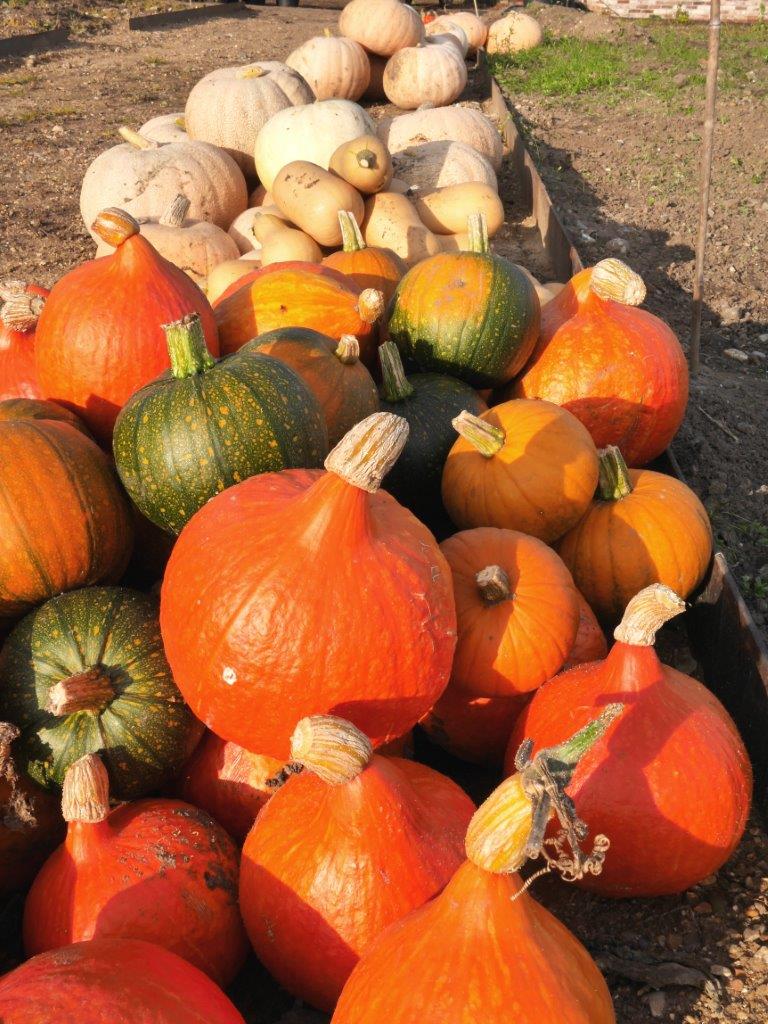
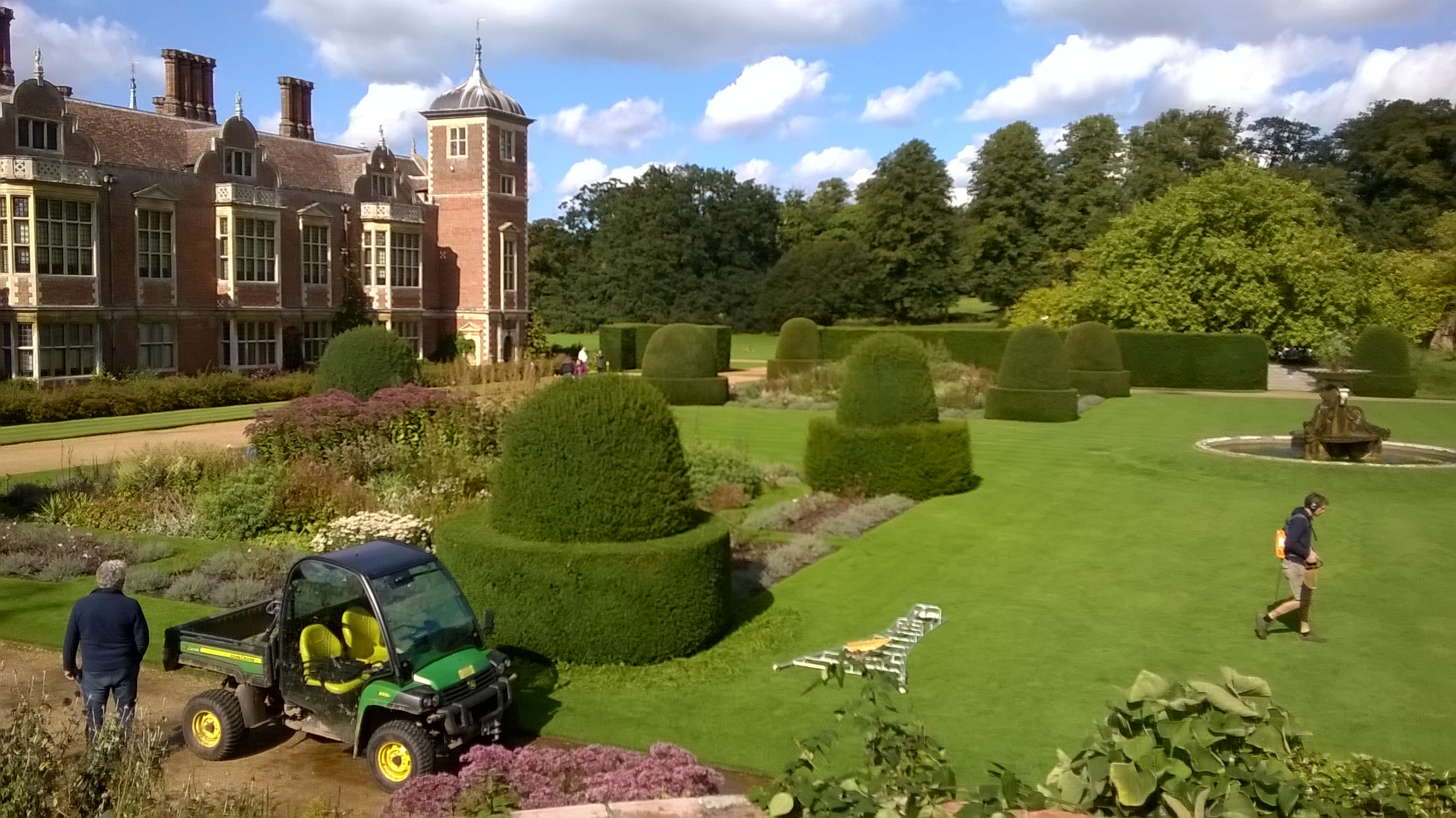
It was great seeing how the pumpkins and squashes that I’d help to plant only a couple of months ago had taken over a large part of the walled garden.
On my most recent visit to blickling, together with new volunteer Gordon, I picked a large number and many heavy weight fruits on a bright, sunny day. We then managed to fill two trailers with the remaining foliage and stems and raked over the ground to leave it for weedkilling action; Project Manager Mike doesn’t like to use chemicals like this, but manpower is limited so it’s a must do in the short term to keep the ground under control.
The pumpkins will probabaly be used in the Hall’s forthcoming Hallowe’en events and the squashes in the restaurant, so its good to see that the developing kitchen garden is continuing to be of practical value.
After that we joined the ladies in weeding the well stocked veg patch along the south facing wall. This all looks very neat, healthy and tidy, despite the threat of rabbits and pigeons.
The Gardens continue to show a great range of colours and textures with Japanese Anemones, Sedums and various grass flowers now adding their sublety to the mix…
Last week I commented on how pleased I was at being able to identify (with their latin botanical names) three plants I was asked about by visitors. I said then it was probably a fluke, and sure enough this day, when asked by a visitor to name a rather unusual pink flower in the double borders, I was stumped- but then again so was another volunteer and one of the gardening staff! I’m trying to find out its name; I think it might be a Salvia of some sort- I’ll post a picture, and its name in my next Blickling post!
Further Information:
Blickling Hall website
Blickling Hall Facebook page
A 360 degree tour of Blickling Hall
Old School Gardener
Old School Garden – 29th September 2015
To Walter Degrasse
Dear Walter,
I’ve looked back at what I wrote to you at this time last year and it began ‘I’m feeling very guilty’. Once more I find myself confessing to not much happening in the garden, well until the last few days at any rate.
As you know we went on a two week trip to the Hebrides (Mull and Arran) and Northumberland in late August-early September and this, coupled with an earlier spell away in Portugal has meant that the garden has been sorely neglected; but for the harvesting and watering efforts of our daughter, Lindsey and friends Steve and Joan, that is.
My other excuse, and you’ll be bored at me banging on about this, has been decorating, decorating, decorating…and still one more room to go plus some finishing details.
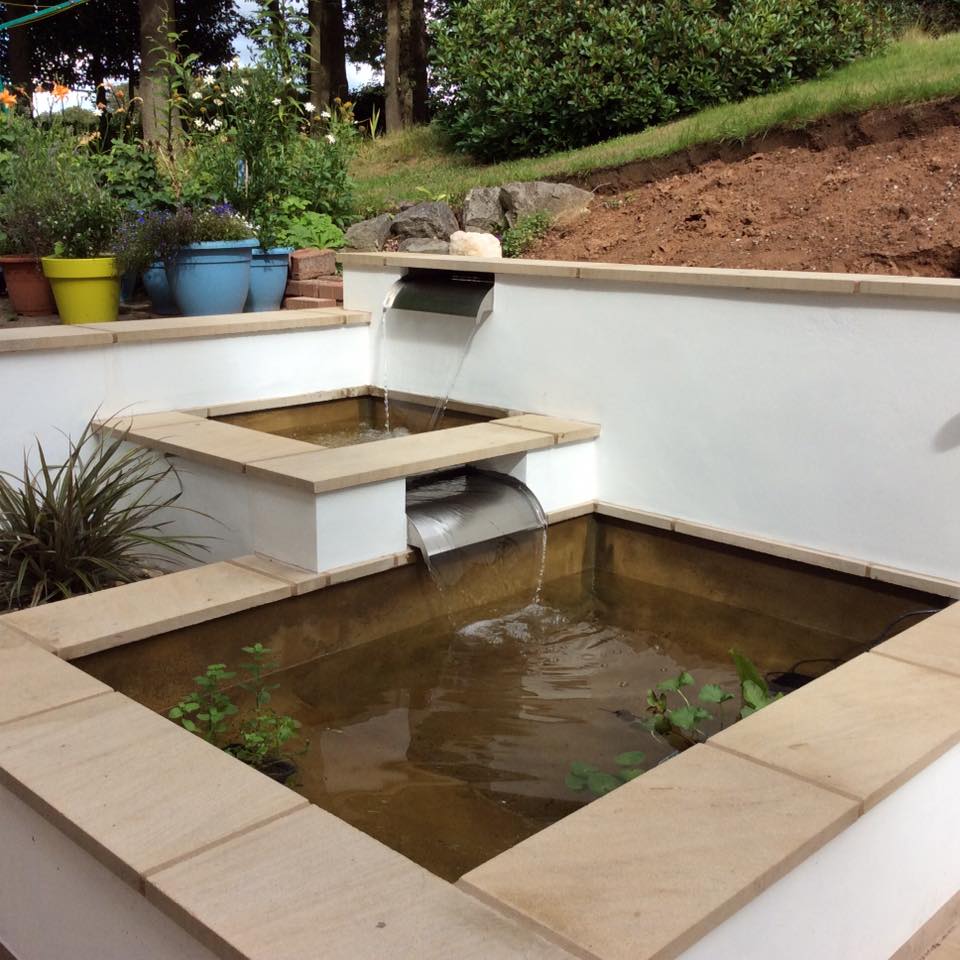
Enough of the excuses, what have I been up to in the garden? Well of late hedge cutting, including an overdue trim of the neighbours’ side of a mixed hedge that forms one of our boundaries. And today I am going to do drastic work on that laurel hedge that backs the main lawn (or should I say ‘Mole patch’). You might recall my plans to create a wildlife pond on the northern side of this and how my plans for the hedge are to:
-
let more sunlight into the pond area
-
reduce the height of the hedge to make it easier to maintain
-
create a sweeping curved profile to add visual interest.
Well, I’ve made a start with hedgecutter and loppers and today I will try to tackle the thicker stems using the wonderful battery-powered chainsaw I was given to trial by it’s makers Ego. And I mustn’t forget to mention Deborah’s efforts in weeding paths and beds, which has certainly made things look a lot tidier.
Despite the neglect nature seems to find a way of surviving and so there’s still plenty of ornamental interest in the garden at present, including a lovely Hydrangea paniculata, Sedums, and of course the various grasses which are now starting to put out their feathery flowers.
There seems to be a good crop of apples on the way to add to those already picked. It’s also been a good year for figs and we are just about coming to the end of the cucumbers, peppers (which were decimated by an attack of caterpillars) and tomatoes (the shortening days and contrasting night time and daytime temperatures are having their effect on what remain on the plants). I’m also rather pleased with the crop of squashes this year, largely planted to provide ground cover while we were away, and they seem to have done this and rewarded us with a winter’s supply!
Returning to the house renovation side of things, I finally bit the bullet and chopped off the stems of the ivy growing up the front of the house, which had been encouraged to cover up some rather unsightly painting over flintwork (sacrilege). I now plan to remove the dead stems with crow bars etc and then get the builders in to sandblast the front and repoint the stones. Quite an undertaking, but I think it will be worth it in improved appearance alone.

The front of the house with its, now dead, ivy- removing this, sandblasting and repointing the flintwork will be a major undertaking, possibly before winter really sets in
I’ve also been splashing out on some bulbs and spring bedding in the form of violas and pansies, which I’ve started to use in some of the containers that were beginning to look a bit sad. They will hopefully provide a good splash of colour during the dark winter months. Oh, and I came across a plant on a visit to Wallington Hall in Northumberland (more on this visit in due course) which I couldn’t resist; a Crocosmia called ‘Norwich Canary’- as a season ticket holder at Carrow Road it just had to come home with me!
It’s also that time of year when I put out the bird feeders and I was immediately rewarded with the usual crowd of Blue and Great Tits plus a few other species. It is lovely watching them have their breakfast while we have ours.
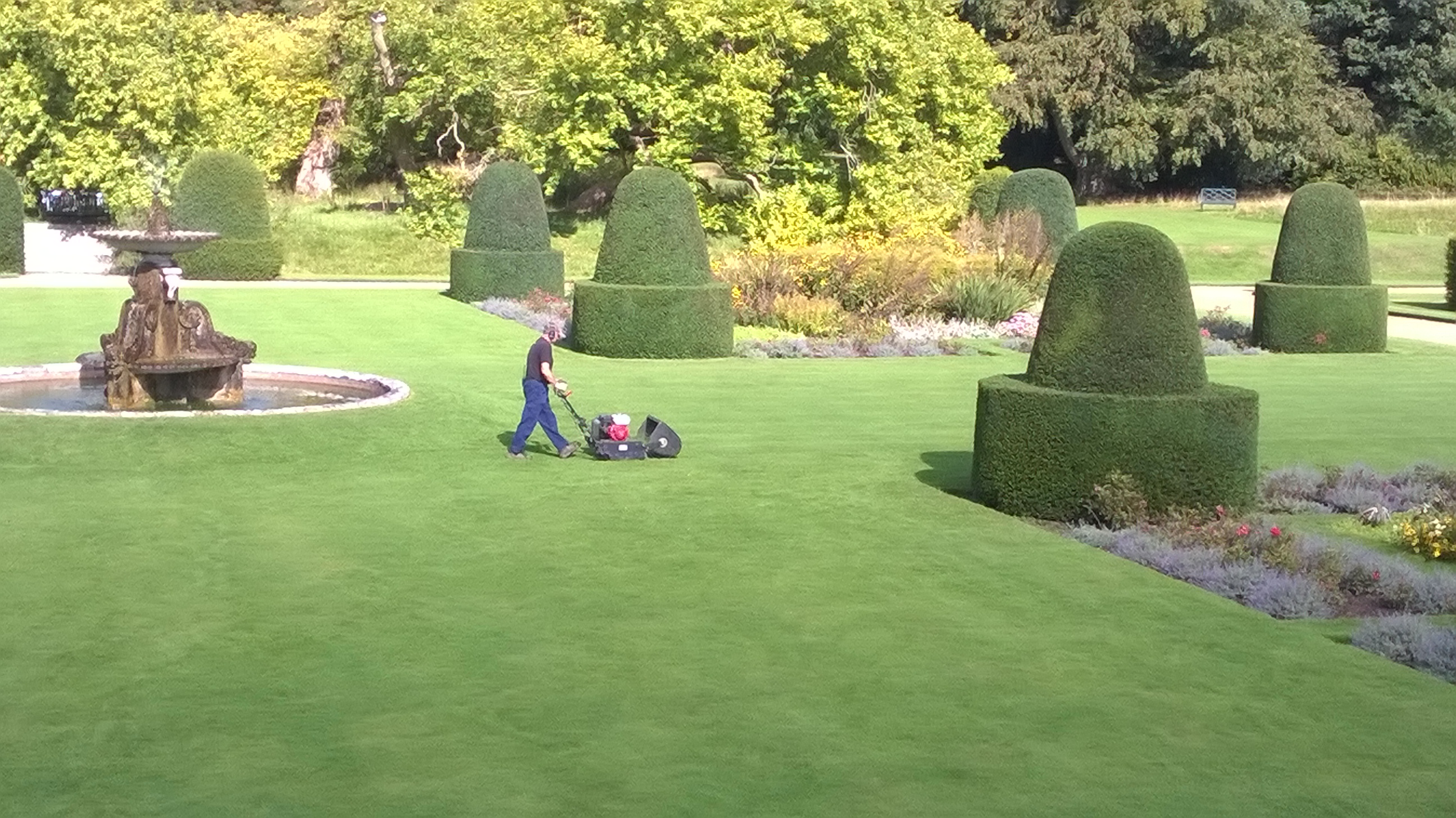
On the wider gardening front I’ve re-engaged with my voluntary input at Gressenhall and Blickling. I’ll be posting about the latter in the next few days, and for the former I’m pleasantly surprised at how well my areas of responsibility have come through the summer and into autumn. I went in last week and felt that not much tidying was required so I turned my hand to mowing the grass and edging this. The front entrance border with its mix of grasses, lavenders and shrubs was looking great.
Oh, and I may well be running my garden design course once more. you might remember that the Reepham Learning Community is no longer functioning so my venue at the High School is no longer available. So I’m making enquiries about running a day time course in the New Year using accommodation at Blickling. This looks promising, and it might be especially helpful to use the gardens here as a way of illustrating elements of the course. I’ve also been invited by a former student to give a talk on the basics of garden design to her gardening group near Fakenham soon, so that will help me to keep my hand in on the teaching front.
Well I think that just about wraps up my recent gardening life. How is your garden looking just now? I bet it’s a picture with the weather helping to bring out those lovely autumn leaf colours in your wonderful collection of trees.
All the best to Ferdy Lise and we hope to see you soon, old friend,
Old School Gardener
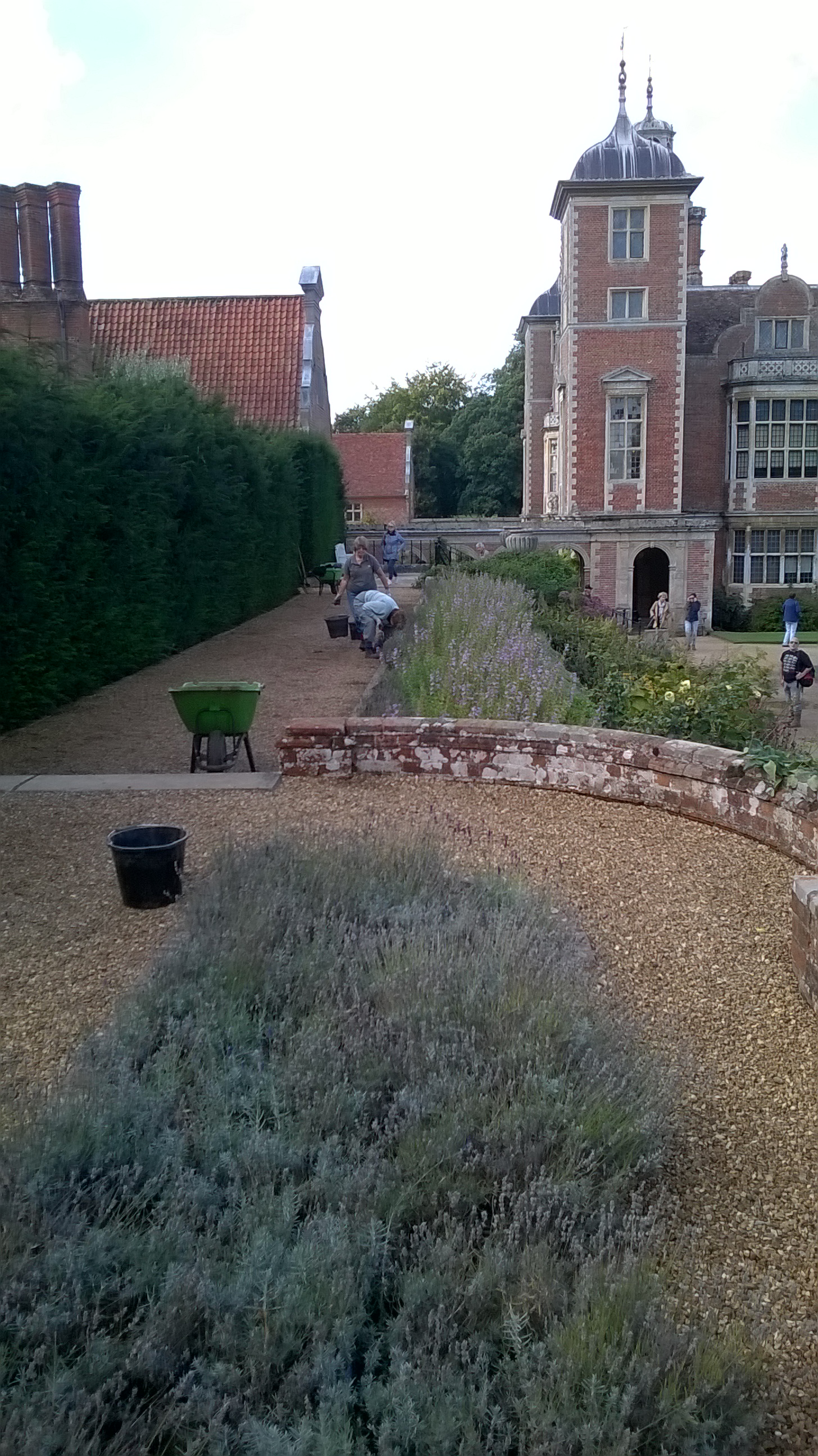
My last session at Blickling Hall involved a lot of weeding along paths in the double borders- which continue to look superb as late summer flower colour is added to by the flourishing grasses.
The White Borders are also looking particularly good, and the Penstemons seem to be hanging on too.
One of the pleasures of volunteering in the gardens is getting to meet and talk with the visitors, many of whom have great gardening experience. On this occasion I was asked the names of three different plants in the borders and I rather surprised myself that I knew all of their latin names! Must be a fluke…
The last person to ask me seemed more than usually interested in the latin names; it turned out he was a chemist and knew latin pretty well, so was able to translate some of the more common terms for describing colours, flower and foliage form etc.
I was also amazed to see how tall the Pawlonia had grown and with such huge leaves! You may recall me being given the task earlier in the year of pruning these back; it certainly seems to have paid off.
Further Information:
Blickling Hall website
Blickling Hall Facebook page
A 360 degree tour of Blickling Hall
Old School Gardener
To Walter Degrasse
Dear Walter,
Another month and little to report as far as Old School Garden is concerned! As you know we’ve spent around 10 days away in Portugal (more posts on this to follow in the next few days), and once more we seem to have found some lovely and interesting places to visit. Fortunately my neighbours and good friends Steve and Joan were able to get in to water while we were away.
There seems to have been a good harvest of tomatoes, cucumbers and soft fruit while we’ve been abroad, and this is continuing ,though starting to tail off a little (apart from the prolific blackberries and promise of many apples to come). The new watering/feeding system for the greenhouse tomatoes seems to be going well, though it seems many others have had a good crop of tomatoes this year too, so we must hold fire on any final conclusions about its advantages over other systems- but having the reservoirs does make watering less of an issue while you’re away.
Almost the first thing I noticed when looking round the garden was a new rash of mole hills and tunnels, so the mole man’s achievement of catching two, has paled as we seem to ave around four or five new and probably young moles at work! I swear they were waiting in the borders for us to go away before they came out into the grass! As we are about to go away again (to Scotland and Northumberland, isn’t retirement tiring?) I’ll hold off on any further action until we return- as I have a couple of traps I might have a go myself.
You know I’ve been puzzled about my raspberries – you might remember that for a few years now the second half of the autumn fruiting variety has not produced any flowers or fruit? Well, I noticed one summer type- fruit on one of the canes the other day and that got me thinking. Maybe these canes are summer varieties and therefore I’ve been pruning them wrongly! I shall leave the canes that have grown this year and treat them like summer varieties and we’ll see if they produce anything next year.
The garden is looking very full and flouncy and its a pleasure just wandering around it or sitting on the terrace, though recent weather seems to have announced autumn rather than the expected dry warmth of late summer! Thankfully most of my house decorating is now done, so I can turn my hands to the garden more seriously upon our return from the north. I’m keen to press on with my pond project and I’m gathering lots of ideas for this as I look round gardens and parks on our travels. Also, as my old potting shed is now reaching the end of its life, I’m thinking about creating a new one using the floorboards taken up during our refurbishment works. This will probably be a spring project.
Well, old friend, once more to the joys of packing cases for another trip, hopefully to include some beautiful landscapes and interesting places (we’re also taking our bikes!), as well as seeing our old circle of college pals for our annual ‘road trip’…
Good gardening!
Old School Gardener
If you’ve enjoyed reading this post and others on this blog, why not comment and join others by signing up for automatic updates via email (see side bar, above right ) or through an RSS feed (see top of page)?