Tag Archive: flowers


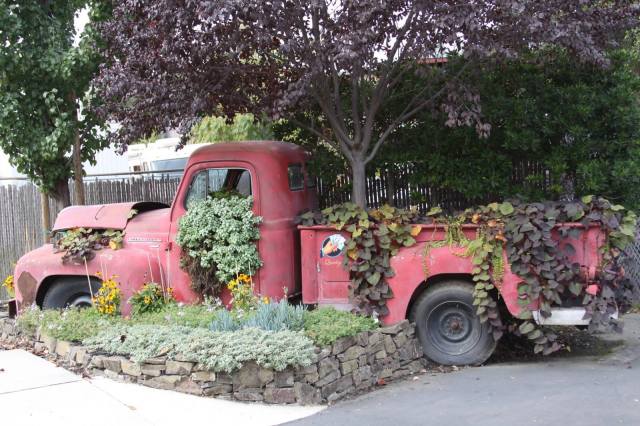
Some great DIY ideas here

Old School Gardener

Hamamelis_flowersOK, a bit of a stretch with this entrant, as Hamamelis is more often a shrub rather than a tree, but there don’t seem to be any garden trees with a botanical name beginning with ‘H’ (go on, prove me wrong)!

Common name: ‘Witch – Hazel’ and occasionally for the North American species, ‘Winterbloom’

Native areas: A native of North America (3 species- ovalis, virginiana and vernalis) Japan (japonica) and China (mollis).

Historical notes: The name ‘Witch’ in witch-hazel has its origins in the middle english word ‘wiche’, from the Old English ‘wice’, meaning “pliant” or “bendable”. “Witch hazel” was used in England as a synonym for Wych Elm (Ulmus glabra) American colonists seem to have simply extended the familiar name to the new shrub they found in their new home. The use of the twigs as divining rods, just as hazel twigs were used in England, may also have influenced the “witch” part of the name. The plant-hunter Charles Maries collected Hamamelis mollis for Veitch Nurseries from China  in 1879. It languished in nursery rows for years until it was noticed, propagated and put on the market in 1902.

Hamamelis in Colonial Park Arboretum and Gardens

Features: The witch-hazels are deciduous shrubs or (rarely) small trees growing to 3–8 metres tall, rarely to 12 metres tall. The leaves are alternately arranged, oval, with a smooth or wavy margin. The genus name, Hamamelis, means “together with fruit”, referring to the simultaneous occurrence of flowers with the maturing fruit from the previous year. H. virginiana blooms in September-November while the other species bloom from January-March. Each flower has four slender strap-shaped petals 1–2 centimetres long, pale to dark yellow, orange, or red. The fruit is a two-part capsule 1 centimetre long.

Uses:  Witch Hazels are popular ornamental shrubs, grown for their clusters of rich yellow to orange-red flowers which begin to expand in the autumn as or slightly before the leaves fall, and continue throughout the winter. Hamamelis virginiana is rarely seen in the nursery trade except for woodland/wildlife restoration projects and native plant enthusiasts. Much more common is H. mollis, which has bright red flowers that bloom in late winter instead of the yellow blossoms of H. virginiana which tend to be lost among the plant’s autumnal foliage. Numerous cultivars have been selected for use as garden shrubs, many of them derived from the hybrid H. x intermedia ‘Rehder’ (H. japonica × H. mollis). Jelena and Robert de Belder of Arboretum Kalmthout, selecting for red cultivars, found three: the first, with bronze flowers, was named ‘Jelena’; the next, with red flowers, was named ‘Diane’ (the name of their daughter); the last, with deep red flowers, was called ‘Livia’ (the name of their granddaughter). The cultivar ‘Arnold Promise’ (mature height 3- 5 metres) is recognised as one of the best yellow-flowering Witch – Hazels, with magnificent yellow flowers that contrast with the red inners, which sometimes last as long as two months without fading.

This slideshow requires JavaScript.

Growing conditions: An open, sunny position is best, as plants become straggly in shade, although they do tolerate partial shade. Avoid exposed and windy positions. Young witch hazels can be damaged by hard frosts, so avoid frost pockets, or be prepared to protect plants with a couple of layers of horticultural fleece in their first few years if there is a hard winter or late spring frost. Witch hazels need free-draining soil conditions with an adequate supply of moisture. A light soil with plenty of added organic matter, such as well-rotted manure or compost, is best. They will tolerate heavy or clay soils if they are improved by digging in organic matter and by ensuring good drainage. Acid to neutral soil pH is preferred (pH 4.5-6.5). Witch hazels may tolerate deep soils over chalk, with plenty of added organic matter. If they become chlorotic (yellow) because of the high pH, then treatment with a chelated (sequestrated) iron fertiliser, ideally one that also contains manganese, can help. They are unlikely to tolerate shallow chalky soils.

Hamamelis virginiana

Further information:

Wikipedia- Witch – Hazel

RHS- Hamamelis

Barcham trees directory- Hamamelis x intermedia ‘Arnold Promise’

7 plants for Winter Wonder

Old School Gardener

Picture via 1001 Gardens

Old School Gardener

house of flowers

Old School Gardener

IMG_9045

Old School Garden

30th June 2014

To Walter Degrasse

Dear Walter,

As I sit looking out at the courtyard here at Old School Garden, the sun has returned after a series of heavy showers that have dominated the weather here over the last few days (some have been thundery). The last month has been a mix of sunshine and rain, the heat building, but not yet above the low 20’s Celsius- quite pleasant, though.

The month in the garden has been typical – the bulk of the ‘heavy’ work was completed in May and this month I’ve been rather focused on ‘preening and planting’ (when the weather permits). Having said that I did undertake a project to reinforce the ‘Fruit Fence’ I erected a few years ago. You might remember seeing this in the kitchen garden. It sits on the northern boundary of the garden next to a wood and effectively forms the edge of a raised bed I created to make use of some surplus soil and create an elevated space for food growing.

I have a Cherry and Plum I’m training into fans against this fence, but over time the posts have leaned over and some work was needed to strengthen this and put in a proper edge to the raised bed (I used sleepers on the other edges). Having got hold of some pallets I decided to try to use these, along with landscape fabric, to create the edge and add in some further posts to buttress the existing ones. I’m pretty pleased with the outcome (see pictures below). As you know, old friend, I’m a fan of recycling in the garden, and especially if it involves those modular wooden wonders, pallets.

The project involved digging out holes next to the four uprights and screwing these to the existing posts. I then cleared an area of nettles and dug out a trench on the woodland side to receive the pallets, which I’d earlier cut into halves. I fixed a length of batten to the frame to which I could then fix the pallets, I used landscaping fabric to ‘wrap’ the pallet sections along the length of the frame, and then extended this for a couple of metres over the adjacent woodland floor, to provide a new storage area for things like plastic plant trays, baskets and chicken wire.

Finally, I used plastic green shading fabric to provide a full backdrop to the frame. I reckon this should help both to shelter the plants a little, as well as providing a dark surface to absorb the sun and so warm the area for the fruit. The additional storage area, which is screened from the main garden, is a real boon and I plan to clear a further area of nettles to keep the woodland edge at bay. And talking of ‘recycling’, you may have also seen my recent post on the old bike rack I converted to a plant stand or ‘theatre’, on which now sit six rows of pelargoniums, nicely lined up in small terracotta pots.

The finished 'Plant Theatre'

The finished ‘Plant Theatre’

The last couple of weeks has seen the first crops of fruit and veg from the garden; we’ve had Raspberries, Strawberries, Calabrese, Broad beans, Chard, Mangetout and early Potatoes in good quantities, testimony to the mild and wet winter and spring we’ve had. Here are some pictures from the Kitchen Garden…

This slideshow requires JavaScript.

The potatoes were a real surprise. I left the first earlies in the ground and waited for the flowers to die down before investigating – a bit too late as it turns out as when I dug up the first row I was amazed at the size of some of them – as the pictures below show, we had some real whoppers! However the first row (which was the one receiving the most sun) was as productive as the other three rows put together! Two rows of second earlies, harvested at the same time, have produced an equivalent amount of better- sized potatoes. The first of these (‘Charlotte’) were delicious the other day.

This slideshow requires JavaScript.

However, I’m disappointed with the apples this year- I think the mild and wet weather brought a dose of ‘blossom wilt’ (as well as some insect damage), so there are relatively few fruits developing on the trees. In contrast the pears and plums are looking good, and we’ve had the first crop of (large) Gooseberries. The blackcurrants are already dripping from the bushes, so that’ll be a another harvesting job for the coming week (we’re still eating last year’s harvest from the freezer!). We’ve also had a couple of  ‘ridge’ cucumbers grown outside in a pot and more are on the way, as are the tomatoes, mainly growing in the greenhouse. Here are some pictures of the produce and the kitchen garden.

Pest control has never been far from my mind, recently. The new ‘plastic owl’ bird scarer I bought seems to have had little effect, I’m sorry to say, so the only sure-fire method of keeping the birds (mainly wood pigeons but also blackbirds and smaller birds) at bay is netting. I’ve adopted and adapted an old-fashioned method of protecting bush fruit by using some lengths of ‘Enviromesh’  draped over the Raspberries and this seems to have been pretty effective. I believe that in days gone by old net curtains were used to achieve the same result! I’ve also netted the Strawberry patch over some more plastic hoops and this is working well.

Apart from birds, slugs and snails seem to have been effectively reduced (I must admit to using an emergency dose of pellets to cure this particular problem a few weeks ago), although the Hostas in the courtyard seem to have suffered a little. The other main problem is moles – they seem intent on re-creating a scene from World War 1 on the edges of the lawn and in the borders too, undermining newly planted flowers and creating, ridges, trenches and mole hills in all sorts of places! I think it may be time to recruit a mole catcher to deal with this particular issue which is getting out of hand!

But I mustn’t really complain, as the ornamental aspects of the garden are looking good, if not quite at their peak as I write. We bought three large terracotta pots yesterday and these now provide homes for three tender, exotic looking specimens and together add a nice feature at one end of the Terrace Lawn. You recall that I mentioned the amount of flower buds on the Philadelphus which I moved around  10 years ago and which hadn’t flowered since? Well, it’s now beautifully covered in the small white flowers of this super shrub and of course the citrus fragrance of ‘mock orange’ is a delight. Here’s a gallery of the latest images from the ornamental gardens.

This slideshow requires JavaScript.

On a broader front I’ve continued with my support of gardening at two schools.  As I write it looks uncertain if the project at Fakenham Academy will continue however, due to budget cuts- a shame as I was starting to think the at least some of the youngsters were ‘getting into gardening’ and actually looking forward to their sessions outside. You may recall that I’ve been working with three groups of ‘foundation skills’ students from years 7, 8 and 9? Next week sees what will effectively be the last sessions this term, so we’ll focus on harvesting the potatoes and doing some general tidying up, I think.

Here are pictures of the Fakenham set up ‘before’ and ‘after’ to give you some idea of the amount of work involved in getting these plots back into production. First, how things looked back in January…

This slideshow requires JavaScript.

And now the scene in June. six months later….

This slideshow requires JavaScript.

At the other School where I help, Cawston, we had an interesting twilight training session run by the RHS Regional coordinator for their Campaign for School Gardening. This saw just under 20 teachers and volunteers from local schools hearing tips about school gardening and outdoor learning and I was able to contribute a little about how the school gardens and grounds have been developed. Here, too, attention is now turning to harvesting; potatoes as well as autumn – sown broad beans, onions and garlic.

On Saturday I did a stint on manning the Norfolk ‘Master Composter’ stand at an event at Sheringham Park, run by Victory Housing Trust- effectively a ‘garden party’ for its tenants from across north Norfolk. This was a lively and well- attended event (and included free ice cream!). I talked to several people who are interested in starting composting at home and it’s always fun showing the children the Wormery and the ‘products’ from this, including a bottle of ‘worm wee’ as well as the beautiful, fine compost they leave behind.

Well, the sun beckons Walter, so I must get outside and shear back a few early flowering perennials and do a number of other ‘odd jobs’ before the rian returns this afternoon. I hope you and Ferdy are faring well, and looking forward to some sun too- especially as I believe you’ve had rather more rain than us – as usual!

Al the best for now,

Old School Gardener


A bridge too far

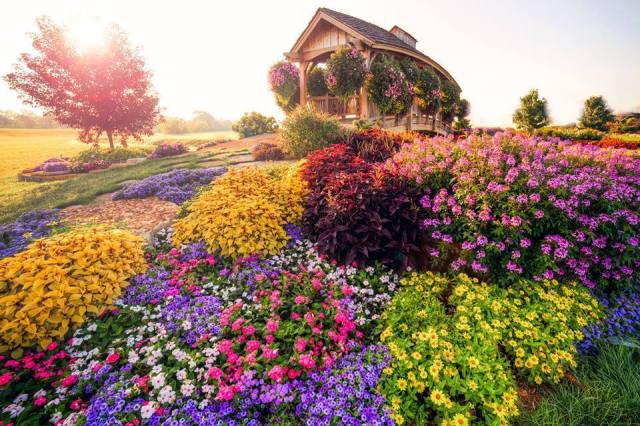
Hmm, a riot of colour, but perhaps a ‘bridge too far’?

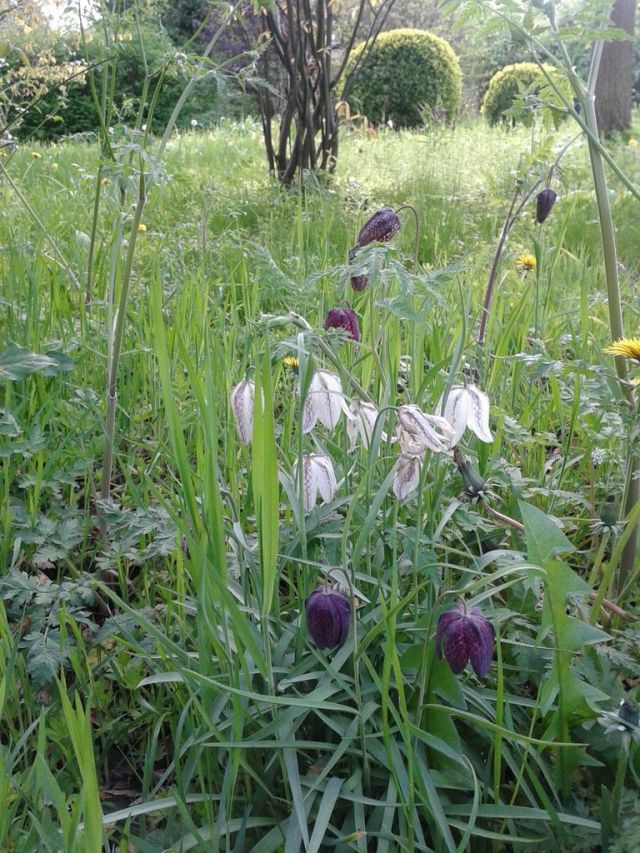
Jen's Fritillaries

Snakes Head  Fritillaries (Fritillaria meleagris– both purple and white flowered forms) at the Henry Moore Foundation at Perry Green, Hertfordshire, taken by my friend Jen on a recent visit.

Old School Gardener

Gardening With Children's avatarGardening with Children

My front garden is at its best at the moment it is packed full of Bluebells, not an inch of soil can be seen, it looks stunning and the heady sweet perfume that greets me when I open the front door is wonderful the Bees love the Bluebells too.
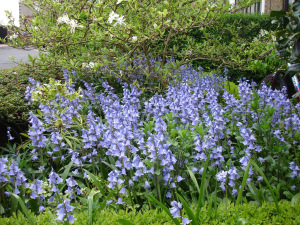
Bluebells in front garden

Hybrid Bluebells in my garden

There are actually 3 types of Bluebell in the UK

The English (native) Bluebell

The narrow bell shaped flowers are violet-blue with straight-sided petals which curl deeply back at the tips, they hang from the same side of the stem which droops over to form an arch, their pollen is creamy white and their leaves are narrow (0.7-2cm wide).

The Spanish Bluebell

Originally from Spain and Portugal their larger flowers open wider with the petal tips curling back only slightly, most flowers are arranged all around the stem which is straight and does not hang over…

View original post 254 more words

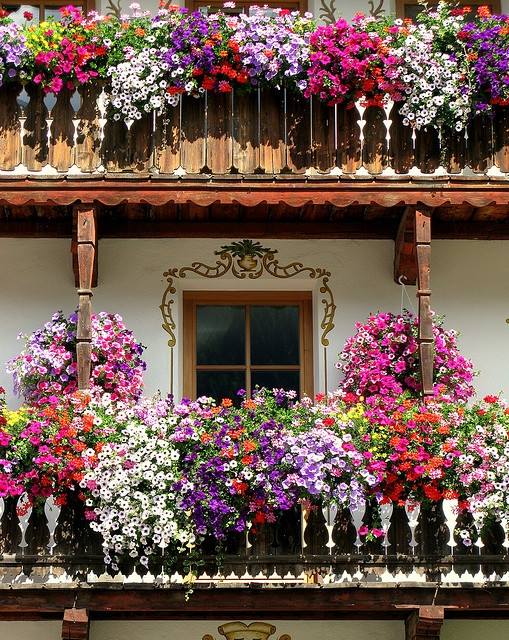
PicPost: Flower Power

The finished 'Woodblockx' planter- soon to be home to an alpine collection

The finished ‘WoodblocX’ planter- soon to be home to an alpine collection

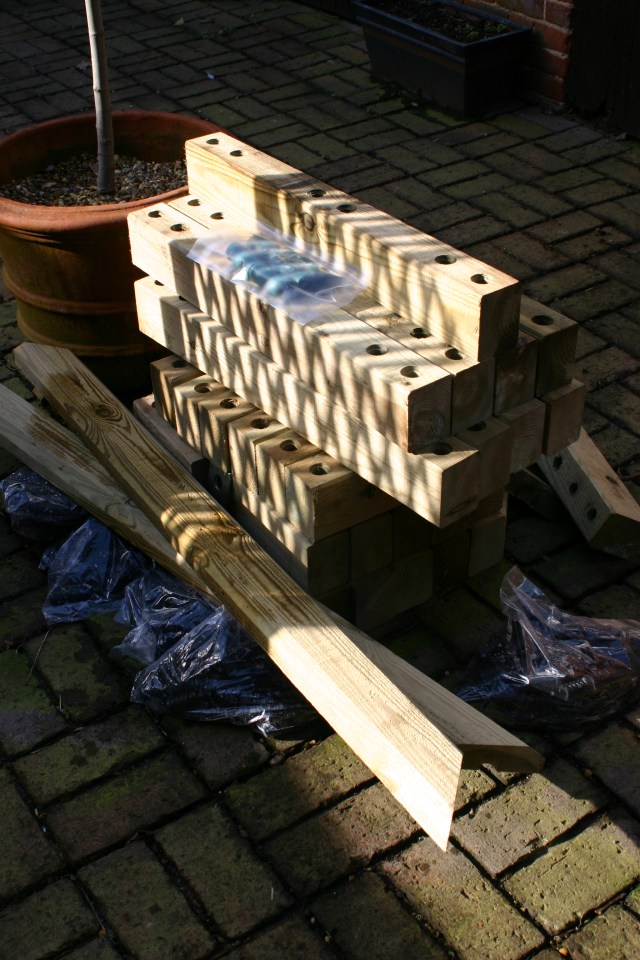
You may recall that two wooden planters in the courtyard here at Old School Garden, recently ‘bit the dust’. Not using pressure treated timber when I made these a few years ago was certainly a mistake. I was wondering what to do to replace them and a few weeks ago was approached by a Scottish company called WoodblocX to do a trial of their products- they make a range of raised planters, beds and ground support systems using an interlinking set of wooden bricks (or ‘blocX’).

Having looked at their comprehensive website, I decided to go for a raised planter (1350mm long by 450mm wide and 450mm high), and I’m hoping to use this both to replace the old planters and create a new feature – an alpine bed. This should be at the right height to be viewed from the nearby metal table and chairs in the courtyard and if suitably finished off will tie in nicely to the predominantly black and terracotta colouring of the many other planters and pots in this sheltered, sun trap setting.

Well, the planter was successfully delivered within a few days of ordering. Last week (having given the courtyard surfacing its yearly clean), I set about constructing it.

In with the new- my new 'Woodblockx' planter awaiting construction
In with the new- my new ‘Woodblockx’ planter awaiting construction

There was a pack of various leaflets and other material supplied with the pallet-load of parts and having checked these off against the list supplied, I wound myself through this material. Though comprehensive, the fact that there were bits of advice and information spread across more than one document initially threw me and I didn’t find any instructions specifically about how my planter should be built or look.

So I spent a few minutes working back from the diagram on the company website to see how each layer of the planter should be built up. I also began knocking in the various plastic dowels and wedges (which join each layer of ‘blocX’ together) to what I hoped was the correct configuration. Then I discovered that these didn’t match up to the next layer’s holes, as the next layer of blocX has to be laid like a brick course with no joints overlapping each other, so not all of the holes correlate. Still no problem, as I guessed that a couple of spare blocX had been sent and, as I discovered later, it is easy to just saw off the tops af any dowels that are in the wrong place! (there was also a good supply of plastic dowels sent so I could afford to waste a couple).

I decided to take another look at the literature I’d been sent and then – to my embarrassment – discovered a set of instruction diagrams for my planter showing which sized blocX should go where and which holes should have the dowels in! Though I hadn’t worked out the layout to exactly match that shown in these diagrams, I thought mine would work too, so I pressed on with the second and subsequent layers. Hammering in the dowels and then pushing home the next layer of blocX on top was very satisfying and I proceeded layer upon layer, to see my planter taking solid form before my eyes!

Using a rubber mallet, and green plastic tubing to hammer home the black plastic dowels was a doddle

After the fourth and final layer of blocX then came the simple, but attractive capping, which really finished of the planter very tidily. This is knocked onto another set of dowels as well as four metal corner brackets which help the planter to hold its shape. The whole construction time- allowing for my careless beginning– took around an hour, was simple and good fun, giving ‘instant results’.

These planters can be used in open ground (they come with two long metal spikes which help anchor it into the ground), but in my situation, sat on clay paviours, the weight of the planter (especially once full of earth) will be sufficient to hold it in place. As advised by the Company I could have also fixed it in place with some angle brackets. I will add an inner lining of landscaping fabric to help protect the wood (though it is all pressure treated) and to avoid soil seeping out from underneath.

Though the rough-planed finish of the WoodblocX is attractive enough from a distance, I think I may sand it down a little and apply either some black wood stain or similar treatment to tie it into the rest of the courtyard planters. I’ll do a further article to show the finished item, planted up.

This slideshow requires JavaScript.

So, what do I think of WoodblocX?

The planter is very solid and I think will last a long time- especially with the extra treatment I’m planning to give it. The solid construction does not look out of place in the ornamental setting of my courtyard and would also look smart in a more ‘kitchen garden’ context too. I should imagine that the construction system using the plastic dowels would be very effective in a ground retaining role too. The modular nature of the system opens up all sorts of design possibilities if you’re considering a multi/split level garden.

As someone who’s a bit of a DIYer (especially using reclaimed timber), I guess that I could have created a similar sort of planter for a fraction of the cost (the planter that I have would cost just under £200, including delivery). I doubt whether it would look as attractive or be as solid and long lasting though. So, if you’re after a smart look and solid construction, your time is limited or your skill level relatively low, WoodblocX offers an ideal ‘self assembly’ solution to your planter/walling needs. I have a friend who’s considering the system for edging a patio that’s surrounded by sloping ground, and I can imagine him setting this up relatively easily and so avoiding the need to engage a tradesman to install a (probably) more expensive brick or similar retaining wall. The company also offers telephone advice and support during your ‘build’ in case of queries (I didn’t take advantage of this).

So, all in all, I’m pleased with the result and enjoyed the construction process, though perhaps a ‘less is more’ approach to the literature the Company sends out would make the construction a little less daunting at the start. If you’d like to find out more, click on the link on the right hand side to go to the WoodblocX website.

Old School Gardener

Finding Nature

Nature Connectedness Research Blog by Prof. Miles Richardson

Norfolk Green Care Network

Connecting People with Nature

Discover WordPress

A daily selection of the best content published on WordPress, collected for you by humans who love to read.

Susan Rushton

Celebrating gardens, photography and a creative life

Unlocking Landscapes

Writing, photography and more by Daniel Greenwood

Alphabet Ravine

Lydia Rae Bush Poetry

TIME GENTS

Australian Pub Project, Established 2013

Vanha Talo Suomi

The Journey from Finnish Rintamamiestalo to Arboretum & Gardens

Marigolds and Gin

Because even in chaos, there’s always gin and a good story …

Bits & Tidbits

RANDOM BITS & MORE TIDBITS

Rambling in the Garden

.....and nurturing my soul

The Interpretation Game

Cultural Heritage and the Digital Economy

pbmGarden

Sense of place, purpose, rejuvenation and joy

SISSINGHURST GARDEN

Notes from the Gardeners...

Deep Green Permaculture

Connecting People to Nature, Empowering People to Live Sustainably

BloominBootiful

A girl and her garden :)