

Tag Archive: children
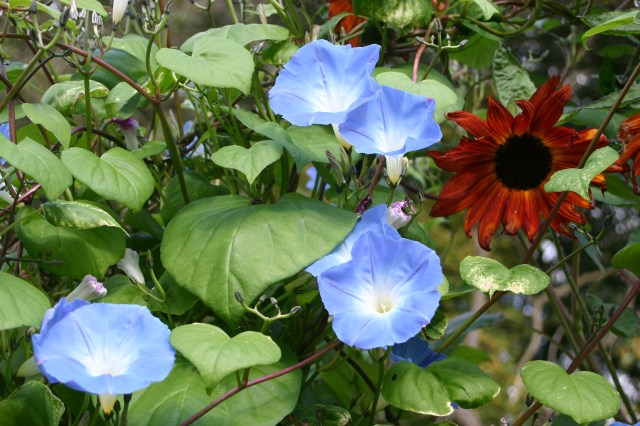 Old School Garden – 3rd October 2014
To Walter Degrasse
Dear Walter,
I’m feeling very guilty. A month has gone by and three weeks out of four we have been away from Old School Garden. So, as you can guess, I’ve not much to report as far as our garden is concerned, well at least in terms of effort, that is. I’m pleased to say, though, that due to the diligent watering of our son and neighbours, we were pleasantly surprised at the state of the garden on our return from foreign climes. Well, mostly.
I thought I’d give you a snapshot of some of the wonderful places we visited whilst away in Spain and Portugal, but first, one of the good things to report is the continued harvest. Here are a few pictures of this month’s offerings. As you’ll see, I’ve cheated a bit and included a bag of almonds donated to us by our hosts in Spain, Michael and Lisa. We sampled some of these, and especially loved the salted ones- I threw a few into a Spaghetti Bolognese we had for supper one day- they added a new dimension!

A good crop of Carrots – ‘Nigel’- grown in a dustbin

Tomatoes and peppers have continued to do well

First of the ‘New England Sugar Pie’ squashes

Almonds- a gift from our hosts in Andalucia, Michael and Lisa

Spent force- the tallest sun flower has just about finished supplying seeds for the birds

Still going- patty pan squashes

More generally, the Old School Garden has definitely put on some of its autumn clothes. However, the driest (and possibly the warmest) September on record in the UK has meant that some things you’d associate with high summer have continued to put on a show, or in some cases, a second flowering. I even spotted some new strawberries in our patch! I’m hoping that the weather will be kind enough to encourage the Melianthus major to flower this year; you remember I grew this from a cutting I took whilst working at Peckover House a couple of years ago? It’s the plant with leaves that smell of peanut butter when you rub them and has claret-coloured spikey flowers.
Here’s a selection of pictures of some of the ornamental interest in the garden right now…
I said that the previous month had involved little gardening effort on my part. I’d forgotten a few things that I managed to squeeze in between the holidays:
-
I sowed some green manure (Phacelia) which is now beginning to look good
-
I tackled (with our soon to move neighbour) an overgrown, mixed hedge boundary and removed a lot of growth to open up the kitchen garden to more morning sun
-
I did the usual late summer round of hedge clipping (and managed to cut through the hedge clipper’s electric cable too)
-
I took some yew cuttings from the old bushes/trees at Gressenhall, and last, but not least…..
-
I continue to ‘deal with’ the rash of mole hills and runs that have spread right across all the areas of our grass (I don’t any longer call them lawns).

Yew cuttings

Phacelia coming on as agreen manure in the kitchen garden

The boundary with next door (Lilac, Laurel, Blackthorn etc.) after its major

Moles everywhere- there isn’t a piece of grass unaffected!
Turning to our trips abroad, these weren’t all about visiting gardens, parks and other lovely places – near the end we did a bit of ‘hands on’ gardening! Our daughter and son-in-law live in Almada, just over the river from Lisbon, Portugal. Their apartment has a rear patio (which I’ve written about before) and also a rather blank piece of ground at the front. This is covered with different layers of concrete and apart from providing a parking place for our son-in-law’s motorbike, does little more than collect wind-swept rubbish and provide a challenging growing space for some tough old weeds which seem to have gradually worked their way into cracks and, once there, swelled these as their roots get a grip.
I don’t know if it was us tiring of being on holiday or the annoyance of looking at this plot every day, but Deborah proposed to do some weeding one morning and so three of us set out ‘armed’ with only our hands and a draw hoe (not usually put into service for this sort of job). You can see the result below. Having begun with limited ambitions, not surprisingly we managed to remove some large chunks of concrete (!) and tilled the rather poor soil in readiness for some planting next year (I suggested some annual poppies and marigolds as good ‘pioneer’ species). Diego, our son-in-law, was obviously inspired by this effort and is now proposing to remove a larger strip of concrete to create some more significant planting areas…watch this space.

Before- weeds in concrete at our daughter and son in law’s flat in Almada

After- weed cleaned and ready for more concrete to be removed to allow planting up
I promised you a snapshot of some of the wonderful places we visited whilst in Spain and Portugal, so here’s a selection to whet your appetite for more extensive articles (and pictures) in the next few weeks…
I almost forgot to mention my holiday reading. Whilst our travels meant we weren’t able to read that much, I did make a start on ‘Noah’s Children’ by Sara Stein. You may recall that I was pointed in her direction by a fellow blogger? After reading her previous book ‘Noah’s Garden’ (in which she discusses her approach to ecological gardening), the sequel gets into the whole issue of how we do or don’t enable children to build a relationship with their environment. I’ve been saving some thought-provoking extracts from this and will somehow share them with you in the coming weeks. Here’s a starter from the Introduction, where Stein sets out her stall for the rest of the book:
‘Land is nourished or not by humans; humans are nourished or not by land. Place and occupant only seem separable because we have created such a distance between liveliness and livelihood. In creating that distance, we have unwittingly detached the nature of childhood from the sense it ought to make. Childish curiosity is to make connections, to realize the larger picture, to become able in the physical environment our lives depend on. We’ve removed the red from the fruit, the fruit from the tree, the tree from the wood, the wood from all the things a child might make of it, and so left fragments much harder to connect than laces on a shoe.’
To conclude this month’s letter, Walter, I’ve a positive note, not unrelated to the theme of ‘Noah’s Children’. Whilst at Gressenhall Museum on Wednesday, the co-ordinator Lynne, mentioned a comment she’d had from a recent visitor. The visitor said her young children loved coming to the ‘Curiosity Corner’ I and colleagues had created for under 5’s in a small part of the gardens here; to the extent that she’d spent a considerable sum getting her own garden landscaped to make it more ‘child friendly’, to introduce some of the features that can engage the young mind in exploring and learning from their environment. That warmed my heart.
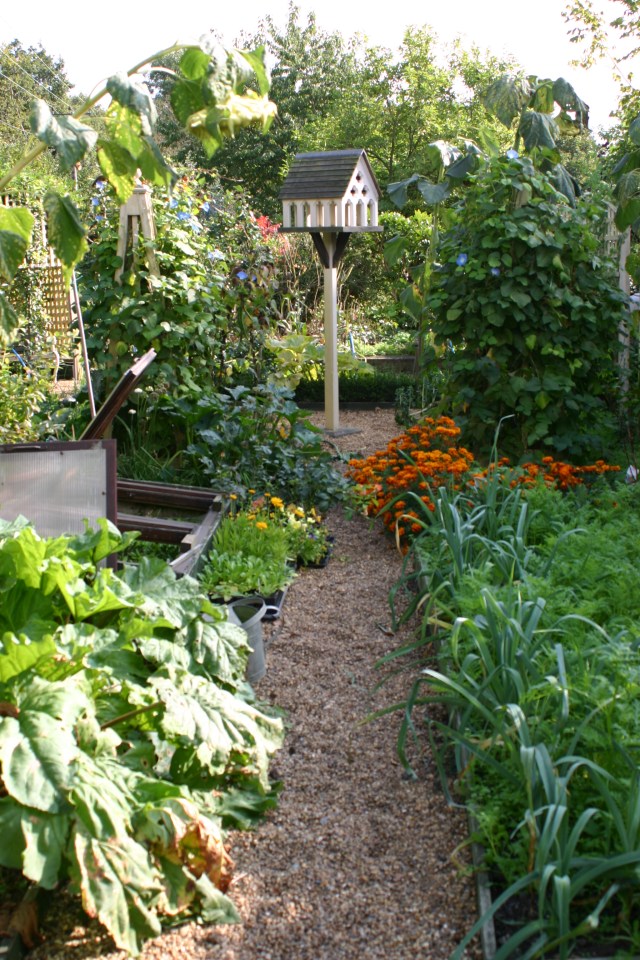
The Kitchen Garden in autumn – ‘fulsome’
All the best for now, old friend,
Old School Gardener

Old School Gardener
Win a greenhouse for your School!
‘What is GYGG?
We’ve teamed up with TV gardener, David Domoney to launch Get Your Grown-ups Growing (GYGG) 2014. We are encouraging schools across the UK to host a GYGG event this October where they invite adults from the local community to help out in the school garden….’
Old School Gardener
Old School Gardener

‘Curiosity Corner’ – a garden I (with help), created for under 5’s to explore at Gressenhall Farm and Workhouse, Norfolk
Old School Gardener
 On Tuesday I attended the latest meeting of the national Landscapes for Early Childhood Network, at the Earlham Early Years Centre in Norwich. The Network, which I joined last year, brings together professionals working with young children and those concerned with designing and creating play and other landscapes for them. It provides a powerful creative forum for discussion of ideas and approaches to early years spaces and activities and also gives a wonderful opportunity to visit excellent examples of these landscapes, sometimes in schools or nurseries, sometimes in public open spaces.
I was pleased to speak at this week’s meeting on the topic of ‘learning for sustainability’ (or as I termed it ‘Nurturing Nurture’) – how we encourage children (and adults for that matter), to understand the way the world works, how mankind’s activities affect this and what can be done to live more sustainably. I talked about the word ‘sustainability’ and how this has become rather diluted and misused in modern language, but is really about maintaining an ecological balance in the world where non renewable natural resources are used (and reused) carefully, if at all.
I featured some of my own work in this field, especially working with youngsters in school gardening activities as well as creating play landscapes and other spaces which inspire younger children to develop their curiosity, imagination and understanding of the natural world. I focused in particular on the importance of engaging children in food growing as a way of contributing towards food production and security.
Presentations were also given by other network members on their work, but the main event was to see and hear about the very special ‘garden’ at the Earlham EYC. Felicity Thomas, the original head teacher and her colleagues gave us a wonderful guided tour of the garden (it was great seeing the children busy in it as we went around), and told us about why and how it had been developed. The brief for the original design (which has since evolved over the last ten years), is worth sharing, so I repeat it below along with a slide show of pictures I took (which for security reasons do not include the children). I hope you enjoy them.
‘To create a unique environment for children and others using the Centre which demonstrates sustainable principles in practice, where children can:-
-
access a varied topography in scale, contour and texture, incorporating dramatic changes in level, big mounds, large areas of sand in which to prospect.
-
plant, grow, harvest and cook food.
-
hide and not be seen, find and create places for refuge and reflection; read, share stories and use their imagination.
-
go on expeditions and journeys; develop an understanding of positional words by having places to be in, under, behind, below and above.
-
experience and understand the elements; interact with moving water, solar power and wind, be protected from the sun.
-
explore their senses through plants, materials and elements which provide a myriad of colour, shape, sound, texture and smell.
-
independently access equipment and loose materials.
-
learn to care and take responsibility for themselves, each other and the environment.
-
be happy, be fulfilled.’
Old School Gardener

 Some of the wonderful planting at Queen’s Lower School for girls, Chester
Old School Gardener
A great way to introduce children (and playful adults) to imaginative design, growing and caring…..mini gardens.

Old containers like this metal bath are great for putting some limits on the space and provide a focal point in the garden too…..

…and plastic trays can replicate ‘real garden’ shapes…

or maybe you have some old cracked pots?

…let the imagination run wild and create a whole ‘fairy world’…

..or why not let them loose in your big garden?..

..and maybe even add a miniature (recycled) greenhouse..




 Old School Garden