

Category: Play
I know you like seeing great ideas for recycling pallets into useful (and beautiful), garden and outdoor objects. So, here are a few more- hope you like them!

Beautiful terrace planters

Garden shed cum woodstore

Fence from pallets

Bench

More benches

Another fence cum planter

A colourful gate

A bee hive

A plant stand- reminiscent of my own ‘plant theatre’ made recently…

…and finally- an Igloo!!
Old School Gardener
Most examples from the wonderful site 1001 pallets

CONVERSATIONS WITH NEIGHBOURS
Originally posted by Naomi on the Playing Out website
I have lived in my street for nine years – a terraced Bristol street of 30 houses – and now know nearly everyone who lives there. There are some people I just say hello to but lots I stop and have a chat with, and I join a group of women of all ages who go for a drink or a meal together once in a while.
The old days … blank stares and broken glass
But it wasn’t always like that. There was a time not so long ago when the only conversation I had with other residents was over the sound of glass being swept as we wielded our brooms the morning after a night of car vandalism. People chatted and tut-tutted together. Men swapped tips on cheap wing mirrors. Neighbours of all ages gathered in…
View original post 661 more words
 Fathers’ Day at Gressenhall Farm and Workhouse Museum yesterday. Self seeded sunflowers in ‘Curiosity Corner’- a mini garden for under 5’s I designed and built (with help).
Old School Gardener

Yesterday brought more news of a looming public health crisis. Over one in three English adults has pre-diabetes (blood glucose levels that place them at significant risk of full-blown type 2 diabetes) according to a new academic study. What is more, the proportion has more than tripled between 2003 and 2011.
Diabetes is already a huge public health problem. According to Diabetes UK, nearly one-tenth of the NHS budget (£12 billion a year) is spent on treating type 2 diabetes: lest we forget, a largely preventable illness.
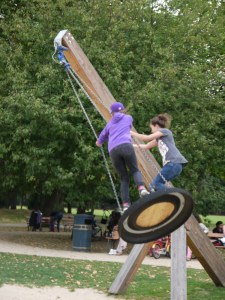 Being more physically active cuts the risk of type 2 diabetes. Physically active children are more likely to grow up to be physically active adults. And there is robust evidence that improving outdoor play opportunities boosts children’s physical activity levels. (I will say more on this when my evidence report is published shortly.) All of which adds up to a compelling…
View original post 801 more words
 On Tuesday I attended the latest meeting of the national Landscapes for Early Childhood Network, at the Earlham Early Years Centre in Norwich. The Network, which I joined last year, brings together professionals working with young children and those concerned with designing and creating play and other landscapes for them. It provides a powerful creative forum for discussion of ideas and approaches to early years spaces and activities and also gives a wonderful opportunity to visit excellent examples of these landscapes, sometimes in schools or nurseries, sometimes in public open spaces.
I was pleased to speak at this week’s meeting on the topic of ‘learning for sustainability’ (or as I termed it ‘Nurturing Nurture’) – how we encourage children (and adults for that matter), to understand the way the world works, how mankind’s activities affect this and what can be done to live more sustainably. I talked about the word ‘sustainability’ and how this has become rather diluted and misused in modern language, but is really about maintaining an ecological balance in the world where non renewable natural resources are used (and reused) carefully, if at all.
I featured some of my own work in this field, especially working with youngsters in school gardening activities as well as creating play landscapes and other spaces which inspire younger children to develop their curiosity, imagination and understanding of the natural world. I focused in particular on the importance of engaging children in food growing as a way of contributing towards food production and security.
Presentations were also given by other network members on their work, but the main event was to see and hear about the very special ‘garden’ at the Earlham EYC. Felicity Thomas, the original head teacher and her colleagues gave us a wonderful guided tour of the garden (it was great seeing the children busy in it as we went around), and told us about why and how it had been developed. The brief for the original design (which has since evolved over the last ten years), is worth sharing, so I repeat it below along with a slide show of pictures I took (which for security reasons do not include the children). I hope you enjoy them.
‘To create a unique environment for children and others using the Centre which demonstrates sustainable principles in practice, where children can:-
-
access a varied topography in scale, contour and texture, incorporating dramatic changes in level, big mounds, large areas of sand in which to prospect.
-
plant, grow, harvest and cook food.
-
hide and not be seen, find and create places for refuge and reflection; read, share stories and use their imagination.
-
go on expeditions and journeys; develop an understanding of positional words by having places to be in, under, behind, below and above.
-
experience and understand the elements; interact with moving water, solar power and wind, be protected from the sun.
-
explore their senses through plants, materials and elements which provide a myriad of colour, shape, sound, texture and smell.
-
independently access equipment and loose materials.
-
learn to care and take responsibility for themselves, each other and the environment.
-
be happy, be fulfilled.’




 Old School Garden