Category: Local Food


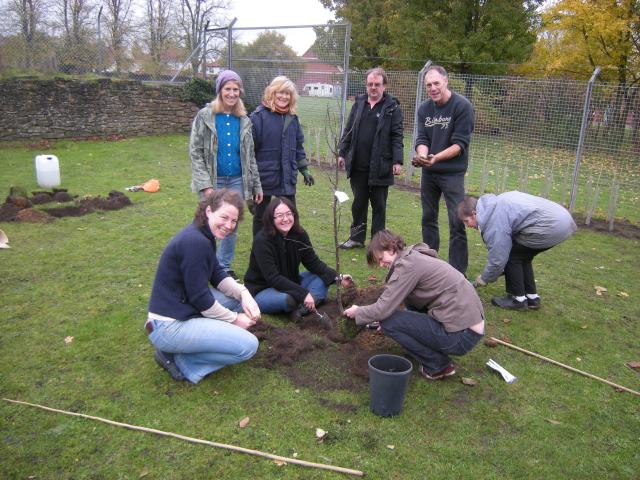
Getting to grips with fruit tree planting- the group at Wensum View Park

Getting to grips with fruit tree planting- the group at Wensum View Park

You may remember that we opened Old School Garden to the public for the first time back in July. Apart from the fun (and worry!) of sharing the garden and getting people’s feedback, it was a chance to raise some money for some local ‘good causes’. The £300 raised was divided equally between gardening projects at Cawston V.C. Primary School (where I help out as a volunteer), towards the upkeep of the fabric of St. Peter’s Church, Haveringland- the ‘Church in the Fields’ you can see from our garden-  and to support small – scale projects in the Norfolk Master Gardener programme.

One of the latter involved funding some new fruit trees for a Community Garden in Norwich and the Master Gardener supporting that project, Jeremy Bartlett, has written a piece about the planting event yesterday. I’m so pleased that our little fundraising effort has achieved something worthwhile- I’ll report on other projects funded in due course, but for now here’s Jeremy’s article.

‘Volunteers spent the morning of Sunday 17th November 2013 planting fruit trees and an edible hedge at Wensum View Park in Norwich, thanks in part to a Norfolk Master Gardener Grant .

The park, at the back of Turner Road in Norwich, is owned by Norwich City Council and contains a small children’s playground and a large area of grass used for games and by dog walkers. Local residents wanted to do more with the park and set up Wensum View Park Community Garden Group in early 2012. Following a public consultation by Norwich City Council earlier this year (http://www.norwich.gov.uk/Environment/ParksAndOpenSpaces/Parks/ParksImprovements/Pages/WensumViewPlayArea.aspx) work to transform the space began this autumn.

So far there have been two gardening tasks, led by Master Gardener Jeremy Bartlett, who has had previous experience setting up and maintaining Norwich’s Grapes Hill Community Garden (http://www.grapeshillcommunitygarden.org/).

In early October we created a herb bed and planted crocus bulbs. This was followed by a task on the morning of Sunday 17th November 2013 when about twenty-five volunteers planted fruit trees and an edible hedge. A Norfolk Master Gardener Grant for £45 went towards the cost of the fruit trees and the 105 small saplings for the edible hedge were supplied by the Woodland Trust.

We planted nine fruit trees: single trees of Apples “Golden Noble” and “Discovery”, Figs “Brunswick” and “Brown Turkey”, Medlar “Nottingham” and Quince “Champion”, two Plums “River’s Early Prolific” and an unnamed variety of Plum, which was donated by a local resident. The hedge consists of Elder, Dog Rose, Blackthorn, Hazel and Crab Apple and will add to the edible harvest once it is established.

Our next task, planned for January or February 2014, will be to build a raised bed for planting herbs and vegetables.

Wensum View Park Community Garden Group have now signed up as a Master Gardener household and Jeremy will continue to provide free growing advice during the next twelve months.

Wensum View Park (also known as “Wensum View play area”) is located on Dereham Road in Norwich. Its entrance is between numbers 319 and 321 Dereham Road and it is open to all, free of charge, every day during daylight hours.’

Old School Gardener

IMG_7215

I recently responded to a challenge from fellow blogger, ‘The Anxious Gardener’, to name my favourite garden. This was a light-hearted way of getting people to enter a competition to win a copy of the recent publication ‘The New English Garden’.

The competition was a ‘name out of the hat’ affair so I stood as much chance as winning as the other 30-odd entrants (and I didn’t win, so there’s another item for the Christmas list). Notwithstanding that, I thought I’d try to do the request justice and thought long and hard about where, if any one ‘where’ stood out in front of the many gardens I’ve visited, read about, seen films and pictures of.

It took some time…

In the end I came up with my nomination and set it out here and the reasons why it came out top. Oh, and I thought I’d share some pics with you too. I hope that you enjoy them.

I’ve visited and seen a few gardens over the years and it’s tricky finding one that I’d call a favourite – some have great borders or other spaces, configurations of plants, superb features and so on. Maybe its because it’s relatively fresh in my mind, but the one that does stand out is Felbrigg walled garden in Norfolk (also a local one to me and so visited quite often).

Why? Well I guess it’s the way the garden team (including volunteers and community gardeners), have managed to create a space that meets so many different needs and in a way that seems to hang together naturally:

* a warm, contained, red brick walled space, with a fountain and dovecote as strong structural elements
* glasshouses with old favourite, traditional exotics and other ‘interesting’ plants
* community food growing in plots that are obviously lovingly cared for
* a children’s gardening area complete with digging pits, tools, washing facilities and novelties such as chickens running free, willow teepees and tunnels
* newer areas set out with mediterranean – style planting, meadows and feature shrubs
* plenty of comfortable seats to entice you to stop, look and soak up the atmosphere
* lots of attractive information about the plants themselves (all the significant ones carefully and attractively labelled) as well as some of the current tasks in the garden and information/quiz sheets for the kids.

All in all a visit to Felbrigg is a tremendously rich experience where the general public, serious gardener and trained horticuluralist (and their children) can come together and have their curiosity tickled, be enthused, amazed and go away feeling regenerated.

Do you have a favourite Garden? I’d love to hear from you!! (no prizes I’m afraid)

Further information: National Trust website

Old School Gardener

If you’ve enjoyed reading this post and others on this blog, why not comment and join others by signing up for automatic updates via email (see side bar, above right ) or through an RSS feed (see top of page)?

deltagardener's avatarThat Bloomin' Garden

Have you ever wanted to start a community garden? With many communities building more and more high density housing , community gardens are becoming all the rage. People living in townhouses, apartments, condos and basement suites often don’t have enough room to grow plants. Although you can grow a lot of food on a  balcony, some places don’t have this kind of space. Starting a community garden means looking for a piece of land that can often be leased from a landowner. Surprisingly these pieces of land are often found quite easily. Lets take a look at this tour of community gardens to see how they got started. Below is a photo of Alexandra House community garden in South Surrey. It’s hard to believe this garden is just over a year old.

community gardens

The gardens are full of abundant harvests and so much fuller than the first season. This garden was built…

View original post 894 more words

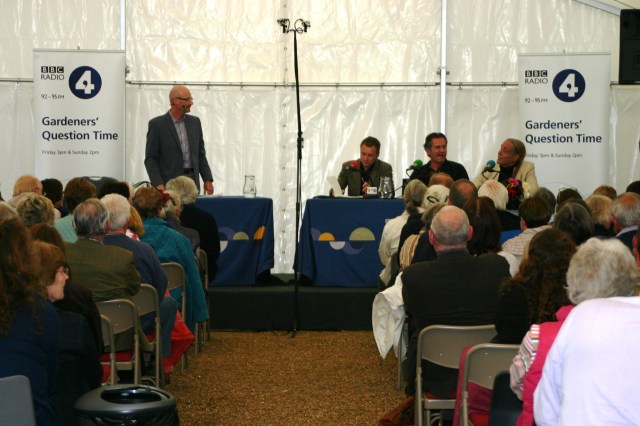
The GQT Panel doing their stuff

The GQT Panel doing their stuff

200 eager gardeners packed the marquee at Gressenhall Farm & Workhouse Museum, Norfolk yesterday. Rather than post my own article answering gardeners’ questions I thought I’d devote this week’s GQT to a report on the real thing!

Well, it turned out to be a fascinating event, especially watching the ‘well oiled machine’ that is GQT in operation. Celebrating its 65th year of broadcasting this year the programme, as chairman Peter Gibbs said, ‘has become a national institution’ attracting some 2.5 million listeners a week. Pleading with the audience not to blame him for the recent weather (for non Brits he’s a well-known TV and Radio weather forecaster as well as a keen gardener), he recalled his time in Norfolk and visiting the Museum with a young family about 15 years ago. He went on to chair not one but two editions of the programme (I’ll give you broadcast dates later). And we were not disappointed with either the range and quality of the questions or the depth and humour of the Panel’s answers.

Earlier I had been involved in a ‘pre recording’ session with some fellow gardeners and the original Museum curator, Bridget Yates. Matthew Wilson and Bob Flowerdew, two of the panelists quizzed us on the history of the place and some of the more recent developments in the gardens. I was mightily impressed with the professionalism of the production team and the two panelists who seemed to conjure an interesting and relevant discussion from the barest of facts – you’ll have to listen in for the full version!

The GQT Team at Gressenhall- from left: Matthew Wilson, Chris Beardshaw, Peter Gibbs, James Wong and Bob Flowerdew

The GQT Team at Gressenhall- from left: Matthew Wilson, Chris Beardshaw, Peter Gibbs, James Wong and Bob Flowerdew

After this I was pleased to have the opportunity of interviewing Matthew Wilson myself, for the online newspaper ‘The Breckland View’. A well known Garden Designer and Director of an historic plant nursery in London, Matthew talked about his (positive) impressions of the Museum gardens and we went on to talk about growing food at home. Matthew believes this is important, not only for the freshness and flavour of the home-grown produce, but as a way for people to ‘reconnect’ with nature in an increasingly ‘virtual’ world. Though his own garden is small, he tries to ensure that his young children are able to experience nature and growing things close up. He seems to be undecided on the ‘GM or not GM’ debate, as frustrated as me on the apparent lack of ‘hard’ evidence to help us decide how to proceed with the urgent business of ‘feeding the world’, though he feels we can still achieve improvements in crops from some of the older techniques of selection and breeding.

The Question time proper featured a dazzling array of questions. The panelists – serial Chelsea gold – winning medallist Chris Beardshaw and ‘new wave’ botanist James Wong  joined Matthew on stage for the first session  – seemed effortless in their answers to questions as diverse as:

  • whether the museum’s collection of historic gardening books and other material is still relevant (a resounding ‘yes’ from all to that one),
  • trying to explain why one poor gardener could only produce some ‘micro rhubarb’ (pencil thin stalks 10 centimetres long) – the ‘answer lies in the soil’ it would seem, specifically the lack of rich, organic matter and the right position, according to Matthew
  • what kinds of veg could be grown in a wet and dismal summer – James came up with some interesting oriental varieties that in a normal hot dry summer would bolt, but in a more dim and damp period would turn out just right
  • selecting some ‘exotic’ but hardy plants for a patio. Chris initially shocked his audience with a suggestion of ‘black negligee and stockings’, but quickly added that these were references to some interesting plants – sorry, the names have eluded me after the initial image he created…!

And I can confirm that, as the programme repeatedly states, the panel were not privy to the questions before they were asked! The audience was very receptive to the ongoing banter and humour between the panelists and seemed to maintain their enthusiasm right through a second session (where James was substituted by well-known Norfolk organic gardener Bob Flowerdew). Chairman Gibbs praised our fortitude and two hours later it was all over! It had been an enjoyable evening and one where gardening colleagues were welcomed from far and wide the gardening Team from Peckover House, Wisbech and Master Gardeners from King’s Lynn being some of the furthest travelled.

The first programme should be broadcast at 3pm on Friday 5th July (repeated Sunday 7th July 2pm) and the second (from a more anonymous ‘Norfolk’ location this one) on the 23rd/25th August. So, tune in to BBC Radio 4 at these times (or try it online via www.bbc.co.uk, on their ‘i player’ or ‘listen again’ facility if you can’t listen ‘live’).

And for anyone within striking distance of Gressenhall this weekend, the Museum has a special interest day on Sunday focused on gardens and gardening, so why not pop along and meet me at the Master Gardener stall, visit the many other attractions on offer and see the gardens, which I must say are looking splendid (but then again I would say that)!

Thanks to Kings Lynn Community Allotment for the photographs

Old School Gardener

If you’ve enjoyed reading this post and others on this blog, why not comment and join others by signing up for automatic updates via email (see side bar, above right ) or through an RSS feed (see top of page)?

PicPost: Urban Farm

Shipping container greenhouse – urban farm unit by Damien Chivialle

What goes on underneath the greenhouse (heating?)?

Does the whole thing rotate on the turntable its standing on?

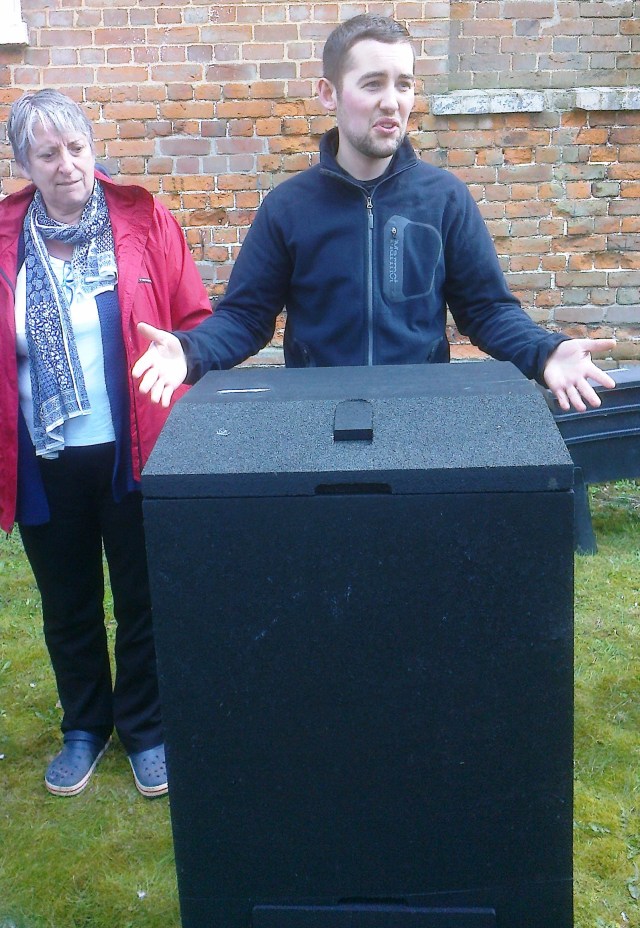
David Garrett from Garden Organic explaing how a 'Hot Bin' works

David Garrett from Garden Organic explaining how a ‘Hot Bin’ works

Since the beginning of the month local councils are having to pay around £100 per tonne of waste they dump in holes in the ground in Norfolk. Increases in the tax charged on ‘landfill’ (which makes up around 75% of the total charge) are becoming a significant cost to hard – pressed councils and by implication local Council Tax payers. So, in addition to the prime environmental reasons for diverting waste away for landfill, there is now an increasingly important economic driver. And this charge – which is planned to increase in years to come – could eventually help to make it economically viable to recycle a lot more of the stuff we stick in the ground – yoghurt pots and other hard plastics for example.

And the holes in the ground that readily lend themselves to landfill are also drying up, leading to controversial proposals for incineration plants which can generate useful heat at the same time. It is clear that reducing waste , re – using or recycling what we can, makes financial and environmental sense. This was the key message from a two day training course I attended last week, which now means that I can play my part in promoting sustainable approaches to waste – in my case and the 18 others who joined me on the training, as a ‘Master Composter’. In my case I don’t pretend to be an expert, as the title perhaps implies, more of an enthusiast expanding my knowledge and able to pass some of this on to others who can be convinced to recycle their green and food waste into ‘black gold’ – or compost for the garden if you like!

The local Master Composter scheme is run as a partnership between Garden Organic and Norfolk County Council and aims  to:

  • raise awareness of the benefits of composting to the public

  • encourage more people to compost at home

  • help those already composting to do so more effectively

  • encourage and support more community composting schemes

Those delivering the scheme are expected to give at least 30 hours of their time to preparing and delivering information and advice at events, to individuals, schools or to community composting schemes. There is a wealth of support and resources available to help in this including three sets of display materials, leaflets and rather natty digital microscopes so that you can see the mini creatures creating compost before your eyes – these are bound to be a hit with children and adults alike!

In the classroom- some of the trainee Master Composters

In the classroom- some of the trainee Master Composters

The two day training was inspiring , informative and lot of fun. After some introductory remarks about the scheme we were invited (‘Who wants to be a Millionaire’ style), to take part in a quiz to focus on the sorts of mind boggling amounts of waste, money and other resources involved in the disposal and processing of household waste. We were then introduced to the different types of larger scale composting:

  • Centralised large scale purpose run, mainly open air facilities where large amounts of green and other organic waste are regularly turned and high temperatures achieved to produce a crumbly black material great as a soil improver
  • ‘In vessel’ or indoor facilities where material is once again handled on a large scale and the ‘cooking’ process begins inside before the material is transferred outside for ‘maturation’
  • On farm composting where farmers will create their own compost heaps from agricultural and animal waste
  • Community composting schemes where local groups offer to collect green waste from households, create compost at a central site and then give the resulting product back to eager gardeners

After a wholesome lunch we were whisked off to see two sites that rammed home the importance of composting, one landfill site the other an ‘in vessel’ composting unit.

Edgefield Land fill site- coming to the end of its life

Edgefield Land fill site- coming to the end of its life

 Edgefield Landfill site in north Norfolk, has been operating a good few years and is focused on filling in holes in the ground left by quarrying. Now into its last few months of life, this site shows how landfill practices have developed over the years. Once these holes were unlined and the ‘leachate‘ (nasty liquid) running away from the rubbish was allowed to do so without any monitoring or control, so the area’s water courses were expected to somehow deal with the poison seeping into them. Now plastic sheeting is laid in the holes and careful measures taken to both monitor the release of leachate and methane gas as well as drawing both of these substances off, the leachate going for reprocessing at a sewage treatment works, the gas used on site to power  an electricity generator which is contributing power to the national grid. As we stood atop the windy mound of rubbish already topped off with soil we could see the open scar of the remaining tip which is due to be finished off in the next couple of months at which point the site will be closed, grassed over, trees planted and monitoring continued.

Our second visit was to the Marsham Composting Facility of Norfolk Environmental Waste Services (‘NEWS’ – a wholly owned company of the County Council). This impressive complex (not far from Old School Garden in fact) has been open about a year and takes in green and food waste collected by local District Councils  and others (who are charged for the amount they dump). I turns it into soil improver which is virtually all sold to a local farmer for use on his fields – and he is impressed with the results, it seems.

Waste material is dumped inside the main building where it is heaped against wooden barriers and the process of activation is started. Temperatures of 60C are achieved and once this process is well underway the material is moved outside into various bays where air is drawn through it by fan- assisted pipes and the cooking process continues until eventually temperatures die down to achieve the final product, which is collected in tractor – towed trailers and deposited on fields or in farmyard dumps awaiting the right time to apply it. The first facility of its kind locally, there seems to be scope for more as green and food waste collection increases. It would be great if the public could roll up and fill their own trailers with this ‘black gold’ – I’ve used something similar on my garden and it not only does great things to the soil, it also is dark enough to act as an attractive foil for the greens and other colours of the garden.


The second day of the training began with an overview of the composting process. A jigsaw of location, organic raw material, heat, water and air combine to produce a chemical reaction which decays and decomposes the green material and encourages a host of micro organisms plus other ‘critters’ who contribute most to this process. We also had a fun exercise exploring how to ‘sell’ the benefits of composting to a range of different ‘characters’ (I pretended to be a female student who was keen to do her bit to manage her own waste!). We distinguished between ‘hot’ and ‘cold’ composting, the former where relatively large amounts of material are brought togetehr at once to generate high temperatures and the composting process is relatively fast, the latter more suited to smaller scale, occasional additions of organic waste and which takes longer. Ideally, you need to ‘turn’ your organic material in ‘hot’ composting and don’t in the ‘cold’ system.

After lunch two experienced Master Composters, Russell and Mary Baylin, described their experiences, which included representing the Master Composters at the Queen’s Diamond Jubilee Tea Party last year! Becoming Master Composters in 2007, this couple are clearly dedicated to the whole composting cause, having been involved in many events around the county and working with schools and individuals to help them make the most of their green waste.

Russell and Mary Baylin, experienced Master Composters

Russell and Mary Baylin, experienced Master Composters

We went on to examine the range of opportunities for ‘getting the message across’ as Master Composters as well as rehearsing the sorts of answers we might give to frequently asked questions. So, for example, we know that compost is ready when its is dark in colour has little or no smell, is crumbly and relatively fine in texture, and we can use it to mulch important, hungry plants as well as a more general soil improver, maybe as a top-dressing to lawns  and in potting mixes.


The afternoon concluded with an examination of different types of composting boxes/ equipment – including a wormery (from which you get not only lovely fine worm – cast compost, but also a liquid fertiliser) a japanese style composter called a Bokashi (involving the intermingling of a special bran meal with green waste) and the latest ‘hot box’ being developed to fast process whole bin loads of material in a few weeks. We examined the pros and cons of each kind and who they might suit. I’m hopeful that my local school, can get a Wormery as way of using up the fruit, salad and other food waste from school lunches for example.


Following a quick tour of the gardens at Gressenhall Farm and Workhouse Museum (our base for the two days) and a look at their larger scale composting facility, including leaf mould and loam making, we gathered up our folders, tee shirts and other resources and began to ponder how we can make the biggest impact on composting in Norfolk. I’m expecting to help my local primary school with its composting activities and we begin this on Thursday with a session with older children to look at composting and what the school already does, including engaging the School Cook to see if we can compost more kitchen waste to use in the School gardens! I’ll let you know how I get on!

Thanks to Garden Organic and Norfolk County Council Staff who made for such an enjoyable and useful event: Jane, the 2 Davids, Amanda and Alex

Old School Gardener

P.S. It’s International Composting Awareness Week on 6th – 12th May – decorate your own compost bin and win a prize! 

If you’ve enjoyed reading this post and others on this blog, why not comment and join others by signing up for automatic updates via email (see side bar, above right ) or through an RSS feed (see top of page)?

PiocPost: Harvest Happy

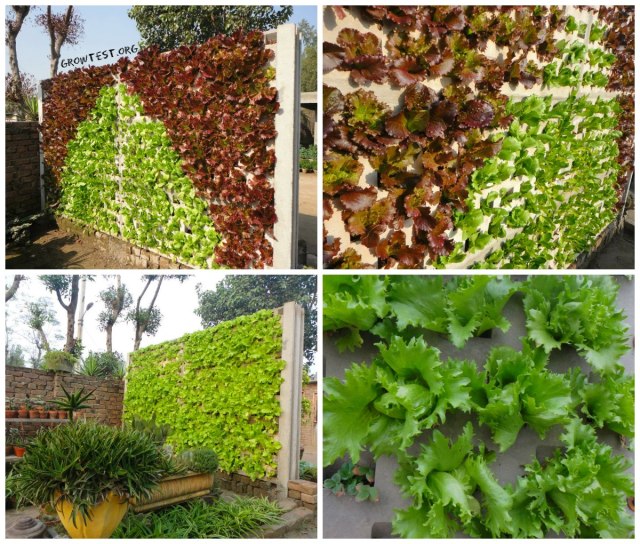
PicPost: Lettuce Play

Financing community food: Securing money to help community food enterprises to grow

Financing community food: Securing money to help community food enterprises to grow

‘This report examines the funding needs of community food enterprises and how they can continue to use food to achieve a wide variety of important social and environmental benefits.

The report was written following a series of community food finance meetings, bringing together organisations that assist community food enterprises, with progressive funders. This process was undertaken as part of the five-year Big Lottery funded Making Local Food Work programme that has – since 2007 – supported a wide range of community-run food enterprises to help communities take control of their food and where it comes from. The community food finance meetings discussed how best to secure funds for community food enterprises in the future, to help them through the all-important start-up phase, and to obtain funds to grow and, thereby, continue work that has more charitable than commercial aims.

We hope to see the community food movement grow and thrive, hence the enterprises need improved prospects for securing the finance they need to succeed. With this report, and work evolving from it, we wish to encourage conversations between enterprises and their communities, the sector organisations that support them, the individuals and organisations that provide funds, and with government, whose policies provides the framework in which we operate….’

deltagardener's avatarThat Bloomin' Garden

seed tape

On Monday we made seed tapes with the grade three class that comes to the Ladner Community Garden. We made so many seed tapes that I was getting worried we wouldn’t have the space to plant them. So when the seed tapes were done, I brought them home and laid them out on my dining room table to make sure they dried out from all the glue the children used. Yes, some children were a little zealous with the glue so I hope it doesn’t affect the seed germination. I looked over all the seed tapes and tallied the seeds.

seeds

The children used 979 seeds! Wow! Now that’s a lot of food for the food bank. That seemed like a lot of seeds but I sat down last night to see how much space we would need to plant them . If you remember from Mondays post I used…

View original post 126 more words

Finding Nature

Nature Connectedness Research Blog by Prof. Miles Richardson

Norfolk Green Care Network

Connecting People with Nature

Discover WordPress

A daily selection of the best content published on WordPress, collected for you by humans who love to read.

Susan Rushton

Celebrating gardens, photography and a creative life

Unlocking Landscapes

Writing, photography and more by Daniel Greenwood

Alphabet Ravine

Lydia Rae Bush Poetry

TIME GENTS

Australian Pub Project, Established 2013

Vanha Talo Suomi

The Journey from Finnish Rintamamiestalo to Arboretum & Gardens

Marigolds and Gin

Because even in chaos, there’s always gin and a good story …

Bits & Tidbits

RANDOM BITS & MORE TIDBITS

Rambling in the Garden

.....and nurturing my soul

The Interpretation Game

Cultural Heritage and the Digital Economy

pbmGarden

Sense of place, purpose, rejuvenation and joy

SISSINGHURST GARDEN

Notes from the Gardeners...

Deep Green Permaculture

Connecting People to Nature, Empowering People to Live Sustainably

BloominBootiful

A girl and her garden :)