Category: Heritage Gardens & gardening


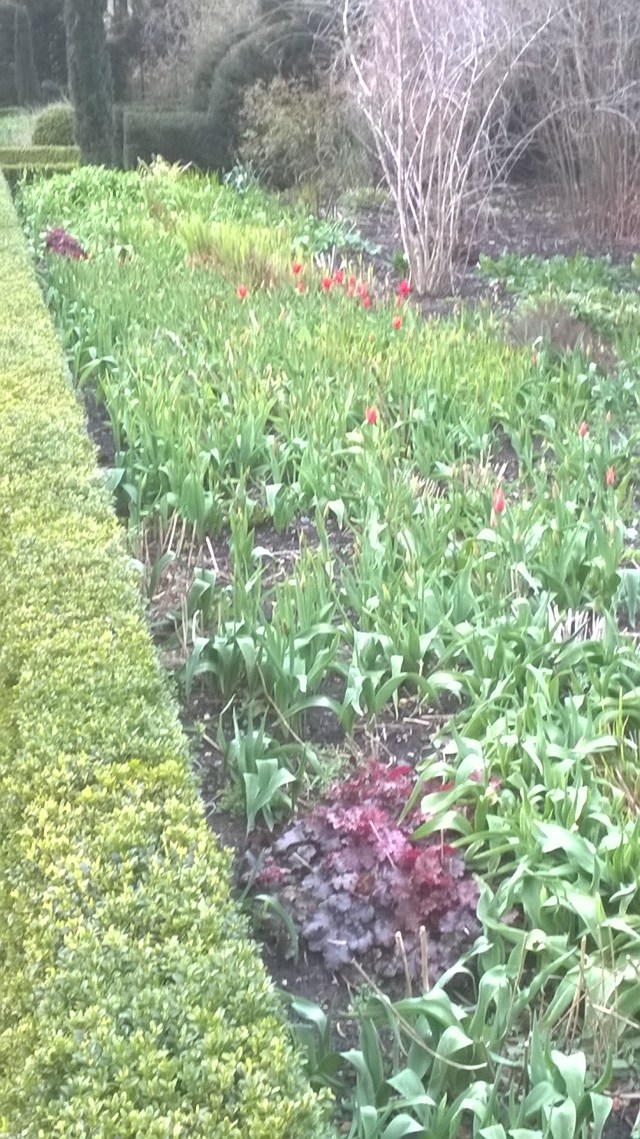
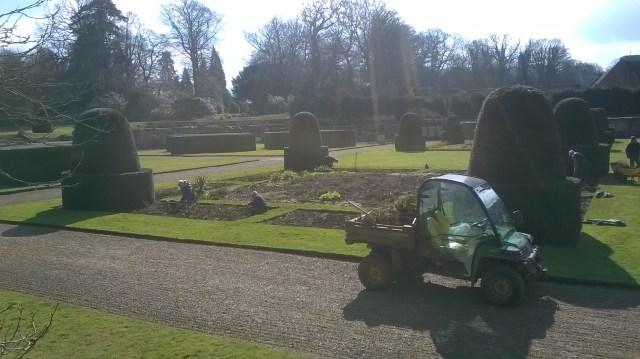
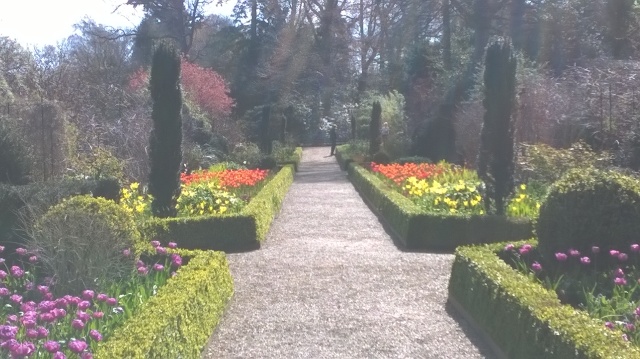
WP_20160421_10_36_32_ProMy latest session at Blickling was spent in the Walled Garden, once more. On my way I stopped to look at the wonderful display of Tulips in the Double Borders, caught in the early morning sun.

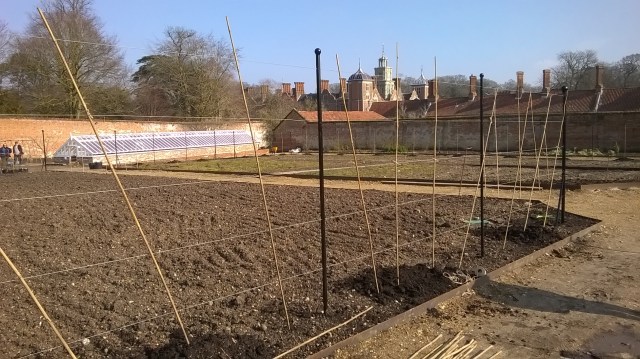
As I arrived it was clear that a lot had happened in the Walled Garden since last week- mainly that the grass paths had been turfed. These really look great, and I also saw that the first prototype metal arch had been installed at one end of the central path… this will eventually be a ‘fruit arch’ covering the entire length of this path.

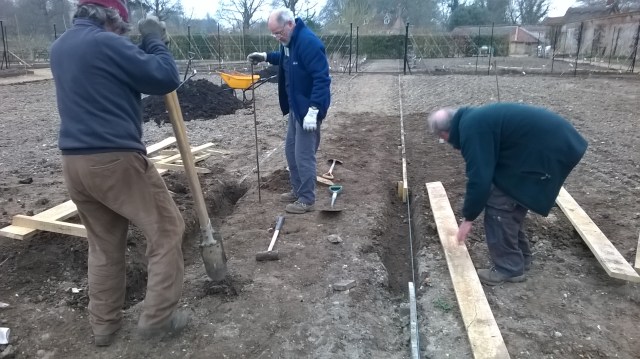
One group of volunteers were set to weeding in the Parterre garden, whilst the two Petes and a new volunteer, Chris and I were detailed to path edging (Norfolk Pete) and digging (yes, you guessed it!) and mulching some borders which will be home to an array of cut flowers, all ready and waiting to go in from the nearby cold frames.

We moved over to one of the quarter beds and dig some double digging- the three of us in line. Or rather, ‘bastard digging’ (!) , so Mike tells me as he says ‘double digging would involve incorporating some organic matter in the trenches before turning in the next spit of topsoil.
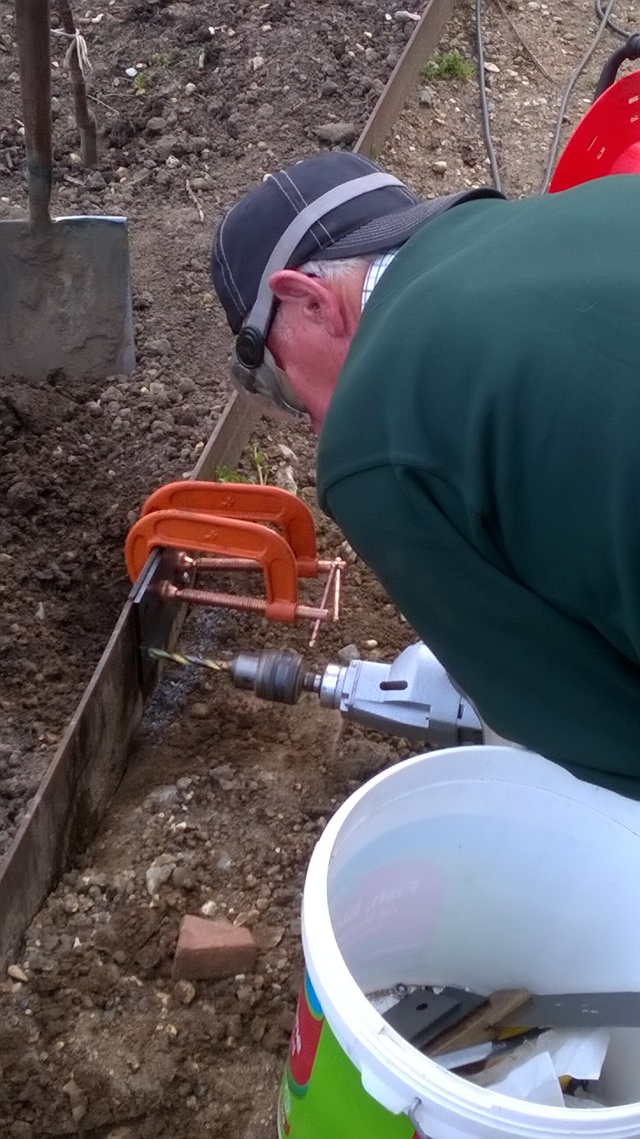
Norfolk Peter- a bolting we will go...

Norfolk Peter- a bolting we will go…

‘Norfolk Pete’ spent the day bolting in some joining plates for the metal edging, which appears to be nearly complete. I saw a large pile (some 120 tonnes) of Carr Stone in the orchard, which is waiting to be put down as the base for the hard paths , which will have peas shingle laid on top. A bit of path near the potting shed had been finished off as a trial run and it does look neat. mike said we may spend next week laying and raking this gravel over the rest of the paths, the Carr stone having been rammed hard. Carr Stone (the gingerbread coloured sand stone found in West Norfolk), when broken down, provides a perfect sandy path sub surface; it binds together well and is hard wearing.

Further Information:

Blickling Hall website

Blickling Hall Facebook page

A 360 degree tour of Blickling Hall

Old School Gardener


The Black Garden with its newly gravelled surface -one of the best views in the garden

View across the Black Garden with its newly gravelled surface; the ‘classic’ view of Blickling

It’s Thursday, so it must be …digging at Blickling!

My latest session involved working with ‘Aussie Pete’ in preparing the soil on some of the paths, ready for turfing next week. you may recall that there are two areas where grass paths cross two of the quarters of the Walled Garden? I’ve lost count of the times we seem to have moved soil, dug it over etc, but after being trodden and barrowed over for a few weeks, it certainly needed ‘fluffing up’ to ensure the turf, when it’s laid, takes easily to the soil underneath.

Aussie Pete 'fluffing up' the soil for some grass paths

Aussie Pete ‘fluffing up’ the soil for some grass paths

‘Norfolk Pete’ was off putting in the remaining lengths of metal edging around the Walled Garden, whilst the remainder of the volunteers were set to weed and aerate the soil in the border beds which are being used to grow cut flowers. Gardener Rebecca was confined to the potting shed sowing trays of veg which are starting to fill the greenhouses.

Weeding in the Cut Flower border

Weeding in the Cut Flower border

During the day we met three new volunteers who will join us next time (assuming they haven’t been put off!) and ‘Aussie Pete’ disappeared for an hour or two in the morning to do some initial training as a ‘Garden Guide’- one of those volunteers that take people around the gardens and give them useful information on its history, layout and challenges. I’ve thought of volunteering to do this as I enjoy meeting the public, but for now my schedule doesn’t allow this…still in a year or two, maybe?

Having made pretty good progress with the soil forking over, I think Project Manager Mike must have felt sorry for me, as he asked if I’d like to do some work on the newly planted soft fruit bushes. I do enjoy pruning and tying in, and so this was a welcome relief from the digging.

You may recall that a week or two ago I mentioned some oak trunks being taken to a local sawmill to be turned into posts and other items? The posts will secure wires that these fruit bushes will be trained against, and Mike was keen to get them pruned and tied in to temporary canes to begin their ‘basic training’. So, I set to work on three varieties of gooseberries, and some redcurrants and wine berries (volunteer Pam says these are gorgeous). Some of the plants are being grown as straight cordons, others as fans.

Though a bit fiddly (I’d succeeded in cutting my finger with a bread knife the day before, so my elastoplasted finger wasn’t the most nimble), this was an enjoyable task that took me up to lunch time. After that ‘Aussie Pete’ returned and we continued to finish off fluffing up the soil for the grass paths …so we will possibly be turf laying next time….

Further Information:

Blickling Hall website

Blickling Hall Facebook page

A 360 degree tour of Blickling Hall

Old School Gardener


Hyacinth 'Blue Jacket' putting on a show- and fragrance

Hyacinth ‘Blue Jacket’ putting on a show- and fragrance

Another Wednesday session this week at Blickling, and, you guessed it, more spade work!

It was a showery day, so the waterproof was never far away…at one point we had an almost horizontal driving shower of hail to contend with. Anyway, my first job in the Walled Garden was to dig a trench (and half) with my fellow volunteers to provide a temporary home for a rather large number of Black Mongo Grass (Ophiopogon) plants which had been removed from the Black Garden.

I’d noticed a digger hard at work in this important area near the Double borders; I’m pleased to say that the grass (or rather mud) surface of this area was being replaced with gravel and a slight remodelling was underway too. This area is heavily trafficked and the grass surface soon cuts up over the season, so something tougher is required.

The Mongo Grass provide an important ‘floor’ to the planting here which features spring tulips and summer Black Elder amongst other ‘black’ plants. It is also home to a large bench which provides one of the best views at Blickling across the parterre, towards the Hall and the Lake beyond.

There were plenty of plants to place out and some of the other volunteers helped Gardener Rebecca pot some up for sale. I’d also noticed a large number of potted Roses, recently delivered and waiting placing out to fill gaps in the Rose Garden.

Plenty of roses waiting to be planted out in the Rose Garden

Plenty of roses waiting to be planted out in the Rose Garden

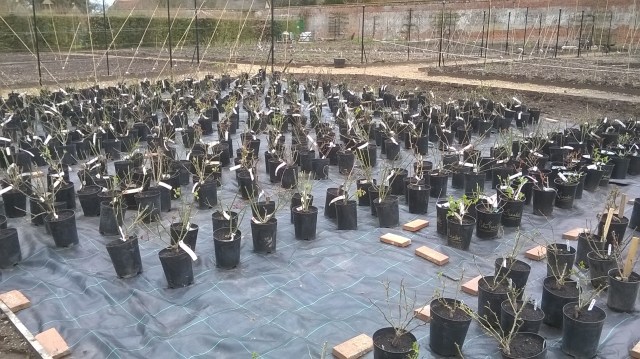
After this work- the plants didn’t require any special watering in as the rain came and went- we turned our attention to preparing the ground for the raspberries, blackcurrants, redcurrants and gooseberries that will occupy a quarter of the walled garden.

All is mucked in... forked over lines for soft fruit in the Walled Garden

All is mucked in… forked over lines for soft fruit in the Walled Garden

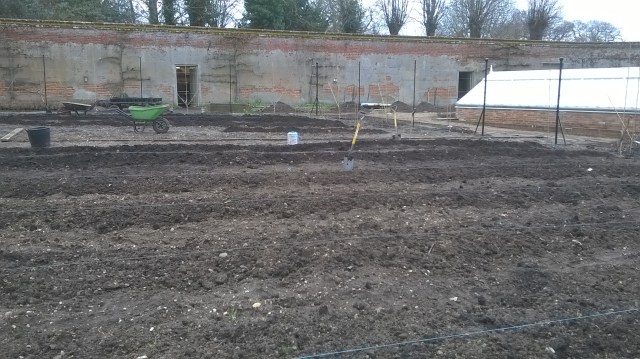
So having moved the piles of muck from the other side of the garden a few weeks ago, we now moved it (again) along lines that Mike had set out; to finish off we incorporated this into the top soil and so the ground is ready for planting. A digger had already been here to deep dig the soil, so, though I was still digging and forking this week, I managed to avoid yet more double digging!

The first Tulips are starting to show in the double borders

The first Tulips are starting to show in the double borders

Further Information:

Blickling Hall website

Blickling Hall Facebook page

A 360 degree tour of Blickling Hall

Old School Gardener


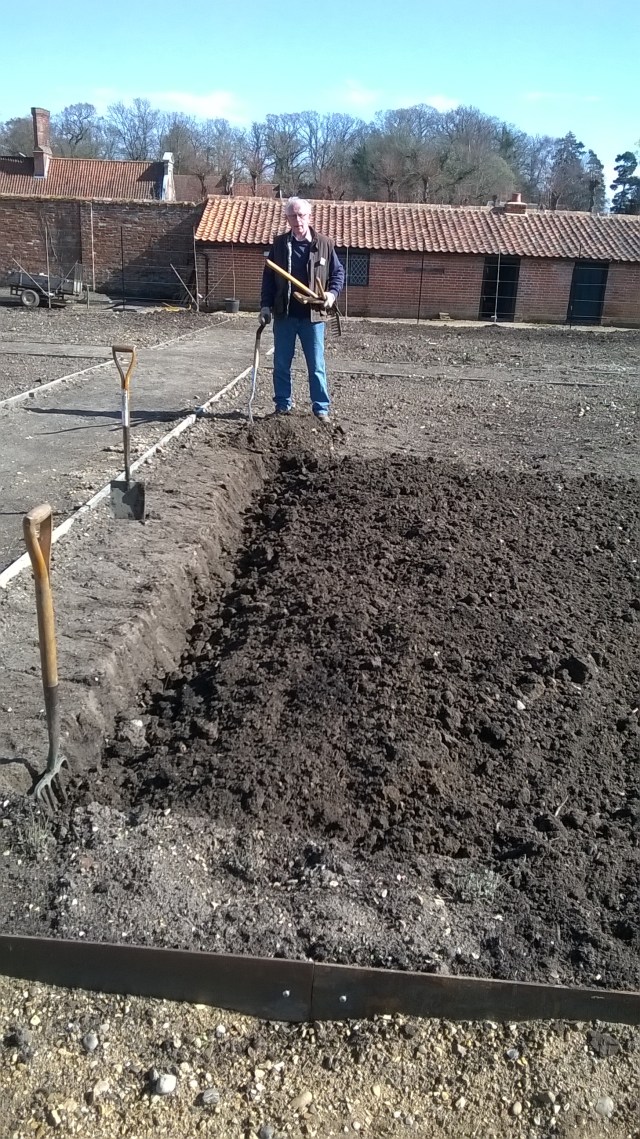
This week's efforts- double digging in the Walled Garden

This week’s efforts- double digging in the Walled Garden

Back to Thursday this week at Blickling, so it was good to see the rest of that day’s volunteer team again.

On my way into the gardens I noticed an orange MG spots car and some people filming- apparently it was for an edition of  ‘Antiques Road Trip’ due to be aired on BBC TV in the autumn.

After our initial meet up in the bothy (the old one) I didn’t see much of the others apart from Norfolk Peter, who joined me in double digging one of the beds in the Walled Garden.

Penstemons potted up- just a few

Penstemons potted up- just a few

The rest of the team were potting up Penstemons prior to their planting out next to the double borders (once the Hyacinths have gone over). I was also pleased to see that a lot of new plants were nestling in the old cold frames along side the glasshouses, all showing their first leaves and promising a good summer show.

After about 4 hours digging Peter and I had finished about a half of one quarter of one quarter of the walled garden! The soil is a bit of a clayey loam and quite stony (it was a car park for a time, I think), so it was a bit harder going than on my sandy loam at home. Having said this, I suppose I ought to subtract the trenches Aussie Peter and I dug a few weeks ago for the trained fruit…

Norfolk Peter resting on his spade after a hard day's digging

Norfolk Peter resting on his spade after a hard day’s digging

Anyway, I think that means we completed about a thirty second of the total area, excluding the side borders. Whilst some areas will be trenched rather than completely double dug, and I think Project Manager Mike is not planning to bring all of the garden into full cultivation this season, that still leaves quite a bit to do…hopefully our fellow volunteers on other days will make a contribution, otherwise I will have to plead to be put onto ‘light duties’!

Further Information:

Blickling Hall website

Blickling Hall Facebook page

A 360 degree tour of Blickling Hall

Old School Gardener


Oh dear, first mud on a nice new floor...

Oh dear, first mud on a nice new floor…

My second Wednesday at Blickling was focused on the Walled Garden. Joined by three other volunteers (one of whom was also a newcomer to Wednesdays), we finished off shifting top soil onto the beds to level them up to the path edges.

So, more barrowing and raking for starters. The available soil had been shifted by the gardeners from the piles in the orchard next door, so we didn’t have far to go. But it was pretty strenuous, nonetheless. The space created will soon be (temporary) home to 100 tonnes of crushed Carr Stone- which will be used to surface the main paths in the Walled Garden.

Since my last session here, the Walled Garden has taken some further big steps forwards; rows of Catmint have been planted along some of the paths which will give a colourful, fragrant and insect-attracting floor to the trained fruit bushes, some of which had also been planted by the canes I had helped set out a few weeks ago.

The other big step is the finishing off of the new Bothy, from where, around mid morning, Project Manager Mike shouted ‘Tea time Team!’- I think this might have been the first time it had been used for refreshments (but probably not the first time Mike had made tea for the volunteers). I duly christened the new room -with it’s shiny spotted grey flooring specially chosen by Mike to hide the dirt!

'Tea time Team!'- Mike in the new Bothy...will it be too comfortable for our own good?!

‘Tea time Team!’- Mike in the new Bothy…will it be too comfortable for our own good?!

After lunch (taken, for now in the old bothy near the double borders), we finished off shifting manure to the beds where the soft fruit (Raspberries, Strawberries and the like) will soon be planted. I may be on trenching in this lovely stuff in my next session (back to Thursday). To finish off the day a couple of us raked over the new soil to avoid the expected rain panning the surface. Another group were finishing off the oak path edging which looks tremendous. Mike tells me he’s decided to turf these grass paths so that they can be used this season.

The final stretch of oak edging to the grass paths in the Walled Garden

The final stretch of oak edging to the grass paths in the Walled Garden

As I left for the day I had a quick word with gardener Rob in the car park, where he was about to deliver half a dozen large oak trunks to a sawmill in nearby Hevingham; these are going to be shaped into the posts for the lines of Raspberries, Blackberries, Tayberries etc.  which will be tied into wires strung between them.

So, some more lovely ‘home grown’ oak will add a touch of class (and longevity) to the Walled Garden. Mike says he’s glad that, at long last, he can soon stop being a builder and start being a gardener once again!

Further Information:

Blickling Hall website

Blickling Hall Facebook page

A 360 degree tour of Blickling Hall

Old School Gardener


Our friends Jen and Dave visited us at the weekend and on the way they stopped off at the wonderful Anglesey Abbey in Cambridgeshire. This National Trust property has a spectacular display of Snowdrops (finished by the time of their visit), formal gardens, summer borders and also a winding Winter Garden which features a fantastic mixture of flower, leaf and stem colour. Here are Jen’s pictures from that Winter Garden; I expect it will soon be pruned- thanks Jen!

Further information: National Trust Website

Old School Gardener


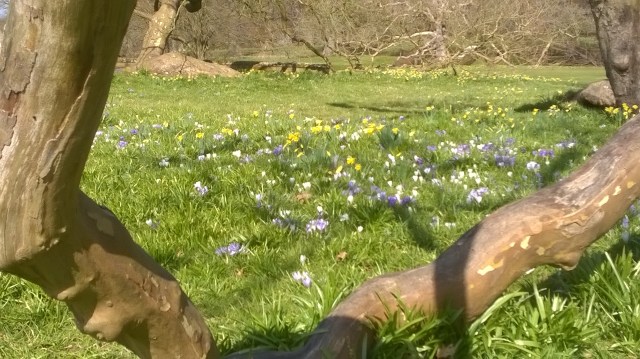
Crocuses looking good in the sun under the Oriental Plane Trees

Crocuses looking good in the sun under the Oriental Plane Trees

I had to change my day at Blickling this week, so was working alongside the Wednesday volunteers, some of whom have been in the gardens for over 10 years, and some, like me, have been inspired more recently by the project to regenerate the Walled Garden.

Our focus was the parterre. Gardener Ed gave us a quick course in rose pruning and we set off around the edges of four main beds.

Previous sessions had replaced the aging Catmint (Nepeta) which runs along side the rose beds. These contain a mixture of floribunda types, several of which are quite old and have lost their vigour…hmm, know what they feel like?

We made good progress, and by the end of the day we had pruned the roses, replaced about 50 old, weak specimens, watered them in (in bucket fulls of water taken from the central fountain) and I hoed over a quarter of the beds to finish off.

I gather from Project Manager Mike, that the fruit trees have arrived, so it could be that next week we’ll be focussed on planting them in the walled garden I’m also taking over my Garden Design group to do a practical session on transferring designs onto the ground.

The end of a sunny spring day..

The end of a sunny spring day..

Further Information:

Blickling Hall website

Blickling Hall Facebook page

A 360 degree tour of Blickling Hall

Old School Gardener


WP_20160224_15_46_02_Pro

En route to West Devon recently we had time for a brief afternoon stop at this wonderful National Trust property just outside Tiverton.

The house was built by Sir John Heathcoat Amory, the grandson of John Heathcoat, creator of the mechanised bobbin lace making machine and owner of a lace factory in Tiverton.

This slideshow requires JavaScript.

The foundation stone was laid in 1869, but it was not until 1873 that the elaborate interior designs were completed. William Burges, designer of Knightshayes, had a rocky relationship with the family and was fired half way through the project, leaving his imaginative vision incomplete.

Burges was replaced by another reputable designer, John Dibblee Crace, who turned out to be another ill-fated choice. Much of Crace’s work was covered up by the family, but later restored by the Trust.

We only had time to see the ‘Gothic Revival’ house and its colourful interiors (the Trust has imaginatively opened up some of the unrestored rooms too)  and quick tour of the formal gardens. These were originally designed by Edward Kemp (1817-1891), a reputable landscape gardener, but it fell into decline by the 1920s. Rescued by Sir John and Lady Heathcoat Amory, after the Second World War, the garden became one of the finest in England, winning the highest horticultural awards, with more than 1,200 species unique to Knightshayes. This garden has a very strong structure created by extensive Yew hedging and some amusing topiary animals scampering along the tops!

The restored Walled Garden was also an interesting spot, with its steeply sloping site being used to grow vines the ‘French Way’.

This slideshow requires JavaScript.

Knightshayes is certainly worth another, longer visit, when we can also explore the woodland garden… on the way out we stopped at a new ‘natural play’ site which cleverly uses three huge toppled oak trees to create a series of walkways, swing points, tunnels and other features.

Further information: Knightshayes National Trust website

Old School Gardener

WP_20160310_12_56_22_Pro

The final solution for the trained fruit trees along the central path?

This week’s session at Blickling was easier- at least to begin with- than the previous few. Norfolk Peter and I were detailed to measure out the positions of the new trained fruit  around the edges and across the middle of the Walled Garden.

Placing and tying in canes to mark the planting positions was pretty straightforward around the perimeter- Mike plans for these to be vertically planted and then trained. Then we needed a bit of discussion about the central path, where Mike wants to put in some angled cordons for apples and pears. Putting them all in at 45 degrees and pointing the same way proved problematic; we ended up with plants placed too close to the concrete footings of the metal posts and some cordons would have to wrap around the corners or there would be gaps at the upper sections if we stuck rigidly to the spaces between each post…

After a bit of trial and error we came up with a combination of outwardly angled and a vertical espalier for each complete stretch of the wire and posts; this would mean some cordons growing over the intermediate metal posts and the angle would have to be steeper than 45 degrees. But overall it seemed to be a pleasing arrangement, and after they were in place I could see two other advantages; the design would visually slow you down as you proceeded along the path (rather than being hastened through if they had all be pointing in the same direction) and the angles nicely framed the other central path where these cross.

The rest of the volunteers were off digging over the parterre alongside the Hall, removing dead or dying Catmint and roses and replanting with new stock.

After lunch, having finished off the cane placing, Peter helped Mike measure up the splendid carved oak top trim for the new noticeboard and I barrowed in some soil and manure along the borders in the walled garden in preparation for the planting out of the many new plants that seem to be arriving in time for my next session… so next time it will be more gardening, less construction.

Further Information:

Blickling Hall website

Blickling Hall Facebook page

A 360 degree tour of Blickling Hall

Old School Gardener


The Royal Botanic Gardens, Edinburgh saw an impressive increase in visitors last year.

The Royal Botanic Gardens, Edinburgh saw an impressive increase in visitors last year.

By Elizabeth Henry (from Horticulure Week 7th March 2016)

‘Visitors continue to flock to gardens around the country, according to figures released today by the Association of Leading Visitor Attractions (ALVA).

Among them, the Royal Botanic Gardens, Edinburgh saw a 10 per cent increase to 889,420, adding to a 19 per cent rise in 2014. RBGE credited their Lights programme in the winter months for the increase.

The Eden Project saw an 11 per cent increase to 960,029 visitors, compared to a 1 per cent increase in 2014.

All four RHS gardens had record visitor numbers in 2015, with RHS Garden Hyde Hall in particular up 12.1 per cent to 242,520 visitors. Rosemoor visitor numbers were up by 9.5 per cent, Wisley by 6.1 per cent and Harlow Carr by 5 per cent.

Kew Gardens saw a more modest increase of 3.5 per cent, but Wakehurst Place, which Kew leases from the National Trust, saw visitor figures climb by 14.9 per cent – a strong turnaround from 2014 when the introduction of carparking fees saw a 29 per cent fall in visitor numbers.

Many National Trust properties held steady or saw more modest gains. Standouts include a 15.2 per cent increase in numbers at Bodnant Garden in Wales, 10.3 per cent at Lanhydrock and 17 per cent at Mount Stewart in Northern Ireland.

The UK as a whole saw a 3.2 per cent increase in visitor numbers, while Scottish attractions proved particularly popular, gaining 5.48 per cent overall.

Chester Zoo was the most visited paid-for attraction in England outside London, mainly as a result of the opening ‘Islands’ in June – a recreation of the tropical environments of six South East Asian islands.

The British Museum continued to be the most popular visitor attraction overall for the ninth year running. But visits to many London attractions plummeted following the Paris attacks in November.

Bernard Donoghue, Director of ALVA, commented:

“2015 continued to be a record year mainly due to our members continuing to show how diverse the UK is to both domestic and overseas visitors….The current weakness of the pound to the dollar and Euro is making the UK a more affordable destination and 2016 is on target to be another memorable year for ALVA members.” ‘

Finding Nature

Nature Connectedness Research Blog by Prof. Miles Richardson

Norfolk Green Care Network

Connecting People with Nature

Discover WordPress

A daily selection of the best content published on WordPress, collected for you by humans who love to read.

Susan Rushton

Celebrating gardens, photography and a creative life

Unlocking Landscapes

Writing, photography and more by Daniel Greenwood

Alphabet Ravine

Lydia Rae Bush Poetry

TIME GENTS

Australian Pub Project, Established 2013

Vanha Talo Suomi

The Journey from Finnish Rintamamiestalo to Arboretum & Gardens

Marigolds and Gin

Because even in chaos, there’s always gin and a good story …

Bits & Tidbits

RANDOM BITS & MORE TIDBITS

Rambling in the Garden

.....and nurturing my soul

The Interpretation Game

Cultural Heritage and the Digital Economy

pbmGarden

Sense of place, purpose, rejuvenation and joy

SISSINGHURST GARDEN

Notes from the Gardeners...

Deep Green Permaculture

Connecting People to Nature, Empowering People to Live Sustainably

BloominBootiful

A girl and her garden :)