Category: Heritage Gardens & gardening


IMG_8801You may have read previously that one of my latest projects involves designing, and then helping to install a new border alongside a 200-year-old ‘Crinkle Crankle’ Wall, near Fakenham town centre, Norfolk. I’m not sure about the history of the wall, but it seems to have enclosed a substantial garden for an important house next to the Church (possibly the old Vicarage or Rectory?). There’s certainly evidence of lean-to glasshouses on some (straight) parts of the wall, which are all ‘listed’ as being of historic or architectural interest.

Crinkle Crankle walls have an interesting history, as Wikipedia says:

‘A crinkle crankle wall, also known as a crinkum crankum, serpentine, ribbon or wavy wall, is an unusual type of garden wall.

The crinkle crankle wall economizes on bricks, despite its sinuous configuration, because it can be made just one brick thin. If a wall this thin were to be made in a straight line, without buttresses, it would easily topple over. The alternate convex and concave curves in the wall provide stability and help it to resist lateral forces.

Both crinkle and crankle are defined as something with bends and turns (Webster’s), but the term is also thought to come from Old English meaning zig-zag. The earliest reference to this meaning has been cited in 1598, but it was not until the 18th century that the term began to be applied to wavy walls. At that time these garden walls were usually aligned east-west, so that one side faced south (Dictionary of Architecture and Landscape Architecture by James Stevens Curl) to catch the warming sun and were historically used for growing fruit.

Many crinkle crankle walls are found in the East Anglia area of England where the marshes of the fen country were drained by Dutch engineers starting in the mid-1600s. The walls’ construction is attributed to these engineers who called them slange muur, meaning snaking wall……’

The Fakenham wall (which must be one of the oldest surviving examples in the U.K.), now encloses the Town’s Community Centre, Registry Office and other community buildings and the surrounding site is mainly laid to grass, with some areas of mature trees and more formal borders. Next to the wall is an old asphalt tennis court (no longer in use) and the border immediately in front was covered in weeds (mainly Alkanet- it has a pretty blue flower, but also has tough tap roots and is a real ‘spreader’), as well as a large area of Hemerocallis (Day Lily). Perhaps a legacy from the wall’s days as a backdrop for fruit growing, each ‘bay’ created by the wavy wall has a fruit tree- apple, cherry or fig. These old trees are all looking rather uncared for and one of my first jobs was to cut back the fig which was covering one of the old brick and slate seats that once must have been used to watch the tennis. Here’s what the area looked like at the start of the project….

The clients (the Community Centre and the Gardening in Fakenham Town – GiFT project) have ideas for improving this wider area and perhaps encouraging it as a space for wedding photos, outdoor events etc. The brief was to come up with a planting plan for the border in front of the south -facing wall to better show off its features, use plants that require limited maintenance and which can cope with the poor soil and aspect.

My design involved limited pruning of the other fruit trees, thinning out the large area of Day Lilies and using the thinnings to create a continuous ribbon of these around the base of the wall, and introducing a few shrubs and sub shrubs (Buddleja and Lavender) at key points. These, and a range of herbaceous perennials and grasses were positioned to provide contrasting textures and forms within a broadly colour-themed series of ‘waves’ to pick up the shape of the wall, and taking account of the other strong structural features of the seats and fruit trees.

These waves are alternating combinations of mainly blue and red; blue and yellow and with purple (including purple foliage) to tie these together as a more continuous ribbon through the whole scheme. In addition a selection of different grasses (including Stipa gigantea and Miscanthus sinensis) have been used around each seat to provide a taller, contrasting, soft veil effect with both flowers and foliage to catch the sunlight. I also suggested that old bricks, to harmonise with the wall, could be laid as flooring in front of each seat, softened with ad hoc planting of varieties of Thyme. The first of these seating areas has been used to pilot this and it is hoped that further work will be done to complete the other areas as voluntary help and materials become available.

Children from the local Junior School were involved alongside a handful of volunteers to help me clear the border, prepare the soil and then to plant it up. Here’s how it looked after clearing and planting up…

The final scheme involved planting over 200 plants supplied in the main by Howard Nursery of Wortham, Suffolk and Taverham Nursery Centre, Norfolk. The planting has deliberately been placed closer together than would ultimately be necessary, so as to speed up the ground coverage and so reduce the need for weeding. However, not surprisingly, some roots of the Alkanet remain and have started to sprout once more, so the border will need to be carefully managed to ensure the plants survive and the weeds are removed in its early days.

This week, the children from the Junior School returned to carry out the ‘first weed’ since planting and to draw the wall and look out for insects etc. This marked the formal completion of the project. Here are some pictures of that event…

This slideshow requires JavaScript.

And here’s one of me together with representatives of the main partners: from left to right Rhoda Hincks (Junior School), Janet Holdom (Community Centre) and Pauline Chamberlain (GiFT).

IMG_8926

This has been an interesting and enjoyable project and I look forward to seeing the border in a few months once it has become better established and to seeing progress on the improvements to the wider area. If you’d like to look at pictures and a brief account of the Junior School’s involvement take a look at their blog. 

Old School Gardener

Jardin's avatarJardin

The winding drive, down an avenue of beech trees to the front of the house, belies the formality of the garden, not yet visible, at the rear.

Photos from Iphone May 2014 248

The picturesque drive arrives at a formal, almost austere, front façade. And contrast is, for me, the key characteristic of the gardens at Powerscourt Estate, named by “National Geographic” as  number 3 in its Top Ten Gardens of the World.

The Powerscourt Estate is nestled in the Wicklow Mountains, an easy drive from Dublin, in an area of breathtaking natural beauty. And it is this contrast, which is particularly interesting at Powerscourt – the formal green symmetrical amphitheatre laid out below,with its terraces, statues and grottoes, wrestling for attention with the natural backdrop of the fields and the Sugarloaf mountain beyond.

april 2014 078

And I think it does pull it off – the monolithic statues managing to frame the distant view and mirrored by the…

View original post 554 more words

gressenhallfw's avatarGressenhall Farm and Workhouse

One of the lovely things about being a Heritage Gardening Trainee is the fact that we are able to garden in so many different heritage settings. Even within the walls of Gressenhall there are different focuses for each gardening area.

My focus has primarily been on the Dyer’s Garden and the Farmhouse garden. It has been a joy to get to know the volunteers who have spent many years in some cases caring for the different areas. Carol and Jenny who look after the Dyer’s Garden are extremely knowledgeable about the whole process of dying, from which plants to grow for which colour, through to the processes of dying fabric. Carol loaned me a fascinating book about the history of wool industry in Norfolk and how dying yarn and silk was a highly valued skill.

Dyer's Garden at Gressenhall FW Dyer’s Garden at Gressenhall FW

Starting the traineeship in winter was a good time to…

View original post 276 more words

gillians's avatarPlant Heritage

After our visit to Kristopher’s we headed out towards the coast to East Ruston Old Vicarage Garden.  ‘Very flat, Norfolk’, as Amanda says to Elyot in Coward’s Private Lives and beyond the city lies an area of open expanses, buffeted by gentle zephyrs from the North Sea and ideal for growing carrots.  Forty years ago, Alan Gray and Graham Robeson bought the house at East Ruston and over the decades have created a garden of views and vistas, cleverly borrowing focal points from outside.  Shelter belts of  Monterey Pine, Italian alder and Eucalyptus have created a microclimate capable of supporting a huge variety of plants in a multitude of garden rooms.

IMG_3493

This courtyard had recently been planted out with Aeonium which are overwintered inside.

Sculpture – one created to look like the waterspouts which occur off the coast.

The desert, carved out of the landscape with a JCB.

Two sides of the…

View original post 156 more words

Planting Patterns #12

Wisteria tunnel at Kawachi fuji Gardens, Japan

Old School Gardener

IMG_8624The second and final stop on our trip home from Devon recently, was Montacute House, Somerset. Surrounded by beautiful, formally laid out gardens, the warm, honey-coloured stone of the house glowed in the spring sunshine. There was a splendid display of tulips and wallflowers and a magnificent ‘cloud’ yew hedge reminiscent of those at Blickling House, near our home in Norfolk. We were fortunate to meet  a gardener in the ”orangery’, which, she explained, was not really in the best spot for this and had in the past been more of a shady water feature, with its tufa – clad grotto. This and it’s surrounds are gradually being replanted with ferns and other suitable species. Pots of standard Bay trees line the terrace outside where once orange and lemon trees would have been placed in summer.

‘Montacute is a masterpiece of Elizabethan Renaissance architecture and design. With its towering walls of glass, glow of ham stone, and its surrounding gardens it is a place of beauty and wonder.

Sir Edward Phelips, was the visionary force and money behind the creation of this masterpiece, which was completed in 1601. Built by skilled craftsman using local ham stone under the instruction of William Arnold, master mason, the house was a statement of wealth, ambition and showmanship.

Come face to face with the past in the Long Gallery, which is the longest of its kind in England. The gallery houses over 60 Tudor and Elizabethan portraits on loan from the National Portrait Gallery.

Beautiful gardens surround Montacute, constantly changing, filling the house with scent in summer and providing an atmospheric backdrop for a winter walk…’

This slideshow requires JavaScript.

Further information: National Trust website

Old School Gardener

gillians's avatarPlant Heritage

In my family, Cartmel in Cumbria, has long been associated with sensory delights, being the home of Sticky Toffee Pudding, a favourite with my boys and always provided by their grandmother on our trips North.  But after a recent trip to this area I can assure you that all your senses will have a treat with a visit to Holker Hall – home of the National Plant Collection of Styracaceae.

From the dramatic ‘Capability Brown’ style entrance drive

IMG_3060

through the formal gardens planted out with tulips

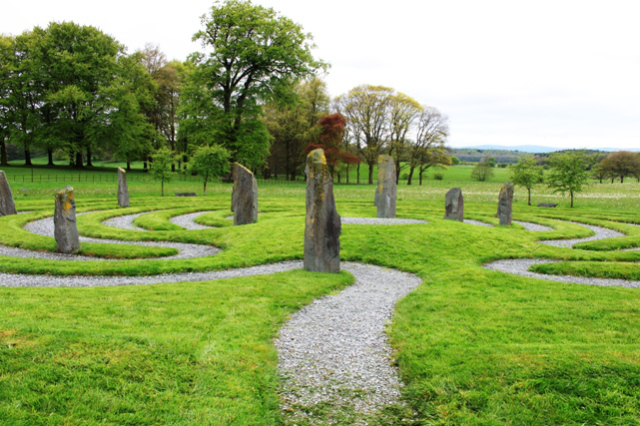
the labyrinth

IMG_3065

and the sundial

IMG_3066

to the woodland, home for the National Collection.

Styrax is the largest genus in this family, but this Collection also covers Halesia, Pterostyrax and Sinojackia.  Small graceful trees found in Europe, Asia and America, they have dainty pale flowers in the spring which were just about to open on our visit.  This specimen of Styrax japonica

View original post 281 more words

IMG_8605On the way home from our recent break in Devon, we took the opportunity to visit a couple of National Trust houses and gardens just off the A303, a road that’s conveniently ‘lined’ with some great gardens. First stop was Barrington Court, Somerset.

A large walled garden was lined with displays of wallflowers and tulips which were  wonderfully vibrant. Much of the rest of this area was bare earth- or so I thought until I noticed it  had been covered with landscape/weedproof fabric and then mulched with compost- one of the gardeners explained how they create planting holes through these layers and so restrict the amount of time they weed- a very useful idea that looks attractive as well as being practical.

I was also glad to see the ‘bones’ of the other gardens (it was rather too early to see the borders in all their glory). To my surprise I also found a Melianthus major in flower! I was told how the gardeners usually give this a protective winter mulch and cover and in the season to follow it puts on lots of leaf growth but no flowers- it must be due to the mild winter that this glorious plant (which smells like peanut butter when you brush the foliage), had managed to put on an early spring show. Having just pruned mine at home to the ground I’m wondering if I would have been better leaving it alone! We shall see if it manages to complete its growth cycle this summer.

‘Discover the haunting echoes of the past at Barrington Court, a Tudor manor house free from collections and furniture. Explore using your imagination and your senses to discover a house full of memories, where light fills the rooms and you feel you can almost touch the past.

The property was saved from ruin and restored by the Lyle family in 1920s, when the court house resembled a barn rather than the proud manor house that it is. Close your eyes and you’ll almost be able to hear the sounds and see the sights of the glamorous parties held in the great hall during Barrington’s hey day. On the first floor listen out for the voices resonating from the past, of the young evacuees who called Barrington home during the Second World War.

 Stroll through the Gertrude Jekyll inspired gardens, which with their focus on plant varieties and colours are a delight for all the senses. Be spurred on in your own garden or allotment by the stone-walled kitchen garden that produces a variety of delicious fruit and vegetables. Don’t just take our word for it, why not stop off in the Strode House Restaurant to taste these home-grown delights.’

Oh, and yes, we had a lovely lunch in the afore said restaurant….

This slideshow requires JavaScript.

Further information; National Trust website

Old School Gardener


IMG_8567Another trip out whilst in Devon recently, involved a rather tortuous journey (and the need to pre book parking) at the former home of Agatha Christie, Greenway, near Brixham. We were a little limited in what we could see of the gardens, and we didn’t get to some of the feature areas like the walled garden and rhododendrons. Another day perhaps….What we did see was a fascinating house (and contents too) and some beautiful riverside sloping gardens full of interesting plants, typical of so many ‘sub tropical’ gardens along this south west coastline.

‘…The beloved holiday home of the famous and much-loved author Agatha Christie and her family. This relaxed and atmospheric house is set in the 1950s, when Agatha and her family would spend summers and Christmases here with friends, relaxing by the river, playing croquet and clock golf, and reading her latest mystery to their guests. The family were great collectors, and the house is filled with archaeology, Tunbridgeware, silver, botanical china and books.

 In the garden don’t miss the large and romantic woodland which drifts down the hillside towards the sparkling Dart estuary. The walled gardens are home to the restored peach house and vinery, as well as an allotment cared for by local school children. A visit to Greenway isn’t complete without seeing the Boathouse, scene of the crime in Dead Man’s Folly, and the battery complete with cannon….’

This slideshow requires JavaScript.

Further Information: National Trust Website

Old School Gardener

IMG_8467

On our recent trip to Devon we visited a few National Trust houses and gardens. We’d been to Saltram, near Plymouth, before, but not in the spring. It was a beautiful sunny day and the photos below show the house and gardens at their best, with deep, sharp shadows adding to the atmosphere.

‘Saltram overlooks the River Plym and is set in a rolling landscape park that provides precious green space on the outskirts of Plymouth. Strolling along the riverside or through the woodland, you can almost forget that the city lies so close. Saltram was home to the Parker family from 1743, when an earlier mansion was remodelled to reflect the family’s increasingly prominent position. It’s magnificently decorated, with original contents including Chinese wallpapers and an exceptional collection of paintings (several by Sir Joshua Reynolds). It also has a superb country house library and Robert Adam’s Neo-classical Saloon…The garden is mostly 19th century, with a working 18th-century orangery and follies, beautiful shrubberies and imposing specimen trees providing year-round interest.’

 Further information: National Trust website

Old School Gardener

Finding Nature

Nature Connectedness Research Blog by Prof. Miles Richardson

Norfolk Green Care Network

Connecting People with Nature

Discover WordPress

A daily selection of the best content published on WordPress, collected for you by humans who love to read.

Susan Rushton

Celebrating gardens, photography and a creative life

Unlocking Landscapes

Writing, photography and more by Daniel Greenwood

Alphabet Ravine

Lydia Rae Bush Poetry

TIME GENTS

Australian Pub Project, Established 2013

Vanha Talo Suomi

The Journey from Finnish Rintamamiestalo to Arboretum & Gardens

Marigolds and Gin

Because even in chaos, there’s always gin and a good story …

Bits & Tidbits

RANDOM BITS & MORE TIDBITS

Rambling in the Garden

.....and nurturing my soul

The Interpretation Game

Cultural Heritage and the Digital Economy

pbmGarden

Sense of place, purpose, rejuvenation and joy

SISSINGHURST GARDEN

Notes from the Gardeners...

Deep Green Permaculture

Connecting People to Nature, Empowering People to Live Sustainably

BloominBootiful

A girl and her garden :)