Category: GQT: your gardening queries answered


RoseWallAs I write today we have some rain in Norfolk (nothing dramatic, just a steady drip) – after three weeks of virtually nothing! I can almost hear the plants saying aahhhh….

Looking through my inbox I’ve come across another interesting question which I’ll use for this week’s GQT:

‘I would like to train some climbers on the wall of my house but do not want to use too many nails. What is the best way to go about it?’

So writes Salome St. John from Headon Platter in Cumbria. Well Salome, there are probably two good ways of tackling this. For small areas and plants which are not too heavy once fully grown, you can put up trellis. For larger areas and for supporting plants which can become very heavy over time (e.g. Wisteria) it might be best to put up a permanent wire – support system. Trellis can be attached to the wall with screws and plastic plugs after you have drilled holes with a masonry drill. To support wires, plug the wall in the same way and screw large ‘vine eyes’ into them – these should be about 1 – 1.2metres apart and at vertical intervals of about 450 – 600mm. Plastic covered or galvanised wires can then be threaded through the vine eyes and tensioned by means of tensioning bolts at one end.

Have you ever thought about using climbers in your borders?

You can train clematis or roses to add height to your borders by using rustic poles about 3m tall- these provide the least obtrusive supports. Dig a hole and/or ram in the posts so that they are at least 450mm, and preferably 600mm in the ground. Paint them before you put them in with a good wood preservative or one of the brightly coloured outdoor paints if you want them to stand out a bit more or tone in with other structures/furniture. A few cross – pieces will help support the plants that can be trained along them. Alternatively you can go for the ‘cottage garden’ look of  swags – these are basically thick ropes or other material (e.g chains) slung between the posts and along which roses can be trained. These make a great not – too – intrusive divider in the garden as well as being a good way of adding height to a border. Other options for adding height to a border are obelisks, which we use here in the Old School Garden to support runner beans and sweet peas.

Add height to your borders with a simple post, plus mesh for Clematis to clamber up

Add height to your borders with a simple post, plus mesh for Clematis to clamber up

Clematis can also be supported on tubes of special clematis netting: 2 metre lengths of netting are nailed to 2.4 metre stakes, which are hammered 600mm into the ground. This support is really only suitable for those late summer -flowering varieties which can be cut back in spring to keep them to a reasonable size.

Here at Old School Garden I’ve used panels of heavy-duty trellis to provide a screen for an oil tank and other things I want to hide and then trained clematis up this tying it in as it produces new growth. You can use all sorts of other climbers in the same way, but be careful you don’t go for those that are very vigorous and which will give you maintenance problems in the future; e.g. Clematis montana, the climbing rose ‘Kiftsgate’ or Boston Ivy (which is a fast wall coverer but which unless kept in check will get under roofs etc.).

A rose trained along a rope 'swag' between posts provides a permeable divider in the garden

A rose trained along a rope ‘swag’ between posts provides a permeable divider in the garden

Home made obelisks in Old School Garden used for Runner Beans and Sweet Peas

Home made obelisks in Old School Garden used for Runner Beans and Sweet Peas and heavy duty trells in the background screening a garage and oil tank

You might also be interested in related articles on this blog:

Arbours and Pergolas in the garden- 7 top tips

Lock down- pros and cons of garden ties

Build yourself an obelisk

Old School Gardener

If you’ve enjoyed reading this post and others on this blog, why not comment and join others by signing up for automatic updates via email (see side bar, above right ) or through an RSS feed (see top of page)?


redcurrantsIt’s the time of year to harvest red currants around here and this week’s question comes from Frew T. Bunn of Oldham:

‘Our red currant bushes always lose their leaf colour in July or August, but the ribs of the leaves always stay green – are they suffering from some sort of disease?’

By the summer months red currant bushes are starting to lose their lustre, but the fact that the leaf ribs of yours remain green suggests a shortage of Magnesium, one of the ‘trace elements’ of importance to plant health. Commercial ‘Epsom Salts’ applied in the spring at around 65 grammes per square metre should improve matters, so try this next year.

My blackcurrants look like they'll give a good crop again this year

My blackcurrants look like they’ll give a good crop again this year

On the subject of currants, my black currants are dripping off the three bushes I have here in Old School Garden, and the family of blackbirds nesting in the courtyard is relieving us of some – literally pecking them through the netting of my too – small fruit cage!

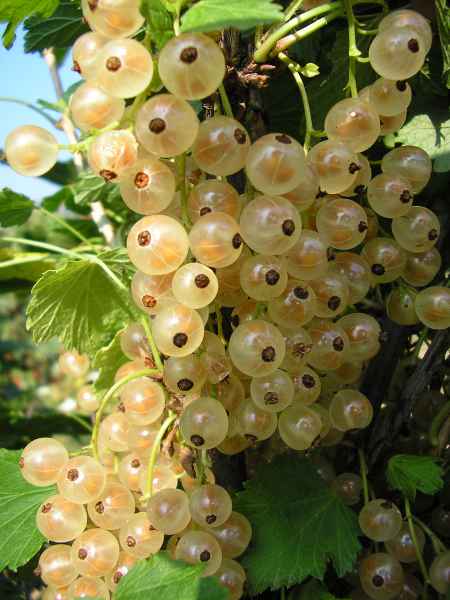
Have you ever thought of growing white currants?

They are apparently not difficult to grow and seem to have returned to favour in recent years. Like red currants (and black currants) they fruit on old wood. ‘White Versailles’ is a popular and reliable early variety, the first white currant to crop. It produces a heavy crop of large, shiny, soft pale yellow/white berries in long heavy trusses during mid-late summer. The fruit is deliciously sweet, not as acidic as red currant, so is great for eating fresh or using for a wide range of culinary purposes. White Versailles has a vigorous, upright bushy growth habit with attractive arching canes and serrated three lobed pale green leaves. It is a very reliable cropper year after year, is self fertile so you only have to grow one bush if you want to – eventual height and spread: 1.5m (5ft).

I’m thinking that I might reorganise my bush fruit cage and substitute one of the three blackcurrant bushes with a white currant, just to get a bit more variety and perhaps less of a storage problem, with the glut of black currants we’ve had in the last couple of years!

'White Versailles' - I thinki I'll try to get hold of one of these to replace one of the blackcurrant bushes

‘White Versailles’

Old School Gardener

If you’ve enjoyed reading this post and others on this blog, why not comment and join others by signing up for automatic updates via email (see side bar, above right ) or through an RSS feed (see top of page)?
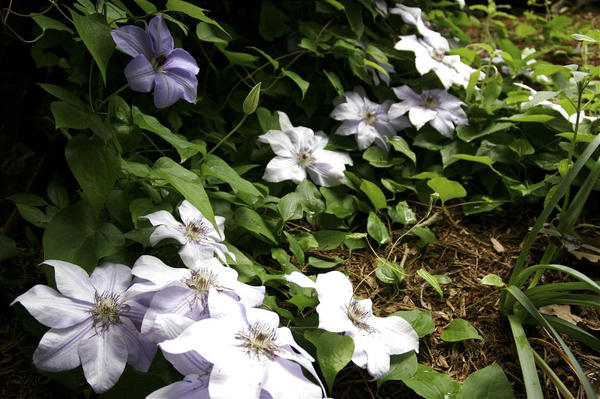
clematis ground coverAn interesting question this week, from a Trevor Arzan of Nether Wallop:

‘Some of the stems on my Clematis have fallen down and are growing along the ground, where they seem to be doing quite well. Can this or any other climber be used as ground cover?’

Clematis make very good ground cover plants as do the yellow-veined honeysuckle (Lonicera japonica ‘Aureo -reticulata’) and the climbing hydrangea (Hydrangea petiolaris). Many roses, especially ramblers, can also be used in this way.

So turn what you might use as climbers into creepers!

And climbers are also useful for covering ugly tree stumps. The less vigourous ivies are ideal for this job. Choose one of the varieties of common ivy (Hedera helix) with prettily marked leaves, such as ‘Glacier’ in grey and white, ‘Buttercup’ with young leaves entirely yellow, or ‘Adam’ with white-margined green leaves. I’ve used this approach ona tallish Cherry Tree stump in Old School Garden and the ivies can even look attractive climbing up living tree trunks. And I’ve also used ivy as ground cover with mixed results- if ground elder is present it’s a devil to get this out without completely destroying the ivy, still Ivy is pretty tough and will re-establish.

It’s also worth trying ‘Dutchman’s Pipe’ (Aristolochia macrophylla), with enormous leaves and yellow and purple pipe-shaped flowers. Schizophragma hydrangeoides, with it hydrangea-like  flowers in creamy white, does very well on old stumps and is self clinging.

ivy cherry tree

Ivy growing up from ground cover to girdle the trunk of a cherry tree in Old School Garden

Old School Gardener

If you’ve enjoyed reading this post and others on this blog, why not comment and join others by signing up for automatic updates via email (see side bar, above right ) or through an RSS feed (see top of page)?


This week's questioner has been offered a second greenhouse...an offer too good to be refused?

This week’s questioner has been offered a second greenhouse…an offer too good to be refused?

GQT this week comes from Mr. Herb E.Vore of  Field Dalling, Norfolk. Herb asks:

‘A friend has offered me his small greenhouse free. I have space to spare – but I have one green house already. Apart from extra capacity, what are the advantages of a second greenhouse?’

Well Herb, the chief advantage is that you can create two quite different environments – one, perhaps, devoted to a special purpose or to growing plants such as orchids, alpines, carnations and the like which do not thrive in the sort of environment you probaly create in your present greenhouse (assuming it’s used to propagate plants, grow tomatoes etc.).

A second greenhouse would also be useful to keep as a conservatory for the display of decorative plants, and quite separate from the placed used for the vital, visually less interesting jobs of propagation and growing – on. Bear in mind, however, that even if you have the room (or time or money) for only one greenhouse, you may be able to create at least two different environments by dividing the structure into two compartments (with a heavy clear plastic sheet as a divider, for example).

And while we’re talking about greenhouses its useful to think in terms of using it all the year round by thinking ahead and producing an annual schedule. As an example:

  • Start in spring with the sowing of bedding plants and planting summer to autumn flowering bulbs
  • In summer, cuttings can be taken of summer to autumn flowering pot plants, and crops such as tomatoes, sweet peppers, cucumbers and melons can be grown
  • With the approach of autumn, Chrysanthemums and other tender plants can be moved in
  • Winter can continue to be colourful from sowings of suitable plants made during summer. There is also a number of useful winter salad crops you can grow during the ‘dark times’, for example lettuces
You may not be offered a second greenhouse, but maybe you can build one yourself?

You may not be offered a second greenhouse, but maybe you can build one yourself?

Link: 10 Greenhouses you can build yourself

If you have any gardening questions that you think I might help with, then please email me at nbold@btinternet.com

Old School Gardener

If you’ve enjoyed reading this post and others on this blog, why not comment and join others by signing up for automatic updates via email (see side bar, above right ) or through an RSS feed (see top of page)?

The GQT Panel doing their stuff

The GQT Panel doing their stuff

200 eager gardeners packed the marquee at Gressenhall Farm & Workhouse Museum, Norfolk yesterday. Rather than post my own article answering gardeners’ questions I thought I’d devote this week’s GQT to a report on the real thing!

Well, it turned out to be a fascinating event, especially watching the ‘well oiled machine’ that is GQT in operation. Celebrating its 65th year of broadcasting this year the programme, as chairman Peter Gibbs said, ‘has become a national institution’ attracting some 2.5 million listeners a week. Pleading with the audience not to blame him for the recent weather (for non Brits he’s a well-known TV and Radio weather forecaster as well as a keen gardener), he recalled his time in Norfolk and visiting the Museum with a young family about 15 years ago. He went on to chair not one but two editions of the programme (I’ll give you broadcast dates later). And we were not disappointed with either the range and quality of the questions or the depth and humour of the Panel’s answers.

Earlier I had been involved in a ‘pre recording’ session with some fellow gardeners and the original Museum curator, Bridget Yates. Matthew Wilson and Bob Flowerdew, two of the panelists quizzed us on the history of the place and some of the more recent developments in the gardens. I was mightily impressed with the professionalism of the production team and the two panelists who seemed to conjure an interesting and relevant discussion from the barest of facts – you’ll have to listen in for the full version!

The GQT Team at Gressenhall- from left: Matthew Wilson, Chris Beardshaw, Peter Gibbs, James Wong and Bob Flowerdew

The GQT Team at Gressenhall- from left: Matthew Wilson, Chris Beardshaw, Peter Gibbs, James Wong and Bob Flowerdew

After this I was pleased to have the opportunity of interviewing Matthew Wilson myself, for the online newspaper ‘The Breckland View’. A well known Garden Designer and Director of an historic plant nursery in London, Matthew talked about his (positive) impressions of the Museum gardens and we went on to talk about growing food at home. Matthew believes this is important, not only for the freshness and flavour of the home-grown produce, but as a way for people to ‘reconnect’ with nature in an increasingly ‘virtual’ world. Though his own garden is small, he tries to ensure that his young children are able to experience nature and growing things close up. He seems to be undecided on the ‘GM or not GM’ debate, as frustrated as me on the apparent lack of ‘hard’ evidence to help us decide how to proceed with the urgent business of ‘feeding the world’, though he feels we can still achieve improvements in crops from some of the older techniques of selection and breeding.

The Question time proper featured a dazzling array of questions. The panelists – serial Chelsea gold – winning medallist Chris Beardshaw and ‘new wave’ botanist James Wong  joined Matthew on stage for the first session  – seemed effortless in their answers to questions as diverse as:

  • whether the museum’s collection of historic gardening books and other material is still relevant (a resounding ‘yes’ from all to that one),
  • trying to explain why one poor gardener could only produce some ‘micro rhubarb’ (pencil thin stalks 10 centimetres long) – the ‘answer lies in the soil’ it would seem, specifically the lack of rich, organic matter and the right position, according to Matthew
  • what kinds of veg could be grown in a wet and dismal summer – James came up with some interesting oriental varieties that in a normal hot dry summer would bolt, but in a more dim and damp period would turn out just right
  • selecting some ‘exotic’ but hardy plants for a patio. Chris initially shocked his audience with a suggestion of ‘black negligee and stockings’, but quickly added that these were references to some interesting plants – sorry, the names have eluded me after the initial image he created…!

And I can confirm that, as the programme repeatedly states, the panel were not privy to the questions before they were asked! The audience was very receptive to the ongoing banter and humour between the panelists and seemed to maintain their enthusiasm right through a second session (where James was substituted by well-known Norfolk organic gardener Bob Flowerdew). Chairman Gibbs praised our fortitude and two hours later it was all over! It had been an enjoyable evening and one where gardening colleagues were welcomed from far and wide the gardening Team from Peckover House, Wisbech and Master Gardeners from King’s Lynn being some of the furthest travelled.

The first programme should be broadcast at 3pm on Friday 5th July (repeated Sunday 7th July 2pm) and the second (from a more anonymous ‘Norfolk’ location this one) on the 23rd/25th August. So, tune in to BBC Radio 4 at these times (or try it online via www.bbc.co.uk, on their ‘i player’ or ‘listen again’ facility if you can’t listen ‘live’).

And for anyone within striking distance of Gressenhall this weekend, the Museum has a special interest day on Sunday focused on gardens and gardening, so why not pop along and meet me at the Master Gardener stall, visit the many other attractions on offer and see the gardens, which I must say are looking splendid (but then again I would say that)!

Thanks to Kings Lynn Community Allotment for the photographs

Old School Gardener

If you’ve enjoyed reading this post and others on this blog, why not comment and join others by signing up for automatic updates via email (see side bar, above right ) or through an RSS feed (see top of page)?

hedge archwayThis week’s Gardeners’ Question Time looks at how and when to trim hedges. The question comes from Anne Elk who lives in West Devon:

‘I never seem to be able to get an even, level cut on my hedge when I give it its annual trim. How can I achieve a really neat appearance?’

Well Anne, first you need to check on whether in fact your hedge is of a variety that does just need only one clip, or whether it should have several (see below). If it’s the latter, it will be difficult with only one cut to keep it smooth and sharp as so much material will have to be removed, so you should perhaps be trimming it more frequently.

In general though, to get a sharp, level shape when cutting, stretch a string line tightly between two posts along the top, at the height you want the hedge to be, and clip exactly to this level – however, be prepared to repair any accidental cutting of the string! For the sides, put in canes vertically at intervals along the hedge, and sight along these as you cut. Alternatively some people can do this by eye and achieve a satisfactory result, especially if the hedge is fairly low.

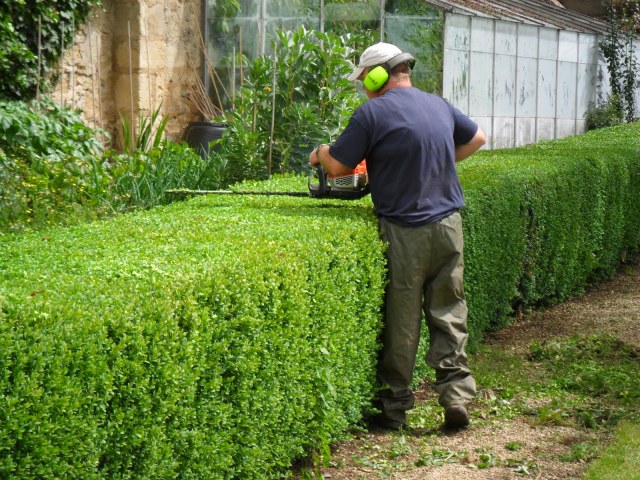
Lowish hedges can eb trimmed by eye as long as a good original line has been established

Lowish hedges can be trimmed by eye as long as a good original line has been established

So how and when should you cut different types of hedge?

Established deciduous hedges that are moderately fast growing (e.g. Beech, Hornbeam, Hazel and Tamarisk) should be trimmed once in August – however, if they are growing particularly well, they might need two trims – one in late July the other (lighter trim) in early October.

Deciduous hedges which tend to be fast growing (e.g. Blackthorn, Myrobalan Plum, Hawthorn) will need about three clippings at about six weekly intervals during the summer- this also applies to some fast growing evergreen hedges such as Lonicera and Gorse.

Some slower growing evergeen hedges such as the various Laurels, Elaegnus and Sweet Bay require just one cut in early autumn, though faster growing evergreens such as confiers are best trimmed once in August – or possibly twice if particularly vigourous (once in July and then again in early October). For Yew, trim once a year in the summer.

For slow growing, smaller – leaved evergreen hedges such as Box, you should be cutting in early summer (June- July) and again in late summer/early autumn (including topiarised shapes).  Box hedges should be cut in overcast weather as if they are cut in the hot and dry their half cut leaves will desiccate and turn brown. For Privet (Ligustrum) you will need at least two and possibly more cuts in a season to maintain its shape.

Mazes are often created from Yew hedging - usually an annual cut will keep it looking trim

Mazes are often created from Yew hedging – usually an annual cut will keep it looking trim

If you have an informal flowering hedge, in general this should be pruned rather than generally cut over. This is best done in spring if it flowers in between mid summer and autumn and in mid summer if it flowers in the spring or early summer. In both cases take off the shoots which have flowered, thin out the growth if it is crowded and remove completely any old growth which is straggly and flowering badly.

For most hedges try to establish sloping sides with a taper inwards towards the top (known as a ‘batter’) – this encourages growth lower down the hedge which if the sides were vertical (or even worse sloping inwards towards the bottom), would result in thin growth at the base where less light reaches the leaves.

Not all hedges are meant to be level and straight- 'cloud pruned' forms such as this are more a work of art than a geometric challenge!

Not all hedges are meant to be level and straight- ‘cloud pruned’ forms such as this are more a work of art than a geometric challenge!

I hope that you find this of help, and if you have any gardening questions that you think I might help with, then please email me at nbold@btinternet.com

Old School Gardener

If you’ve enjoyed reading this post and others on this blog, why not comment and join others by signing up for automatic updates via email (see side bar, above right ) or through an RSS feed (see top of page)?

 Close up of strong wind break netting

Close up of strong wind break netting

No, not a reference to too many sprouts, but a serious question from L. Onerf in Somerset:

‘Vegetables are not growing well in my windy garden, but I am reluctant to plant windbreaks of trees or hedges, as they will create shade and take moisture from the soil. What alternatives are there?’

If you want to avoid the costs of installing a fence/trellis with openings to allow the wind to percolate through at an acceptable speed, I think the answer lies in putting in a screen of synthetic wind break material, obtainable from most garden centres or online. The strength and quality of this varies and some is fairly costly, but a 1.5- 1.8 metre high wind break around your plot would give dramatic results. I found a 50 metre x 2 metre roll of knitted net on offer online for around £170 or much the same on Ebay for about £40, and £13 for a 10 metre length. Make sure the posts are anchored firmly in the ground (corner posts may need to be reinforced and they should ideally be bedded in concrete), as the netting takes a tremendous strain in high winds.

On the subject of vegetable or kitchen gardens, is yours laid out for maximum efficiency and growing space?

Traditionally vegetables were grown in large plots, often 6-9 metres wide and as long as the garden allowed. The vegetables were arranged with a lot of wasted space between rows. Today we know that vegetables can be grown far closer together without any adverse effects; indeed, there is a a trend towards abandoning rows and growing vegetables with equal spacing between the plants in each direction, in blocks or patches.

Narrow beds in the Kitchen Garden at Old school Garden

Narrow beds in the Kitchen Garden at Old School Garden

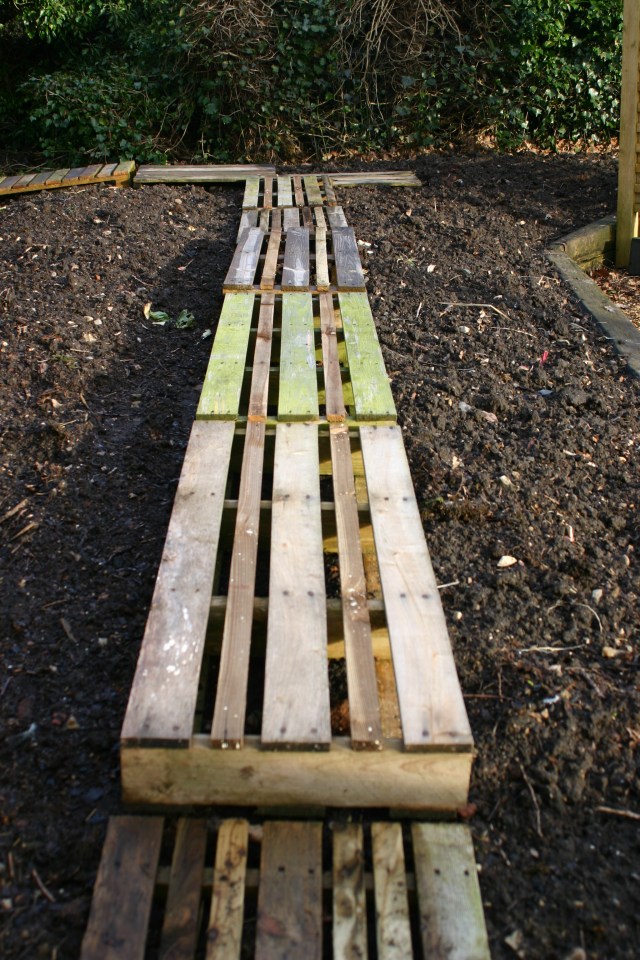
This compactness lends itself to smaller, narrower beds, say 0.9 – 1.5m wide, which can be any length you like. These narrower beds are easier to manage from either side (so avoiding walking on the bed itself and opening up the possibility and benefits of ‘no dig’ cultivation) and the denser planting also helps to crowd out weeds. here at Old School Garden, my kitchen garden ahs been laid out along these lines, though I still have a one large bed which I’ve effectively split into two by creating a ‘boardwalk’ path out of old pallets.

New boardwalk made of old wooden pallets

Boardwalk made of old wooden pallets, used to split a large veg bed into two

Do you have any gardening questions I might help you with? If so, please email me: nbold@btinternet.com

Old School Gardener

If you’ve enjoyed reading this post and others on this blog, why not comment and join others by signing up for automatic updates via email (see side bar, above right ) or through an RSS feed (see top of page)?

ChrysanthemumsI’ve received a question from a Nottinghamshire gardener about different kinds of cutting. Mr. R.Hood asks:

‘What is the difference between softwood and greenwood cuttings? I’ve read that chrysanthemums are propagated from greenwood.’

Well, Mr. Hood, the difference comes down to something quite smallsoftwood cuttings are taken from the first flush of new growth in spring, whereas greenwood cuttings are taken slightly later, when the wood at the base of the cutting is a little firmer – these cuttings do not root quite as quickly.  Greenwood cuttings are easier to handle than softwood, and they are less prone to wilting. Therefore, greenwood cuttings should be used to propagate plants that root readily, like Delphiniums, Pelargoniums and indeed Chrysanthemums. Chrysanthemum cuttings could not be easier and for every mother or grandmother plant, you can produce at least 10 of a new generation. For an easy guide on how look at this article.

Softwood cutting

Softwood cutting

And while we’re talking about propagating new plants from cuttings how about evergreen plants?

Cuttings from these plants are usually taken from ‘ripe or semi ripe wood’ (i.e. when stems are firmer and buds have developed) in early summer and autumn and rooted  in a cold frame. They can be anything from 50 -150cm long, depending on the size of the plant, and preferably with a ‘heel’ of older wood where the cutting stem has been pulled away from the main stem. You then strip off the lower leaves, and if there is no heel, make a wound about 13mm long at the base of the cutting. Apply a hormone rooting powder to the base of the cutting (just a light dusting) and insert the cutting to half their length in soil – you can probably put a number around the edge and in the centre of a pot. To help reduce water loss from the remaining leaf/leaves, cut these in half.

Semi ripe cutting

Semi ripe cutting

The pot should then be placed in a cold frame (you can also root the cuttings directly into the soil in a cold frame , but make sure it has been forked over and manured/composted a week or two beforehand).  Water them well and close the frame completely. Inspect and water them regularly and harden them off during the summer to prepare them for planting out the following autumn.

You can create your own 'mini cold frame' by using plastic covers or bags over pot-planted cuttings

You can create your own ‘mini cold frame’ by using plastic covers or bags over pot-planted cuttings

Another technique, if you don’t have a cold frame, is to put a plastic cover, or bag secured with an elastic band over the top of the pot – this helps to prevent the cuttings drying out, by maintaining a naturally humid atmosphere. These effectively become ‘mini cold frames’ themselves.

It seems you can grow some evergreen cuttings by placing them into a cut potato! - this one is Wisteria.

It seems you can grow shrub cuttings by placing them into a cut potato! – this one is Wisteria, see the link for further info

Further information:

Softwood and Greenwood cuttings – RHS

Semi ripe cuttings- RHS

Propagating shrubs in a potato

Old School Gardener

If you’ve enjoyed reading this post and others on this blog, why not comment and join others by signing up for automatic updates via email (see side bar, above right ) or through an RSS feed (see top of page)?

Are your Water Lilies taking over?

Are your Water Lilies taking over?

This week’s gardener’s question is about dividing the tubers of water lilies and comes from Paul Theother of South Mimms. He asks:

“I have a garden pond which is so full of water lilies that the other plants are being swamped. Can I divide and repot them or is it necessary to start afresh?”

Yes Paul, now’s the time to remove the plants from the pond and divide them. You can do this at any time between April and June. Cut the tubers into smaller pieces so that each contains a number of ‘eyes’ from which the new leaves are produced. Tie back the long, straggly roots and plant them individually in large baskets to help contain their growth, using aquatic compost and gravel to help to weigh them down. They should be put into the pond at a depth where they can send their flowers to the surface – this will depend on the variety and maturity of the plant.

Another plant that benefits from dividing, and which can yield many more plants as a result, is the Flag Iris.

If you want to do this then wait until after they have flowered. Lift the rhizomes (the tuberous roots), with a fork and discard the older pieces. The outer, younger growth will provide you with your new plants – this is where most of the new horizontal growth will occur. Having cut away the the old part of the rhizome to leave only a small part of this season’s growth and with some roots and leaves attached, trim the leaves back just above the point where they begin to spread out, leaving a small fan.

Replant or pot these up in soil which has had organic matter added – but don’t overdo it. Leave the top of the rhizome visible, so that they look rather like a crocodile in a lake! If you have a windy garden you can plant them slightly deeper – or try to place them somewhere where they won’t be toppled or suffer windrock. The shortest varieties of tuberous Iris can be left undivided for several years, whereas taller varieties should be divided regularly after flowering – usually every third year.

Here’s a picture gallery from Wikihow.

Iris 'Samurai Warrior'- the closest breeders have come to a red Iris

Iris ‘Samurai Warrior’- the closest breeders have come to a red Iris

Further information:

Lifting and dividing irises

A-Z of Perennials: I is for Iris

Do you have a gardening question I can help with? If so please email me at: nbold@btinternet.com

Old School Gardener

If you’ve enjoyed reading this post and others on this blog, why not comment and join others by signing up for automatic updates via email (see side bar, above right ) or through an RSS feed (see top of page)?

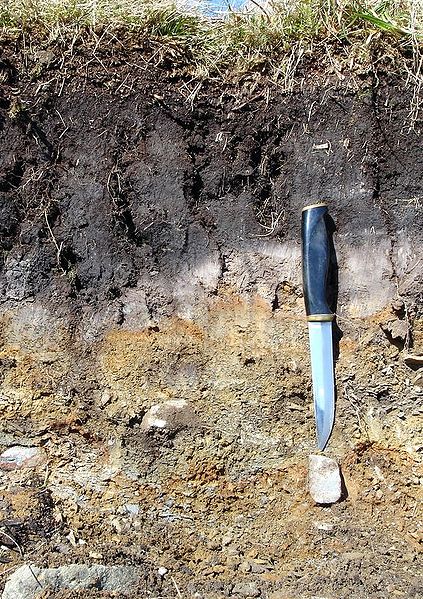
A profile of a typical 'podzol' showing the grey layer of leached out minerals below the dark top level of soil
A profile of a typical ‘podzol’ showing the grey layer of leached out minerals below the dark top level of soil

This week, ‘Gardener’s Question Time’ features soil. A Mr. T. Breck asks:

‘What is a soil pan? I think I may have one in my sandy soil here in south west Norfolk, as my plants don’t seem to be growing very well. Can I do anything to get rid of this?’

Well Mr. Breck, it does sound as though you may have a soil pan. This occurs when certain soil minerals are washed down through the soil by rain lodging some way below the surface. It does often happen in sandy soil containing a high proportion of iron. Over a period of time the minerals weld together to form a hard layer impervious to water. This layer restricts the downward spread of plant roots, so that poor growth results. In former heathland or coniferous forest areas (which is broadly speaking what much of south west Norfolk used to be) these soils may be termed ‘podzols’.

A similar situation can happen if a rotary cultivator is used regularly and its tines  are set at the same depth on each occasion – the action of the tiller blades causes soil compaction at that depth. You can avoid creating this pan by varying the depth of the rotivation.

To remove a pan it’s a case of digging deep and using a pick or fork to break up the welded layer of minerals and incorporating as much organic material (leaf mould, compost, manure) with the replaced topsoil.

More difficult hardpans may be further improved through the action of both adjusting the soil pH with lime if the soil is acidic, and with the addition of gypsum. This combination can help loosen clay particles bound into a hardpan by the actions of hard salts such as iron, calcium carbonate and sodium, by promoting their mobility. It is likely that mechanical removal of the soil pan and some changes to the soil structure as suggested above will be the most successful strategy, rather than relying on just one approach.

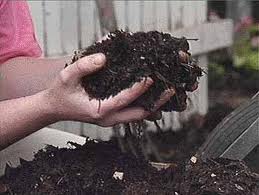
Adding home made compost or other organic matter to your soil will improve its structure and nutrient levels

Adding home made compost or other organic matter to your soil will improve its structure and nutrient levels

Whilst we are talking about soil it is perhaps worth just noting what soil actually is. It is made up of many different ingredients including varying proportions of clay, silt and sand. A soil containing a high proportion of clay is considered to be heavy and, whilst rich in nutrients, is often difficult to cultivate, especially when wet. Sandy soils, on the other hand, are light and easy to work, even after rain.

The soil here in the Old School Garden is a sandy loam and is a joy to cultivate, though I do have to add organic material to improve its moisture retention and nutrient levels. So, decomposing plant remains (or other organic material) is another important ingredient of soil as are air and water. Microbes by the million are also present and these and other organisms like earth worms are doing the job of breaking organic material down and  processing this into soil.

Links:

Improving soil by adding organic matter

The importance of organic matter

Compost – 10 things you wanted to know, but were afraid to ask…

Old School Gardener

If you’ve enjoyed reading this post and others on this blog, why not comment and also join some other people and sign up for automatic updates via email (see side bar, above right ) or through an RSS feed (see top of page)?

Finding Nature

Nature Connectedness Research Blog by Prof. Miles Richardson

Norfolk Green Care Network

Connecting People with Nature

Discover WordPress

A daily selection of the best content published on WordPress, collected for you by humans who love to read.

Susan Rushton

Celebrating gardens, photography and a creative life

Unlocking Landscapes

Writing, photography and more by Daniel Greenwood

Alphabet Ravine

Lydia Rae Bush Poetry

TIME GENTS

Australian Pub Project, Established 2013

Vanha Talo Suomi

The Journey from Finnish Rintamamiestalo to Arboretum & Gardens

Marigolds and Gin

Because even in chaos, there’s always gin and a good story …

Bits & Tidbits

RANDOM BITS & MORE TIDBITS

Rambling in the Garden

.....and nurturing my soul

The Interpretation Game

Cultural Heritage and the Digital Economy

pbmGarden

Sense of place, purpose, rejuvenation and joy

SISSINGHURST GARDEN

Notes from the Gardeners...

Deep Green Permaculture

Connecting People to Nature, Empowering People to Live Sustainably

BloominBootiful

A girl and her garden :)