Category: Design


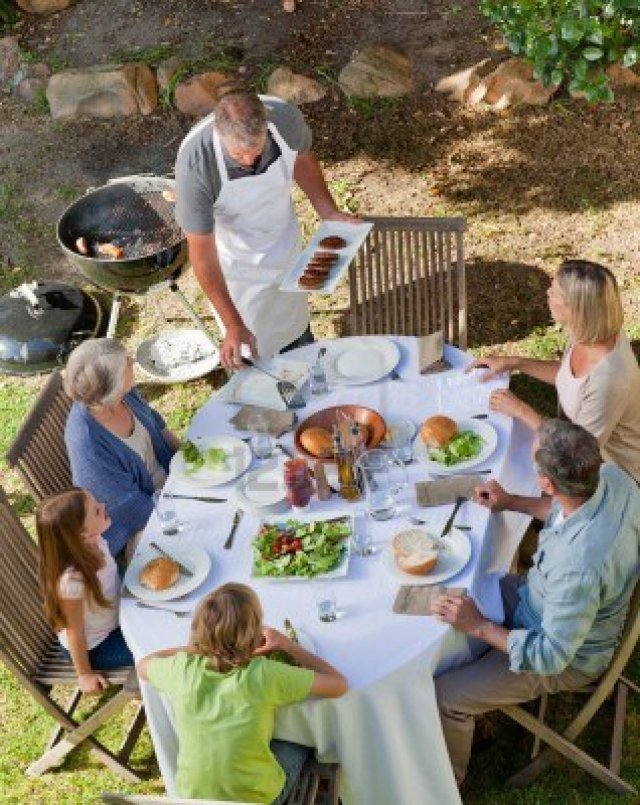
family eating in the gardenYou might not think of ‘family gardens’ as a particular garden style, but there are some common ingredients needed for a successful space for everyone from the toddler through to parents (and possibly grandparents) as well as the family pet(s) of course! My latest ‘snippet on style’ focuses on what you might need in your family space.

Having said that there are some common ingredients in family gardens, in terms of its overall look these spaces can adopt almost any of the more common design styles such as formal, country, cottage etc., though the functional needs of the family garden do impose some limitations. The minimum requirements are usually to provide a flexible space for games (and scope for these games to change as children grow), room for entertainment and play, and an area for outside dining (maybe including an area for cooking the food too, such as a barbeque). The smallest gardens can accommodate a sandpit or swing, while larger plots have space for separate adult- and child-friendly zones. The key features often include:

  • Play equipment

  • Colourful materials

  • Dens and tents

  • Tough plants

  • Wildlife features

  • Easy care seating

For tips on including play opportunities in gardens see my earlier article ”Free range’ children? – seven tips for successful garden play’ and others on play.

Other articles in the ‘Style Counsel’ series:

Productive Gardens

Japanese Gardens

Country Gardens

Modernist Gardens

Formal Gardens

Mediterranean Gardens

Cottage gardens

Old School Gardener

If you’ve enjoyed reading this post and others on this blog, why not comment and join others by signing up for automatic updates via email (see side bar, above right ) or through an RSS feed (see top of page)?

My earlier articles about projects using pallets seem to have been a big hit – they’ve certainly had a lot of visitors. I’ve been working on my own project with local school children to create vertical planters and these are due to be finished off next week, so I’ll do a piece on that project and the lessons I’ve learned. I’m still collecting examples of novel recycled uses of old wooden things and so here are a few more pictures of some other interesting ideas. If you have any ideas or examples of your own, please send me some pictures!

This amazing shed is made out of old fruit trays. you can see that they're from the 'Royal Fruit Farm' at Sandringham, Norfolk! (For those who don't know, Sandringham is one of the grand residences of the Brtish Royal family - about 30 miles away from  Old School Garden and a lovely landscape with some beautiful trees.

This amazing shed is made out of old fruit trays. you can see that they’re from the ‘Royal Fruit Farm’ at Sandringham, Norfolk! (For those who don’t know, Sandringham is one of the grand residences of the British Royal family – about 30 miles away from Old School Garden and a lovely landscape with some beautiful trees)

pallet decking

Here’s a super example of the ways in which pallets can be reused and how they can be finished off to look like an up market product. These pallets have been taken apart, reassembled and sanded off to give a smooth surface. Laid like giant decking tiles they create a pleasing, practical terrace. Note that it uses quite thick planks, an important consideration if the floor is to bear body weight!

vertical planter adam haden

My previous articles on pallet projects can be seen here:

Pallet Power

Pallet Power- the sequel

Raised beds on the cheap

Old School Gardener

If you’ve enjoyed reading this post and others on this blog, why not comment and join others by signing up for automatic updates via email (see side bar, above right ) or through an RSS feed (see top of page)?

The Kitchen Garden in Old School Garden- my attempt to create something productive and also pleasant to look at.

The Kitchen Garden in Old School Garden- my attempt to create something productive and also pleasant to look at.

This week’s ‘snippet on style’ looks at Productive Gardens- those where the emphasis is on growing food.

The layout of productive gardens tends to be orderly, with geometric beds separated by paths for ease of maintenance and access. Beds are often a maximum of 1.5 metres wide along two parallel sides to prevent the need for walking on the soil. Materials can vary but are often utilitarian rather than ornamental (unless the garden is intended as an ornamental kitchen garden or French ‘potager’). Concrete slabs, brick paths or even compacted earth are common  surfaces. Planting varies seasonally and may rotate to reduce the risks of pests and diseases and to avoid sapping the soil by growing the same crops each year. Other features of productive gardens include:

  • raised beds

  • wide paths

  • rustic obelisks

  • planting in rows or blocks

  • simple if any decoration and with a practical angle- e.g. ornamental bird scarers

71977_10151553299256970_1641852360_n

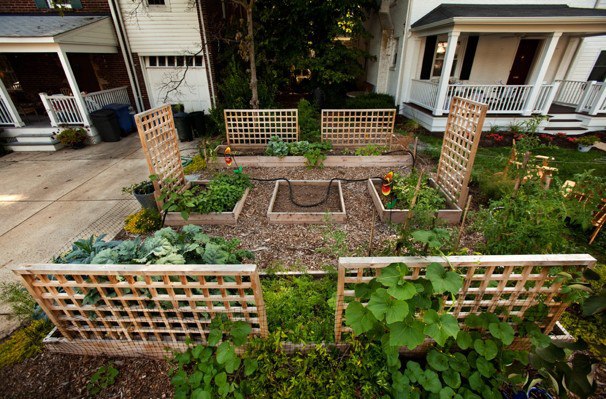
Here’s an example of a productive garden shared between two neighbours.Communal food growing also takes place at larger scales, for whole neighbourhoods in shared beds or in long established ‘allotments’ where each tenant gardens their own plot.

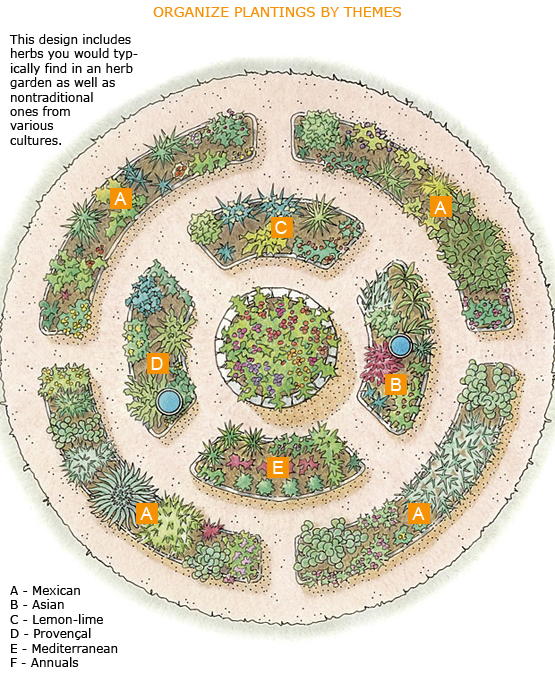
If you're a keen cook and you have the space, you may want to create a special herb garden like this- or if not just find a sunny spot for a few fragrant favourites!

If you’re a keen cook and you have the space, you may want to create a special herb garden like this – or if not just find a sunny spot for a few fragrant favourites!

Let me know what you think makes a Productive style garden, and if you have some pictures I’d love to see them!

Links/ further information:

Garden Organic

RHS Campaign for School Gardening

Food for Life- school gardening

Growing communities

Space for food growing- free guide

Vertical veg

RHS- grow your own food

Food growing case studies – pdf

Other posts in the series:

Japanese Gardens

Country Gardens

Modernist Gardens

Formal Gardens

Mediterranean Gardens

Cottage gardens

Old School Gardener

If you’ve enjoyed reading this post and others on this blog, why not comment and join others by signing up for automatic updates via email (see side bar, above right ) or through an RSS feed (see top of page)?

PicPost: From Fork to Plate

PicPost: Doing Cartwheels

Photo from Grow Veg

PicPost: Gate

PicPost: Great Garden @ Awaji Yumebutai, Japan

‘Awaji Yumebutai is the site where earth was removed to build artificial islands in Osaka Bay such as the Kansai International Airport. The natural environment which was once destroyed by man has been returned to its original state and a place where various animals and plants exist has been created.

Before the building was built, saplings that match the flora of Awaji Island were first planted. Designed by famous architect Tadao Ando, Awaji Yumebutai is a one-of-a-kind “environment creation” project equipped with facilities that blend in with the magnificent landscape that takes advantage of a dynamic slope.

As a core part of the “Awaji Island International Park City” being promoted by Hyogo Prefecture, Awaji Yumebutai was constructed along with the adjacent Akashi Kaikyo National Government Park and opened on March 9, 2000. The facilities also hosted the Awaji Flower Exposition “Japan Flower 2000” that ran from March 18 to September 17 that same year…’

About  Awaji Yumebutai

PicPost: Bin Laden

Decorated Compost Bin Competition
Winners Announced!!

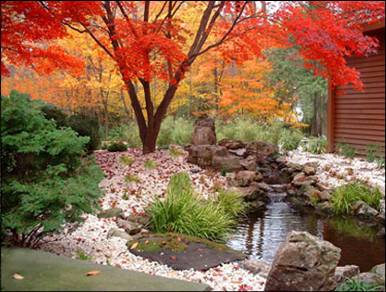
Maples (Acers) provide glorious autumn colour in this Japanese style garden

Maples (Acers) provide glorious autumn colour in this Japanese style garden

Today’s ‘snippet’ on different garden styles focuses on a very distinctive form, ‘Japanese Gardens’.

Japanese gardens have a balance which is achieved through the careful placing of objects and plants of various sizes, forms and textures. These are placed asymmetrically around the garden and are often used in contrast – rough and smooth, vertical and horizontal, hard and soft. These gardens often create miniature idealized landscapes, frequently in a highly abstract and stylised way. Pruning and garden layout are usually considered to be more important than the plants themselves which are used sparingly and with restricted use of both different species and colours.

Historically, there are four distinctive types of Japanese garden:

  1. Rock Gardens (karesansui) or Zen Gardens, which are meditation gardens where white sand replaces water

  2. Simple, rustic gardens (roji)  with tea houses where the Japanese Tea ceremony is conducted

  3. Promenade or Stroll Gardens (kaiyū-shiki-teien), where the visitor follows a path around the garden to see carefully composed landscapes

  4. Courtyard Gardens (tsubo-niwa)

Other key features of Japanese Gardens include:

  • Typical Japanese plants – e.g. Azalea, Camellia, Bamboo, Cherry (blossom), Chrysanthemum, Fatsia japonica, Irises, Japanese Quince and Plum, Maples, Lotus, Peony, Wisteria and moss, used as ground/stone cover

  • Water features and pools

  • Symbolic ornaments

  • Gravel and rocks

  • Bamboo fencing

  • Stepping stones


Bonsai- literally meaning ‘plantings in tray’ – is a Japanese art form using miniature trees grown in containers. The purposes of bonsai are primarily contemplation (for the viewer) and the pleasant exercise of effort and ingenuity (for the grower). Bonsai is not intended for food production, medicine, or for creating domestic or park-size gardens or landscapes, though some people display their bonsai specimens in garden settings, as this video shows.

Let me know what you think makes a Japanese style garden, and if you have some pictures I’d love to see them!

Further information:

Wikipedia – Japanese Gardens

Pictures of popular Japanese plants

Japanese plants

Japanese Garden Database

Japanese Garden history etc.

Wikipedia- Bonsai

Other posts in the series:

Country Gardens

Modernist Gardens

Formal Gardens

Mediterranean Gardens

Cottage gardens

Old School Gardener

If you’ve enjoyed reading this post and others on this blog, why not comment and join others by signing up for automatic updates via email (see side bar, above right ) or through an RSS feed (see top of page)?

Why Places Matter – new booklet for local councils and communities

WPM

Produced by Living Streets with the People and Places Coalition, of which The Glass-House is a member, the booklet is being sent to all councils in England and offers a practical manifesto for councillors and communities on how they can transform the places where they live.

The booklet also includes signposting to useful information and tools that can help communities and local councils work together effectively to shape their neighbourhoods.

The Glass House– Useful resources for open space projects

Finding Nature

Nature Connectedness Research Blog by Prof. Miles Richardson

Norfolk Green Care Network

Connecting People with Nature

Discover WordPress

A daily selection of the best content published on WordPress, collected for you by humans who love to read.

Susan Rushton

Celebrating gardens, photography and a creative life

Unlocking Landscapes

Writing, photography and more by Daniel Greenwood

Alphabet Ravine

Lydia Rae Bush Poetry

TIME GENTS

Australian Pub Project, Established 2013

Vanha Talo Suomi

The Journey from Finnish Rintamamiestalo to Arboretum & Gardens

Marigolds and Gin

Because even in chaos, there’s always gin and a good story …

Bits & Tidbits

RANDOM BITS & MORE TIDBITS

Rambling in the Garden

.....and nurturing my soul

The Interpretation Game

Cultural Heritage and the Digital Economy

pbmGarden

Sense of place, purpose, rejuvenation and joy

SISSINGHURST GARDEN

Notes from the Gardeners...

Deep Green Permaculture

Connecting People to Nature, Empowering People to Live Sustainably

BloominBootiful

A girl and her garden :)