Category: Design


Flooding- How Permacuture Design can help

from-bottom-of-garden.jpg

An interesting article about one person’s experience of ‘extreme weather events’ and how permaculture design helped to redesign a garden and home. Click on the title for the weblink to the article.

You might also be interested in the series of articles I wrote about Gardening and Climate Change last year- have a look in the ‘Four Seasons in One Day’ category of articles in the right hand column.

Old School Gardener

Large Gardens can be broken up into smaller spaces, but these can be held together by features such as water channels, paths and planting, as here in a scheme by Audax Design

Large Gardens can be broken up into smaller spaces, but these can be held together by features such as water channels, paths and planting, as here in a scheme by Audax Design


Garden Design is concerned with creating spaces which both meet the functional needs of their users (relaxing, entertaining, playing, growing food, getting washing dry etc.) and which are appealing to the senses, especially vision.

The latter is about achieving concepts like harmony and unity – the design ‘hangs together’- and using layout and structure (the features, plants and other things which are the visual backbone of the garden) to achieve variety and interest.

Some gardens have shapes which pose particular design challenges, but various approaches can be taken to get the most from them. Here’s a list of some of these and ways to lay out the garden for maximum effect. All the examples assume that you are looking at the garden from the back of the house.

Triangular 

Challenge: These plots typically are wide near the house and the sides taper away to converge to a point and this is exaggerated through perspective, making the garden appear smaller than it is.

Solution: Try to disguise the garden boundaries, especially the narrow point at one end. Focal points can also be used to draw the eye away from the corner, or if a focal point is used near the end make sure it is brought well forward. Another approach is to use sweeping curves and not follow the lines of the boundaries.

triangular garden after

After- showing good use of floorscape at an angle and a pergola to break up the view to the end. Picture- Fiona Edmond. Designed by Fiona Edmond of Green Island Gardens

trianglegardenoverheadsmall

A triangular garden – before Picture-Fiona Edmond
 

Rectangular

Challenge: The boundaries can dictate the internal layout which can be rather formal and symmetrical – what if you don’t want formal?

Solution: Try to hide the boundaries, especially the horizontal fence line with a mixed planting of trees, shrubs and climbers. You could make use of sweeping curves, especially circles or part circles, or alternatively use a 45 degree/60 degree grid.

L- shaped

Challenge: This is an interesting shape which can potentially allow for the creation of a ‘secret area’. However, like the rectangular plot it can become rather formal if you follow the boundaries in the internal layout.

Solution: Unless you want a formal garden, use either a layout based on a 45 degree grid to the boundaries or sweeping curves to take the eye away from the sides of the plot. Oh, and of course think about varying this in the ‘dog leg’ of the shape to create a diffferent if not ‘secret’ space. Another option is to use the part of the ‘L’ that’s out of the main view from the house to hide things like bin areas, sheds or play spaces (though you might want areas for younger children to remain in sight from the house).

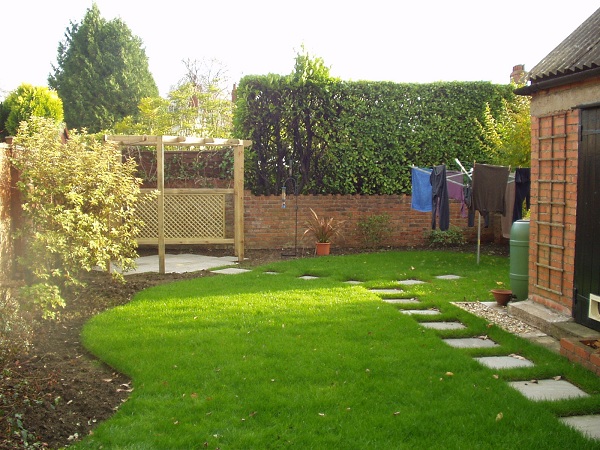
An L shaped garden which has been designed to hide utilities such as washing line and water butt, and at the same time introduced curves and a focal point seating area - designed by Dewin Designs

An L shaped garden which has been designed to hide utilities such as washing line and water butt, and at the same time introduced curves and a focal point seating area – designed by Dewin Designs


Large gardens

Challenge:The scale of the challenge can be overpowering so the designer does very little or nothing; the result is often a plot which lacks interest; large open expanses of grass with thin borders around the edges, for example.

Solution:These give the designer lots of scope for creating a series of smaller spaces within one larger plot. It is quite a common technique to divide the garden into three; first, the area near the house is normally more ‘architectural’ and formal (with hard lanscaping features like terraces, steps, archways); the second is a transitional space; the third is more informal so it blends in with the landscape beyond.

A large garden can be broken up into a series of more interesting spaces using arches, hedges, screens etc.

A large garden can be broken up into a series of more interesting spaces using arches, hedges, borders, screens etc.


Long and narrow

Challenge: These can create a ‘tunnel’ effect, making the space seem claustrophobic.

Solution: One way to rectify this is to divide the garden into two or three smaller spaces, each linked together but with its own theme or function: this then prevents you seeing straight down the garden. Another option is to put in a long serpentine lawn/open gravelled area with certain features on the insides of the bends to block the view, or you could design in a path that zig zags across the garden from left to right and then back again. In this type of plot it is important to screen the boundaries so it is not so obvious how narrow the plot is.

A design for a long and narrow garden which shows paving placed at an angle to the sides, plus a curved path -these help to widen the impression of the space

A design for a long and narrow garden which shows paving placed at an angle to the sides, plus a curved path – these help to widen the view of the space – design by Albert’s Garden


Wide and shallow

Challenge: The view to the end of the garden is foreshortened, so if you see the back boundary you know that the plot is shallow and you see the whole plot at once- pretty uninteresting .

Solution: Avoid using the boundaries as the guide to internal layout as this will emphasise the foreshortening even more. Only use the boundaries if you are creating a formal garden. Try to disguise the far boundary fence/ wall so that you are not aware of how close it is. This can be achieved by introducing a false archway or by using tall planting between the house and the boundary to draw the eye to the middle distance. Use layouts based on the diagonal axis and/or use circles, curves, rectangles, ovals or ellipses to define a strong internal shape that draws the eye. An alternative approach is to use a narrowing shape towards the short end to give a false sense of perspective and so give the impression of greater distance to the rear boundary (e.g. edges of paths/ lawn and a focal point like a statue, structure or feature plant).

A design for a triangular community garden showing how paths and various features draw the eye into the central space.

A design for a triangular community garden showing how paths and various features draw the eye into the central space.

Photo credits: Fiona Edmond, Green Island Gardens (see link below)

Further information:

Albert’s Garden- design examples

Triangle Community Garden

Green Island Gardens- design

Old School Gardener

ERay's avatarGrowing the World We Live in

In a recent article on Io9, I came across this article: 10 Failed Utopian Cities that Influenced the Future

Reading through the Utopian dreams and failed society reboots of architects like Frank Lloyd Wright and industrialist Henry Ford, I can’t help but notice their different relationships to food and its production whether in gardens or pastures. They definitely focus on the planned and built environment as the cure to the diseases of human settlements. I guess when all you have is a city planning hammer, everything looks like a nail.

But let’s get back to the issue of agriculture and the placement or absence of gardens and farms in these failed bright futures of the past. Henry Ford’s Fordlandia actually built a city in a cleared part of the Brasilian rainforest to harvest rubber for the new Ford automobiles rolling off of the assembly lines in the U.S.  Based…

View original post 230 more words

PicPost: Baroque Brassicas

Cabbage beds at Villandry, France

Old School Gardener

PicPost: Mexican Wave

Green wall in Mexico City

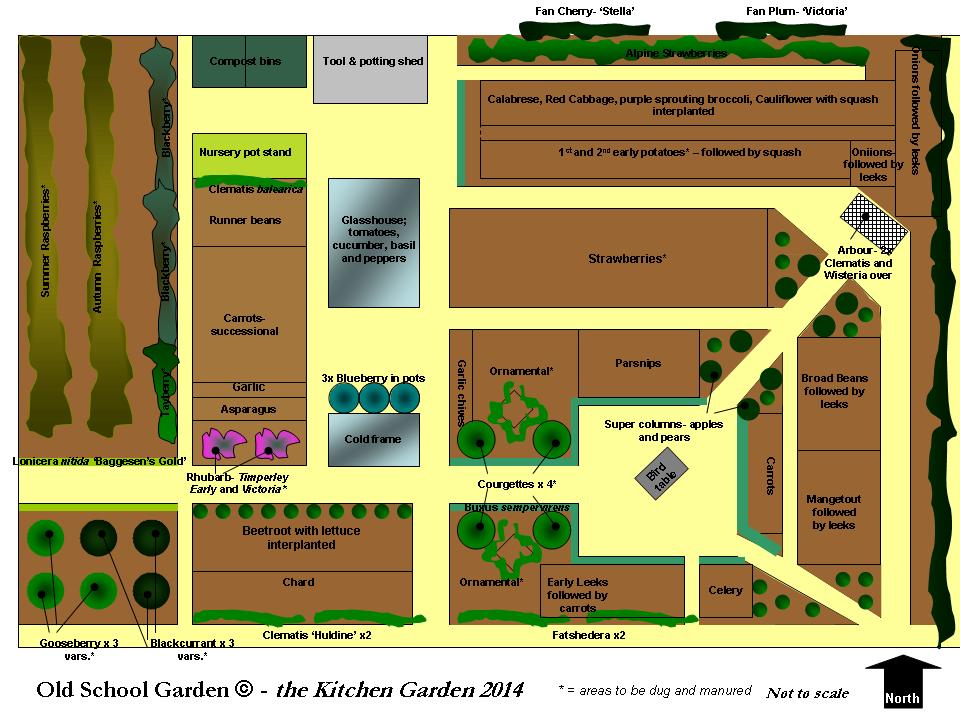
Well here it is, my plan for the kitchen garden here at the Old School. I’ve reviewed last year’s results and have tried to rotate crops as well as introducing more variety and greater successional cropping. This approach will, I hope,  help me to avoid gluts, reduce the overall level of food and waste, while at the same time increasing the range and the ornamental value of the area through introducing more perennial and annual flowers.

I’m also going for some ‘heritage’ varieties- squash, cauliflower, leek, pea, runner beans and beetroot.

What do you think?

kitchen gdn layout 2014

Old School Gardener

Specifier Review's avatarArchitecture, Design & Innovation

by Paul Gilby – Riefa Green Roof

ONE of the paradoxes of the living roof industry is that, for all our evangelical promotion of the environmental agenda, our products have often been surprisingly un-green.

RIEFA2

Living roofs are a case in point. What we hold out as the bright new hope of the inner city frequently requires an onerous quantity of plastic trays, felt bases, and granular linings whose eco-credentials are, to put it kindly, borderline.

Ten years ago, I was introduced to a product which, the German makers claimed, would change that. I was initially dubious about the whole proposition; how was this vorsprung durch organic product going to live up to the remarkable promises made?

A decade on, I am utterly convinced. And I’d like to take the next couple of minutes to explain why, and urge you to test the truth of the Riefa system for yourselves.

Riefa…

View original post 636 more words

ruarkmosaicart's avatarruarkmosaicart

My friend and professional mosaic artist, Jo de Freitas, recently started and completed a very big mural commission for the Greenest Hotel in Africa, Hotel Verde. This environmentally conscious hotel is situated in Cape Town near the Cape Town International Airport. The mural is to be 16 meters high and 4 meters wide. This was a large and challenging project indeed, that kept 5 people permanently busy for 2 solid and exciting mosaic filled months.

Jo and I met taking a smalti class in the Southern Peninsula and we became firm friends united in mosaic enthusiasm for the art form. Jo asked me if I could help out for a few days on her project so I had the privilege of working on the mosaic team for a few short days, where I also gained valuable experience.

Hotel Verde Mosaic in progressMosaic water drop Mosaic mural design

Assisted by her strong team the mosaic quickly progressed on schedule at her studio…

View original post 119 more words

Municipal Dreams's avatarMunicipal Dreams

What more is there to be said on Robin Hood Gardens?  Its architecture and its planned demolition have inspired voluminous and passionate writing on both sides of the debate – it’s become less a council estate, more a proxy in a cultural war.

This story begins in 1963 – though it stretches back further, of course, in terms of East End housing problems and the visions of politicians, planners and architects in solving them.  Still, in that year, three small areas of land became available to the then London County Council for redevelopment. Alison and Peter Smithson were commissioned to draw up designs for two separate buildings with plans for further which would form ‘one big linked dwelling group’.

Two years later, the Greater London Council decided to demolish the adjacent Grosvenor Buildings – seven private tenement blocks opened in 1885, replacing slums cleared by the Metropolitan Board of Works.  The…

View original post 1,255 more words

Open Ended Spaces

‘Loose parts play’ is a well known term to describe play that is not prescribed, but enables children to use ‘stuff’ to make their own play world. This interesting blog extends that concept into ‘open ended spaces’, where the design is ambiguous, but full of play possibilities. I try to include such spaces when designing playful landscapes – click on the ‘playful landscapes’ category on the right for some examples.

Old School Gardener

Finding Nature

Nature Connectedness Research Blog by Prof. Miles Richardson

Norfolk Green Care Network

Connecting People with Nature

Discover WordPress

A daily selection of the best content published on WordPress, collected for you by humans who love to read.

Susan Rushton

Celebrating gardens, photography and a creative life

Unlocking Landscapes

Writing, photography and more by Daniel Greenwood

Alphabet Ravine

Lydia Rae Bush Poetry

TIME GENTS

Australian Pub Project, Established 2013

Vanha Talo Suomi

The Journey from Finnish Rintamamiestalo to Arboretum & Gardens

Marigolds and Gin

Because even in chaos, there’s always gin and a good story …

Bits & Tidbits

RANDOM BITS & MORE TIDBITS

Rambling in the Garden

.....and nurturing my soul

The Interpretation Game

Cultural Heritage and the Digital Economy

pbmGarden

Sense of place, purpose, rejuvenation and joy

SISSINGHURST GARDEN

Notes from the Gardeners...

Deep Green Permaculture

Connecting People to Nature, Empowering People to Live Sustainably

BloominBootiful

A girl and her garden :)