Category: Dear Walter – letters/info from Old School Garden


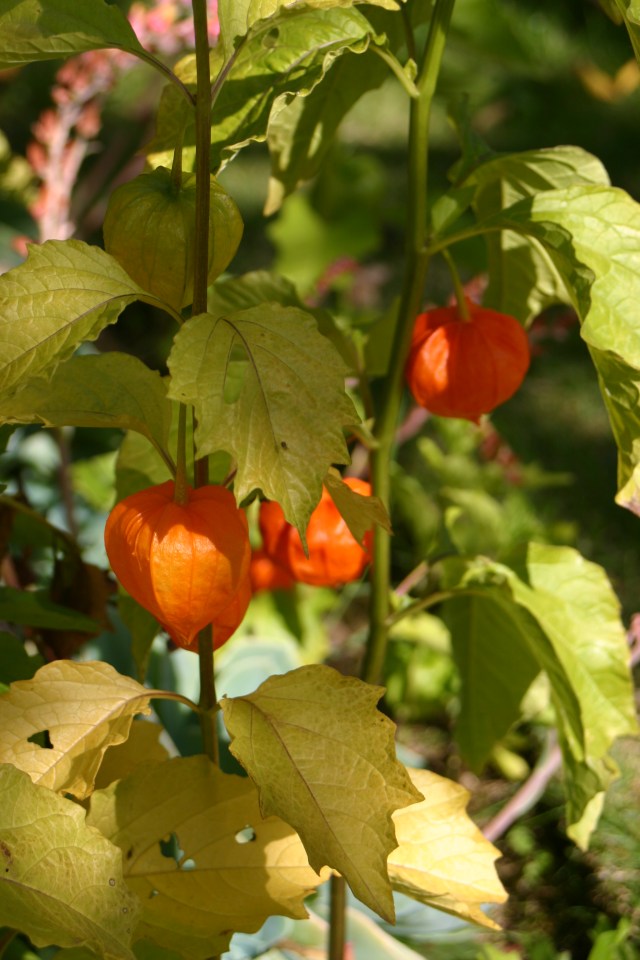
Physalis seed pods mark the move into autumn...

Physalis seed pods mark the move into autumn…

Old School Garden – 28th August 2014

To Walter Degrasse

Dear Walter,

The last few weeks have felt more like autumn than summer, here at Old School Garden. The first week of the month was thankfully sunny and warm and coincided with our holiday in Suffolk; you may have seen a couple of articles I’ve posted about some of our visits.

I feel that I’ve been very lazy in the garden over the remaining weeks, just focusing on the ‘ticking over’ tasks of grass cutting, dead heading, watering, feeding and harvesting- and the occasional bit of weeding. Taking it easier seems to have made my back problems disappear, at least for now.

I dug my carrots up the other day and I was relived that this year I seem to have had some success; though a few have been nibbled around the tops and one or two have split or forked, most are what would pass as good specimens for the supermarket (not that this is test of quality of course!). The celery and courgettes and runner beans continue to crop well; I think we’re just about on top of the courgette glut! We’ve discovered a great recipe for ‘Italian style courgette and Parmesan soup’ on the BBC food website– well worth a try if you like a creamy soup with a bit of ‘edge and bite’. cauliflowers and cabbages seem to putting on a lot of leaf, but no heads, so these may be a ‘no show’ this year.

The ‘heritage’ squashes are rampant and I’ve started removing flowers to try to concentrate the energy into fewer fruit; they are colouring up nicely. Cucumbers are exceeding our needs; I must remember to resist the temptation to grow two plants next year. The tomatoes are steady, if not prolific, though recent weather conditions have probably contributed to the re-emergence of blight in the greenhouse. Still,  it seems to be under control, especially as I’ve removed most of the foliage now to try to concentrate the growth into the fruit and to help with ripening.

I’ve also been regularly harvesting plums (including a wonderful crop of cherry plums from a wild tree on our street border), raspberries and more recently blackberries. Both of these berries all seem to be doing well, with good-sized, tasty fruit, though the mystery of my raspberries remains- for the second year now the back half of both the summer and autumn raspberries have not yielded much if any flowers or fruit. I wonder if this is due to some sort of soil deficiency, though many of the summer fruiting plants are old and in need of replacement; but I can’t understand why the back end is so poor, and the otherwise good autumn row is also affected. Yes, they are next to the wood, but they are in full sun  just like the southern end of the rows. Any advice would be welcome! Here are a few pictures of fruit in the garden at present.

This slideshow requires JavaScript.

I’ve also harvested my first pears from the two ‘super column’ plants I put in about four years ago. These (Williams and Conference varieties) are looking great (and the first couple of Williams tasted delicious); I must ensure I get to them before the birds do! As I’ve reported before, the apples this year are disappointing; some large cookers have appeared and been used from one of the ‘super columns’, but more generally in the orchard there are very few fruit developing, due to a combination of pest attack and probably the wet, mild spring causing blossom wilt. I’ve now given all the trees and trained fruit their summer prune, cutting back the ‘water shoots’ to encourage spurs to form (I’ve also done the Wisteria).

Begonias keeping the terrace colourful

Begonias keeping the terrace colourful

The ornamental garden areas are hanging on in there, the late summer performers just coming into their own; sedums, grasses, asters, cannas, helianthemum etc. I’ve grown some autumn pansies from seed and also bought a couple of trays to brighten up the containers on the terrace, which are starting to look tired- apart from those full of ‘non stop’, bright red Begonias.

You remember I said that I was going to experiment with the ‘Chelsea Chop’ this year? I’m pleased with the results. I gave many of the sedums this treatment back in May and the plants are now looking squat, bushy and with lots of flower heads starting to colour up, obviating the need for staking and giving a nicely proportioned show. I shall definitely do this again next year.
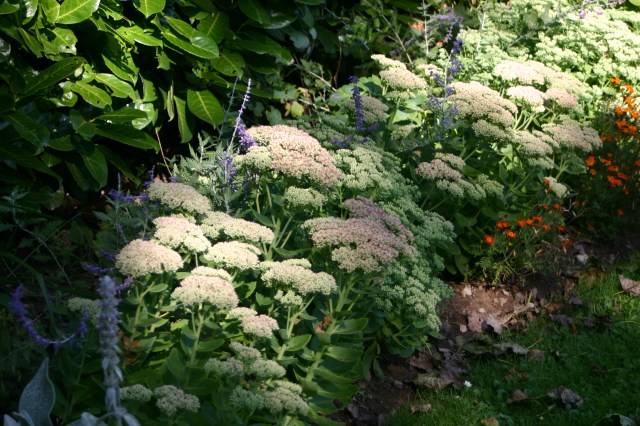
Sedums given the 'Chelsea Chop'

Sedums given the ‘Chelsea Chop’

The courtyard fruit is also developing, though the recent lack of sun and warmth has obviously checked this to a degree. Still grapes, figs and possibly olives are all on the way; my miniature peach which suffers from Peach leaf curl has now recovered and put on a good show of healthy new leaves, though the fruit, as before, is disappointing. I must take a closer look at what I need to do with this next year.

I’m afraid the excavating moles are still going about their business, and the main lawn is looking very patchy as a result. I’m in two minds about what to do, if anything about this- do I leave well alone and see the, probably enlarged, mole family wreak even more havoc next year, or do I get a ‘mole man’ in to ‘deal’ with them? Despite reading ‘Noah’s Garden’ and its advocacy of an ecological approach to gardening (so I should convert my lawn to meadow to hide the mole hills), I’m not yet convinced of the case for ‘leaving them be’.

As I mentioned last month my gardening support at the two schools has come to an end, though I’m still puttign in some time at Gressenhall Museum to keep on top of a few areas i’ve been involved with. I shall start to look for other projects once September is done; one might be a new project at our nearby National Trust property, Blickling Hall, where they are intending to restore the large walled garden which is currently largely a ‘blank canvas’. I’ll keep you posted.

I hope that you and Lise enjoyed your holiday in Scotland, though I guess that you didn’t have much good weather in the last couple of weeks, like here? We’re off to Devon next week to do some walking. Now that Deborah has retired she has an ambition to do some ‘open moor’ walking, trying to reach as many Dartmoor tors as we can in four or five days- I may be longing for some work in the garden as light relief after this!

All the best Walter, as we’re away towards the end of September, it’ll probably be early October before you hear from me again. I hope that you enjoy the transition to autumn. We’re looking forward to our visit to you in October.

Old School Gardener


WP_20140812_002I mentioned the sunflowers in my last update from Old School Garden. I sowed a few different varieties and the big ones are now coming into their own, though the remnants of Hurricane Bertha have done their best to topple them in the last couple of days. In case of disaster I thought I’d better capture them right now, especially so that I can enter the title race(s) for the tallest, largest flower head and thickest stem….

OK, I got it wrong yesterday when I boasted on Twitter that I had a sunflower 20 feet tall! Still the actual measurement is still pretty impressive, if a bit short of that figure; 14 feet to be precise. That and a couple, of others have stems 2″ in diameter, and the largest flower heads are 10 “- 12” diameter.

Here are the pictures as promised….how big are yours?

This slideshow requires JavaScript.

Old School Gardener

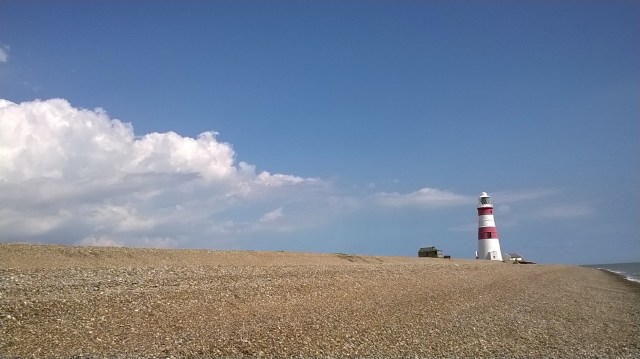
WP_20140807_017I’ve just returned from a week away in coastal Suffolk and had only limited access to the internet. While there I must have passed 100,000 hits on Old School Garden

I’m not sure (even remotely) how many pebbles there are in this picture of Orford Ness and its lighthouse, but I’d guess a few more than that. Still, nice to have logged the first 100k views since I started the blog back in December 2012.

Thanks to all my blog followers, both dedicated and casual!

Old School Gardener

IMG_9469Old School Garden – 30th July 2014

To Walter Degrasse

Dear Walter,

I’ve just read the latest chapter of an interesting book- ‘Noah’s Garden’, by Sara Stein. recommended to me by a fellow tweeter (thanks Jo Ellen). This twenty-one year old book tells of the author’s quest to garden more ecologically- or about ‘unbecoming a gardener’, as she puts it. In language as rich as the ‘natural garden’ she describes, Stein’s offering must have been one of the earliest manifestoes for a less intensive, less expensive, less consuming style of gardening. Despite the North American setting and species, she makes a pretty compelling case that’s as applicable to the UK as the USA. Here’s how the chapter I’ve just read ends:

‘Provided one plants a reasonable facsimile of a natural ecosystem- particularly with regard to a generous diversity of species adapted to the habitat- one can retire from that rank of gardeners and homeowners who, supposing that their services are the only ones that matter, work too hard, pay too much, and in return are cheated of the bounty that natural plantings offer.’

My purchase was prompted by my mention of moles and the trouble their burrowings and excavations are giving me in Old School Garden– I think that I mentioned this last month. Well, they are still here and my daily routine seems to start with using a leaf rake to gently spread the moles’ nightly offerings together with the removal of the biggest stones. In short, large parts of the lawn are looking a right old mess. But I’m starting to take a sanguine view, I suppose, fuelled by the advocacy of an ‘ecological approach’ to my plot in ‘Noah’s Garden’!

Hosta haven- the courtyard garden

Hosta haven- the courtyard garden

It’s been a rather ‘laid back’ month here, old friend. The summer heat has built quite nicely and the long days of sunny weather have finally arrived following a rather wet and dismal Spring. I’ve reduced my gardening time to a couple of hours a day (at most) and spent some periods on the terrace, reading, listening to music and enjoying the surroundings. These times have been the closest to ‘contentment’ I’ve been , I think! Here are some pictures of blooms that are doing their stuff at present.

This slideshow requires JavaScript.

The ornamental garden  has shot up and I’m amazed at the height of some things- the Achillea, Macleaya and Helianthemum to name just three. Some of the annuals have proved disappointing (e.g Nicotiana) and I was interested to hear that another local gardener (the Head Gardener at nearby Salle Park where I did part of my Heritage Gardening traineeship), has also had very mixed results. Deborah and I cycled there last Sunday for their open day and as usual the standards of horticulture on display were exceptional, though Katie (the aforementioned Head Gardener) bemoaned the fact that the roses which I said were looking really healthy and had assumed were just about to give their second flush of flowers, had in fact been ‘nibbled’ by something earlier and the flower buds we saw were in fact the first round! Anyway here are some pictures of the ornamental areas of Old School Garden, just to keep you up to date with how things look at present.

As for food, I’m pleased to say (fingers crossed) that the blight problem with the greenhouse tomatoes seems to have receded; a combination of higher temperatures, removing infected and other foliage, watering less and only on the ground, keeping ventilation up, feeding more frequently and spraying with ‘Bordeaux Mixture’ seems to have paid off. We’ve had our first few tomatoes from here (along with the ones I’m growing in hanging baskets) and there are more to come, though perhaps inevitably the crop is reduced because of the drastic action I’ve taken. Ho hum, you win some you lose some….but the bush fruit contnues to impress!

This slideshow requires JavaScript.

Talking of losing, I harvested the beetrootyesterday- well what is left of it. I must take more time to keep an eye on things! Something (slugs? beetles?) has eaten round the tops of virtually all of the roots so that I guess only about 50% of the harvest is usable. Still, there should be enough to satisfy Deborah’s pickling needs for another year. The onions and garlic have also been disappointing. I planted these out last Autumn and the wet winter and dull spring  (probably along with poor positioning in the garden), seem to have prevented much growth in these, but again there is at least something to show for my efforts.

On a more positive note, the cucumbers, courgettes and squashes seem to be doing well and I can see that courgette will be a major veg ingredient on the table in the next month or two! And we’ve had our second (good) crop of Gooseberries, this time the sweeter, red varieties. These are destined for a ‘fool’ I’m making tomorrow with Elder Flower cordial. Also, the sunflowers in the Kitchen Garden have romped away. Here is a selection of pics of them- they always add a cheery note to any garden, I think.

This slideshow requires JavaScript.

Further afield, I said my goodbyes to the two School Gardening projects I’ve been involved with this year. The one at Fakenham Academy seems likely to be halted due to lack of cash, but maybe some activity will continue on a more limited basis; I do hope so, for several of the youngsters I worked with seemed to have caught the ‘growing bug’.

As Deborah has just retired (38 years of teaching), I thought it best to also draw a line under my involvement at the local Primary School where she worked. It’s been a joy helping the children here over many years and an input I’ve been proud of, including a lot of tree and hedge planting to make the grounds a more diverse and interesting place for outdoor learning. So, as Deborah and I enter a new phase in our lives, I guess I’ll be looking for another challenge…watch this space.

IMG_9435

Hanging baskets at Old School Garden

We’re off to Suffolk for a week with some old college friends next week, so this next day or two I must get the garden ready for a week of less attention – hopefully our good neighbours will do some essential watering and harvesting while we’re away. Then, in September (for the first time ever due to school terms!) we’re off to Spain and Portugal, hopefully to include a further visit to the Alhambra in Granada, the garden I visited about 8 years ago and which really gave me the inspiration to get into gardening and garden design. I’ll do some posts on all my garden visits as and when, and hopefully keep up the momentum on the blog whilst on holiday.

The Walled Garden at Salle Park, Norfolk

The Walled Garden at Salle Park, Norfolk

I do hope you and Ferdy are faring well, Walter, and enjoying the lovely weather (it looks like it’s becoming more unsettled just as we go on holiday). We both wish you a lovely Summer break and look forward to seeing you in the Autumn.

Al the best,

Old School Gardener


IMG_9045

Old School Garden

30th June 2014

To Walter Degrasse

Dear Walter,

As I sit looking out at the courtyard here at Old School Garden, the sun has returned after a series of heavy showers that have dominated the weather here over the last few days (some have been thundery). The last month has been a mix of sunshine and rain, the heat building, but not yet above the low 20’s Celsius- quite pleasant, though.

The month in the garden has been typical – the bulk of the ‘heavy’ work was completed in May and this month I’ve been rather focused on ‘preening and planting’ (when the weather permits). Having said that I did undertake a project to reinforce the ‘Fruit Fence’ I erected a few years ago. You might remember seeing this in the kitchen garden. It sits on the northern boundary of the garden next to a wood and effectively forms the edge of a raised bed I created to make use of some surplus soil and create an elevated space for food growing.

I have a Cherry and Plum I’m training into fans against this fence, but over time the posts have leaned over and some work was needed to strengthen this and put in a proper edge to the raised bed (I used sleepers on the other edges). Having got hold of some pallets I decided to try to use these, along with landscape fabric, to create the edge and add in some further posts to buttress the existing ones. I’m pretty pleased with the outcome (see pictures below). As you know, old friend, I’m a fan of recycling in the garden, and especially if it involves those modular wooden wonders, pallets.

The project involved digging out holes next to the four uprights and screwing these to the existing posts. I then cleared an area of nettles and dug out a trench on the woodland side to receive the pallets, which I’d earlier cut into halves. I fixed a length of batten to the frame to which I could then fix the pallets, I used landscaping fabric to ‘wrap’ the pallet sections along the length of the frame, and then extended this for a couple of metres over the adjacent woodland floor, to provide a new storage area for things like plastic plant trays, baskets and chicken wire.

Finally, I used plastic green shading fabric to provide a full backdrop to the frame. I reckon this should help both to shelter the plants a little, as well as providing a dark surface to absorb the sun and so warm the area for the fruit. The additional storage area, which is screened from the main garden, is a real boon and I plan to clear a further area of nettles to keep the woodland edge at bay. And talking of ‘recycling’, you may have also seen my recent post on the old bike rack I converted to a plant stand or ‘theatre’, on which now sit six rows of pelargoniums, nicely lined up in small terracotta pots.

The finished 'Plant Theatre'

The finished ‘Plant Theatre’

The last couple of weeks has seen the first crops of fruit and veg from the garden; we’ve had Raspberries, Strawberries, Calabrese, Broad beans, Chard, Mangetout and early Potatoes in good quantities, testimony to the mild and wet winter and spring we’ve had. Here are some pictures from the Kitchen Garden…

This slideshow requires JavaScript.

The potatoes were a real surprise. I left the first earlies in the ground and waited for the flowers to die down before investigating – a bit too late as it turns out as when I dug up the first row I was amazed at the size of some of them – as the pictures below show, we had some real whoppers! However the first row (which was the one receiving the most sun) was as productive as the other three rows put together! Two rows of second earlies, harvested at the same time, have produced an equivalent amount of better- sized potatoes. The first of these (‘Charlotte’) were delicious the other day.

This slideshow requires JavaScript.

However, I’m disappointed with the apples this year- I think the mild and wet weather brought a dose of ‘blossom wilt’ (as well as some insect damage), so there are relatively few fruits developing on the trees. In contrast the pears and plums are looking good, and we’ve had the first crop of (large) Gooseberries. The blackcurrants are already dripping from the bushes, so that’ll be a another harvesting job for the coming week (we’re still eating last year’s harvest from the freezer!). We’ve also had a couple of  ‘ridge’ cucumbers grown outside in a pot and more are on the way, as are the tomatoes, mainly growing in the greenhouse. Here are some pictures of the produce and the kitchen garden.

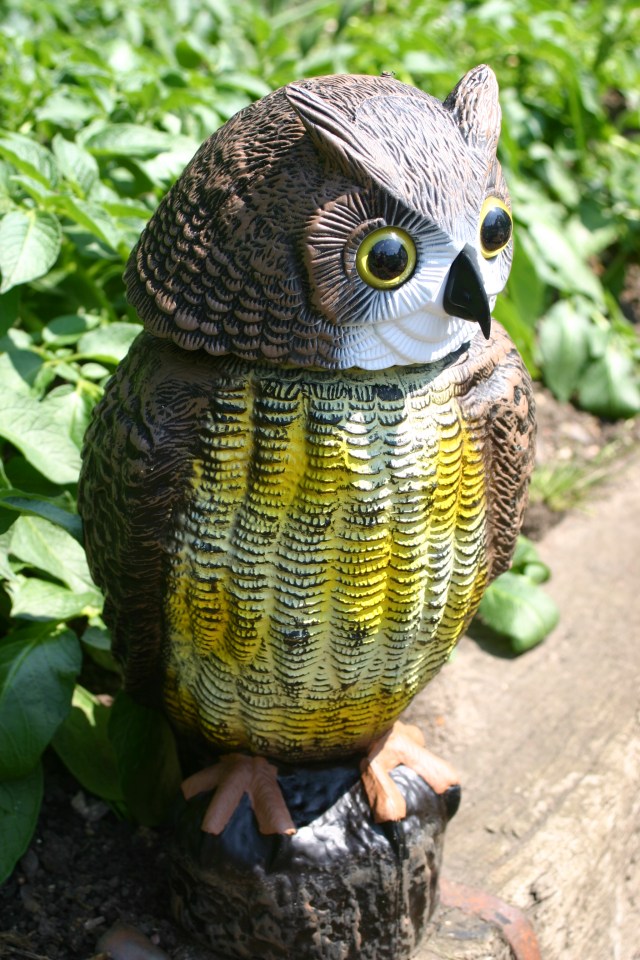
Pest control has never been far from my mind, recently. The new ‘plastic owl’ bird scarer I bought seems to have had little effect, I’m sorry to say, so the only sure-fire method of keeping the birds (mainly wood pigeons but also blackbirds and smaller birds) at bay is netting. I’ve adopted and adapted an old-fashioned method of protecting bush fruit by using some lengths of ‘Enviromesh’  draped over the Raspberries and this seems to have been pretty effective. I believe that in days gone by old net curtains were used to achieve the same result! I’ve also netted the Strawberry patch over some more plastic hoops and this is working well.

Apart from birds, slugs and snails seem to have been effectively reduced (I must admit to using an emergency dose of pellets to cure this particular problem a few weeks ago), although the Hostas in the courtyard seem to have suffered a little. The other main problem is moles – they seem intent on re-creating a scene from World War 1 on the edges of the lawn and in the borders too, undermining newly planted flowers and creating, ridges, trenches and mole hills in all sorts of places! I think it may be time to recruit a mole catcher to deal with this particular issue which is getting out of hand!

But I mustn’t really complain, as the ornamental aspects of the garden are looking good, if not quite at their peak as I write. We bought three large terracotta pots yesterday and these now provide homes for three tender, exotic looking specimens and together add a nice feature at one end of the Terrace Lawn. You recall that I mentioned the amount of flower buds on the Philadelphus which I moved around  10 years ago and which hadn’t flowered since? Well, it’s now beautifully covered in the small white flowers of this super shrub and of course the citrus fragrance of ‘mock orange’ is a delight. Here’s a gallery of the latest images from the ornamental gardens.

This slideshow requires JavaScript.

On a broader front I’ve continued with my support of gardening at two schools.  As I write it looks uncertain if the project at Fakenham Academy will continue however, due to budget cuts- a shame as I was starting to think the at least some of the youngsters were ‘getting into gardening’ and actually looking forward to their sessions outside. You may recall that I’ve been working with three groups of ‘foundation skills’ students from years 7, 8 and 9? Next week sees what will effectively be the last sessions this term, so we’ll focus on harvesting the potatoes and doing some general tidying up, I think.

Here are pictures of the Fakenham set up ‘before’ and ‘after’ to give you some idea of the amount of work involved in getting these plots back into production. First, how things looked back in January…

This slideshow requires JavaScript.

And now the scene in June. six months later….

This slideshow requires JavaScript.

At the other School where I help, Cawston, we had an interesting twilight training session run by the RHS Regional coordinator for their Campaign for School Gardening. This saw just under 20 teachers and volunteers from local schools hearing tips about school gardening and outdoor learning and I was able to contribute a little about how the school gardens and grounds have been developed. Here, too, attention is now turning to harvesting; potatoes as well as autumn – sown broad beans, onions and garlic.

On Saturday I did a stint on manning the Norfolk ‘Master Composter’ stand at an event at Sheringham Park, run by Victory Housing Trust- effectively a ‘garden party’ for its tenants from across north Norfolk. This was a lively and well- attended event (and included free ice cream!). I talked to several people who are interested in starting composting at home and it’s always fun showing the children the Wormery and the ‘products’ from this, including a bottle of ‘worm wee’ as well as the beautiful, fine compost they leave behind.

Well, the sun beckons Walter, so I must get outside and shear back a few early flowering perennials and do a number of other ‘odd jobs’ before the rian returns this afternoon. I hope you and Ferdy are faring well, and looking forward to some sun too- especially as I believe you’ve had rather more rain than us – as usual!

Al the best for now,

Old School Gardener


This is the life- our cat enjoying a bask in the sun...
This is the life- our cat enjoying a bask in the sun…

 To Walter Degrasse

28th May 2014
Dear Walter

It’s been a busy May, Walter- ‘as usual’ I suppose you  might say! The last couple of days have seen heavy rain, but thankfully I managed to get out for a full day in Old School Garden on Monday, anticipating the rain by planting out lots of seedlings. This stage of the year also coincides with the cleaning of the (now empty) greenhouse and getting in the 12 different varieties of tomato and chillies my friend Steve has given me – plus a cucumber.

Today, as the weather is clearing up I’ll be out putting in a cane framework up which to train them. Or rather, most of them, as this year Steve has given me two varieties of tomato which don’t require tying in and training as cordons. Roma is a ‘determinate’ variety so should be grown as a bush (it doesn’t need it’s side shoots pinching out), and Marmande is ‘semi determinate’ which means limited pinching out is required. He’s also given me a ‘ridge’ cucumber which I’m going to try to grow outside in a pot.

I’m also feeling quite pleased that I managed to find a good use for the old compost I removed from the greenhouse. I grow my tomatoes in bottomless pots sunk into the ground (the so-called ‘ring culture’ method), so a dozen holes need to be dug to make way for the pots which are then filled with growbag and other compost. I’ve used the old compost in a plastic bin that once ‘graced’  the courtyard – you may remember I’d bought some rather nice large terracotta pots to replace the utilitarian plastic dustbin and pots that previously contained the peach and an olive bush? Any way, I thought I’d have a go at growing some carrots in the dustbin and the old compost. This is very friable and lacks any stones, so seems the perfect medium for this. So the bin is full and I’ll hopefully get round to sowing the carrots later today – they’re a variety called ‘Nigel’ given to me at Christmas by Steve and his wife!

The rest of the kitchen garden is also looking pretty full- potatoes have been earthed up a couple of times and the first flowers are forming on the first earlies. The Brassica cage is also looking increasingly full with Cauliflowers, Calabrese, Spinach and Broccoli. Rainbow Chard and Leeks are bulking up and the first Broad Beans look like they’ll be ready to pick very soon. My sowings of Parsnip, Carrot and Beetroot are also coming along nicely. We’ve had plenty of Lettuce in the last couple of weeks. The Strawberry bed has been mulched with straw and as a bit of fun I’ve bought a plastic owl with a swiveling head to see if I can deter pigeons and other birds from the swelling fruit and other goodies in the garden (they usually go for my raspberries which are also looking promising this year)!

I’ve just about managed to catch up with the major weeding- just one area of the woodland edge to do and then I think I’ll mulch this with wood chippings to try to keep the weeds down. I’m hoping to do the same in the fruit cage once I’ve been through with the hoe later today. Oh, and some good news. You remember we had that extension put on about ten years ago that created Deborah’s Study? Well, I had to move a rather old Philadelphus bush and so put it in the main mixed border as a back drop to other things. It’s never flowered since, despite some careful successive pruning out of old wood, and encouragement of new growth. Well, it may be weather-related, but its covered with flower buds this year – I’ll post a pic when it comes out!

I’ve still got some half-hardy annuals coming through (I spent a couple of hours inside the shed potting these up while it poured down outside, yesterday). However,  I’ve managed to plant out most of these and especially the front bed which is my ‘homage’ to Victorian bedding and one or two other spots to add complementary colour or texture to perennials that will flower later- e.g. putting some golden-yellow looking Amaranthus in with the blue Agapanthus.

Several things are looking good here, including the rapidly filling mixed borders, so here’s a slide show of some of the highlights.

This slideshow requires JavaScript.

Unfortunately I didn’t manage to get the number of takers necessary to run the various gardening courses I’d planned for May and June, but I’ll try again the autumn, which seems the time most people do an evening class, especially if it’s garden -related. My work in other gardens has also been rather hectic. The sessions at Fakenham Academy have really begun to take off. The children seem more focused and interested and are starting to ‘own’ their plots, which are fast filling up with all sorts of food crops and some annual flowers to add colour and scent as well as attracting the pollinators of course. Unfortunately an assortment of pests is also posing a challenge- rabbits, mice and pigeons in the main. So remedial action has been necessary to try to prevent further damage- we had great fun last week trying to erect a pigeon-proof cage over the brassicas!

We’ve also got some tomatoes, cucumber and aubergines growing in the greenhouse. Also in Fakenham the project at the Community Centre to clear and plant a border next to the two hundred year old ‘crinkle crankle’ wall, has gone well. I, together with volunteers and children from the local primary school, planted this up last week. Now we wait for the plants – which I’ve positioned in repeating drifts of different colours, textures and forms to reflect the wave of the wall -to get hold and push on to do their stuff. I’ll post some pictures of this next week.

Another pest controller- I hope!

Another pest controller- I hope!

I was also pleased to be positively mentioned by one of the Inspectors at a recent Ofsted Inspection at the local primary school, where I was showing the children how to weed and earth up potatoes and explaining why we do this. This school (which now has level 5 of the RHS Campaign for School Gardening award), is shortly to host a training session for other local schools interested in school gardening activities. I’ll let you know how it goes.

How is your garden looking, Walter? I expect your orchard has  finished flowering by now, but I have fond memories of visiting you and Lise one spring and seeing all the beautiful blossom there. From my own garden, it looks like we’ll have another good year for fruit- there certainly seem to be a lot of plums forming on the tree and I can even seen some (and cherries) on the young fan- trained plants in the kitchen garden.

So, I think its getting to that time of year when we can take the foot off the accelerator a little and begin to enjoy the fruits of our labours! Hopefully that last major bit of weeding will be done by the end of the week and I can then get the remaining flowers planted out, as well as hoeing here and there to keep the weeds down. And maybe then a bit more sitting in the sun!

Having said that, I do think there’s something very satisfying about forking into a light, damp soil and pulling whole strands of Ground Elder root out (and of course trying not to breaking any of it off in the ground)!

Old School Gardener


 To Walter Degrasse

28th April 2014
Dear Walter

I hope all’s well with you and Lise and that you’re managing to get out and about in your garden at this busy time. I’m certainly behind where I should be here at Old School Garden. I’ve weeded and dug over about two-thirds of the borders here and managed to mulch the fruit with a mix of horse manure and compost. I edged the lawns for the first time the other day and then cut the grass – all in all it took me about 4 hours! Still it does look the better for it.

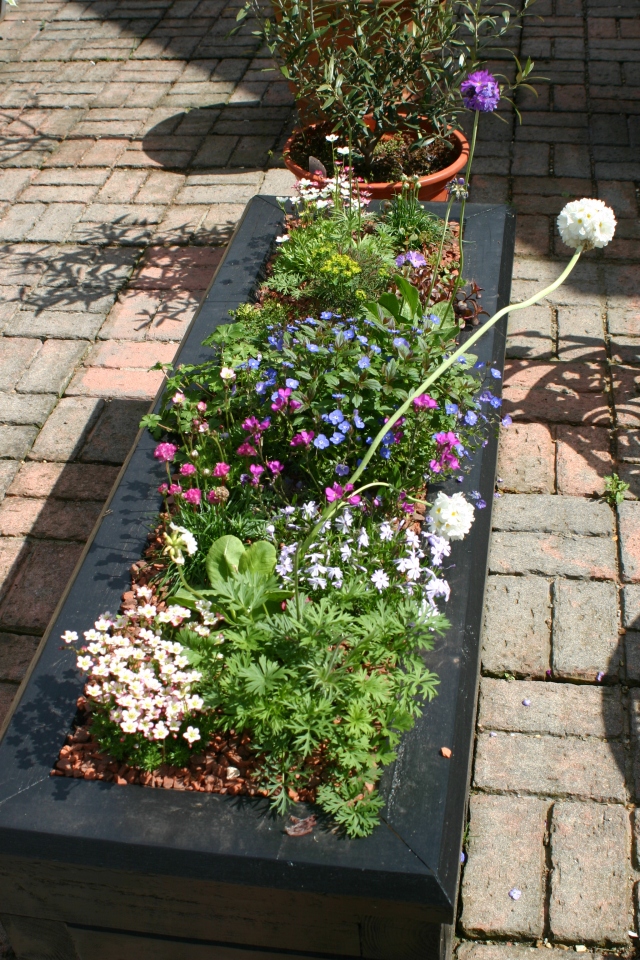
The alpine planter I made from 'Woodblocx' and planted up a few weeks ago- delightful if getting bit overcrowded...

The alpine planter I made from ‘Woodblocx’ and planted up a few weeks ago- delightful if getting a  bit overcrowded…

Apart from being behind with the weeding etc. everything elses is pretty much on track. The greenhouse and cold frame (as well as the lunge window sill) are packed full of seed trays and seedlings at various stages of growth. I’ve tried experimenting with a mix of multi purpose compost as a base layer and then some John Innes seed compost on top to get the seeds started; I’m still not very happy with the John Innes, as it seems to get water sodden and so not very healthy, quite quickly, whereas the multi purpose is not really fine enough for the really small seeds. I shall have to try further mixes.

The flower borders are starting to fill out very nicely, and I’m just about to mulch these with old wood chips and put in staking for the larger perennials. The bulbs and other spring flowering plants are also making a good show at present, though I’ve been disappointed with the tulip bulbs I bought in Amsterdam last November. Only one of the three packs I bought has come up as expected, the other two being nowhere close to the blue or violet colours promised on the packaging. So, the best laid colour mixing plans have gone out of the window and I’ll have to rearrange these in the autumn. The other, more established tulips are looking grand; I’m especially pleased with the way some old cast offs from Peckover House, planted 18 months ago, have responded to their new situation. They are flowering very well in the sandier soil here,  perhaps evidence that you can leave tulips in this sort of soil, but in heavier soils they tend to shrivel up and rot- the soil here is a lot more sandy than the siltier, clayey material in Wisbech.

This slideshow requires JavaScript.

Food crops are coming along, and I managed to spot the stem of an artichoke the other day (just one!), so the roots I put in last autumn may have not been a complete write off. I obviously miscalculated the amount of seed potatoes I needed, as I’ve ended up with s ix rows instead of the planned two! So, the kitchen garden plan has already had to be amended! Anyway, most of the beds are full of growth now; broad beans, mangetout peas, chard, lettuce,chives, calabrese, cauliflower, red cabbage, spinach, carrots, onions and garlic as well as the potatoes and more permanent beds of fruit. So far so good (and pests seem to be under control)!

We recently visited my mother-in-law in Devon and I spent a good day or two pruning back a number of over grown shrubs. The cuttings amounted to about 10 big bags, so I must have made an impact! As you will recall, her garden is on a steep slope overlooking the edge of Tavistock and farmland beyond. A lovely setting, but a garden that is just too much for her to cope with now. She does get some gardening help, but this seems to amount to grass cutting and not much more. You may have gathered that whilst there we managed to visit several lovely gardens and other places, so keep an eye out for more articles and photographs in the next couple of weeks.

My Mother-in-Law's garden in Devon
My Mother-in-Law’s garden in Devon

I’ve continued with my work with the three groups of students at Fakenham Academy and am pleased to say that the three plots are now starting to fill up- we’ve planted a lot of potatoes, some beetroot (grown by the students from seed) and in the next couple of weeks we’ll be sowing and planting a lot more. Hopefully this activity will start to generate more enthusiasm in the students who, to be fair have had not much more than digging to keep them occupied up to now. On Thursday I also begin work on a planting scheme for a border in the grounds of the community centre at Fakenham. This is backed by a lovely old ‘crinkle crankle’ wall which is over 200 years old. The first job- with volunteers assisting I hope – is to clear the majority of the borders of an invasion of Borage and other plants and then to measure up and start to consider a planting plan. The local primary school is also getting involved and we hope to complete the project by the end of May. I’ll do some articles and pictures about this as it progresses.

The Cawston School garden is also looking full, though I haven’t been there for a few weeks, so it must be in dire need of weeding! I think I may have told you that the School has now not only achieved the highest grading in the RHS Campaign for School Gardening (level 5) but has also achieved a gold standard in the broader ‘learning outside the classroom’ that they do. On that note I’m giving a presentation about education for sustainability at a national network of early years landscape professionals tomorrow, and hope to cover a wide range of projects that I’m involved with. I’ll let you know how it goes- I’m particularly looking forward to seeing the outside environment at the Earlham Early Years Centre in Norwich where the meeting is taking place- must remember my camera!

Work to promote my forthcoming courses  has been progressing and I’m going along to Gressenhall Farm and Workhouse Museum for its ‘Going Wild’ event on 5th May to conduct a couple of garden tours and promote the Wild life Gardening course there on 18th May. I’m not yet sure about the numbers signed up for this or the other two courses that are scheduled to begin in early May. Both of these are in the evening at Reepham High School and College and once again I’m covering garden design and growing your own food. Fingers crossed I get the numbers that mean they’ll go ahead.

Well, this is obviously a busy time and so far today I’ve spent the morning on the computer and occasionally looking out at the weeding still to be done and all the other jobs in the garden, so I must get moving! Bye for now, old friend, and all the best until I write again in a few weeks time.

Old School Gardener


Spring has sprung at Old School Garden

Spring has sprung at Old School Garden

To Walter Degrasse

Dear Walter,

I’m a bit under the weather at present. A heavy cold was preceded earlier in the week with an infection in the nerves of one of my teeth- very painful, but thankfully the antibiotics are now dealing with it. However, I can ‘look forward’ to some root canal work and a crown in a few week’s time!

The illnesses have rather put back my gardening activities this week, but I’ve still managed to make some progress. You probably saw my articles about the new alpine planter in the Courtyard; I’m really pleased with how that’s turned out and look forward to a new horticultural experience with alpines, which I haven’t grown before. Another project I’m hoping to start today is to turn an old wooden bike rack into a ‘pot plant theatre’ – this should be a fairly simple challenge and will hopefully add another nice feature to the courtyard garden- more on this next week!

The rest of the garden is really starting to kick in too- bulbs appearing in all sorts of places (including some I’d forgotten about), and the early flowering shrubs and trees- Viburnum, Forsythia, Chaenomeles, Cherry, Clematis (armandii and balearica), Currants and magnolias are all looking great. The pink magnolia in the front garden is just about coming into flower- we need a few days of the warmth of a week or two ago. And the Amelanchier is just about to give us its spring shower of white blossom- I can’t wait.

I’ve begun weeding and tidying the various borders but had hoped to be further on by now (I always seem to be saying that). Still, a few days next week should see the bulk of this done. I’ve also spent a good couple of days pressure washing the terrace, paths and copurtyard floors- this seems to get harder each year, or maybe it’s because we’ve had the warm, wet conditions over the winter that help algae to grow! A weather presenter last week reported that one frosty night (when temperatures fell to about -5 degrees C) had been not only the coldest of the spring, but also of the entire winter too!

I’ve been sowing seeds- veg and flowers- and most of these have so far been successful, though a couple of packets of perennials I bought have been disappointing, yielding only one plant each from packets of 10 or so seeds- maybe I didn’t get the conditions quite right for these. I’m now getting to the stage when I need to clear the greenhouse of the remaining tender, over-wintered plants to create space for further racking for more seed trays.

That reminds me, last week there was a minor disaster in the greenhouse, which is already jam-packed with trays and modules. Our cat decided to ‘explore’ – he jumped up onto the staging and managed to tip three trays of seeds onto the floor! I think I’ve managed to salvage many of the seedlings in two of these, but the third one hadn’t yet germinated, so I may not see anything from that given the way the compost (and seed) was turned upside down!

I’ve finished turning over the soil in the kitchen garden and started to mulch the fruit with manure. The rhubarb is looking good and we had our first crop of ‘forced’ stems last week- very sweet too. The first crops of broad beans, carrots, red cabbage, spinach, onions and garlic are all in (some sown last autumn and over wintered), so we should be getting some tender new veg in a few months. I gave the lawn its first cut a week or two back and it looks like it now needs another, so that’s a further job for the next few days- and edging this will also take some time, especially as I want to straighten out one section that isn’t quite parallel with its opposite edge.

Further afield I’ve continued with my support to two schools (one primary, the other a secondary). Yesterday – despite some heavy rain (or maybe because of it), the younger primary school children had great fun making ‘mud creatures’ in the grounds- a creative use of the many mole hills in what’s called the ‘Eco Park’. We also set up a greenhouse (which was bought with some of the money raised st the opening of Old School Garden last year) and pallet planting spaces (using the vertical planters I made with some of the children last year, but this time using them horizontally). The two younger classes will use these to get growing close to their classrooms – they had great fun filling these with compost yesterday, a natural follow on from getting their hands muddy making ‘mud creatures’!

This area will focus on container growing and provide the children with an introduction to growing which they can then use to progress into the main school garden area. This is starting to look very neat and tidy and has a range of crops already underway. Yesterday the class whose responsibility is the potatoes, planted three varieties of ‘earlies’ out in the raised bed we’ve earmarked for this (covered with sheets of polycarbonate). We’ve told them about rotation too – this plot had peas and beans in it last year. Oh, and I’m pleased to say that the School has now been confirmed as achieving the highest award for ‘Learning Outside the Classroom’ -Gold, which will sit nicely alongside its top marks in the RHS Campaign for School Gardening (where it has achieved Level 5, again the highest possible).

At the secondary school, we’ve just about managed to get the three plots (of 12m x 6m each) ready for planting- last week saw a local chap come in with his rotivator to finish off tilling the soil- though we have had to limit this in one plot as we’ve discovered what looks like an old lead water pipe! Still, I hope next week to get temporary landscape fabric paths laid and potatoes planted with each year group. The process of weeding/taking off grass  has been a real challenge, not least for children with short attention spans! Still, we’re nearly there and so we can start to plan out next term’s activities to bring in a bit more variety to what they do.

It’s sad that the Master Gardener programme has been wound up in most of Norfolk, as the original funding has come to an end, but it is progressing in one or two community gardening projects and in the whole of the Breckland area, where the Council has kindly agreed to continue funding it. I’m going off to the induction day for the new Breckland Master Gardener volunteers on Sunday, hopefully to inspire rather than de-motivate!

A beauty from inside the house- Clivia

Well that’s about it for this month’s update, Walter. I was pleased to hear that you’ve taken on an allotment with Ferdy but sympathise with you on the tiring preparatory work, similar to what I’ve experienced at the secondary school! Still, it sounds like you’re nearly ready to sow and plant like us, so all the best for that. I’m sure you’ll really enjoy ‘growing your own’ alongside tending your fabulous ornamental garden at home.

Tomorrow, our young German guest, Lisa, is returning home. This will be a sad day as she’s been a delightful addition to our rather depleted household over the last few months. One can fall into stereotyping today’s youngsters as rather shallow, lacking interest in anyone but themselves and focused on ‘having fun’. Lisa has rebalanced my perspective, and we wish her every success in her university studies and chosen career in teaching.

Stay in touch old friend,

Old School Gardener

An early show from Euphorbia characias in Old School Garden

To Walter Degrasse – 27th February 2014

Dear Walter,

Mild weather has continued here and so I’ve taken the opportunity to start lightly turning over the soil, cutting back dead stems on herbaceous perennials and grasses and recently pruned back some shrubs such as Cornus and Buddleja to channel the new growth that’s starting to emerge.

In the last couple of weeks, the basal growths of new leaves around many plants have started to push upwards and the pattern of planting in the mixed borders is slowly taking shape – a very satisfying sight too.

I was surprised at how easily my kitchen garden soil responded to a light forking over, which included turning in some green manures and removal of a few weeds. With all the rain we’ve had I was expecting it to be rather claggy, but then again my sandy loam is always a joy to work with, so I should have known better. It’s also been perfect weather for dividing and moving some herbaceous perennials I didn’t get around to doing last year.

Having repaired the little storm damage we’ve had (a few bent hinges on one of the garage doors and a fence post needing to be replaced), I’ve also finally taken apart my wooden planters built about 7 years ago, but unfortunately not with pressure treated timber, so that all the money and effort has not lasted as long as I’d hoped. Still, I’ve been pleasantly surprised at an offer from a Scottish Raised bed manufacturer (‘Woodblockx’).

They’ve kindly donated me a new planter  and I’m finalising my plans about where best to use this, possibly as a feature in the courtyard with alpines  or maybe somewhere in the kitchen garden for food growing. The system they use looks both very strong and relatively easy to build, but I’ll do a review on the blog as I get to grips with the build in the next few weeks.

Having completed all the pruning and clearing of spent stems and foliage, I’ll also be turning my attention to further spring soil turning in the next few weeks. My first batches of seeds have germinated pretty well and I’ll be potting up some french marigolds and moving on some early food crops (Calabrese, Cauliflower and Leeks). To date the new bed of asparagus I planted last  autumn doesn’t appear to have made any growth above ground, but it’s still bit early for that, perhaps.

Next door the garlic bulbs and most of the broad beans I sowed last autumn are now doing well, as are the patches of onion sets (Red and white) and some Red cabbage and spinach. Mole activity seems to have subsided a little of late – hopefully it will tail off further as I get to give the lawn its first cut – and new grass will come up where the mole hills once lay.

Further afield, I’ve continued my new support at Fakenham Academy (a local high School), helping three groups of students prepare a food growing plot each in their school garden; in fact three plots of 12m x 6m, all of which have either been covered with weeds or grass.

Getting these ready for sowing is proving to be a tough job, the weather requiring us to turn over the clumps of grass/weeds and soil to allow for some drying out, so that we can remove most of the soil before piling up the weeds and turves in separate heaps for rotting down. Still, it does look like we’re making progress.

However, I discovered the other day that due to there being some asbestos in the better of two greenhouses  there, we will have to wait longer for a propagation space. This is unfortunate as I’d hoped to have broken up the hard physical toil with some lighter seed sowing activity especially as I have now bought the seeds and seed potatoes in line with the crops the students say that they want to grow. It’s fun working with these students, though not surprisingly they can get tired and bored of digging and so behaviour standards can sometimes drop!

Yesterday I returned to Gressenhall Farm and Workhouse Museum (where I volunteer) and was pleased to commence a tidy up of the gardens I’m responsible for. It was also encouraging to meet two new volunteers, Jonathan and Mike, as well as two new Heritage Gardening trainees, Sam and Sonny.

This new injection of person power will make it a lot easier to keep on top of the maintenance of the gardens and may even allow us some scope for further improvement projects.

It was a lovely day too, which makes garden tidying a real joy! The museum opens to the public again on 9th March, so next week no doubt we’ll all be trying to get the gardens looking presentable. The tubs of pansies and spring bulbs I planted in the autumn are looking good and along with other spring interest should give the gardens a splash of early colour- the pinky blushed Hellebores in the Education Garden are looking good for example.

I’m just back from a morning at my local primary school (first visit since early winter) to help with their ‘outdoor learning’, focusing on the garden. The morning began rather wet but we managed to spend a couple of hours with two groups of children turning over soil and weeding as well as moving a pile of wood chips around the fire pit- these had come from a fallen hawthorn tree that toppled over in the main drive during the recent storms. Some of the children also worked out how many potatioes they’d need for one of the raised beds and I took in a few fruit boxes with moulded paper liners to help with ‘chitting’.

The children seemed to have a great time and were especially interested in the warmth that had built up in the pile of wood chippings – a great opportunity to explain the rudiments of composting!

I’m also pleased that we have some extra help in the garden, in the form of Ann, one of the students on the GYO course I did last autumn and a parent of one of the children at the school. And our current house guest, Lisa, also helped out with groups spotting the ‘first signs of spring’. Lisa is staying with us for a few months to experience British school life and brush up her English before commencing her own university career with a view to teaching. She’s from Muenster in Germany – and we are also eagerly anticipating the arrival of her mother, Anne tomorrow for a weekend stay.

Seems like this is the time for important germans to visit the UK, as their Chancellor, Angela Merkel is in London today, addressing the Houses of Parliament and taking tea with the Queen!

The Garden Design course that I’m running at Reepham seems to be progressing well, with 9 enthusiastic participants. They have all pretty much surveyed and drawn up a scale base plan of their gardens and are now exploring functional and form layouts as well as developing sketch designs incorporating ideas for creating structure in their designs. Next week we turn our attention to planting design as the ‘fourth dimension’ (seasonal variations) adding to the 2D and 3D views of the garden we’ve covered to date.

Tonight I’m off to County Hall in Norwich to attend an event for the Norfolk Master Composters, featuring a talk by well known Norfolk organic gardener, Bob Flowerdew – and there’s a buffet too!

I hope you and Lise are well and getting stuck into your plot once more – remember to take it easy and limber up before you do anything strenuous – you don’t want that back problem again!

all the best,

Old School Gardener

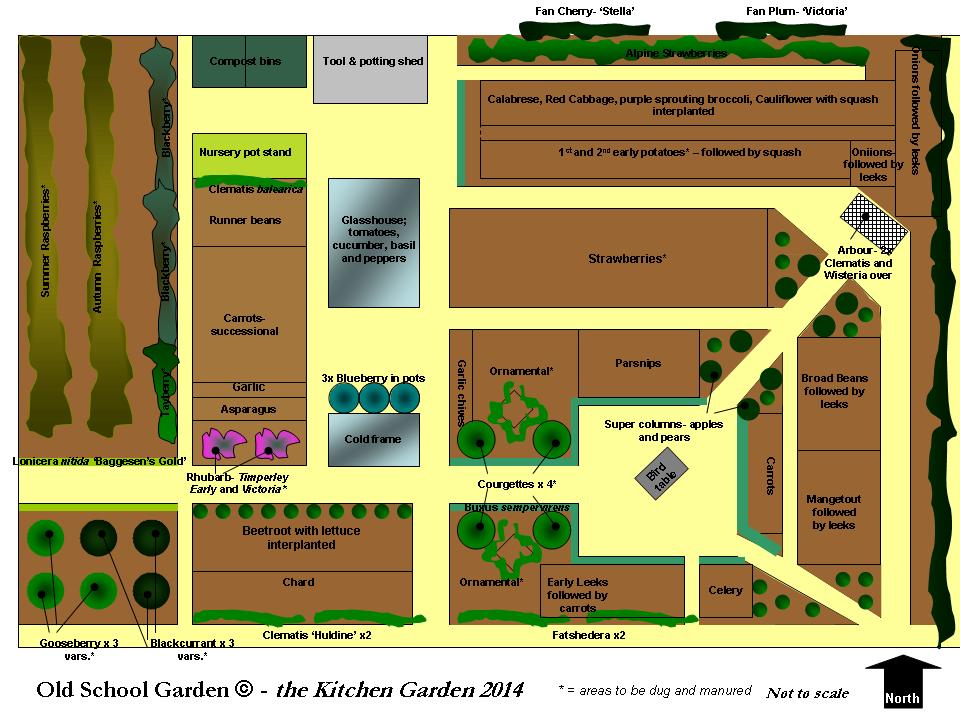
Well here it is, my plan for the kitchen garden here at the Old School. I’ve reviewed last year’s results and have tried to rotate crops as well as introducing more variety and greater successional cropping. This approach will, I hope,  help me to avoid gluts, reduce the overall level of food and waste, while at the same time increasing the range and the ornamental value of the area through introducing more perennial and annual flowers.

I’m also going for some ‘heritage’ varieties- squash, cauliflower, leek, pea, runner beans and beetroot.

What do you think?

kitchen gdn layout 2014

Old School Gardener

Finding Nature

Nature Connectedness Research Blog by Prof. Miles Richardson

Norfolk Green Care Network

Connecting People with Nature

Discover WordPress

A daily selection of the best content published on WordPress, collected for you by humans who love to read.

Susan Rushton

Celebrating gardens, photography and a creative life

Unlocking Landscapes

Writing, photography and more by Daniel Greenwood

Alphabet Ravine

Lydia Rae Bush Poetry

TIME GENTS

Australian Pub Project, Established 2013

Vanha Talo Suomi

The Journey from Finnish Rintamamiestalo to Arboretum & Gardens

Marigolds and Gin

Because even in chaos, there’s always gin and a good story …

Bits & Tidbits

RANDOM BITS & MORE TIDBITS

Rambling in the Garden

.....and nurturing my soul

The Interpretation Game

Cultural Heritage and the Digital Economy

pbmGarden

Sense of place, purpose, rejuvenation and joy

SISSINGHURST GARDEN

Notes from the Gardeners...

Deep Green Permaculture

Connecting People to Nature, Empowering People to Live Sustainably

BloominBootiful

A girl and her garden :)