Tag Archive: Workhouse

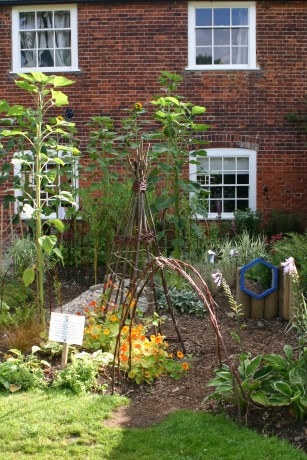
‘Curiosity Corner’ – a garden I (with help), created for under 5’s to explore at Gressenhall Farm and Workhouse, Norfolk
Old School Gardener

The entrance to the workhouse as it looked in the early 1900’s – the well house stands next to the person (gardener?) to the rear
The former grand entrance of the Gressenhall Workhouse now performs a very different function. The once ornamental gardens and driveway have given way to a busy hub for this Norfolk Museum’s outdoor events.
As can be seen from the old photograph the main approach to the Workhouse was once a rather grand affair – a heart-shaped island of formal lawns and borders surrounded by a circular drive. To the front, huge iron gates and a much smaller wooden door provided the entrances from the forbidding outer wall of the complex. The smaller door was the main pedestrian entrance to the workhouse being next to the porter’s lodge, the man who controlled the arrival and departure of Workhouse inmates. This door today still carries the solid metal knocker shaped into a clasped hand around a metal bar – a hint of the prison-like existence to come for the new inmates! They must have entered here with very mixed emotions – relief at having somewhere to get a square(ish) meal and a warm (ish) bed, mixed with guilt at not being able to fend for their families and anxiety about the harsh regime they were entering.
Towards the main building, but long since demolished, once stood a small building enclosing the Workhouse well (still visible in the old photograph) and the front of the 18th century main building once carried a magnificent Wisteria clambering up and along the warm red brickwork. This was, apparently, cut down to the ground by an over – enthusiastic work placement trainee about thirty years ago! A small rooted area remains and is being carefully trained up the walls once more, in the hope of restoring this once glorious feature. To the side the workhouse chapel is fronted by a small border which is dominated by two Yews and a cherry tree with spring bulbs and other under – planting. Recently these Yews were reduced in width in an attempt to provide a more open, sunny site for the other planting (and increase the width of the adjacent paths). The hard cut – back has improved the shape and balance of the border whilst not harming the Yews, where new growth has begun.
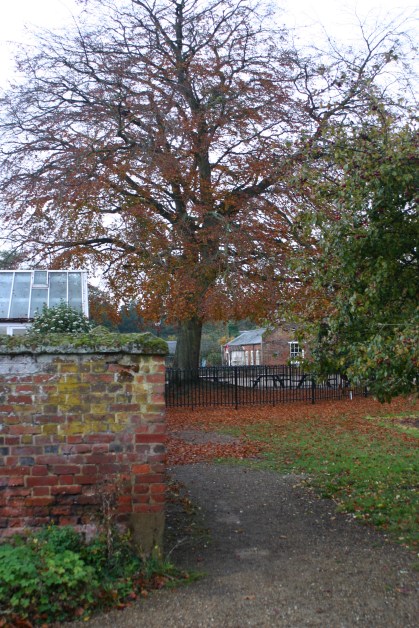
To the right of the main approach sits a majestic old Copper Beech tree (which gave its name to the Old People’s Home that succeeded the workhouse after the 2nd World war – ‘Beech House’). This area was originally sub divided by walls into exercise yards and a playground for the adjoining boys school, and in later years for those in the nearby infirmary (and featuring two revolving wooden tuberculosis pavilions). There is also an avenue of beech trees on the approach to the Workhouse believed to be 150 years old.
There is some evidence that the southern section of this area, adjoining the modern café was laid out as a formal ‘garden’ but the historical accuracy of this is uncertain. Today this area houses a semi – permanent marquee used for the many events now taking place at the Museum. A large expanse of grass (useful for picnicking for the Museum’s many summer visitors) is surrounded by areas of planting including an isolated Crab Apple tree, planted in more recent years as a memorial to a former member of the Norfolk Archaeology Department (also housed on the site).
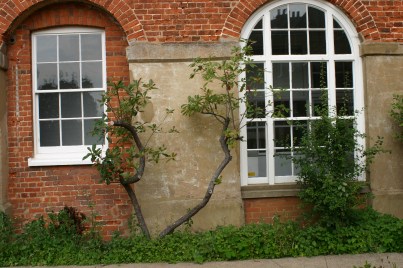
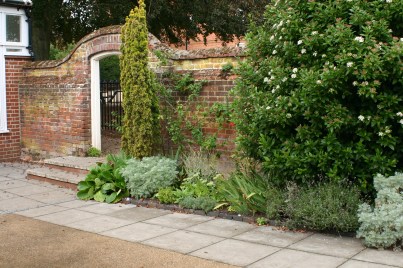
There is also a long south – facing border of mixed shrubs adjoining the walls of the former workhouse, some of which are now rather large for their position adjacent to the building. Others – such as several clumps of Boston Ivy – clamber up the walls and are vigorous enough to get under the eaves and into the roof! Recently these shrubs have been pruned to try to restore their scale and shape as well as encouraging new growth, with some success. And spring bulbs also provide splashes of colour underneath the mainly evergreen shrubs. But a perennial problem is the rabbit population which have burrows in this border and which also occasionally escape into some of the adjoining gardens to wreak havoc!
The walls here still show the evidence of the (once open) arcading that sheltered individual ‘cottages’ for families living in the workhouse. This was before its daily routine became harsher in the mid 19th century, when inmates were divided by sex and age and so families were split up.
Today’s cafe building was once a fever or isolation ward commonly known as the ‘itch ward’. More recently this was the Museum’s Education Centre, for which a garden was laid out by volunteers in the 1980’s. This was further remodelled into the current space, presumably upon creation of the café and now houses a delightful, smaller courtyard garden of mixed borders with picnic tables.
Today, the large entrance courtyard and its adjoining spaces provide a great setting for the main workhouse buildings and perform an important role as a thoroughfare for the Museum’s visitors as they explore the surrounding gardens and on event days when tents, stalls and other temporary exhibits spring up into a hub of activity.
Other posts in this series:
Gypsies, tramps and thieves: garden where once poor trod at Norfolk Museum
Cottage garden recreates 1930’s at Norfolk Museum
Old Workhouse Garden a wildlife oasis at Norfolk Museum
Unique heritage gardens at Norfolk museum
Old School Gardener
If you’ve enjoyed reading this post and others on this blog, why not comment and join others by signing up for automatic updates via email (see side bar, above right ) or through an RSS feed (see top of page)?

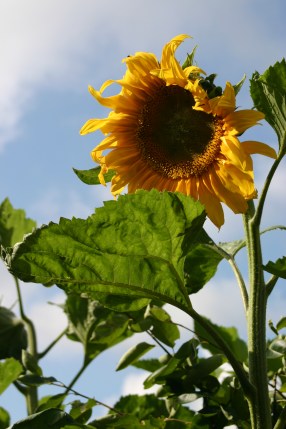
Sunflowers were planted by a local playgroup at the May opening of the garden – with the wet summer they grew to over 2.5 metres tall!
A renovated garden is moving towards maturity in what were once exercise yards for tramps and unmarried mothers at Gressenhall Farm and Workhouse Museum, Norfolk.
The garden occupies what were once two exercise/work yards for inmates of the Victorian Workhouse. The footings of what was once the dividing wall between these two yards can still be seen, emerging as the lawn above is worn away. In Victorian times these yards joined two blocks of accommodation:
- for so-called ‘casuals’ or tramps who used to travel between workhouses earning ‘a night’s board for 2 days hard labour’ – possibly crushing stones for use in road building
- for unmarried mothers nursing their babies – they wore distinctive uniforms to mark them out from the other workhouse inmates.
These buildings today provide the Museum’s Learning Centre and space for occasional groups and events. Until last year the garden area between the two buildings was kept maintained as grass and a range of mixed borders which is an important picnic/ rest spot as well as being used by school and pre school groups for art and learning activities. In 2012 funding from the Friends of the Museum as well as the Museum itself and donations from a range of local businesses were secured to refurbish and redesign it. A number of design issues were tackled, including:
- Providing further paved terrace space with new picnic tables and some renovated paving
- Introducing a number of planting containers to add interest to the paved terraces
- Realigning paths to follow ‘desire lines’ and make access easier
- Deepening borders to provide more visual interest and unified planting
- Creating a new ‘curiosity corner’ to provide a space designed for under 5’s which contains a range of features to encourage children to explore.
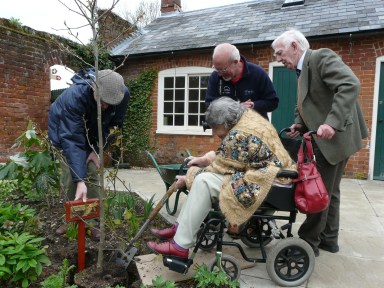
The newly renovated garden was formally opened on 6th May 2012, and two of the original gardening volunteers, Mary and Derek Manning, planted a ‘Paper Handkerchief Tree‘ to mark the occasion. Local children also played their part and cut ribbons to open ‘Curiosity Corner’.
The Curiosity Corner proved to be very popular in its first season last year and included some giant sunflowers planted by a local play group as well as a turf seat; a willow tunnel and arches; hazel wigwam; mirror; ‘fossil slab’; various ‘animals’ hidden away in the planting and a range of different path surfaces and planting. There is also a half barrel filled with stones,water and pond plants, so that youngsters can ‘get up close’ to this watery habitat.
The coming year will see the garden mature further and hopefully there will be sunny days so that visitors can really enjoy this lovely picnic area at its best.
Quizzicals:
Two more cryptic clues to the names of plants, fruit or veg…
- The scourge of female chickens
- Cheap goods in a pile of dung
Old School Gardener
If you’ve enjoyed reading this post and others on this blog, why not comment and also join some other people and sign up for automatic updates via email (see side bar, above right ) or through an RSS feed (see top of page)?
There are around ten different heritage gardens or other tended spaces at Gressenhall Farm and Workhouse Museum, near Dereham, Norfolk.
I’ve been a garden volunteer here for the last couple of years and spent time as a trainee Heritage Gardener. I plan to explore these spaces in my blog over the coming weeks. Here’s some background information.
References to ‘gardens’ in the Workhouse records (from late 18th to mid 20th centuries) are relatively few, as most of the spaces within the walls of the former Workhouse were ‘yards’ of various kinds, being used for exercise or work by the inmates (including stone crushing). Records indicate that there were areas of active cultivation, mainly to grow food for the Master, staff and inmates. Major areas of food cultivation (most located just outside the Workhouse walls) no longer exist.
The current workhouse buildings were developed in the late 18th century after an Act of Parliament encouraged ‘Houses of Industry’ to be set up. People unable to look after themselves and/or their families were able to live in the buildings and do work to earn their keep. Before this, from Tudor times, the poor were the responsibility of local parishes and prior to this were looked after by religious orders, or informally by neighbours, friends or family.
1834 saw the Poor Law Reform Act which converted the House of Industry into The Workhouse. Conditions became much harsher with families split up into different groups – adult males, adult females, boys, girls, unmarried mothers with babies, tramps (or ‘casuals’) etc. Dickens’ novel Oliver Twist conveys the strict regime.
Gressenhall and other Norfolk workhouses expanded and reorganised accordingly and this system remained largely the same for the next 100 years. The Poor Law was eventually abolished just after the 2nd World War and Gressenhall became an old peoples’ home- ‘Beech House’ (named after the magnificent Copper Beech tree in the main courtyard). Finally, in 1979 the old peoples’ home closed and the site was developed as the Norfolk Rural Life Museum, including the acquisition and development of the adjacent Union Farm as a showcase for farming methods and practices of yesteryear.
The historical role of today’s heritage gardens has resulted in most of them being enclosed by the walls of the workhouse buildings, boundary or dividing walls and sometimes, native species hedges or other natural boundaries. These ‘Gressenhall Gardens’ are principally the result of voluntary effort beginning in the 1980’s. The spaces were developed to support the Museum’s role in telling the story of the Workhouse and Farm, Norfolk’s broader landscape and rural life, as well as the more contemporary issues of environmental sustainability and biodiversity.
Several of these heritage gardens are domestic in scale and style with mixed planting and other features, probably due to their clear definition into manageable spaces coupled with the interests and ideas of volunteers and staff. Some of them perform specific roles in helping to interpret this Norfolk museum site and deliver some of it’s messages;
- Cherry Tree Cottage Garden illustrates a typical Norfolk cottage garden of the 1930’s, using plants and techniques from that time
- The Wildlife Garden has habitats, planting and other features that are conducive to wildlife. A small border also features ‘useful plants’
- The Orchards are growing varieties of apple and other fruit native to Norfolk (this is located on the graveyard of the old Workhouse)
- The Dyers’ Garden features plants used in natural dyeing
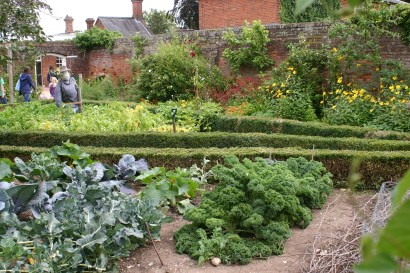
Cherry Tree Cottage garden is set out like a typical 1930’s Norfolk cottage garden with vegetable varieties and techniques of the time
A recent development has focused on the ‘Education Garden’, which is an important space used by the Museum’s Learning Team and others, adjoining as it does the Learning Centre. A new ‘Curiosity Corner’ provides an area for children under 5 to explore – it has various natural and other ‘child-size’ features; eg a willow tunnel, turf seat, rock pile, fossils, various metal birds, insects and animals and a hazel ‘wig wam’.
Over the coming weeks I’ll introduce you to some of the more important heritage gardens in this important Norfolk museum.
Further information:
Gressenhall Farm and Workhouse Museum on Facebook
Gressenhall Farm and Workhouse Museum blog

Our final garden visit whilst travelling home from the Lake District last week, was to Southwell workhouse, Nottinghamshire.
Sources and further information: