Tag Archive: wildlife


Keep the bird bath topped up in hot weather

Keep the bird bath topped up in hot weather

Well, yesterday was St. Swithin’s day and folk lore decrees that the weather on that day sets the pattern for the next 40, so we can ‘look forward’ to days in the mid to upper 20’s Celsius (and warm nights too):

‘St. Swithin’s day if thou dost rain
For forty days it will remain
St. Swithin’s day if thou be fair
For forty days ’twill rain nae mair.’

dost = does
thou = you
nae mair = no more.

And the forecasters seem to be saying this hot weather is likely to continue for the next couple  of weeks at least. So how can we care for the fragile eco systems that are our gardens? It’s all about moisture- using it wisely, keeping it in place in the plants and making sure wildlife has enough to survive. Here are 7 tips that might help:

1. Apply a mulch around plants that are most sensitive to water loss – grass clippings are ideal as they are light reflective (though you might well not have many that are usable in a heat wave- see tip 5 below). Straw is another option.

grass_mulching_tomatoes tiny farm blog

Grass mulching tomatoes from  tiny farm blog

2. Water your garden early morning or late evening (ideally from your own saved rainfall or ‘grey water’ forom the house) – morning is best as the plants need most of their water during the day time when they are growing. Leave a bucket or watering can full of water inside the greenhouse to help keep up humidity and so reduce the rate at which plants lose water through transpiration.

3. Get creative about shading your tenderest plants and crops – use shade netting, cloth, or fleece and maybe even think about using picnic awnings, table parasols and even tent poles with bedsheets!

movable awning

Movable awnings can bea useful shade for tender plants

4. If you need to plant out seedlings try to plant them alongside taller neighbours to help provide some protection, or even better hold off transplanting until the weather is more suitable – you can better care for seedlings in a container if you remember to water and shade them (and pot them into bigger pots if need be).

5. If you haven’t already stopped mowing your lawn then do so and leave at least 5 – 8cms of growth to help conserve moisture.

6. Avoid adding fertiliser to your ground as plants don’t need it in the heat as their growth rate slows.

7. Look after the wildlife – top up ponds, bird baths and drinking bowls for hedgehogs etc. and put out some food for these critters too, as it will be harder for them to find natural food like worms which bury themselves deeper into the ground.

Here’s hoping you and your garden survive the heat – how long before we Brits are hankering after a ‘traditonal’ Summer!

Old School Gardener

Playing out – and nature in the garden

street playA super couple of items from Monday’s BBC TV ‘One Show’. The first is about the new street play project in England, the following item about what nature can live in a square metre of a garden….The two items begin about 2 minutes from the start of the programme and last about 12 minutes in total.

Enjoy and share!

Old School Gardener

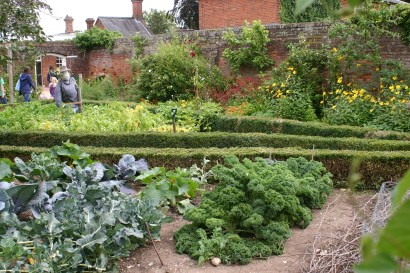
The Kitchen Garden at Old School Garden

The Kitchen Garden at Old School Garden

To Walter Degrasse

Dear Walter,

As I write to you on midsummer day it’s cloudy and rain threatens. We have had some warm spells and even some sunshine, but you get the feeling that ‘proper summer’ has yet to find its way to Norfolk. I know that you’ve had pretty similar weather in your neck of the woods and no doubt you’re as curious as me as to the way the ‘late’ (read almost non-existent) spring has had an impact on the plants. A few pointers from Old School Garden as I write:

  • the Magnolia is still in flower as are the Siberian Wallflowers, Pansies and Violas
  • Sweet Williams are just about coming into flower but the pink Peonies, though with huge fat flower buds, have yet to fully unfurl (having said that the earlier, red varieties have been and gone)
  • Irises are looking good (though last year’s Iris Rust problem has retuned to some)
  • Carrots and Broad beans probably need a further week or two to be fully ready for harvesting
  • Second early (but not first early) potatoes are flowering
  • Lettuces are ready to crop

So it’s a story of some things flowering late and running into other things which is making for some interesting combinations and a few weeks of intense colour; certainly the best show at this time of year I can remember for some time!

Rather than spend a lot of words telling you about my gardening activities in the last month I thought that I’d let ‘the pictures do the talking’ so I’ve included three photo galleries and will give you a few guiding comments for each. The first one is a few pictures of the Gardens at Gressenhall Farm and Workhouse Museum, where the Education Garden I redesigned and with volunteer support, replanted last year is looking superb. A mass of pink and orange oriental poppies along with Salvia ‘Mainacht’  with the billowing leaves of Macleaya in the background, are putting on a wonderful show, remarked on by many visitors, it appears.

There’s a call for me to provide some information on the plants included in the borders, so I’ll have to dig out my original design and plant lists and put together some sort of illustrated guide. Likewise, after a clean out and weed, the Wildlife Garden, and especially the pond and bog areas, are filling out nicely, though there doesn’t appear to be much wildlife evident to date. Monday is going to be something special here as BBC Radio 4’s ‘Gardeners’ Question Time’ is being recorded at the Museum and I’ll be on hand to help guide the audience and provide some information on the gardens. I’m not sure when this is broadcast but I’ll let you know when I’m sure, though I know that you’re a regular listener like me.

My voluntary work at the local Primary school continues with a regular weekly slot working with groups of children of different ages in the School Garden. You may have seen my recent post on the vertical planters we’ve made out of old wooden pallets – these are looking very colourful alongside the playground and I’m pleased to say that the children are being diligent in their watering duties. I’m going over there later today so will have a quick look to see that they’re holding up – I’m not sure the compost will hold in place especially if it gets at all dry. At yesterday’s session we weeded around the various veg beds and cracked open the first pods of Broad Beans which the children eagerly popped into their mouths – once I’d assured them that they would be deliciously sweet and tender – there came  a predictable ‘hmmm, yummy’ in response!

The other crops are all coming along well, and the attention to regular weeding and watering has really paid off this year, so we should be cropping potatoes, onions, cabbages, calabrese, peas, runner and broad beans, turnips and carrots soon! The other big  job was to empty out the wooden compost bins which have been clogged up with grass, sticks and soil over the years and are in real need of starting over once more. Hopefully, we’ll get this finished off today and we can then get more of a systematic approach to adding food peelings etc. from the kitchen as well as ‘green waste’ from the school lunches. The wormery seems to be going well, and the School Cook is pleased that the refuse collectors are now collecting food waste for composting at a local centre, too.

My other Master Gardener activity is picking up a bit. I’m doing stints at the Norfolk Show next week and also an event in a nearby village where some Lottery cash looks like it’s going to make some new adult education classes possible, including something from me on growing your own food or maybe design, depending on the level of interest. I’m going along to an open day on this to gauge interest and promote both Master Gardener and the idea of the courses, so we’ll see if anything comes of that.

As far as Old School Garden goes, I’ve mentioned the great show we’ve had recently so will let the photographs give you the details! Its been a month of systematic weeding around the different borders, finishing off staking the herbaceous perennials, dead heading and recently planting out the many annuals I’ve een raising from seed to plug gaps etc. I must say I’m pleased with the result, and after visiting a few gardens recently we’ve decided to open ours for charity in mid July. I’ll let you have details in due course, but we hope to make this a lively afternoon with advice from  my friends in the Master Gardener and Master Composter projects and of course plant sales and some delicious tea and cakes!

I hope that you enjoy the picture gallery which shows a few shots of different parts of the garden taken yesterday. As I was walking around I spotted a female blackbird raiding my cold frame and carrying off some poppy seedlings (and compost) in her beak! Having seen her later in the courtyard garden I suspect she’s gathering material for a new nest! We do seem to have had a lot of Blackbirds this year and they seem intent on disturbing the wood chip mulch I put on the long borders in search of food, with the result that sweeping the paths is rapidly becoming a daily chore!

Well,  matey, I hope this little update finds you and your good lady in the best of health. It’s great that you’re now well on the road to recovery and no doubt pleased that you can get outside and dig your patch once more. Did you manage to find any paid garden help? I know that the grass cutting is your biggest nightmare and this is one thing you could do with some help on. Or maybe you might think about turning some of that grass into flowering meadow? I’ve seen some lovely examples of mown paths through long grass recently that must be less maintenance heavy and more wildlife friendly too – worth a thought.

Well, bye for now and I’ll give you a further update next month, though in the mean time I’ll do a post next week about how the recording of ‘GQT’ goes and my experiences at the Norfolk Show.

all the best

Old School Gardener

Other posts in this series:

Dear Walter….letter from Old School Garden, 20th May 2013

Dear Walter….letter from Old School Garden, 18th April May 2013

Dear Walter….letter from Old School Garden, 11th March 2013

Dear Walter… letter from Old School Garden: 15th February 2013

If you’ve enjoyed reading this post and others on this blog, why not comment and join others by signing up for automatic updates via email (see side bar, above right ) or through an RSS feed (see top of page)?

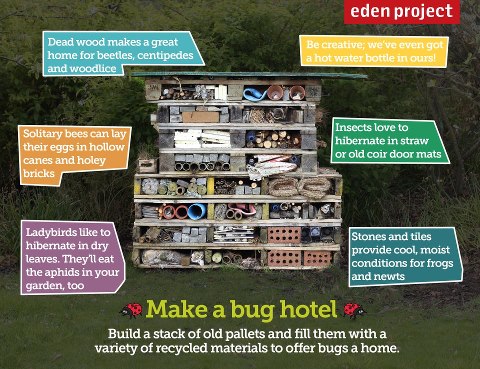
Make your own bug hotel

Courtesy of The Eden Project

PicPost: Claridge's

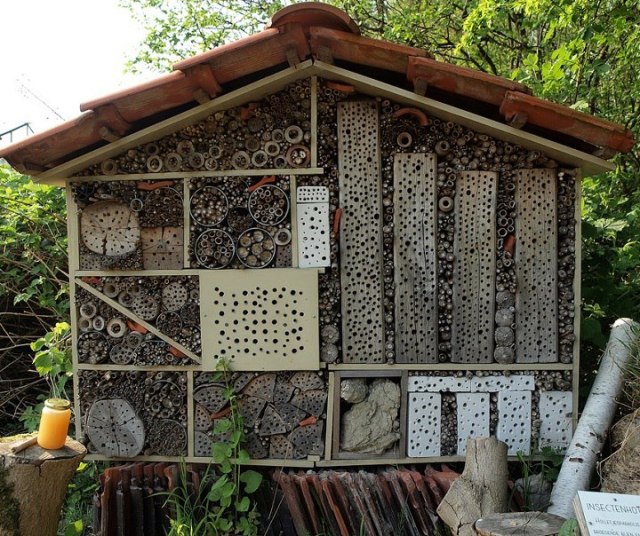
See more insect hotels here

Next post will give you a guide to making your own bug hotel

Old School Gardener

Recording wildlife near you

01 February 2013

Recording wildlife near you

This isn’t a strange safari group, but a request from Cambridgeshire and Peterborough Environmental Records Centre (CPERC) to help increase wildlife records across the county. Thanks to a grant of £40,400 from the Heritage Lottery Fund, CPERC have been running a recording project to help communities recognise and record their wildlife, which has already led to an increase of over 2,500 extra records from the general public in 12 months – more than 20 times what was submitted in 2011!

Although a year through this eighteen month project, there is still a lot to do and plenty of chances to get involved. CPERC’s Biodiversity Outreach Officer, Jane Andrews-Gauvain, explained:

We are extremely grateful to everyone who helped us record species last year, they did a fantastic job! We only have six months left, but we feel sure with help we can double our public records for last year in that time! There are plenty of opportunities for anyone to get involved, both in recording species near you (whether in your own garden, or out and about in the beautiful Cambridgeshire countryside with friends) and in surveying larger areas, particularly in Fenland District and east Peterborough. It doesn’t matter what your expertise are as there is training available and we can provide help with transport, all you need is an interest in wildlife and a bit of patience.

Toad and Frog Spotting
Toads and frogs are the first species CPERC want help recording as the weather warms up. CPERC are teaming up with Froglife and the Cambridgeshire and Peterborough Amphibian and Reptile Group (CPARG) to record these species. CPERC would like to hear from you if you are happy to just record when you see them hopping about, to let them know if your pond has frog spawn in, to help search for the species’, or to help at a Toad Crossing.

Specialist Training
Thanks to the Heritage Lottery Fund and support of several wildlife organisations and county naturalists, there is a chance for members of the public and organisations to learn about recording and identifying bats, butterflies, dragonflies, otters, water voles and several other species in Cambridgeshire. If you want to have this opportunity, make sure you contact CPERC!

Further details
To ensure you get all the latest information about events and how you can help, contact Jane Andrews – Gauvain on 01954 713572, or email jane.andrews-gauvain@cperc.org.uk.

You can find out more about ‘Recording Wildlife’ and see events coming up on CPERC’s website,www.cperc.org.uk and their Facebook page www.facebook.com/cperc and to find out more information about Toad Crossings and Toad patrols go to www.froglife.org/toadsonroads/

From Cambridgeshire Action for Communities in Rural England

Old School Gardener

garden pic gressenhallThere are around ten different heritage gardens or other tended spaces at Gressenhall Farm and Workhouse Museum, near Dereham, Norfolk.

I’ve been a garden volunteer here for the last couple of years and spent time as a trainee Heritage Gardener. I plan to explore these spaces in my blog over the coming weeks. Here’s some background information.

References to ‘gardens’ in the Workhouse records (from  late 18th to mid 20th centuries) are relatively few, as most of the spaces within the walls of the former Workhouse were ‘yards’ of various kinds, being used for exercise or work by the inmates (including stone crushing). Records indicate that there were areas of active cultivation, mainly to grow food for the Master, staff and inmates. Major areas of food cultivation (most located just outside the Workhouse walls) no longer exist.

The current workhouse buildings were developed in the late 18th century after an Act of Parliament encouraged ‘Houses of Industry’ to be set up. People unable to look after themselves and/or their families were able to live in the buildings and do work to earn their keep. Before this, from Tudor times, the poor were the responsibility of local parishes and prior to this were looked after by religious orders, or informally by neighbours, friends or family.

The Workhouse meant a harsh, regimented life

The Workhouse meant a harsh, regimented life

1834 saw the Poor Law Reform Act  which converted the House of Industry into The Workhouse. Conditions became much harsher with families split up into different groups – adult males, adult females, boys, girls, unmarried mothers with babies, tramps (or ‘casuals’) etc. Dickens’ novel Oliver Twist conveys the strict regime.

Union Farm showcases historic farming practices with animals and fields

Union Farm showcases historic Norfolk farming practices

Gressenhall and other Norfolk workhouses expanded and reorganised accordingly and this system remained largely the same for the next 100 years. The Poor Law  was eventually abolished just after the 2nd World War and Gressenhall became an old peoples’ home- ‘Beech House’ (named after the magnificent Copper Beech tree in the main courtyard). Finally, in 1979 the old peoples’ home closed and the site was developed as the Norfolk Rural Life Museum, including the acquisition and development of the adjacent Union Farm as a showcase for farming methods and practices of yesteryear.

The historical role of today’s heritage gardens has resulted in most of them being enclosed by the walls of the workhouse buildings, boundary or dividing walls and sometimes, native species hedges or other natural boundaries. These ‘Gressenhall Gardens’ are principally the result of voluntary effort beginning in the 1980’s. The spaces were developed to support the Museum’s role in telling the story of the Workhouse and Farm, Norfolk’s broader landscape and rural life, as well as the more contemporary issues of environmental sustainability and biodiversity.

an aerial view of Gressenhall Farm and Workhouse Museum

An aerial view of Gressenhall Farm and Workhouse Museum, Norfolk

Several of these heritage gardens are domestic in scale and style with mixed planting and other features,  probably due to their clear definition into manageable spaces coupled with the interests and ideas of volunteers and staff. Some of them perform specific roles in helping to interpret this Norfolk museum site and deliver some of it’s messages;

  • Cherry Tree Cottage Garden illustrates a typical Norfolk cottage garden of the 1930’s, using plants and techniques from that time
  • The Wildlife Garden has habitats, planting and other features that are conducive to wildlife. A small border also features ‘useful plants’
  • The Orchards are growing varieties of apple and other fruit native to Norfolk (this is located on the graveyard of the old Workhouse)
  • The Dyers’ Garden features plants used in natural dyeing
Cherry Tree Cottage garden is set out like a typical 1930's cottage garden with vegetable varieties and techniques of the time

Cherry Tree Cottage garden is set out like a typical 1930’s Norfolk cottage garden with vegetable varieties and techniques of the time

A recent development has focused on the ‘Education Garden’, which is an important space used by the Museum’s Learning Team and others, adjoining as it does the Learning Centre. A new ‘Curiosity Corner’  provides an area for children under 5 to explore – it has various natural and other ‘child-size’ features; eg a willow tunnel, turf seat, rock pile, fossils, various metal birds, insects and animals and a hazel ‘wig wam’.

Over the coming weeks I’ll introduce you to some of the more important heritage gardens in this important Norfolk museum.

Further information:

Gressenhall Farm and Workhouse Museum on Facebook

Gressenhall Farm and Workhouse Museum blog

Old School Gardener

Finding Nature

Nature Connectedness Research Blog by Prof. Miles Richardson

Norfolk Green Care Network

Connecting People with Nature

Discover WordPress

A daily selection of the best content published on WordPress, collected for you by humans who love to read.

Susan Rushton

Celebrating gardens, photography and a creative life

Unlocking Landscapes

Writing, photography and more by Daniel Greenwood

Alphabet Ravine

Lydia Rae Bush Poetry

TIME GENTS

Australian Pub Project, Established 2013

Vanha Talo Suomi

The Journey from Finnish Rintamamiestalo to Arboretum & Gardens

Marigolds and Gin

Because even in chaos, there’s always gin and a good story …

Bits & Tidbits

RANDOM BITS & MORE TIDBITS

Rambling in the Garden

.....and nurturing my soul

The Interpretation Game

Cultural Heritage and the Digital Economy

pbmGarden

Sense of place, purpose, rejuvenation and joy

SISSINGHURST GARDEN

Notes from the Gardeners...

Deep Green Permaculture

Connecting People to Nature, Empowering People to Live Sustainably

BloominBootiful

A girl and her garden :)