Tag Archive: spring


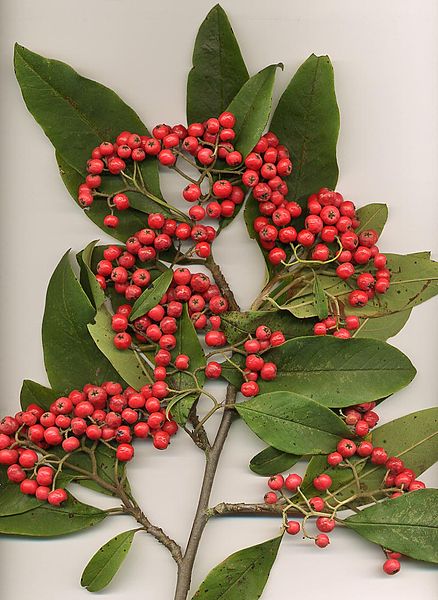
Cotoneaster frigidus leaves and fruit

Cotoneaster frigidus – leaves and fruit

Cotoneaster  is a genus of flowering plants in the rose family, native to temperate Asia, Europe and north Africa. It has  a strong concentration of different species in the mountains of southwestern China and the Himalayas. They are related to Hawthorns, Firethorns, Photinias and Rowans. Depending on the definition used, there are between 70 and 300 different species.

The majority of Cotoneaster species are shrubs from 0.5–5 metres tall, varying from ground-hugging prostrate plants to erect shrubs. A few, notably C. frigidus, are small trees up to 15 metres tall and 75 centimetres trunk diameter. The prostrate species are mostly alpine plants growing at high altitude (e.g. C. integrifolius, which grows at 3,000–4,000 metres in the Himalayas), while the larger species occur in scrub and woodland gaps at lower altitudes. Cotoneasters are very popular garden shrubs, grown for their attractive habit and decorative fruit. Many are cultivars, some of  hybrid origin; of these, some are of known parentage.

Cotoneaster franchetii

Cotoneaster franchetii

Cotoneaster horizontalis

Cotoneaster horizontalis

The name Cotoneaster derives from the old Latin cotoneus meaning Quince and aster probably a corruption of ad instar meaning ‘a likeness’ – so ‘Quince like’.

Other species names are:

C. adpressa = close, pressed-down growth or fruits closely pressed against the branch

C. applanata = the branches lie flat or in a plane

C. bullata = wrinkled, referring to the leaves

C. buxifolia = box (buxus) -leaved

C. congesta = crowded, the plant’s habit

C. divaricata =spread-out, forking , referring to the branches

C. franchettii = after Franchet, a French botanist

C.  frigida = cold,frosty, probably referring to its native habitat

C. harroviana = after G. Harrow, a nurseryman once of Coombe Wood Nursery

C. henryana = after Dr. Augustine Henry, a 19th century Chinese customs official and ‘plant hunter’

C. horiziontalis = horizontal, its growth habit

C. humifusa = spread on the ground

C. lacteus =  milky, probably referring to the milky white flowers (the ‘Late Cotoneaster’)

C. lucida = shining, referring to the leaves

C. microphylla = small – leaved

C. multiflora = many flowered

C. pannosa = woolly, the foliage

C. rotundifoilia = round leaved

C. salicifolia = willow (salix) leaved

C. simonsii = after Simons, (The ‘Himalayan Cotoneaster’ or ‘Simon’s Cotoneaster’)

Cotoneaster adpressus

Cotoneaster adpressus

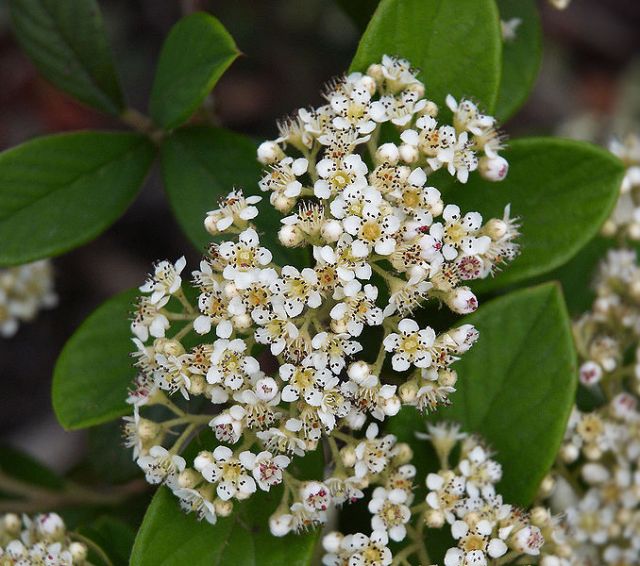
Cotoneaster lacteus - flowers

Cotoneaster lacteus – flowers

Cotoneaster simonsii

Cotoneaster simonsii

Sources and further information:

Wikipedia

Encyclopedia Britannica

Growing Cotoneasters

Cotoneaster horizontalis

Cotoneaster lacteus

Cotoneaster simonsii

Quizzicals: answers to the two in Plantax 7…

  • Bird swearing – Crocus
  • Vasectomy for Dad – Parsnip

..and 2 more cryptic clues to the names of plants, fruit or veg…

  • Irish singer is growing worse
  • Tease Mr Disney

(thanks to Les Palmer, answers in the next Plantax!)

Old School Gardener

If you’ve enjoyed reading this post and others on this blog, why not comment and join others by signing up for automatic updates via email (see side bar, above right ) or through an RSS feed (see top of page)?

PicPost: Spring not sprung

Nature lies dormant ahead of first day of spring

UK Spring Weather : Icicles on the side of a road in South Derbyshire

‘Conservationists report lack of budding plants, animals returning to hibernation and migrating birds held back by wintry weather

One hundred years ago, on the official first day of spring, the Anglo-Welsh war poet and naturalist Edward Thomas set off from Clapham Common in London to cycle and walk to the Quantock Hills in Somerset. The record of his journey, called In Pursuit of Spring, became a nature-writing classic, telling of exuberant chiffchaffs and house martins, daffodils and cowslips in full flower and “honeysuckle in such profusion as I had never before seen”.

Had Thomas taken the same route today, he might not have seen very much wildlife – and could well have frozen. Mist and fog, rain, a bitter north wind, and temperatures just above freezing are forecast for , the first “official” day of spring…’

PicPost: Happy as Larry

16th March 2013

Hi!

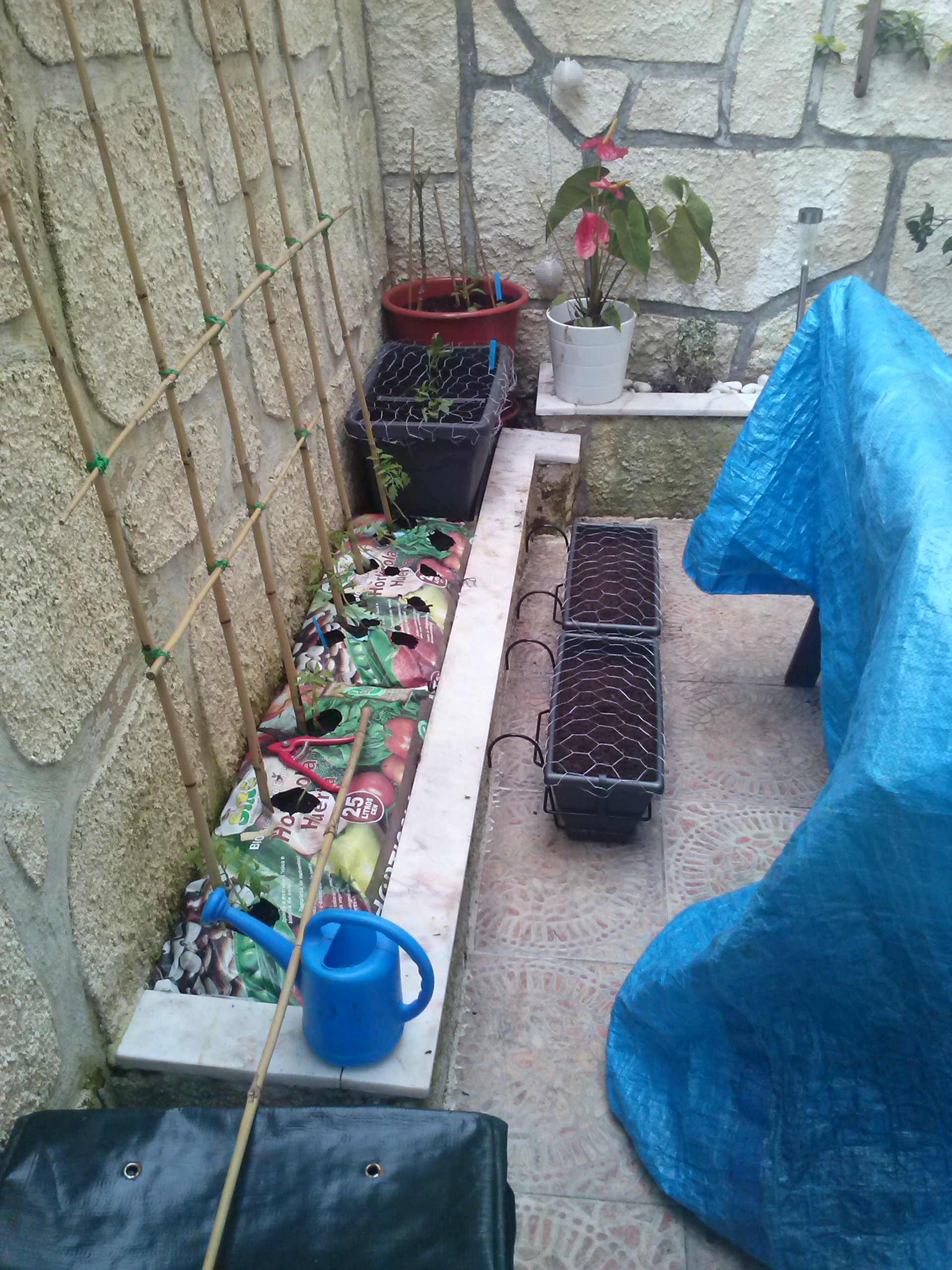
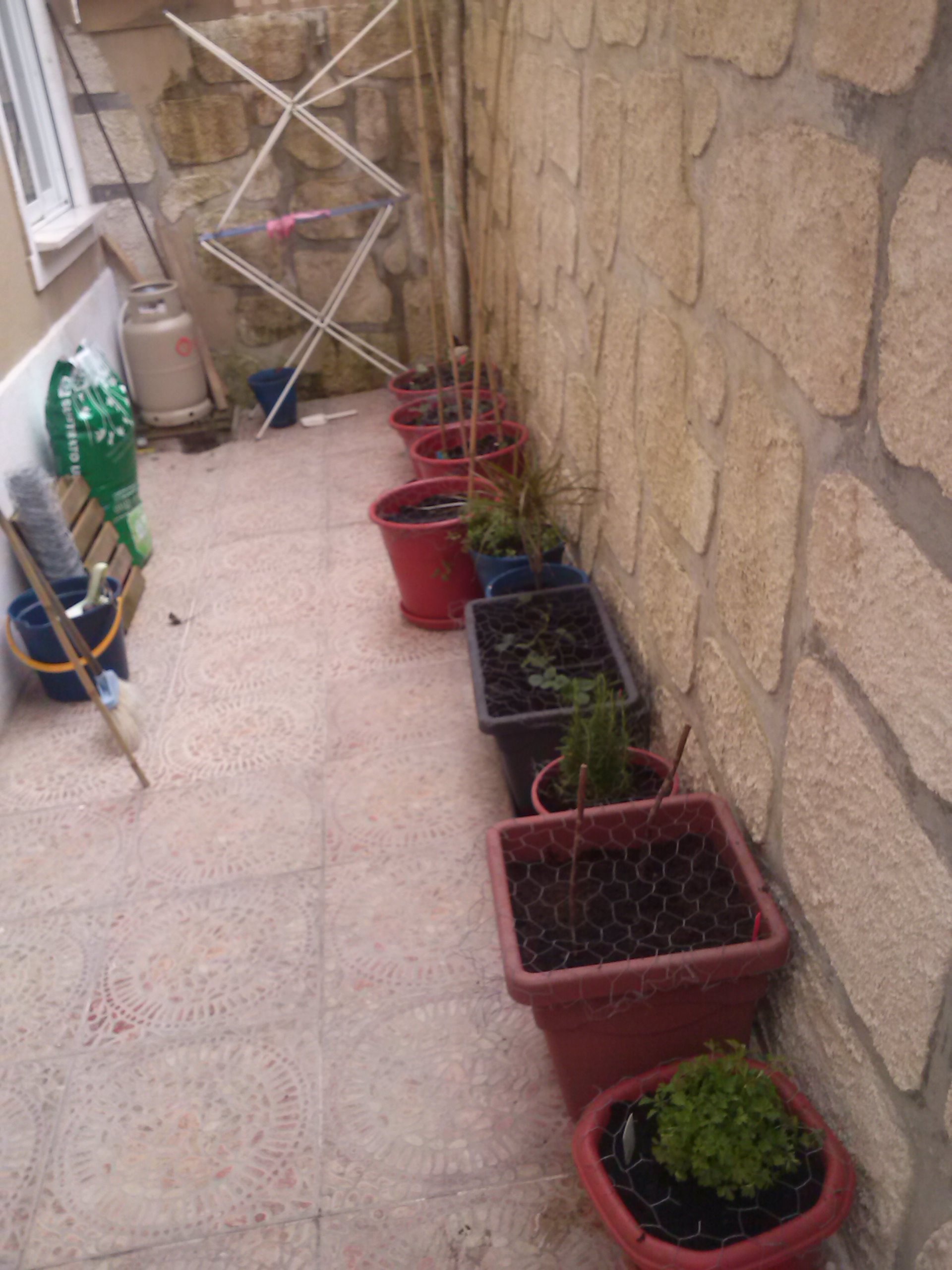
Thanks for the tips… have pretty much done everything now!

Bought some seeds and have planted them in a compartmentalized seed tray… went for basil, coriander , parsley , sage, oregano and piripiri chillies.

Also got some raspberry plants – maybe they’ll work this year!!

Now to wait and see if they sprout!

ImageImageImage

To be continued…. do youn have any tips about growing fruit and veg in containers? Please let me know!

Previous post: Dear Dad ….15th March 2013

Old School Gardener

If you’ve enjoyed reading this post and others on this blog, why not comment and join others by signing up for automatic updates via email (see side bar, above right ) or through an RSS feed (see top of page)?

Thinking of spring and the Dell at Bodnant

Some lovely pictures and words by Chas Spain

http://chasspain.files.wordpress.com/2013/03/img_1172.jpg

Time to prune your blueberries: early March is ideal, as it is usually easier to see the fruit buds. Start by taking out your 3 Ds (dead, diseased and dying). Then remove the ends of the branches which fruited last year, taking them back to a strong bud or branch. Finally, remove a third of the oldest stems from the base, to open up the bush and encourage new growth. If it’s newly planted just do your 3 Ds!

More info here: http://apps.rhs.org.uk/advicesearch/Profile.aspx?pid=85

– Becky, RHS Members Advisory (who is now craving blueberries!!)

Red Cabbage seedlings on one of my 'seedy cills'

Red Cabbage seedlings on one of my ‘seedy cills’

Old School Garden

11th March 2013

To Walter Degrasse

Dear Walter,

As it’s a few weeks since I last wrote, and more importantly the weather today has put the block on any practical gardening outside, I thought I’d drop you a line and update you with what’s been happening in Old School Garden and further afield.

First, I was pleased to hear that your operation was successful and that you can now get back to lifting things – but make sure you do it safely next time!

Well, it’s been rather mixed few weeks, reflecting the March weather! today, just for the record we have the return of ‘The Beast from the East’ – average 30 mph winds and occasional snow  showers whcuin seem to have plunged us right back into winter. Quite a contrast to the weather last week when it reached 14 degrees C! (today there’s a wind chill which will make it feel like -4 degrees!- not that I plan to be out in it). The sort of day that reminds me of the comment one of the vergers at Winchester Cathedral made when he heard Deborah and I live in Norfolk:

‘So, there are about three strands of barbed wire between you and Siberia!’

Winter returns to the Old School Garden

Winter returns to the Old School Garden

We met him when we paid a visit to this great building at the end of February (you may have seen some of the photos of our trip south on this blog). One of the highlights of that trip was to Mottisfont Abbey where we had a lovely day in bright sunshine. This was perfect for exploring the gardens of this wonderful old estate, especially the relatively new Winter Garden (there is a gallery of pictures of this visit on the blog). The bright sunshine really set off the colours in the winter stems of Dogwoods, Snake Bark maples and Cyclamen flowers (and there were many drifts of snowdrops too).
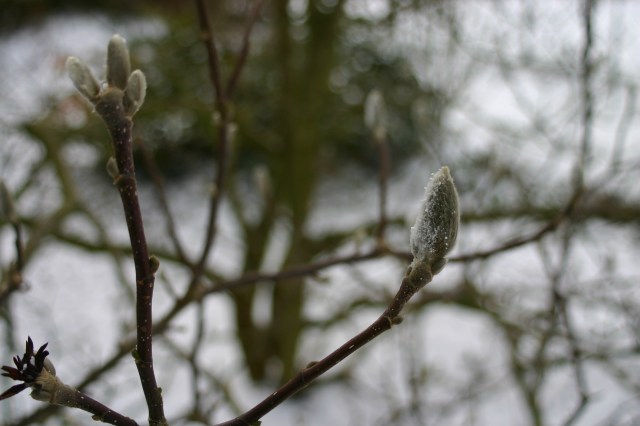
Magnolia flower buds -frosted once more

Magnolia flower buds -frosted once more

Closer to home, I’ve managed to make some progress in digging over one of the main mixed borders here, one that didn’t benefit from an autumn clear up. I guess I must be about two-thirds through this and have taken the opportunity to divide and move some perennials (including grasses), so hopefully we’ll have rather more balanced planting as a result. I hope – when weather permits – to get out and finish this, then I’ll feed the main shrubs (with Fish, Blood and Bone) and use my compost to mulch around them.

Talking of mulch, my friend Robert let me have another load of his excellent horse manure so I’ve spread about a tonne of that over most of the Kitchen Garden beds, fruit trees and bushes and roses (having first given them a little rose fertiliser). It really is lovely stuff, friable, and once raked over incorporates into the soil really well.

Apart from this it’s been a few weeks of getting seeds underway. You may recall that I’d started off a few things back in February, but I now think that may been a tad too early, as some of them are struggling to put on enough growth for me to pot them up. Still there’s time yet for having another go. I’ve now got two windowsills and the greenhouse going with seed trays (including a couple of heated propagators), so soon the house will be full of plants at various stages of development as I move them into progressively cooler conditions and larger pots prior to planting out once warmer times have arrived.

One of my 'seedy' window cills- veg and flowers underway

One of my ‘seedy’ window cills – veg and flowers underway

One indoor plant that is doing well is the Clivia I bought at the School Fair a few years ago. I must admit that I probably should have potted this on a few months ago, but this doesn’t seem to have held it back, as it’s just about to burst into flower (and we have last years stalk with a seed fruit on it for added colour!).
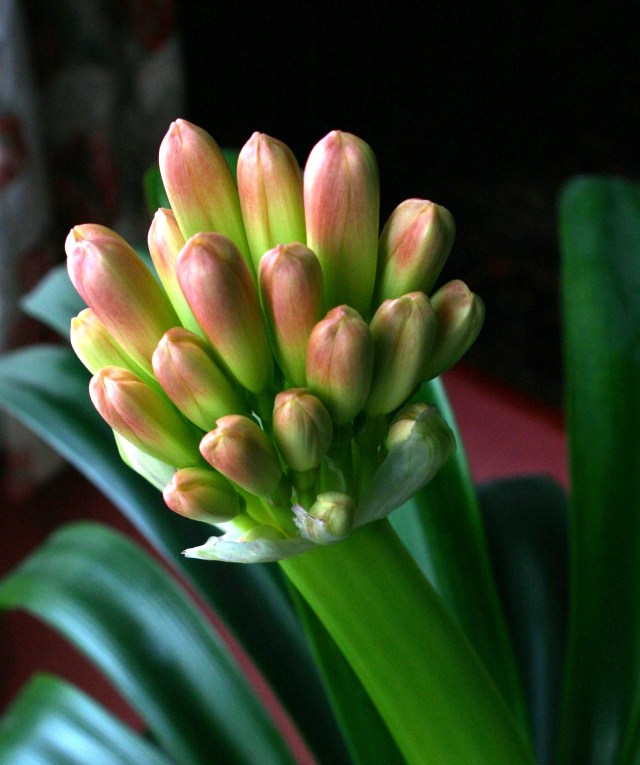
Clivia flower head ready to burst

Clivia flower head ready to burst

Clivia fruit - from last year's flower on the same plant

Clivia fruit – from last year’s flower on the same plant

I’ve returned to the gardens at Gressenhall Farm and Workhouse Museum (you remember I’ve been volunteering here for a couple of years?). The gardens overall seem to be in pretty good shape, but with Steve, a friend who also volunteers here, I’ve begun to clear, dig over and mulch borders in the areas we’re responsible for. I’m also pondering how to make some features of the ‘Curiosity Corner’ for young children a little more robust and secure. Perhaps not surprisingly small feet have wandered off the paths and into the beds so trampling down some plants). Steve has some spare trellis so I might try to put up a low screen of this to deter the kids and at the same time grow some dwarf Sweet Peas up it for fragrance and colour.

Youngsters at Cawston Primary School have been enjoying seed sowing

Youngsters at Cawston Primary School have been enjoying seed sowing

I’ve also begun my regular Thursday ssessions at the local Primary school. The School Garden there is now really taking off, with much more structured use to which I’m contributing. So far this has focused on what we do in the garden in spring, digging over the raised beds and talking about tools and tool safety etc. We’ve got some onion sets in as well as some Broad Beans, and potatoes are ‘chitting’ ready for planting straight after Easter. I also got hold of some more manure for these beds, which have rather poor soil, so our efforts at breaking this up and digging in the manure will hopefully be repaid later in the year. The children –  rotating groups from four of the six classes – have responded well and seem to be enjoying the sessions, though they are only about 30 minutes each. I’ll do a final introductory session on Thursday before we turn our attention to renovating the ‘Nectar Bar’ of insect – friendly plans I installed a few years ago, but which has suffered from lack of maintenance. Then, after the Easter break, I think we’ll be into planting potatoes and some of the seedlings the children have been sowing into paper pots (Broad Beans so far but Turnips and other crops to come, some directly into the ground).

Children have been learning how to prepare soil for seed sowing

Children have been learning how to prepare soil for seed sowing

Well, looks like coffee time, so I’ll put the kettle on, look out at the snow and try to make the best of the day ahead inside!

I’m currently researching climate change and gardening as this is a topic I expect to be writing a post about shortly. I have a few ideas about what we gardeners might do to cope with not only steadily increasing temperatures (and advancing seasons), but the increased unpredictability of the weather – flood to drought to snow blizzards in as many days! Or as one fellow blogger put it recently ‘Four seasons in a week’ !(we’re not quite up to 4 in a day as per the song).

I’ll be in touch again in a few weeks. In the meantime I hope that your recovery progresses well and that you’ll soon be out and about in your wonderful garden!

Very best wishes,

Old School Gardener

If you’ve enjoyed reading this post and others on this blog, why not comment and join others by signing up for automatic updates via email (see side bar, above right ) or through an RSS feed (see top of page)?

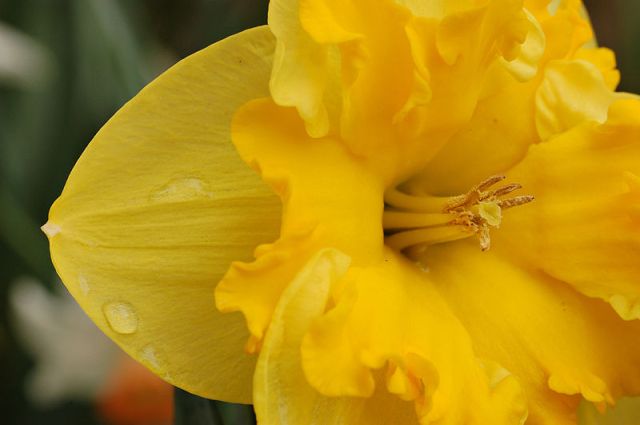
Daffodil flower close up

Narcissus is a genus of bulbous perennials in the Amaryllis family. They are in the  main hardy and most flower in the spring. There are various common names used to describe all or some of the genus – daffodil, narcissus, and jonquil. Narcissus are native to meadows and woods in Europe, North Africa and West Asia, centred in the Western Mediterranean.

There is disagreement about the number of distinct species (these range from 26 to more than 60 depending on who you ask) – as some are very similar and others have hybridised. All Narcissus cultivars are split into 13 divisions (using a combination of flower form and genetic background). New cultivars are registered by name and color with the Royal Horticultural Society, which is the international registration authority for the genus.

More than 27,000 names were registered as of 2008!

Narcissus flowers

Narcissus flowers

The name “daffodil” is derived from an earlier word  “affodell”, a variant of Asphodel (another group of Mediterranean plants). The reason for the addition of the  initial “d” is not known, although it could be a ‘slip of the dutch tongue’ – the merging of the main word with the Dutch article “de”, as in “De affodil”. Playful synonyms  “Daffadown Dilly”, “daffadown dilly”, and “daffydowndilly” appeared as early as the 16th century. Everyday use of the term Daffodil tends to refer to the wild daffodil (N. pseudonarcissus).

The name Narcissus comes from the same latin word, which in turn is based on an ancient greek word – but its meaning is unknown. It could be a word loaned from another language. The most common explanation is based on the Greek myth of Narcissus, a Thespian hunter renowned for his beauty. He became so obsessed with his own reflection in a pool of water that as he knelt and gazed into it, he fell into the water and drowned. Some variations of the myth say that he died of starvation and thirst. In both versions the Narcissus plant sprang from his remains. However, this is by no means a certain derivation and it could be the that the hunter’s name was derived from the flower rather than the other way round!

Another explanation for the name comes from Pliny who stated that the plant was named because of its narcotic properties (the greek word means ‘to grow numb’). There’s no evidence to support this idea and it seems to have fallen out of favour. However,  all Narcissus species do contain the poison lycorine (mostly in the bulb but also in the leaves). The bulbs can often be confused with onions, thereby leading to incidents of accidental poisoning.

On 1 May 2009 a number of schoolchildren fell ill at Gorseland Primary School in Martlesham Heath, Suffolk, England, after a daffodil bulb was added to soup during a cookery class.

Another problem is what florists call, “daffodil itch” – a skin problem often found on the hands after contact with the plant’s sap. Some cultivars seem more likely to cause this kind of dermatitis; eg  ‘Actaea’, ‘Camparelle’, ‘Gloriosa’, ‘Grande Monarque’, ‘Ornatus’, ‘Princeps’ and ‘Scilly White’.

Narcissus geranium

Narcissus geranium

The Narcissus is used quite widely as a symbol:

  • of unrequited love (after the Narcissus myth)
  • of vanity (the West)
  • of wealth and good fortune (the East).
  • of the new year (Kurdish and Chinese cultures).
  • of beautiful eyes (Persian culture)
  • of the nation (Wales – where the daffodil is known as ‘Peter’s Leek’)
  • of Easter (the German for daffodil is Osterglocke or ‘Easter Bell’)
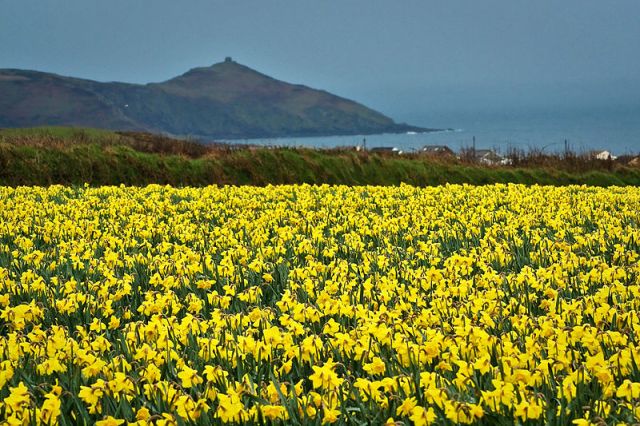
Cornwall daffodils- traditionally the place (along with the Scilly Isles and Channel Islands) where early supplies of cut flowers are sent out to the rest of Britain.

Cornwall Daffodils- traditionally the place (along with the Scilly Isles and Channel Islands) where early supplies of cut flowers are sent out to the rest of Britain.

Some of the species names are:

N. bulbocodium = probably greek for ‘bulb’ (bolbos) and ‘a little fleece’ (kodion) – referring to the covering of the bulb – the ‘Hoop Petticoat Daffodil’

N. cyclamineus = like a Cyclamen flower

N. incomparabilis = incomparable

N. jonquilla = probably from ‘juncus’ (a rush) – the leaves being rush-like. The ‘Jonquil’

N. juncifolia = like Jonquil, rush – leaved!

N. major = larger

N. maximus = largest

N. minor = smaller

N. odorus = sweet-scented

N. poeticus = poet’s – the ‘Poets’ Narcissus’

N. pseudonarcissus = the false Narcissus. The ‘English Daffodil’

N. tazetta = an old name for the ‘Polyanthus Narcissus’

N. triandrus = having three stamens

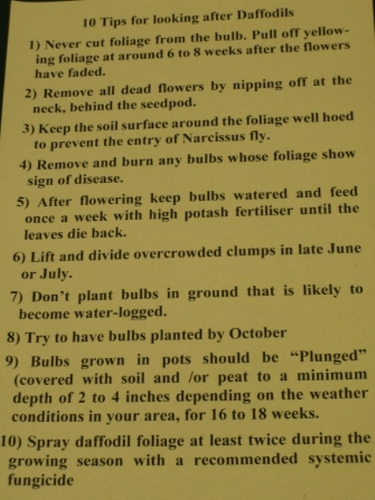
Daffodil growing tips

Daffodil growing tips

Both species and hybrids are used extensively in gardens and grounds, looking good planted in borders or in naturalized drifts at the base of deciduous trees. Propagation is mainly from bulbs which are very easy to grow. They require little maintenance, but with some minimum care they can be more vigorous and floriferous, and they’ll multiply much more quickly, improving the show they provide each year. (see ‘Ten tips for looking after Daffodils’ above). Narcissus grows almost anywhere, although it does prefer well-drained soils with a sunny or light shade environment. The Narcissus species types are more specific in their requirements.

Naturalised Daffodils

Naturalised Daffodils

Source and further information:

Wikipedia

Growing Narcissus

Kew Gardens- Narcissus pseudonarcissus

Daffodil classification

Old School Gardener

If you’ve enjoyed reading this post and others on this blog, why not comment and join others by signing up for automatic updates via email (see side bar, above right ) or through an RSS feed (see top of page)?

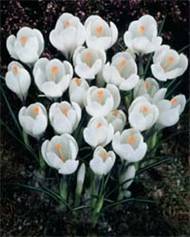
Crocus 'Jeanne d'Arc'

Crocus ‘Jeanne d’Arc’

In the wild, Crocus vernus begins to flower as the snow melts in the mountains of Europe. It is native to the Mediterranean from the Pyrenees in the west to the Ukraine in the east, and south as far as Sicily and the Balkans. This spicy herald of spring has a history dating back thousands of years.

Crocus (plural: crocuses, croci) is part of the Iris family and consists of around 90 species. They are perennials, growing from corms. Cultivated mainly for their flowers which appear in autumn, winter, or spring, Crocuses are also cultivated and harvested for Saffron– the spice obtained from the flower’s anthers. This practice was first documented in the Mediterranean, notably on the island of Crete.  Saffron’s bitter taste and hay-like fragrance is complimented by its rich golden-yellow hue, used to colour food and textiles.It has been  traded and used for over four thousand years. Iran now accounts for approximately 90 percent of the world production of Saffron. Because each flower’s anthers need to be collected by hand and there are only a few per flower, Saffron is the most expensive spice in the world.

The name Crocus is derived from the Greek (krokos), which in turn is probably derived from a Semitic or Sanskrit word, which mean saffron or saffron yellow. Over the years the classification of Crocus species has been revised several times, the division of the many species challenging botanists because of the range of characteristics that are available for scrutiny. Some of the species are:

C. aureus = goldencrocus

C. biflorus = two – flowered – the ‘Scotch Crocus’

C. chrysanthus = golden – flowered

C. minimus = smallest

C. nudiflorus = naked flowered

C. ochroleucus = yellowish – white

C. sativus = The Saffron Crocus

C. sieberi = after Sieber, a botanist

C. susianus = from Susa, Persia

C. vernus = spring flowering- the Dutch or Spring Crocuses are derived from this species

C. versicolour = changing or varied colour

The first crocus seen in the Netherlands, where crocus species are not native, were from corms brought back in the 1560s from Constantinople by the Holy Roman Emperor’s ambassador who sent a few corms to the botanical garden in Leiden. By 1620, new garden varieties had been developed. Some species, known as “autumn crocus”, flower in late summer and autumn, often before their leaves appear. They should not be confused with Colchicum, a different genus of autumn – flowering plants.

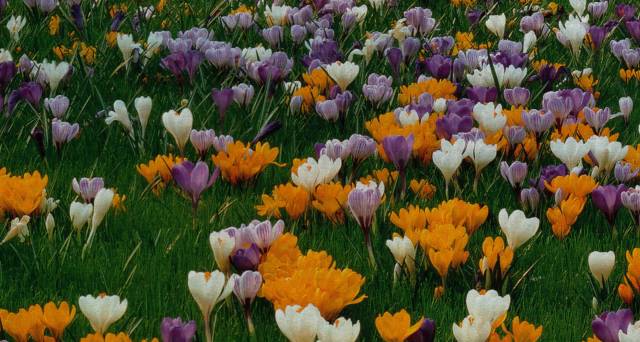
crocus carpetAt the Royal Botanical Gardens, Kew, in 1987, Reader’s Digest sponsored the planting of 1.6 million corms of cultivated Dutch crocus for their 50th anniversary. A further 750,000 corms of C. vernus ‘Jeanne d’Arc’ and C. vernus ‘Purpureus grandiflorus’ have been planted since – a visit to Kew to see this ‘Crocus Carpet’ is a must.

Sources and further information:

Wikipedia

The Alpine House – information

National Crocus collection – Wisley

A crocus planter

Crocus carpet at Kew

Saffron

Pacific Bulb Society

Old School Gardener

If you’ve enjoyed reading this post and others on this blog, why not comment and join others by signing up for automatic updates via email (see side bar, above right ) or through an RSS feed (see top of page)?

Finding Nature

Nature Connectedness Research Blog by Prof. Miles Richardson

Norfolk Green Care Network

Connecting People with Nature

Discover WordPress

A daily selection of the best content published on WordPress, collected for you by humans who love to read.

Susan Rushton

Celebrating gardens, photography and a creative life

Unlocking Landscapes

Writing, photography and more by Daniel Greenwood

Alphabet Ravine

Lydia Rae Bush Poetry

TIME GENTS

Australian Pub Project, Established 2013

Vanha Talo Suomi

The Journey from Finnish Rintamamiestalo to Arboretum & Gardens

Marigolds and Gin

Because even in chaos, there’s always gin and a good story …

Bits & Tidbits

RANDOM BITS & MORE TIDBITS

Rambling in the Garden

.....and nurturing my soul

The Interpretation Game

Cultural Heritage and the Digital Economy

pbmGarden

Sense of place, purpose, rejuvenation and joy

SISSINGHURST GARDEN

Notes from the Gardeners...

Deep Green Permaculture

Connecting People to Nature, Empowering People to Live Sustainably

BloominBootiful

A girl and her garden :)