Tag Archive: school


Red Cabbage seedlings on one of my 'seedy cills'

Red Cabbage seedlings on one of my ‘seedy cills’

Old School Garden

11th March 2013

To Walter Degrasse

Dear Walter,

As it’s a few weeks since I last wrote, and more importantly the weather today has put the block on any practical gardening outside, I thought I’d drop you a line and update you with what’s been happening in Old School Garden and further afield.

First, I was pleased to hear that your operation was successful and that you can now get back to lifting things – but make sure you do it safely next time!

Well, it’s been rather mixed few weeks, reflecting the March weather! today, just for the record we have the return of ‘The Beast from the East’ – average 30 mph winds and occasional snow  showers whcuin seem to have plunged us right back into winter. Quite a contrast to the weather last week when it reached 14 degrees C! (today there’s a wind chill which will make it feel like -4 degrees!- not that I plan to be out in it). The sort of day that reminds me of the comment one of the vergers at Winchester Cathedral made when he heard Deborah and I live in Norfolk:

‘So, there are about three strands of barbed wire between you and Siberia!’

Winter returns to the Old School Garden

Winter returns to the Old School Garden

We met him when we paid a visit to this great building at the end of February (you may have seen some of the photos of our trip south on this blog). One of the highlights of that trip was to Mottisfont Abbey where we had a lovely day in bright sunshine. This was perfect for exploring the gardens of this wonderful old estate, especially the relatively new Winter Garden (there is a gallery of pictures of this visit on the blog). The bright sunshine really set off the colours in the winter stems of Dogwoods, Snake Bark maples and Cyclamen flowers (and there were many drifts of snowdrops too).
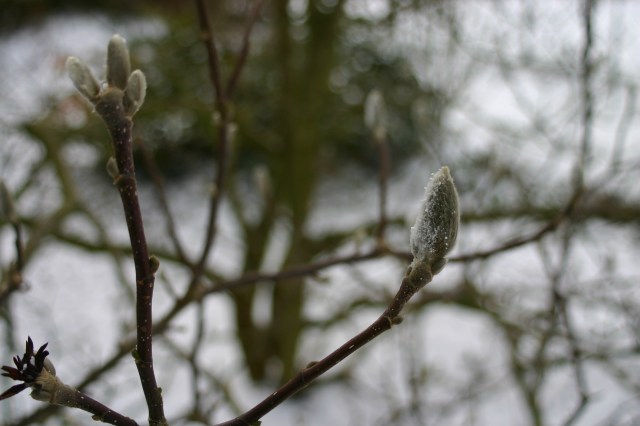
Magnolia flower buds -frosted once more

Magnolia flower buds -frosted once more

Closer to home, I’ve managed to make some progress in digging over one of the main mixed borders here, one that didn’t benefit from an autumn clear up. I guess I must be about two-thirds through this and have taken the opportunity to divide and move some perennials (including grasses), so hopefully we’ll have rather more balanced planting as a result. I hope – when weather permits – to get out and finish this, then I’ll feed the main shrubs (with Fish, Blood and Bone) and use my compost to mulch around them.

Talking of mulch, my friend Robert let me have another load of his excellent horse manure so I’ve spread about a tonne of that over most of the Kitchen Garden beds, fruit trees and bushes and roses (having first given them a little rose fertiliser). It really is lovely stuff, friable, and once raked over incorporates into the soil really well.

Apart from this it’s been a few weeks of getting seeds underway. You may recall that I’d started off a few things back in February, but I now think that may been a tad too early, as some of them are struggling to put on enough growth for me to pot them up. Still there’s time yet for having another go. I’ve now got two windowsills and the greenhouse going with seed trays (including a couple of heated propagators), so soon the house will be full of plants at various stages of development as I move them into progressively cooler conditions and larger pots prior to planting out once warmer times have arrived.

One of my 'seedy' window cills- veg and flowers underway

One of my ‘seedy’ window cills – veg and flowers underway

One indoor plant that is doing well is the Clivia I bought at the School Fair a few years ago. I must admit that I probably should have potted this on a few months ago, but this doesn’t seem to have held it back, as it’s just about to burst into flower (and we have last years stalk with a seed fruit on it for added colour!).

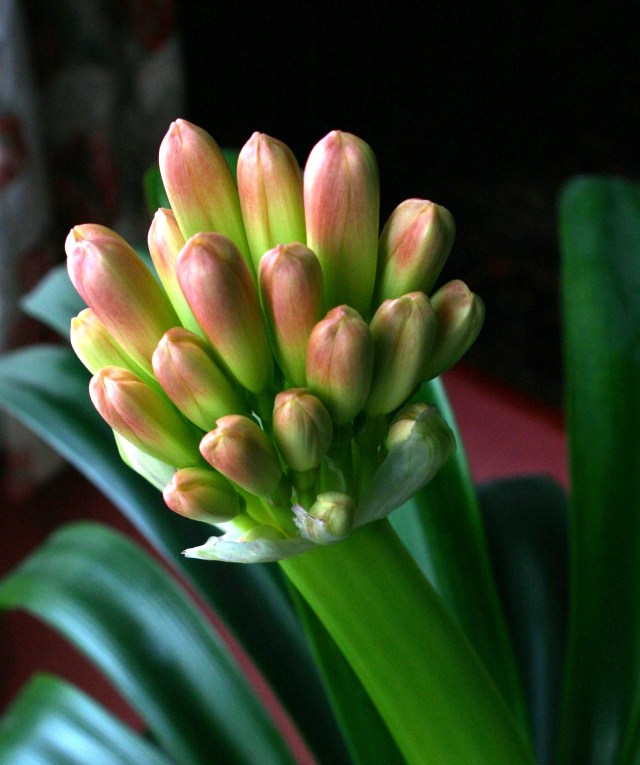
Clivia flower head ready to burst

Clivia flower head ready to burst

Clivia fruit - from last year's flower on the same plant

Clivia fruit – from last year’s flower on the same plant

I’ve returned to the gardens at Gressenhall Farm and Workhouse Museum (you remember I’ve been volunteering here for a couple of years?). The gardens overall seem to be in pretty good shape, but with Steve, a friend who also volunteers here, I’ve begun to clear, dig over and mulch borders in the areas we’re responsible for. I’m also pondering how to make some features of the ‘Curiosity Corner’ for young children a little more robust and secure. Perhaps not surprisingly small feet have wandered off the paths and into the beds so trampling down some plants). Steve has some spare trellis so I might try to put up a low screen of this to deter the kids and at the same time grow some dwarf Sweet Peas up it for fragrance and colour.

Youngsters at Cawston Primary School have been enjoying seed sowing

Youngsters at Cawston Primary School have been enjoying seed sowing

I’ve also begun my regular Thursday ssessions at the local Primary school. The School Garden there is now really taking off, with much more structured use to which I’m contributing. So far this has focused on what we do in the garden in spring, digging over the raised beds and talking about tools and tool safety etc. We’ve got some onion sets in as well as some Broad Beans, and potatoes are ‘chitting’ ready for planting straight after Easter. I also got hold of some more manure for these beds, which have rather poor soil, so our efforts at breaking this up and digging in the manure will hopefully be repaid later in the year. The children –  rotating groups from four of the six classes – have responded well and seem to be enjoying the sessions, though they are only about 30 minutes each. I’ll do a final introductory session on Thursday before we turn our attention to renovating the ‘Nectar Bar’ of insect – friendly plans I installed a few years ago, but which has suffered from lack of maintenance. Then, after the Easter break, I think we’ll be into planting potatoes and some of the seedlings the children have been sowing into paper pots (Broad Beans so far but Turnips and other crops to come, some directly into the ground).

Children have been learning how to prepare soil for seed sowing

Children have been learning how to prepare soil for seed sowing

Well, looks like coffee time, so I’ll put the kettle on, look out at the snow and try to make the best of the day ahead inside!

I’m currently researching climate change and gardening as this is a topic I expect to be writing a post about shortly. I have a few ideas about what we gardeners might do to cope with not only steadily increasing temperatures (and advancing seasons), but the increased unpredictability of the weather – flood to drought to snow blizzards in as many days! Or as one fellow blogger put it recently ‘Four seasons in a week’ !(we’re not quite up to 4 in a day as per the song).

I’ll be in touch again in a few weeks. In the meantime I hope that your recovery progresses well and that you’ll soon be out and about in your wonderful garden!

Very best wishes,

Old School Gardener

If you’ve enjoyed reading this post and others on this blog, why not comment and join others by signing up for automatic updates via email (see side bar, above right ) or through an RSS feed (see top of page)?

school gdn headerIn part one of this series of posts I outlined a few tips on getting your School Garden project up and running. If you’ve got the key people on board, identified what the overall aims and objectives of the project are and hopefully secured some start-up funding and promises of help, it’s time to get serious about the design of your Garden. Here are seven ideas to help you…

1. Who will be using your space and what are their needs? It’s important to think about the range of users and why they’ll want to use your garden. Yes, children, but what numbers and ages? During the school day or afterwards? Will parents or the wider community want to get involved? And just what sorts of activities will your garden need to support: growing food, outdoor play, studying nature, formal lessons (in some sort of shelter?) etc.? It’s important to list these and start to see what they suggest in terms of the overall layout of different areas, spaces, structures etc

2. Survey and appraise your site– you may have your area already defined by walls, fences, hedges etc. or perhaps you’re confined to an area of the playgrround. In any event it’s important to accurately measure out the plot. From these measurements you can create a scale drawing (say 1cm = 1 metre) and any key features that are likely to remain – e.g water taps; significant slopes; trees; hedges; types of soil (you can see if it needs improving and what the pH is by using a simple test kit); the way the site lies (in relation to sun, wind, prevailing rainfall etc.) and how the site is accessed. It’s also worth checking on the current maintenance regime and who’s responsible for this (e.g. if you’re thinking of taking over an area of sports field that is regularly mown).

A gathering place like this shelter is probably important

A gathering place like this shelter is probably important

3. Think about basic needs:

  • Sunlight- ideally you’ll have a space which is open to sun at most times of the day, but use your survey information to identify the sunniest and shadiest spots and start to think about what to place in these
  • Shelter – from strong, cold winds and midday sun – look at boundaries and think about growing hedges , using fences (ideally with gaps to allow slowed wind to pass through) or putting in wind breaks of mesh material. Do you need some trees or an awning to provide a sun shade?
  • Water – either from a tap or through adequate outdoor harvesting of rainwater from sheds, glasshouses, or possibly school buildings
  • Pathways –  to get around the various areas. These need to be wide enough and of a surface and gradient that a wheelchair – user can negotiate without too much effort
  • Good soil – if you’re removing asphalt, the soil underneath is likely to need radical improvement or possibly overlain with imported topsoil. In most situations you’ll need to get organic matter – compost, manure, leafmould– to improve it over time
  • Fencing or another suitable boundary – to keep younger children in and intruders out . You could grow a hedge and whilst this gets established, on one side try a chain link or similar fence which in due course can be removed leaving you the wonderful sight and wildlife value of the hedge
  • Plants– what are you intending to grow? Each type will have different needs – are you envisaging growing under glass/polythene, if so space for a glasshouse/polytunnel will be needed. Do you envisage some sort of wildlife pond, if so this will need a suitable range of plants and may need a secure boundary
  • A gathering area – where groups/classes can be instructed or shown a task. This can be outside and informal (e.g. getting an annual supply of straw bales is a good cheap way of providing seating)  or enclosed within a shelter
  • Storage– a good tool shed, which if large enough can possibly double up for seed sowing/potting up, or alternatively a separate shelter/structure for this if that’s something you envisage doing in your garden
  • Tools and equipment – these will vary according to what you are growing and the size of your plot (and your children), but here’s a guide. Tools:  gloves– enough for everyone who’s gardening at any one time; trowels and hand forks or hand cultivators (enough for half a full class – say 15) ; a mix of adult and child – sized spades, digging/border forks, rakes, hoes (3 or 4 of each); wheelbarrows (probably at least 3); Secateurs, loppers, pruning saws, brooms (1 or 2 of each); watering cans – a couple should do, you can make home made ‘plant showers’ out of plastic tubs with holes in the bottom. Equipment: clipboards (one each for a full class); stationery supplies – paper, pencils, crayons, markers, glue, string, tape, scissors and a First Aid Kit! Also, if you plan to sow and grow your own plants you’ll need a range of other equipment like seed trays etc.
Get some child -sized tools

Get some child -sized tools

4. Get the children involved (and your wider support group) – you will by now have a good idea about what could be in the garden and you need to share these ideas and discuss others with the children who’ll be using the space and those key adults (teachers, parents etc.) who will also want to feel the project is theirs. You can devise some fun ways of engaging these people, perhaps involving n a loose outline drawing of the plot and your first ideas in pictorial form (e.g photos cut out from magazines), from where children can be asked to draw/write/otherwise think about and convey their ideas and wants for their garden (I can guarantee someone will want a swimming pool!). This will generate interest and ownership of the project.

Raised beds, narrow enough to allow access to the centre without walking on the soil

Raised beds, narrow enough to allow access to the centre without walking on the soil


5. Options for planting –  depending on what you want to grow and the space you have available I guess you’ll either be planting in containers (pots, planters and all sorts of quirky planters too), open beds (which have their edges cut into the surrounding ground, often grass) or raised beds– these are edged with boards or other timber and so help to define the growing areas (especially for food crops). If the sides are about 20cms high they can be used to contain additions of manure/compost from year to year as you build up the soil’s goodness and structure. Raised beds can be to varying heights to cater for different ages of children, but ideally they need to be narrow enough to be tilled from the surrounding pathways so that feet don’t trample and compress the growing areas.  Rectangular beds are probably the most efficient shape. These beds can be constructed using pressure – treated timber or alternatively there are several places where ‘ready to assemble’ kits can be purchased. If you want to avoid too much digging of the soil (this can be detrimental to its structure) you can just lay a covering of organic material over the beds each year (taking note of the requirements of different groups of plant if growing food) and lightly fork this top-dressing in as you begin the growing season.

How about a plastic bottle greenhouse?

How about a plastic bottle greenhouse?

6. Go beyond basic needs– it’s important to focus on basic needs in developing your designs, but if we just stick to the functional requirements, we will miss an important opportunity to make the School Garden exciting, fun and an experience for all the senses!  So, think about growing herbs and other plants which have differing fragrances, leaf textures, colours and are in other ways interesting – tall grasses that catch the sunlight and bend in the wind for example, or Stachys (‘Lambs’ Ears’), which has wonderful velvety leaves, Lavender for that midsummer heady smell! Likewise Sunflowers are a wonderful example of the power of nature as they shoot up to enormous heights and beauty starting from little seeds that the children can sow themselves. Similarly, children can get involved in producing signs for different parts of the garden, another way to make them feel that this is their garden and make it look funky too!

A simple scale model heps to convey your design

A simple scale model helps to convey your design

7. Consult on an outline plan – once you’ve taken all of the above into account you can firm up your plans on paper and maybe even produce a simple 3D cardboard/ scrap model of how your garden could look! Models are especially useful for getting children (and adults) to imagine just what features there are and what the layout will look like.  This could go on display at the School for a week or two and you can invite people to put their views on sticky notes nearby so that everyone can see who’s saying what. Gather these up and then  with your committee/support team work out those which should be incorporated into the scheme.

By the end of this process you should have a clear, accurate design plan on paper that everyone is signed up to and which is ready to rock!

In Part 3 of this series I’ll share some thoughts on constructing your School Garden and especially the day you ‘ground break’.

Sources & Further information:

How to grow a School Garden’ – Arden Bucklin-Spooner and Rachel Kathleen Pringle, Timber Press Books

School Gardening Club- ideas

Budding Gardeners- lots of advice and info

Garden planner tool

Planning your school garden

Food & Agriculture Organisation School Garden Planner

California School Garden Network Guide to School Gardening

School Gardening Wizard

Old School Gardener

If you’ve enjoyed reading this post and others on this blog, why not comment and join others by signing up for automatic updates via email (see side bar, above right ) or through an RSS feed (see top of page)?

sowing seeds The case for gardening in schools has perhaps never been stronger – it encourages exercise and healthy eating and helps to ensure that children ‘reconnect with nature’ – as discussed in the initial post on school gardening.

Today, in the first of a series of posts on the practical steps to creating a successful School Garden, I’m looking at how to get your project up and running.

Where do you start? How do you build up the momentum that’ll be needed to turn your dreams into  reality? How can you get the resources you need to get it off the ground? Here are 7 steps to help get your school gardening project off the starting blocks.

1. Do your homework- check out the internet for advice and ideas about school garden learning and explore other school gardens in your area. This research will help you to firm up your ideas and think about how you might present them. Talk to those involved in the school gardens you visit – their advice and experience is priceless. And they might even offer to help you get started!

2. Make the Case – so how do you get the key people on your side? If you’re a volunteer, float your idea with one or more teachers who you think might be sympathetic and explore the idea a bit further (if you’re a teacher speak with your colleagues and sound out some parents). Once you’ve firmed up your initial thoughts, it’s time to get the Head teacher on board. You need to have a clear outline of what the project is going to achieve and how it could benefit the school’s approach to learning in general (including curriculum links if possible) and ‘learning outside the classroom’ in particular – so think ‘outdoor classroom’ and use this key phrase in your plans. Your outline should ideally include a suggested location for the garden, rough design,timescale and how the garden will be established and looked after. It might also be an idea to say how you think progress will be monitored and reported. If you are able to convice a number of teachers, governors, parents and friends of the School, so much the better.

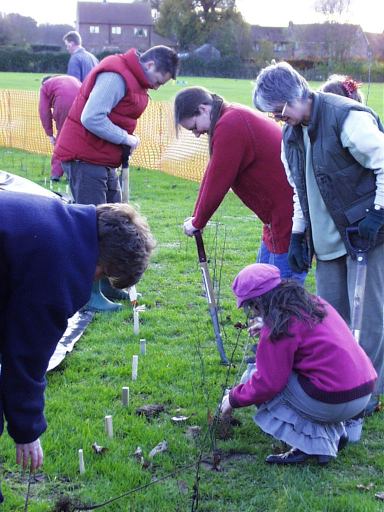
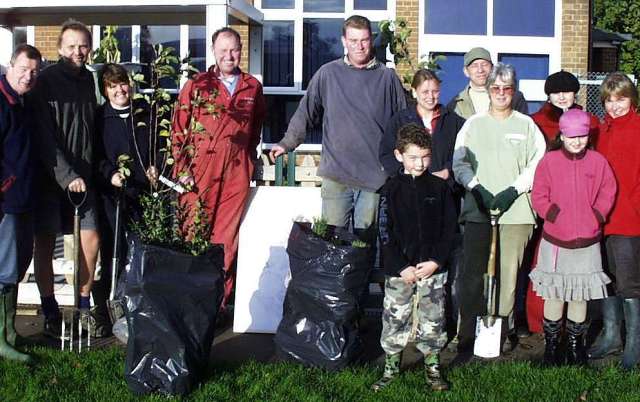
Hedge planting- put some natural boundaries around your garden with community effort!

Hedge planting- put some natural boundaries around your garden with community effort!

3. Build a team – you  will not create the garden alone, even less ensure its effective ongoing use. You need to build a team around the project which can do the many things needed. A committee/ steering group/ project team of some sort needs to be set up and at this stage. It will be important to get all the key interests in the project involved; later on your committee structure might be slimmed down as individual roles start to pan out and inevitably some people lose interest. So who should you target? Keep an eye out for parents who can bring particular skills, assets (mini diggers!) or contacts to the project  – these might be builders, gardeners, landscapers, forestry workers, publicists or funding bid writers and so on. Establishing a broad and varied support base at this stage will set the project on a positive course. Hold formal meetings to develop your project but also use the web to communicate. Don’t forget to ask the Head, teachers and governors to be on the committee – their involvement at this stage is important, but may reduce once the project is flying!

4. Think ahead – as the project develops it will become clear what the real goals will be and the main lines of action you’ll need to take to achieve these. Being clear, concise and friendly will help to communicate the project effectively. At the same time, be patient – it’s natural to want to launch right into construction works, but it will take time for your project to evolve and the learning opportunities to be firmed up, which will in turn have a bearing on your design, layout, routine etc. So it’s important to have detailed discussions with the teachers who will make use of their ‘outdoor classroom’. This discussion may take anything from a few months to a year.

picture- RHS

picture- RHS

5. ‘Quick wins’ to promote your cause – whilst it will take time to clarify your overall objectives and start to firm up your design, you can keep up the momentum and start to generate wider interest. Plan activities which will test out some ideas and generate interest ; e.g. can you start to grow things in containers around the school and get children involved in cultivating flowers or food in these? A little project starting with seed sowing in the classroom and eventually seeing mature plants placed outside will demonstrate what can be achieved and get the children on board.

6. Check possible barriers to progress and get permissions – check out whether your outline design has implications for the school’s utilities or the way it operates,  and if you need them get permissions in principle before going much further with your design work. For example, a reliable source of water nearby is an important if not vital consideration – will this be possible from existing outside taps/ rainwater harvesting or do you need to get another connection installed? Will this be acceptable to the school?

7. Secure the start-up resources – once you have a clear, albeit outline, view of your project and the design of the garden, it’s time to firm up what resources you’ll need to get the project established and get commitments for these. Some of these can be ‘promises’ of help from well skilled/equipped parents or friends of the school. But you’ll probably need some start up cash – to purchase materials, tools, seed etc.  Sources internal to the school can be approached – the school budget if possible, but more likely a Parents/ Friends Association. Then you can explore outside sources including local charities as well as national programmes like the Big Lottery.

Once you have a strong team around you, a clear plan with the start up resources you need and a growing awareness and support from the school and wider community, it’s time to get serious! In the next post on School Gardening I share some tips about planning and designing your new space for growing children!

Source: ‘How to grow a School Garden- a Complete Guide for Parents and Teachers’- Arden Bucklin-Sporer and Rachel Kathleen Pringle, Timber Press Books 2010

Useful websites:

Garden Organic support for Schools

RHS Campaign for School Gardening

RHS young gardener of the year 2013

Learning outside the classroom- manifesto

Learning through landscapes

Setting up and running a school garden- UN Food and Agriculture organisation

Morrisons ‘Let’s Grow’

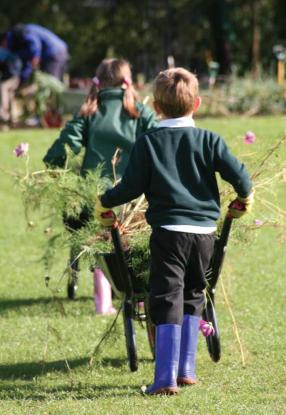
Cawston Primary School Garden following work by a 'Garden Gang' event last Saturday

Cawston Primary School Garden following work by a ‘Garden Gang’ event last Saturday

Old School Gardener

If you’ve enjoyed reading this post and others on this blog, why not comment and also join some other people and sign up for automatic updates via email (see side bar, above right ) or through an RSS feed (see top of page)?

child with wheellbarrowAcross the developed world there is concern about a growing ‘disconnect’ between children and the natural world around them – increased time spent indoors, less time out playing – the scenario is well reported. School gardening projects are an important way to reconnect children with nature.

School gardening, like ‘growing your own’ seems to be on the increase in the UK as we look for ways of bridging the ‘ecological disconnect’, saving money, reducing ‘food miles’, improving food quality and strengthening local economies. There’s powerful evidence that school gardening is one, convenient and effective way of ‘learning outside the classroom’. A way of helping to engage children with the natural world and to deal effectively with some other important issues at the same time by:

  • raising academic achievement
  • promoting healthy eating
  • instilling a sense of responsibility for the world around us
  • encouraging social and community development and a ‘sense of place’
  • providing a place for unstructured, imaginative play

In Norfolk, England, the voluntary group of Mastergardeners is playing its part in supporting around 20 schools and many others are waiting to connect with a suitably trained volunteer in their area to develop new school gardening initiatives.

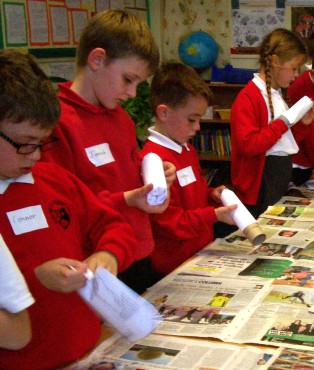
I’ve been helping a primary school to develop its school garden, which now has several raised planting beds (one for each class) and a recently completed wildlife pond with dipping platform and boggy planting areas. I tried to engage the children in growing food with a short session about the food they like to eat and where it comes from, why growing our own is important and the different types of fruit and veg we could grow. We ended up with each child making their own paper pot and sowing a broad bean seed – these were later transferred by the children to the school garden and formed a wonderful source of ‘free sweets’ during the summer!

making paper pots - an easy way to get children involved in 'growing their own'

Making paper pots – an easy way to get children involved in ‘growing their own’

The whole community– governors, staff, parents, children, local businesses together with ‘shopping voucher’ and grant schemes have played their part in creating this valuable resource. The new gardening year is about to kick off with a ‘Garden Gang’ (parents, children, staff and friends of the school) session on Saturday to get the beds ready, complete the greenhouse (made out of canes and plastic bottles) and plant some new apple trees.

Other Mastergardeners are playing their parts around the County. This includes several new and more established gardens at secondary and primary schools and a novel ‘inter – generational’ project in Norwich, where some spare ground behind a library has been turned into a food growing plot by children from a local school, library staff and older people from a sheltered housing scheme overlooking the site.

One secondary school gardening coordinator recently wanted to introduce children to the ideas of ‘veg families‘ and crop rotation. She printed out 56 small veg pictures and separate names – the first task was for the students to ID the veg. Then they looked at veg families (with the students placing  the different vegetables into different groups ) –  then they used their computers to create their own set of ‘Veg family prints’. Finally, they looked at crop rotation and by the end of the session they had come up with a basic 4 bed rotation over 4 years, along with a write-up explaining about why we rotate crops yearly.

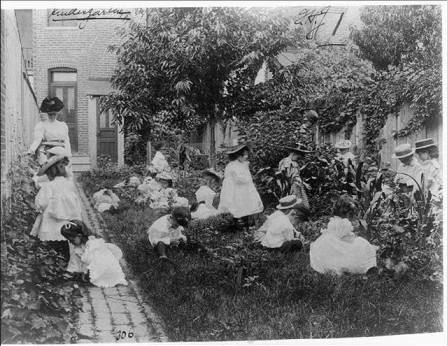
school gardening a century ago- birth of the 'kindergarten'

School gardening a century ago- birth of the ‘kindergarten’

School gardening has been around a long time – originally developing as part of the formal school curriculum at a time when many more households grew their own food. There were war – time efforts to boost food production at schools and the ‘Kindergarten’ movement saw playing and being creative in an outdoor setting as the heart of nursery education.

school gardening in wartime- US style

School gardening in war time- US style

Recently in the UK the Food Growing in Schools Taskforce, led by Garden Organic was established as a response to increasing concerns about the health and well-being of children and young people, and a confidence that food growing in schools is a successful way of dealing with these concerns, delivering many benefits. The Taskforce is made up of people representing a diverse set of interests, but all with a strong belief that food growing in schools is an important activity. You can read their findings here.

Getting the whole community involved in the school garden

Getting the whole community involved in the school garden

Over the coming weeks I plan to post a series of articles about how to go about setting up and developing a school garden, so if you have any experiences or ideas to share I’d love to hear from you!

Old School Gardener

If you’ve enjoyed reading this post and others on this blog, why not comment and also join some other people and sign up for automatic updates via email (see side bar, above right ) or through an RSS feed (see top of page)?

Finding Nature

Nature Connectedness Research Blog by Prof. Miles Richardson

Norfolk Green Care Network

Connecting People with Nature

Discover WordPress

A daily selection of the best content published on WordPress, collected for you by humans who love to read.

Susan Rushton

Celebrating gardens, photography and a creative life

Unlocking Landscapes

Writing, photography and more by Daniel Greenwood

Alphabet Ravine

Lydia Rae Bush Poetry

TIME GENTS

Australian Pub Project, Established 2013

Vanha Talo Suomi

The Journey from Finnish Rintamamiestalo to Arboretum & Gardens

Marigolds and Gin

Because even in chaos, there’s always gin and a good story …

Bits & Tidbits

RANDOM BITS & MORE TIDBITS

Rambling in the Garden

.....and nurturing my soul

The Interpretation Game

Cultural Heritage and the Digital Economy

pbmGarden

Sense of place, purpose, rejuvenation and joy

SISSINGHURST GARDEN

Notes from the Gardeners...

Deep Green Permaculture

Connecting People to Nature, Empowering People to Live Sustainably

BloominBootiful

A girl and her garden :)