You may recall I mentioned trying to convert an old wooden bicycle rack into a plant theatre. These are traditionally structures where small specimen plants are put on display- usually in old terracotta pots. Auriculas and Pelargoniums are some of the plants often used. Here’s an example of an Auricula Theatre recently shown at an RHS show.
Auricula Theatre at an RHS show
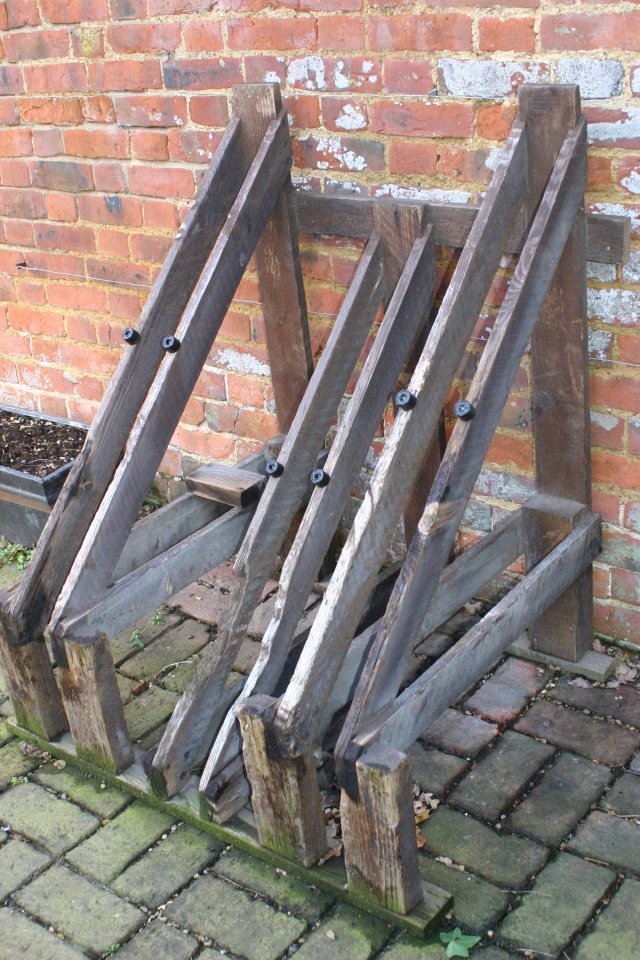
To avoid losing the interesting foliage effects (or ‘bloom’) on some varieties of Auricula, its advisable for the plants to have some overhead protection from the rain. Having recently completed an Alpine planter for the Courtyard here at the Old School Garden (which is now looking splendid- I’ll put some pictures in my next ‘Dear Walter’ letter), I thought this would add another interesting feature. Here’s what the bicycle rack looked like before I got to work on it.
The old Bike Rack before it’s makeover
It is a relic of the local School at Cawston and must be a good 50- 60 years old. Having reorganised our sheds and so no longer in need of a rack for our bikes, it seemed a good opportunity to recycle something with local historical links. Having measured up and done a rough design, I bought a few planks of pressure-treated gravel boards from a local timber merchant and set to work; measuring out the spacing of the ‘shelves’ that would sit on the angled frame, cutting the notches in this to receive the shelves and screwing them home. Having some black wood stain left over from the alpine planter I used this to give the whole thing a unifying finish that would tie it into the courtyard. Here’s the final result, before and after painting, with the six shelves awaiting the addition of plants.
This slideshow requires JavaScript.
As I have some pelargoniums in pots I think this is what I’ll use the planter for this year, though I’ll need to purchase a few more interesting varieties and source some old 3″ or 4″ pots. Next year I might do a spring display of Primulas (including Auriculas) as well as something for the summer months. I might have to think about an overhead canopy of some sort to protect the Auriculas from rain (maybe some sort of movable ‘pram hood’ that can be pulled over from back to front?)
Once the new planter is planted up I’ll show you how it turns out!
As trees tend to be the largest and longest lived plants in the garden, they should be one of, if not THE first item to consider when designing or redesigning your garden.They rank alongside some of the hard landscaping elements (seats, arches, pergolas, arbours etc.) in helping to provide the ‘bones’ or structural framework of a garden i.e. the structure by which we navigate ourselves around the plot both visually and in terms of guiding our movement. Shrubs (especially evergreens), provide a similar service and should be thought about in conjunction with whether, where and what sorts of trees to include in a design or redesign.
Trees also offer a range of other potential sources of interest in a garden apart from their overall shape or form; leaf size shape and colour (which may vary from season to season), bark (colour, texture or special effects such as peeling or patterned), flowers and fruit (catkins, conkers, apples and so on).
In visual terms the planting of a tree or trees can have a dramatic effect on the layout (or form) and perspectives around the garden. They can be used as a focal point to draw the eye. This includes those planted as a ‘specimen’. Those planted in the foreground or middle distance help to increase the sense of depth or perspective in a garden, while those planted further away help to give a sense of scale to the overall space. So, in a small garden a large tree in the foreground and a small tree at the end will make the garden seem longer.
Leaf size and texture is another important consideration. If you want a strong shape to provide a key structural element all year round in the garden, then go for small leaved, evergreen varieties with distinctive shapes or which can be pruned (topiarised) into these- e.g. Box.
Horse Chestnut flower about to burst
Why not take a look at your garden and ask if you have one or more trees that aren’t in the right place- are they are too tall, too broad, drying out the soil or causing shade where you don’t want it? Perhaps removal or pruning is the answer. Could you introduce a tree or two and help to strengthen what your garden has to offer- providing food or a home for birds, for example or adding a brilliant show of flowers or autumn leaf colour?
Traditionally we seem to have used trees in gardens as stand alone ‘specimens’, often in an island in the middle of a lawn for example. Today, with the wide range of trees available and with characteristics that suit almost any situation, its possible to be a bit freer with how we use them- in groups or among other planting in borders.
If you are using a tree as a specimen think about its positioning carefully- if it’s planted by itself without any surrounding planting to soften its impact, it will be a focal point from the start, and as it grows bigger this impact will become even more pronounced.
If planting several trees together,including adding one or two to an existing group, think about their ultimate height and spread. As in nature, some trees grow well together; eg. Betula pendula, or ‘Silver Birch’- see my recent article in the A-Z of Trees series. The wild cherry (Prunus avium), is another example. So as with any other tree planting think carefully about their ultimate height and spread and allow room for them to grow. If you want to give a denser appearance in the time it takes the trees to mature, try growing them closer together, but expect to remove some as they mature to allow the remaining ones to grow to full size.
When planting more than one tree together in an area of grass, the relationship of one to another will determine the effect and this can change depending on where you are in the garden. A good idea is to use large posts or bamboo canes to mark their positions. Try out different positions to see what effect you like the best. Look at the positioning from different places, including from inside the house. and remember to think about their ultimate height and width and what they might obscure or hide.
Chracterisitcs of the White Fir
We tend to think short term when it comes to gardens- we want immediate impact or effect.
The danger here is that you’ll end up with something that outgrows its space and gives you problems- a classic example is the Monkey Puzzle tree (Araucaria araucana) that was planted in the front garden of a Victorian terrace house or villa and is now way too large and tottering precariously above and perhaps towards the house! So the speed of growth is also a consideration; very slow growing trees may take 30 years to have a significant impact, so if you want an impact over a shorter period than this, then that’s perhaps a good choice.
If you have a relatively small garden, don’t think that you can’t have any trees. Smaller varieities of many different types are often available, and by choosing trees that have a more conical or upward habit you can achieve an impact without having a major loss of garden space .
Planting trees too near to buildings is another common problem. Some have relatively compact root systems ; e.g. Birch (Betula), Sorbus, Hornbeam and Magnolia are good examples and rarely cause problems. However trees like Willow will seek out water and their roots are liable to invade drains if planted close by.
If an existing tree is of concern seek the advice of a qualified tree surgeon. and if you think a tree may be subject to a Tree Preservation Order, make sure you consult your local authority before doing anything to affect it. And always consider your neighbours- trees planted close to boundaries may look good from your side of the fence, but think about what impact the tree is going to have on your neighbour’s garden and house. The inconsiderate planting of hedges of Leylandii conifers is the most familiar example of the wrong species being chosen to achieve rapid but usually unattractive results. Left to its own device this tree will grow to well over 100′ high and it looks superb, so don’t expect it to enjoy continually being hacked back!
The finished ‘WoodblocX’ planter- soon to be home to an alpine collection
You may recall that two wooden planters in the courtyard here at Old School Garden, recently ‘bit the dust’. Not using pressure treated timber when I made these a few years ago was certainly a mistake. I was wondering what to do to replace them and a few weeks ago was approached by a Scottish company called WoodblocX to do a trial of their products- they make a range of raised planters, beds and ground support systems using an interlinking set of wooden bricks (or ‘blocX’).
Having looked at their comprehensive website, I decided to go for a raised planter (1350mm long by 450mm wide and 450mm high), and I’m hoping to use this both to replace the old planters and create a new feature – an alpine bed. This should be at the right height to be viewed from the nearby metal table and chairs in the courtyard and if suitably finished off will tie in nicely to the predominantly black and terracotta colouring of the many other planters and pots in this sheltered, sun trap setting.
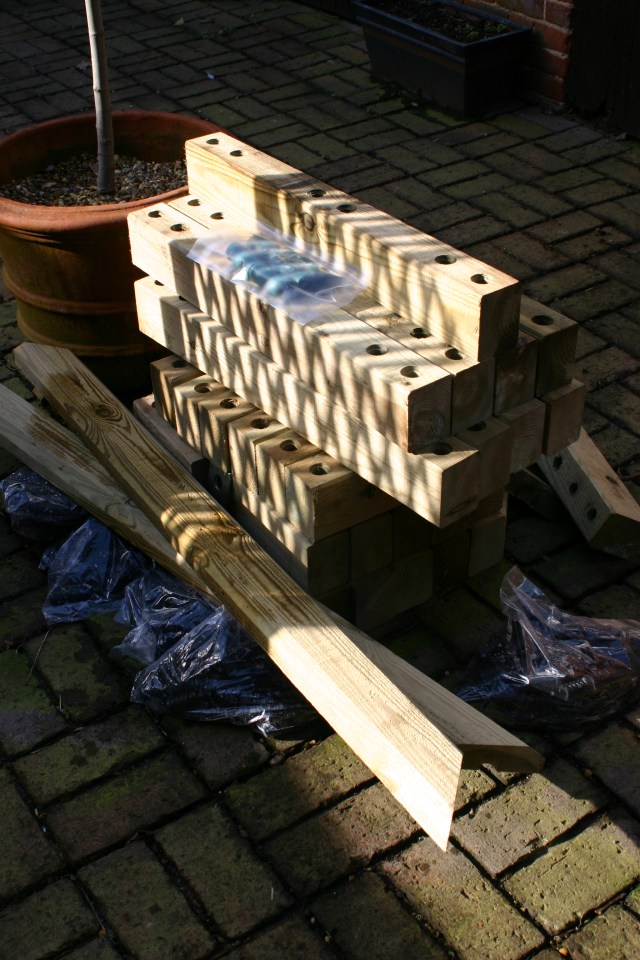
Well, the planter was successfully delivered within a few days of ordering. Last week (having given the courtyard surfacing its yearly clean), I set about constructing it.
In with the new- my new ‘Woodblockx’ planter awaiting construction
There was a pack of various leaflets and other material supplied with the pallet-load of parts and having checked these off against the list supplied, I wound myself through this material. Though comprehensive, the fact that there were bits of advice and information spread across more than one document initially threw me and I didn’t find any instructions specifically about how my planter should be built or look.
So I spent a few minutes working back from the diagram on the company website to see how each layer of the planter should be built up. I also began knocking in the various plastic dowels and wedges (which join each layer of ‘blocX’ together) to what I hoped was the correct configuration. Then I discovered that these didn’t match up to the next layer’s holes, as the next layer of blocX has to be laid like a brick course with no joints overlapping each other, so not all of the holes correlate. Still no problem, as I guessed that a couple of spare blocX had been sent and, as I discovered later, it is easy to just saw off the tops af any dowels that are in the wrong place! (there was also a good supply of plastic dowels sent so I could afford to waste a couple).
Two layers in place, the planter starts to take shape
On the way- the first two layers completed
I decided to take another look at the literature I’d been sent and then – to my embarrassment – discovered a set of instruction diagrams for my planter showing which sized blocX should go where and which holes should have the dowels in! Though I hadn’t worked out the layout to exactly match that shown in these diagrams, I thought mine would work too, so I pressed on with the second and subsequent layers. Hammering in the dowels and then pushing home the next layer of blocX on top was very satisfying and I proceeded layer upon layer, to see my planter taking solid form before my eyes!
Using a rubber mallet, and green plastic tubing to hammer home the black plastic dowels was a doddle
After the fourth and final layer of blocX then came the simple, but attractive capping, which really finished of the planter very tidily. This is knocked onto another set of dowels as well as four metal corner brackets which help the planter to hold its shape. The whole construction time- allowing for my careless beginning– took around an hour, was simple and good fun, giving ‘instant results’.
These planters can be used in open ground (they come with two long metal spikes which help anchor it into the ground), but in my situation, sat on clay paviours, the weight of the planter (especially once full of earth) will be sufficient to hold it in place. As advised by the Company I could have also fixed it in place with some angle brackets. I will add an inner lining of landscaping fabric to help protect the wood (though it is all pressure treated) and to avoid soil seeping out from underneath.
Though the rough-planed finish of the WoodblocX is attractive enough from a distance, I think I may sand it down a little and apply either some black wood stain or similar treatment to tie it into the rest of the courtyard planters. I’ll do a further article to show the finished item, planted up.
This slideshow requires JavaScript.
So, what do I think of WoodblocX?
The planter is very solid and I think will last a long time- especially with the extra treatment I’m planning to give it. The solid construction does not look out of place in the ornamental setting of my courtyard and would also look smart in a more ‘kitchen garden’ context too. I should imagine that the construction system using the plastic dowels would be very effective in a ground retaining role too. The modular nature of the system opens up all sorts of design possibilities if you’re considering a multi/split level garden.
As someone who’s a bit of a DIYer (especially using reclaimed timber), I guess that I could have created a similar sort of planter for a fraction of the cost (the planter that I have would cost just under £200, including delivery). I doubt whether it would look as attractive or be as solid and long lasting though. So, if you’re after a smart look and solid construction, your time is limited or your skill level relatively low, WoodblocX offers an ideal ‘self assembly’ solution to your planter/walling needs. I have a friend who’s considering the system for edging a patio that’s surrounded by sloping ground, and I can imagine him setting this up relatively easily and so avoiding the need to engage a tradesman to install a (probably) more expensive brick or similar retaining wall. The company also offers telephone advice and support during your ‘build’ in case of queries (I didn’t take advantage of this).
So, all in all, I’m pleased with the result and enjoyed the construction process, though perhaps a ‘less is more’ approach to the literature the Company sends out would make the construction a little less daunting at the start. If you’d like to find out more, click on the link on the right hand side to go to the WoodblocX website.
Zantedeschia is a genus of about 8 tuberous or rhizomatous perennials, found in swamps or moist soils at the margins of lakes in southern and eastern Africa. The name of the genus was given as a tribute to Italian botanist Giovanni Zantedeschi (1773–1846) by the German botanist Kurt Sprengel (1766–1833).
Zantedeschia fall into two main types:
hardier outdoor forms (Z. aethiopica and Z. pentlandii ), often called arum lilies, with striking white flowers (these are in fact ‘spathes’ – a coloured bract or leaf- wrapped round a thin, creamy yellow column, or spadice); and
the more tender hybrid forms, typically with white-spotted leaves and pretty yellow, orange, pink or dark purple spathes (Z. elliottiana and Z. rehmannii hybrids), which are borne in spring or summer. Z. elliottiana have broadly, heart shaped leaves, most with a covering of translucent white dots and usually yellow spathes, whereas Z. rehmannii have mid to dark green, lance – shaped leaves, rarely spotted, with white to pink or dark purple spathes. These are often called calla lilies.
However, Zantedeschia is neither a true lily (Liliaceae) nor an Arum or a Calla!
It has often been used in paintings, and is visible in many of Diego Rivera’s works of art (see The Flower Vendor, amongst others). It was a favourite subject of the painter Georgia O’Keefe.
Zantedeschia aethiopica
Z. aethiopica is the most common form in British gardens, grown as a marginal aquatic plant. This is a wonderful architectural plant for pond margins in areas that do not suffer from very hard frosts. The leaves alone are an attraction. They are large, 40cm (16in) long, and arrow-shaped, and a bright, glossy green with distinct veins. However, arum lilies are mainly popular for their serene, white flowers.They make superb, classy cut flowers.
Grow the arum lily as a water plant, planting it into a special aquatic basket, in water up to 30cm (12in) deep. Or you can plant it into moist soil around the pond, protecting it with a deep mulch over winter. The Royal Horticultural Society have given it their prestigious Award of Garden Merit.
In frost – prone areas they should be covered with a deep winter mulch. Where temperatures fall below 10 celsius more tender arums can be grown in a warm greenhouse or as houseplants, or can be planted out in summer in a sunny site. Zantedeschia can be propagated by seed or division (divide in spring).
Zantedeschia elliottiana
Z. elliottiana close up
For early flowering plants at Easter, plant the rhizomes in December. Keep in a light, cool place at a temperature of 16°C (61°F) by night and 18°C (65°F) during the day. Feed fortnightly with a high-nitrogen fertiliser when in active growth but withhold feed during flowering. A high potassium feed such as a tomato fertiliser can be given once a week after flowering.
Both types of Zantedeschia can be grown in containers. When planting, use a loam-based compost such as John Innes No. 2 and plant the rhizomes (underground stems) just showing at the surface of a container with the eyes of the rhizome uppermost.
Z. albomaculata by Forest and Kim Starr
Z. ‘Neon Amour’ by Stan Shrebs
Water freely through the summer and feed with a balanced liquid fertiliser every two weeks until the flowers have faded. Zantedeschia are generally pest and disease free, but can suffer from winter cold unless protected.
Zantedeschia species are poisonous due to the presence of calcium oxalate. All parts of the plant are poisonous, typically producing local irritation or a burning sensation in the mouth and occasionally vomiting and diarrhoea. However leaves are sometimes cooked and eaten.
This concludes my series ‘A-Z of Perennials’, started last year. I hope you’ve enjoyed it and will also like my new series- ‘A-Z of Garden Trees’, coming soon!
Bio-Based Solar Panels That Could Run On Dirt And Plants
‘An inspiring design aims to get rid of the expensive and toxic materials used to make solar panels today, and replace it with something a lot more natural.
What if solar panels could be dirt, plants, and batteries rather than the expensive and often toxic chemicals and heavy metals used today?
That’s the aim of this ambitious design from architecture students at a Spanish university. It uses bacteria in soil to make mini fuel cells to power devices. Plants growing in the soil keep the bacteria alive as a product of photosynthesis, and water keeps everything running. The whole structure could be simple to build….’














 Old School Garden