Tag Archive: plants


PicPost: Hanging baskets are so boring...

Pena PalaceThe Pena National Palace (Palácio Nacional da Pena) is a Romanticist palace in Sintra, Portugal. The palace stands on the top of a hill above the town of Sintra, and on a clear day it can be easily seen from Lisbon. It is a national monument and constitutes one of the major expressions of 19th century Romanticism in the world. The palace is a UNESCO World Heritage Site and one of the ‘Seven Wonders of Portugal’.

Pena Palace Park is a vast forested area completely surrounding the Pena Palace, spreading for over 200 hectares of uneven terrain. The park was created at the same time as the palace by King Ferdinand II, who was assisted in the task by the Baron von Eschwege and the Baron von Kessler. The exotic taste of the Romanticism was applied to the park as it was to the palace. The king ordered trees from diverse, distant lands to be planted there. Those included North American Sequoia, Lawson’s cypress, Magnolia, and Western Red Cedar, Chinese Ginkgo, Japanese Cryptomeria  and a wide variety of ferns and tree ferns from Australia and New Zealand, concentrated in the Queen’s Fern Garden (Feteira da Rainha). The park has a labyrinthine system of paths and narrow roads, connecting the palace to the many points of interest throughout the park, as well as to its two gated exits.

Source: Wikipedia

PicPost: Great Garden @ Barnsdale

Barnsdale Gardens in Rutland, England were made famous by Geoff Hamilton through the BBC television series Gardeners’ World which he presented from 1979 until his death in 1996. With 38 gardens in it’s eight acre site, the gardens have been described as a ‘theme park for gardeners’. Not only do they provide a host of ideas for smaller scale gardens, but they are a delight to experience.

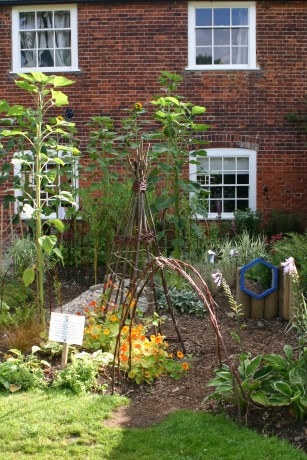
Sunflowers were planted by a local playgroup at the May opening of the garden - with the wet summer they grew to over 2.5 metres tall!

Sunflowers were planted by a local playgroup at the May opening of the garden – with the wet summer they grew to over 2.5 metres tall!

A renovated garden is moving towards maturity in what were once exercise yards for tramps and unmarried mothers at Gressenhall Farm and Workhouse Museum, Norfolk.

The garden occupies what were once two exercise/work yards for inmates of the Victorian Workhouse. The footings of what was once the dividing wall between these two yards can still be seen, emerging as the lawn above is worn away.  In Victorian times these yards joined two blocks of accommodation:

  • for so-called  ‘casuals’ or tramps who used to travel between workhouses earning ‘a night’s board for 2 days hard labour’ – possibly crushing stones for use in road building
  • for unmarried mothers nursing their babies – they wore distinctive uniforms to mark them out from the other workhouse inmates.
The refurbished 'Education Garden'

The refurbished ‘Education Garden’

These buildings today provide the Museum’s Learning Centre and space for occasional groups and events. Until last year the garden area between the two buildings was kept maintained as grass and a range of mixed borders which is an important picnic/ rest spot as well as being used by school and pre school groups for art and learning activities. In 2012 funding from the Friends of the Museum as well as the Museum itself and donations from a range of local businesses were secured to refurbish and redesign it. A number of design issues were tackled, including:

  • Providing further paved terrace space with new picnic tables and some renovated paving
  • Introducing a number of planting containers to add interest to the paved terraces
  • Realigning paths to follow ‘desire lines’ and make access easier
  • Deepening borders to provide more visual interest and unified planting
  • Creating a new ‘curiosity corner’ to provide a space designed for under 5’s which contains a range of features to encourage children to explore.
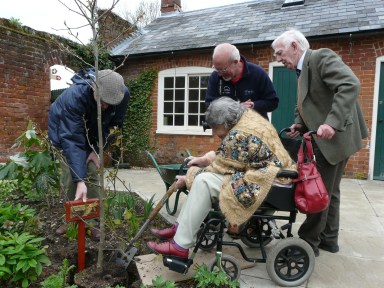
Mary and Derek Manning plant a tree to mark the opening of the garden

Mary and Derek Manning plant a tree to mark the opening of the garden

The newly renovated garden was formally opened on 6th May 2012, and two of the original gardening volunteers, Mary and Derek Manning, planted a ‘Paper Handkerchief Tree‘ to mark the occasion. Local children also played their part and cut ribbons to open ‘Curiosity Corner’.

One of the new residents of the Garden!

One of the new residents of the Garden!

The Curiosity Corner proved to be very popular in its first season last year and included some giant sunflowers planted by a local play group as well as a turf seat; a willow tunnel and arches; hazel wigwam; mirror; ‘fossil slab’; various ‘animals’  hidden away in the planting and a range of different path surfaces and planting. There is also a half barrel filled with stones,water and pond plants, so that youngsters can ‘get up close’ to this watery habitat.

 'Curiosity Corner'

‘Curiosity Corner’

The coming year will see the garden mature further and hopefully there will be sunny days so that visitors can really enjoy this lovely picnic area at its best.

New planters with sweet peas on conical obelisks

New planters with sweet peas on conical obelisks

Quizzicals:

Two more cryptic clues to the names of plants, fruit or veg…

  • The scourge of female chickens
  • Cheap goods in a pile of dung

Old School Gardener

If you’ve enjoyed reading this post and others on this blog, why not comment and also join some other people and sign up for automatic updates via email (see side bar, above right ) or through an RSS feed (see top of page)?

PicPost: Great Garden @ Cambridge Botanic Garden

‘Since its opening in 1846, Cambridge University Botanic Garden has been an inspiration for gardeners, an exciting introduction to the natural world for families and a refreshing oasis for all our visitors. This heritage-listed Garden has been designed for both year-round interest and seasonal inspiration so, whenever you visit, you will find plants to intrigue and enchant.’

PicPost: Great Garden @ The Old Vicarage

The Old Vicarage – East Ruston, Norfolk

“Throughout the garden you will see many rare and unusual plants growing…. Our garden lies 1½ miles from the North Sea in an exposed prairie landscape containing large arable fields. Many of the wildlife habitats have long been swept away and we have endeavoured throughout the garden to replace these by the planting of mixed hedgerows, banks, wildflower areas and ponds.

The soil here is of excellent quality, a light sandy loam with a neutral pH. Due to the maritime influence the garden suffers little in the way of serious frost damage and we have planted large shelter belts of Pinus radiata, the Monterey Pine, Alnus cordata, the Italian alder and many Eucalyptus. This enhances the garden’s unique microclimate which enables us to grow such a huge range of plants.”

Source : Old Vicarage website

Old School Gardener

Roses are one of the splendours of the gardens

Roses are one of the splendours of the gardens

The Peckovers – a quaker banking family – left behind them a secret gem of a house and garden in Wisbech, Cambridgeshire. This is one ‘banker’s bonus’ that can be shared by everyone.

Peckover House is said to be one of the finest Georgian town houses in the country. It stands proudly fronting the River Nene in this Fenland market town of 20,000 people. Originally built in 1722, the house was initially rented by the Peckovers in 1794, and purchased soon after. Jonathan Peckover had a grocery business and then moved into banking, setting up the first bank in Wisbech in partnership with the Gurney family- who later founded Barclays Bank. Peckover established a good reputation – it was said that during times of financial crisis the Peckover Bank was safer than the Bank of England!

Peckover House was initially called Bank House, reflecting the role of the house and it’s newly built banking wing. The property remained in the family for over 150 years, eventually passing over to the National Trust from its last owner, Alexandrina Peckover, in 1948.

The gardens – of around 2 acres – extend to the rear of the house and grew over the years as the family purchased ground from adjacent landowners. They also included a much larger estate extending to 48 acres, much of which today is used as playing fields and has some character-ful old trees. The Peckovers were also  keen collectors, and introduced a number of foreign plants into the garden. The gardens today maintain the basic layout from Victorian times –  including the old walls that used to mark the boundaries of adjacent properties.

The rear of the hous with the Croquet lawn in front- surrounded by some glorious trees such as the Tulip Tree (Liriodendron tulipifera)

The rear of the house with the Croquet lawn in front- surrounded by some glorious trees such as the Tulip Tree (Liriodendron tulipifera)

Step out into the garden and you feel as though you are back in Victorian times, as you move from one delightful space to another.

Once needing a team of 17 gardeners, todays gardening team of three is headed up by Allison Napier. She finds it difficult to single out her favourite part of the garden –  ‘It depends on the time of year’, she says. ‘In late winter and early spring the Wilderness Walk is full of the colours and scents from bulbs, Hellebores, Winter Honeysuckle, Christmas Box and an impressive Cornus mas. There is also the  fantastic trunk of an old Ginkgo which stands out and this with surrounding evergreens, deciduous shrubs and trees creates a strong framework.’

‘In spring the Orangery is a riot of colour and fragrance from the various bulbs and other spring plants all arranged in terracotta pots on the staging and if the flowering of the Wisteria on the front of the house coincides with the wall flowers in the various formal beds at their peak, then that is a wonderful spot.’
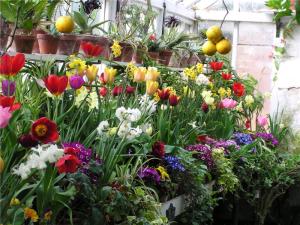
Inside the orangery- a heady mix of seasonal colour and fragrance

Inside the Orangery- a heady mix of seasonal colour and fragrance

And what about the summer The various rose gardens come into their own. There are over 60 species of rose here, many lovingly pruned and tied in every year over several metal pergolas and against walls. The area christened ‘Alexandrina’s Rose Garden‘ is a particular focal point.

But the show isn’t over yet. In late summer and autumn a ‘Red Border’ provides an array of warm colours and varied textures which are set off brilliantly against a golden privet hedge. This and an Autumn Border provide a glorious conclusion to the year. Jenny Windsor, one of the gardening team, loves these herbaceous borders and especially the contrast that they offer to other, more formal areas of the garden. ‘I love nothing more than to ‘have a play’ in the borders,’ she says –  ‘weeding, dead heading, tying in etc.’

Herbaceous borders

Herbaceous borders surrounding the Orchard Lawn with a fine old Quince tree

Many first-time visitors are surprised at the size and variety of plants in the garden. And, not surprisingly, they also commend the high standards of care maintained by the team.

Very few chemicals are used in the gardens and Allison finds that biological controls are effective in the glasshouses. As she says,

‘The healthy populations of beneficial insects, frogs and birds in the garden are testament to the ‘greener gardening’ policies we like to follow.’

The orangery (left) has rotten timbers and is due for a major renovation this year

The orangery (left) has rotten timbers and is due for a major renovation this year

The gardening team is well supported by local volunteers and a small number of trainees who come to gain practical horticultural experience (as I know, because I had the pleasure of being one last year!). Allison also thinks it important to encourage future generations of potential gardeners, so the team actively seeks school visits and has a Garden Club with students from the local grammar school.
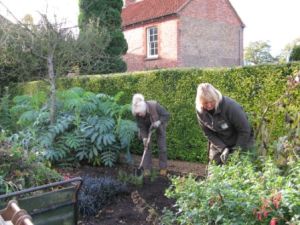
Gardeners Jenny and Janet digging over and mulching the 'Red Border'

Gardeners Jenny and Janet digging over and mulching the ‘Red Border’

What of the future? Well,the forthcoming restoration of the Orangery – with its 300 year old orange trees – is a major project due to get under way this year. Allison plans to complete work on the Conservation Plan for the garden this year, but it will be a major challenge working out the priorities and policies for the future, especially as the climate appears to be entering a very unpredictable phase affecting decisions about the range of plants to be used.

Still, the team seem to be a pretty content bunch, even though on occasions paperwork and ‘office stuff’ may get in the way of being outside and doing what they love. As Allison says, even the laborious turning of the compost heaps can sometimes be rewarding:

  ‘.. it gives you a good workout and you can find a surprising  number of lost hand tools!’

Gardener in charge Allison Napier- normally not sitting on the compost, but turnning it!

Gardener in charge Allison Napier- normally not sitting on the compost, but turning it!

Acknowledgement: thanks to Allison, Jenny and Janet, the Peckover Gardening Team for their contributions.

Quizzicals:

answers to the two on the post ‘Lock down- pros and cons of garden ties’

  • Hello Miss Black – Hyacinth
  • A punch up in the water – hydrophyte

Old School Gardener

If you’ve enjoyed reading this post and others on this blog, why not comment and also join some other people and sign up for automatic updates via email (see side bar, above right ) or through an RSS feed (see top of page)?


sowing seeds The case for gardening in schools has perhaps never been stronger – it encourages exercise and healthy eating and helps to ensure that children ‘reconnect with nature’ – as discussed in the initial post on school gardening.

Today, in the first of a series of posts on the practical steps to creating a successful School Garden, I’m looking at how to get your project up and running.

Where do you start? How do you build up the momentum that’ll be needed to turn your dreams into  reality? How can you get the resources you need to get it off the ground? Here are 7 steps to help get your school gardening project off the starting blocks.

1. Do your homework- check out the internet for advice and ideas about school garden learning and explore other school gardens in your area. This research will help you to firm up your ideas and think about how you might present them. Talk to those involved in the school gardens you visit – their advice and experience is priceless. And they might even offer to help you get started!

2. Make the Case – so how do you get the key people on your side? If you’re a volunteer, float your idea with one or more teachers who you think might be sympathetic and explore the idea a bit further (if you’re a teacher speak with your colleagues and sound out some parents). Once you’ve firmed up your initial thoughts, it’s time to get the Head teacher on board. You need to have a clear outline of what the project is going to achieve and how it could benefit the school’s approach to learning in general (including curriculum links if possible) and ‘learning outside the classroom’ in particular – so think ‘outdoor classroom’ and use this key phrase in your plans. Your outline should ideally include a suggested location for the garden, rough design,timescale and how the garden will be established and looked after. It might also be an idea to say how you think progress will be monitored and reported. If you are able to convice a number of teachers, governors, parents and friends of the School, so much the better.

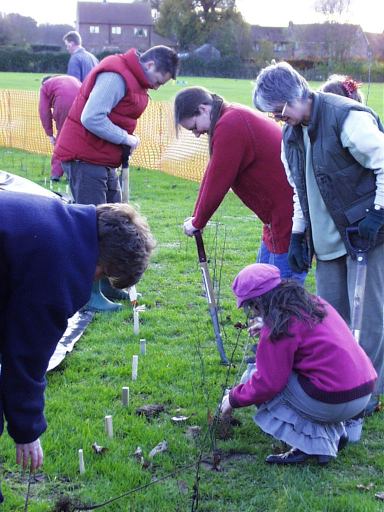
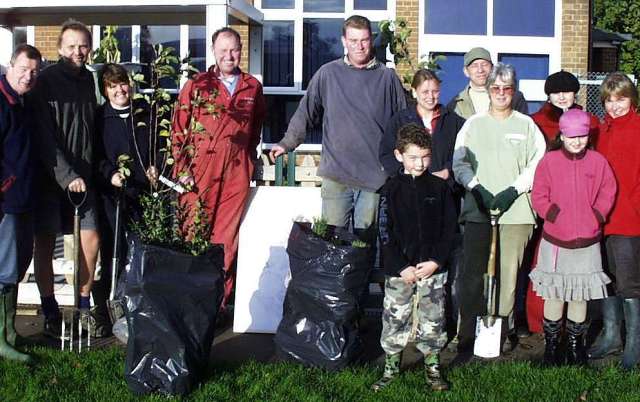
Hedge planting- put some natural boundaries around your garden with community effort!

Hedge planting- put some natural boundaries around your garden with community effort!

3. Build a team – you  will not create the garden alone, even less ensure its effective ongoing use. You need to build a team around the project which can do the many things needed. A committee/ steering group/ project team of some sort needs to be set up and at this stage. It will be important to get all the key interests in the project involved; later on your committee structure might be slimmed down as individual roles start to pan out and inevitably some people lose interest. So who should you target? Keep an eye out for parents who can bring particular skills, assets (mini diggers!) or contacts to the project  – these might be builders, gardeners, landscapers, forestry workers, publicists or funding bid writers and so on. Establishing a broad and varied support base at this stage will set the project on a positive course. Hold formal meetings to develop your project but also use the web to communicate. Don’t forget to ask the Head, teachers and governors to be on the committee – their involvement at this stage is important, but may reduce once the project is flying!

4. Think ahead – as the project develops it will become clear what the real goals will be and the main lines of action you’ll need to take to achieve these. Being clear, concise and friendly will help to communicate the project effectively. At the same time, be patient – it’s natural to want to launch right into construction works, but it will take time for your project to evolve and the learning opportunities to be firmed up, which will in turn have a bearing on your design, layout, routine etc. So it’s important to have detailed discussions with the teachers who will make use of their ‘outdoor classroom’. This discussion may take anything from a few months to a year.

picture- RHS

picture- RHS

5. ‘Quick wins’ to promote your cause – whilst it will take time to clarify your overall objectives and start to firm up your design, you can keep up the momentum and start to generate wider interest. Plan activities which will test out some ideas and generate interest ; e.g. can you start to grow things in containers around the school and get children involved in cultivating flowers or food in these? A little project starting with seed sowing in the classroom and eventually seeing mature plants placed outside will demonstrate what can be achieved and get the children on board.

6. Check possible barriers to progress and get permissions – check out whether your outline design has implications for the school’s utilities or the way it operates,  and if you need them get permissions in principle before going much further with your design work. For example, a reliable source of water nearby is an important if not vital consideration – will this be possible from existing outside taps/ rainwater harvesting or do you need to get another connection installed? Will this be acceptable to the school?

7. Secure the start-up resources – once you have a clear, albeit outline, view of your project and the design of the garden, it’s time to firm up what resources you’ll need to get the project established and get commitments for these. Some of these can be ‘promises’ of help from well skilled/equipped parents or friends of the school. But you’ll probably need some start up cash – to purchase materials, tools, seed etc.  Sources internal to the school can be approached – the school budget if possible, but more likely a Parents/ Friends Association. Then you can explore outside sources including local charities as well as national programmes like the Big Lottery.

Once you have a strong team around you, a clear plan with the start up resources you need and a growing awareness and support from the school and wider community, it’s time to get serious! In the next post on School Gardening I share some tips about planning and designing your new space for growing children!

Source: ‘How to grow a School Garden- a Complete Guide for Parents and Teachers’- Arden Bucklin-Sporer and Rachel Kathleen Pringle, Timber Press Books 2010

Useful websites:

Garden Organic support for Schools

RHS Campaign for School Gardening

RHS young gardener of the year 2013

Learning outside the classroom- manifesto

Learning through landscapes

Setting up and running a school garden- UN Food and Agriculture organisation

Morrisons ‘Let’s Grow’

Cawston Primary School Garden following work by a 'Garden Gang' event last Saturday

Cawston Primary School Garden following work by a ‘Garden Gang’ event last Saturday

Old School Gardener

If you’ve enjoyed reading this post and others on this blog, why not comment and also join some other people and sign up for automatic updates via email (see side bar, above right ) or through an RSS feed (see top of page)?
moth on leafA new report charting the numbers of moths in Britain over forty years makes grim reading. Climate change and habitat loss are driving some to extinction – especially in southern Britain.

Moths are perhaps not as popular as butterflies. But they are an important ‘indicator’ of how our native ecology is faring, a significant pollinator and source of food for birds, bats etc. Whilst many are subtly coloured, others are as eye-catching as their cousins.

The Butterfly Conservation report  says that two-thirds of common and widespread larger species of moth (macro-moths) declined in the last 40 years, most seriously in southern Britain. The report suggests that the decline in habitats through development and agricultural practices are the factors behind the decline in the south, whereas it sees climate change (a gradual warming) as a key factor in the broadly neutral results in the north – declines in some species have been matched by increases in others.

And climate change is also the explanation behind the growth in new species in the country. More than 100 species have been recorded for the first time in Britain this century and 27 species have colonised Britain from the year 2000 onwards. However, the report says that three species have become extinct in the last 10 years and three more are at serious risk of extinction, having already declined by more than 90% in the last forty years.

What can gardeners do to create the right habitats for moths? The Royal Horticultural Society makes several suggestions about planting.

  • Night-flowering, nectar-rich plants, such as Nicotiana (Tobacco plant) and Evening Primrose (Oenothera) have evolved to feed night flying insects – and the wonderful evening scent of some is a bonus for any garden
  • Day flying moths can be served by plants such as Sea Lavender, Buddlejas, Red Valerian and Lychnis
  • It’s also important to provide food for caterpillars with plants such as Clarkia and Fuchsia. leaving a ‘wilder’ area of the garden with longer grasses, thistles and knapweeds will benefit smaller moths. Many native trees, hedges and ornamental plants also provide food sources fo moth caterpillars.
Garden Tiger Moth caterpillar

Garden Tiger Moth caterpillar

Kate Bradbury suggests:

‘Avoid using pesticides to give their caterpillars free rein on your plants (which will mostly only be nibbled a bit – so don’t worry).’

The website Mothscount says we also need to tolerate some untidiness in our gardens:

‘Moths and their caterpillars need fallen leaves, old stems and other plant debris to help them hide from predators, and especially to provide suitable places to spend the winter. It’s very helpful to delay cutting back old plants until the spring, rather than doing it in the autumn, and just generally be less tidy. If you want your garden to look tidy in the summer, try leaving some old plant material behind the back of borders or in other places out of sight…..’

All green form of the Red - Green Carpet Moth'

All green form of the Red – Green Carpet Moth

Further information:

Back Garden moth.org

Winners and losers in latest butterfly survey – 7 tips for gardeners

Old School Gardener

If you’ve enjoyed reading this post and others on this blog, why not comment and also join some other people and sign up for automatic updates via email (see side bar, above right ) or through an RSS feed (see top of page)?

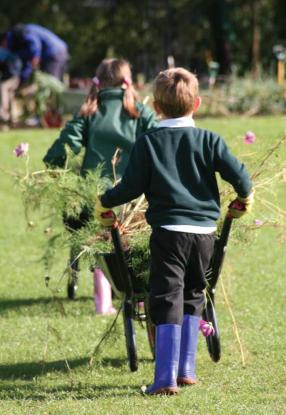
child with wheellbarrowAcross the developed world there is concern about a growing ‘disconnect’ between children and the natural world around them – increased time spent indoors, less time out playing – the scenario is well reported. School gardening projects are an important way to reconnect children with nature.

School gardening, like ‘growing your own’ seems to be on the increase in the UK as we look for ways of bridging the ‘ecological disconnect’, saving money, reducing ‘food miles’, improving food quality and strengthening local economies. There’s powerful evidence that school gardening is one, convenient and effective way of ‘learning outside the classroom’. A way of helping to engage children with the natural world and to deal effectively with some other important issues at the same time by:

  • raising academic achievement
  • promoting healthy eating
  • instilling a sense of responsibility for the world around us
  • encouraging social and community development and a ‘sense of place’
  • providing a place for unstructured, imaginative play

In Norfolk, England, the voluntary group of Mastergardeners is playing its part in supporting around 20 schools and many others are waiting to connect with a suitably trained volunteer in their area to develop new school gardening initiatives.

I’ve been helping a primary school to develop its school garden, which now has several raised planting beds (one for each class) and a recently completed wildlife pond with dipping platform and boggy planting areas. I tried to engage the children in growing food with a short session about the food they like to eat and where it comes from, why growing our own is important and the different types of fruit and veg we could grow. We ended up with each child making their own paper pot and sowing a broad bean seed – these were later transferred by the children to the school garden and formed a wonderful source of ‘free sweets’ during the summer!

making paper pots - an easy way to get children involved in 'growing their own'

Making paper pots – an easy way to get children involved in ‘growing their own’

The whole community– governors, staff, parents, children, local businesses together with ‘shopping voucher’ and grant schemes have played their part in creating this valuable resource. The new gardening year is about to kick off with a ‘Garden Gang’ (parents, children, staff and friends of the school) session on Saturday to get the beds ready, complete the greenhouse (made out of canes and plastic bottles) and plant some new apple trees.

Other Mastergardeners are playing their parts around the County. This includes several new and more established gardens at secondary and primary schools and a novel ‘inter – generational’ project in Norwich, where some spare ground behind a library has been turned into a food growing plot by children from a local school, library staff and older people from a sheltered housing scheme overlooking the site.

One secondary school gardening coordinator recently wanted to introduce children to the ideas of ‘veg families‘ and crop rotation. She printed out 56 small veg pictures and separate names – the first task was for the students to ID the veg. Then they looked at veg families (with the students placing  the different vegetables into different groups ) –  then they used their computers to create their own set of ‘Veg family prints’. Finally, they looked at crop rotation and by the end of the session they had come up with a basic 4 bed rotation over 4 years, along with a write-up explaining about why we rotate crops yearly.

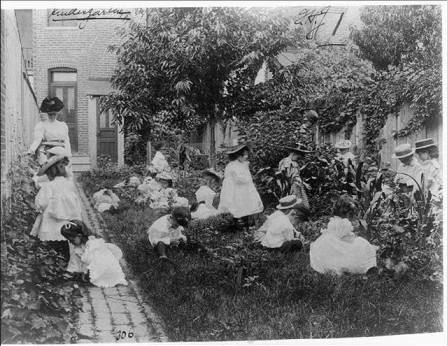
school gardening a century ago- birth of the 'kindergarten'

School gardening a century ago- birth of the ‘kindergarten’

School gardening has been around a long time – originally developing as part of the formal school curriculum at a time when many more households grew their own food. There were war – time efforts to boost food production at schools and the ‘Kindergarten’ movement saw playing and being creative in an outdoor setting as the heart of nursery education.

school gardening in wartime- US style

School gardening in war time- US style

Recently in the UK the Food Growing in Schools Taskforce, led by Garden Organic was established as a response to increasing concerns about the health and well-being of children and young people, and a confidence that food growing in schools is a successful way of dealing with these concerns, delivering many benefits. The Taskforce is made up of people representing a diverse set of interests, but all with a strong belief that food growing in schools is an important activity. You can read their findings here.

Getting the whole community involved in the school garden

Getting the whole community involved in the school garden

Over the coming weeks I plan to post a series of articles about how to go about setting up and developing a school garden, so if you have any experiences or ideas to share I’d love to hear from you!

Old School Gardener

If you’ve enjoyed reading this post and others on this blog, why not comment and also join some other people and sign up for automatic updates via email (see side bar, above right ) or through an RSS feed (see top of page)?

Finding Nature

Nature Connectedness Research Blog by Prof. Miles Richardson

Norfolk Green Care Network

Connecting People with Nature

Discover WordPress

A daily selection of the best content published on WordPress, collected for you by humans who love to read.

Susan Rushton

Celebrating gardens, photography and a creative life

Unlocking Landscapes

Writing, photography and more by Daniel Greenwood

Alphabet Ravine

Lydia Rae Bush Poetry

TIME GENTS

Australian Pub Project, Established 2013

Vanha Talo Suomi

The Journey from Finnish Rintamamiestalo to Arboretum & Gardens

Marigolds and Gin

Because even in chaos, there’s always gin and a good story …

Bits & Tidbits

RANDOM BITS & MORE TIDBITS

Rambling in the Garden

.....and nurturing my soul

The Interpretation Game

Cultural Heritage and the Digital Economy

pbmGarden

Sense of place, purpose, rejuvenation and joy

SISSINGHURST GARDEN

Notes from the Gardeners...

Deep Green Permaculture

Connecting People to Nature, Empowering People to Live Sustainably

BloominBootiful

A girl and her garden :)