Tag Archive: planting


PicPost: Garden Wrap

Disguise your ugly garden structures with vertical planting!

PicPost: Plant Pallette

bare_root_bundlesAs we roll on towards Christmas, you might be lucky to receive a present of some bare rooted shrubs like George Wellbeloved from the Scottish highlands:

‘I’ve been given a birthday present of some shrubs but the ground is frozen in the garden and I’m not sure what to do with them. Can you advise me?’

A belated Happy Birthday George, what a great idea for a present! Most shrubs and climbers, and especially deciduous ones sent out by mail order, are despatched with bare roots, not in containers. If they dry out they will die, so when they arrive, and there is not soil at all on the roots, stand them in a bucket fo water for a day or two in a cool, frost-free place until the soil is in a fit sate to plant them. Alternatively, store them for longer periods with their roots in damp compost – this can be ‘spent’ (old) rather than new if you have some (from emptying out summer flowering hanging baskets or other containers, for example).

If the plants arrive with some soil, on the roots, probably wrapped in netting, these are best watered carefully with a can fitted with a fine rose and then stored in moist compost. As soon as possible after arrival, dig  a trench in a vacant bed of soil, lay in their roots, and replace the earth. ‘Healed in’ like this the shrubs will stay in good condition for many weeks until the planting site is frost-free, fully prepared and in good condition.

When planting shrubs there are two schools of thought. The traditional method is to mix a good supply of well-rotted manure with loosened soil from the bottom of the planting hole, but if you can’t get hold of this, try using your own compost, or spent growing bags (you might be able to get hold of these from commercial tomato growers). Spent mushroom compost is also a possibility, as it usually contains some manure, but as it also contains chalk it should not be used for lime hating plants. Lastly, you can use shop-bought composts or bulky organic materials, though the latter can be pricey. Add a few handfuls of bone meal to the material you use to encourage root development.

The alternative method is to raise the fertility level of the soil around the planting site so that the plant’s roots are encouraged to spread out and so lead to more vigourous growth as the roots are encouraged to seek out nutrients more than if all the goodness is concentrated in the planting hole. Of course for ‘belt and braces’ job you can do both, or use your judgement about whether and how much  fertility needs to be added to the site of the planting. Increasing fertility in the space surrounding the planting hole may be impractical where there are already plants in this area or where you’re planting into a lawn. Here’s a useful guide to planting bare rooted trees.

You can also consider adding Mycorrhizal fungi in the planting hole. These are now widely available in Garden Centres and online. As the RHS says:

‘Mycorrhizas are beneficial fungi growing in association with plant roots, and exist by taking sugars from plants ‘in exchange’ for moisture and nutrients gathered from the soil by the fungal strands. The mycorrhizas greatly increase the absorptive area of a plant, acting as extensions to the root system.

Phosphorus is often in very short supply in natural soils. When phosphorus is present in insoluble forms it would require a vast root system for a plant to meet its phosphorus requirements unaided. It is therefore thought that mycorrhizas are crucial in gathering this element in uncultivated soils. Phosphorus-rich fertilisers are widely used in cultivated ground and not only reduce the need for this activity but are thought to actually suppress the mycorrhizas. For this reason it is best not to use phosphorous rich fertilisers in conjunction with mycorrhizal fungi.

Neither fungi nor plants could survive in many uncultivated situations without this mutually beneficial arrangement. Mycorrhizas also seem to confer protection against root diseases.’

Root tips showing mycorrhizal fungi (the white coating)

Further information:

A Guide to planting bare root trees, shrubs and perennials- Toby Buckland

Mycorrhiza- Wikipedia

Old School Gardener

The blckbirds nesting among the vine in the Courtyard Garden at Old School Garden- picture by Gabbie Joyce and Paul Hill

The blackbirds nesting among the vine in the Courtyard Garden at Old School Garden- picture by Gabbie Joyce and Paul Young

To Walter Degrasse

Dear Walter,

It’s coming to the end of one of the driest and hottest July’s we’ve had in nearly 10 years. Today looks like it will be the hottest of the year to date – somewhere in the upper 20s if not low 30s Celsius in our corner of England (and higher elsewhere)! Having spent a couple of hours this morning planting out the last of my summer annuals, thinning and transplanting wallflowers and planting some leeks, I’ve escaped the worst of the heat and come inside to drop you a line!

As you can imagine, the last few weeks have been very busy on several gardening fronts. I guess the most significant event was our first garden opening last week, which I’ve done a separate article about. This was great fun and I was very pleased with the way the garden looked and the many positive comments from the 70+ visitors. We raised over £300 too which will be going to three local ‘good causes’.

One of these is ‘Master Gardener’, where I continue to offer my voluntary advice and help to those starting  to grow their own food. Gabbie, the local co-ordinator, has come up with the idea of using the money we raised as a special fund to be tapped into by Norfolk Master Gardeners to purchase small items to help their households, groups and other new growers- I’ll tell you more about this in due course. I’ve attended a few events recently and had fun talking with a range of people about their food growing experiences and maybe even helped to recruit a few new households. The latest event was the ‘Destination Aylsham’ Fun Day yesterday, which I helped out at with fellow Master Composter Sally Wilson- Town and co-ordinator David Hawkyard. Well over 70 people came over to discuss composting and ‘growing your own’, though my period at the stall seemed to coincide with the quieter, ‘wind down’ phase towards the end. Still,  no matter, we seem to have promoted composting and food growing to a few more people – and I managed to sell some plants and produce too!

I’ve done my last session this academic year at Cawston Primary School, where we had great fun harvesting potatoes, broad beans and a few onions. In truth, with the exception of the Broad Beans, these were harvested a little too soon, because this was the last opportunity for the children to garden before their holidays which begin on Thursday. Still, the potatoes were of a good size and a reasonable quantity and will be used in the school kitchen this week along with the beans and some of my donated home grown produce (we’ve had some enormous Calabrese and Cauliflowers lately). The children also continued to dig out the old compost bins so that we can make a new start there in the Autumn. However, it’s disappointing that we’ve not been able to keep on top of the weeding in the bog garden around  the wildlife pond (which is also looking extremely dry), as many weeds have now set seed, so that will be an added problem for us in the Autumn, when  hopefully the soil will be damper and weeding easier. However, the Outdoor Learning Co-ordinator , Sharon, tells me that the pond has been a real winner with the children and has yielded examples of a wide range of insect and other wildlife.

The gardens at Gressenhall Farm and Workhouse Museum are struggling in the sun and heat, but the planting and care taken earlier in the year by myself and other volunteer gardeners seem to be paying off. The rambling rose ‘Rambling Rector’ in the Wildife Garden looks particularly splendid as it covers the arbour and adjoining wall, where I and my friend Steve spent an hour or two pruning and tying in last autumn.


At home, Old School Garden is also struggling in the heat, and evening watering sessions of hand held spray and sprinkler have lasted a good few hours in recent weeks – and still many new plantings are wilting! Anyway, the long borders are looking great, though with a few gaps after shearing back the oriental poppies. I’m hoping that my strategically placed pots of tender perennials and plantings of annuals will soon plug these and the overall show will reach a crescendo in a few weeks time. The kitchen garden has proved to be very productive to date, though we  continue to get problems with pests such as pigeons and to a lesser extent blackbirds and aphids. I’ve noticed a few Cabbage White butterflies recently, but hopefully with my planting of Nasturtiums and netting of my Brassicas, we’ll not be too badly affected by their hungry green caterpillars! So far we’ve had crops of :

  • Potatoes – though I had to lift many of these a bit early as blight had started to affect them

  • Calabrese  -huge heads from the F1 variety ‘Beaumont’

  • Cauiliflowers- though a few heads were ‘blown’ as we couldn’t keep up with the supply!

  • Mange Tout – despite early pigeon attacks!

  • Celery – too much to cope with!

  • Carrots – a reasonable first crop though many were twisted and misshapen, possibly a combination of too rich and stony soil

  • Lettucs – a few varieties from the garden have tasted good along with some ‘cut and come again’ varieties in pots.

  • Tomatoes – just a few of the smaller, golden variety to date, but plenty on the plants in the greenhouse, ready for swelling and ripening.

  • Courgettes – the start of what promises to be a bumper year, especially as my friend Steve has given me four ‘Patty Pan’ plants to go with the two green varieties he’d already supplied!

  • Strawberries-  you remember I’d started the process of relocating the strawberry bed? Well the new plants seem to have taken well, though, as youd’ expect I didn’t let them flower or fruit this first year, but the old plants I left hoping for ‘one more year’ of fruit were a disaster. Very few fruits and what there were the blackbirds, slugs and mould seem to have taken. So for the first time in many years I actually bought two punnets of strawberries!

  • Raspberries – these are coming on well and we’ve enjoyed a few days supply so far, though the pigeons, despite my various ‘bird scarers’, seem to be enjoying themselves and breaking off the fruiting stems as they use them like ladder to go up and down the canes!

  • Garlic – most now harvested but some along with the onions are just drying  out before storing

  • Broad Beans – a good crop of a rosy pink variety, though when cooked their attractive colour seems to turn a rather dull grey, but they taste just fine!

  • Gooseberries- first bush harvested , two red varieties to come this weekend

  • Blackcurrants- two bushes harvested and a lot frozen, with one more to come shortly

Later today, I’ll be sowing some further crops of Lettuce, Mange Tout, Carrots and Cabbage as well as some Pansies I got from the Royal Norfolk Show and which  should provide us with some autumn and winter colour. That’s if it is not too hot of course.

Well, old friend, I see that it’s about time for lunch, so I’ll close for now and wish you and your good wifeFerdy’ well. By the way, would she mind terribly if I called her by her second name, which I find so much more attractive? Lise seems to capture her elegant beauty a lot more than that  nickname she got all those years ago at University! We’re looking forward to seeing you both here at Old School Garden in a week or two’s time – hopefully the garden will still look good and the weather will mean we can enjoy some warm summer evenings on the terrace with some good food, and even better wine!

all the best

Old School Gardener

Other posts in this series:

Dear Walter…. letter from Old School Garden 21st June 2013

Dear Walter….letter from Old School Garden, 20th May 2013

Dear Walter….letter from Old School Garden, 18th April May 2013

Dear Walter….letter from Old School Garden, 11th March 2013

Dear Walter… letter from Old School Garden: 15th February 2013

If you’ve enjoyed reading this post and others on this blog, why not comment and join others by signing up for automatic updates via email (see side bar, above right ) or through an RSS feed (see top of page)?

This is the third in a series of ‘snippets’ on different garden styles. Today, formal gardens.

A successful formal garden is balanced, the design based on symmetry in its layout and a clearly recognisable ground plan or other pattern. Other features include:

  • Vistas – long channels in which the view is drawn towards a distant point or view

  • Statuary – often used as focal points within formal garden spaces or at the end of vistas

  • Topiary – ‘living statuary’ – small-leaved evergreen plants (Box and Yew, typically) are used to create all year round structure and focal points in the borders or spaces as well as hedges to create edges/ boundaries, parterres and knot gardens

  • Ornament – structures or materials are used which embellish otherwise plain surfaces or features

  • Natural stone – limestone, sandstone, granite, marble are all used to create a rich hard landscape which harmonises with the planting

  • Dramatic planting – specimen tress and shrubs are used as focal points and large expanses of single or limited numbers of species are used in mass effects

Let me know what you think makes a Formal style garden, and if you have some pictures I’d love to see them!

Other posts in the series:

Mediterranean Gardens

Cottage gardens

Old School Gardener

If you’ve enjoyed reading this post and others on this blog, why not comment and join others by signing up for automatic updates via email (see side bar, above right ) or through an RSS feed (see top of page)?

Two projects in the village of Cawston, Norfolk enabled me to ‘cut my teeth’ on designing playful landscapes.

Both were completed about 6 years ago and largely on a voluntary basis. I remain involved at the local Primary School, helping them with their School Gardening activities, but my early involvement was in designing, sourcing planting and organising the creation of an ‘Eco Park’ – basically to try and diversify the habitats and play opportunities in a bland, mown grass playing field with a solitary multi function play unit. The design features a curved mixed native species hedge (which is now over 2 metres high) and a haven for wildlife, several groupings of native trees such as Silver Birch, Hazel, Douglas Fir, Beech, Oak, Feild Maple, Mountain Ash and Black Poplar, and some areas of shallow mounding.

The planting has been used to create several different spaces, and grass within these has been left to grow long both to provide varied habitats and interesting play areas. In addition a ‘Nectar Bar’ of insect – friendly herbaceous and other flowering plants has been created alongside the school, including a painted pergola which both helps to privide shade to the south – facing side of the school and added planting interest.

The second project involved working on commission for the Parish Council and a local charity to design, seek funding, consult local people and supervise the creation of a new play landscape at the ‘Oakes Family Field’ located to one side of the village. The design was constrained by the need to retain areas for cricket and football pitches and to avoid placing play areas close to housing on one side of the field. There is a mix of landscape features including a large mound (with a slide), timber play equipment for balancing and enclosed social areas, as well as a selection of traditional play equipment in two main areas, one for younger, one for older children. Over £100,000 was raised from various sources and so a wide range of play equipment and features has been possible.

Old School Gardener

If you’ve enjoyed reading this post and others on this blog, why not comment and join others by signing up for automatic updates via email (see side bar, above right ) or through an RSS feed (see top of page)?

First Lady and 3 sisters - Michelle Obama showing American children how to plant

First Lady and ‘3 sisters’ – Michelle Obama showing American children how to plant

The final post in the series ‘Growing Children’ sets out a few tips on techniques for planting and nurturing your School Garden and making the most of harvesting and cooking what you’ve produced.

Planting and nurturing

  • Grow easy crops such as Broccoli, Chard, lettuce, Carrots, potatoes, Garlic, leeks, peas, beans, cucumber, tomato and herbs. Aim to grow a good amount of each crop to take account of children’s inexperience and if you have lots of plants these can be sold or grown on and the produce sold or given away.
  • Aim to grow different types of crop in different areas and ‘rotate’ these each year to avoid building up pests and diseases and to ensure the soil doesn’t get drained of its nutrients.
  • Save time and hassle by growing some plants from bought/donated seedlings rather than directly sowing in the garden. You could grow your own seedlings if you have a greenhouse or indoor space to develop these from newly germinated seeds. However, it might be worth buying in some seedlings from the local nursery and planting these out, once conditions are right. Plants such as Broccoli, Chard, Leeks, onions and tomatoes might be best grown from seedlings.
  • For both seed sowing or planting divide your class into smaller groups and one group can sow seed while the other does something else, and then swap over. This makes it easier to explain and demonstrate the sowing process.seed-packets-2009
  • When sowing directly into the ground pay attention to the seed packet directions as to time of year and temperature of the soil etc. Larger seeds such as peas, beans and squash can be sown directly by the children. Smaller seeds are more fiddly and need constant moisture to germinate (so avoid dry spells or be prepared to water). Broadcasting seeds (randomly spreading across the ground) is useful for tiny seeds though you could add some fine sand into the seed mix and use this to sow more easily in rows. Get the children to help prepare the seed bed, rule out the area for sowing/ mark a row and evenly distribute the seed. You’ll probably need to thin out the growth from broadcast seeds – children’s small hands and fingers are great for this! Look at the seed packet for guidance on final spacing of the thinned crop.
  • When planting seedlings show children how to remove the plant from its pot (by gently tapping the bottom and squeezing the sides, not by pulling the stem!). Look at the roots – untangle them gently if they are bound together and place the plant gently in a prepared hole that’s larger than the plant’s roots. Gently pull soil over the roots and up to the stem, firming the soil gently around it. Check all the children’s planting to make sure they are all firmed in and water them in.
  • Potatoes should be grown from disease free tubers purchased from the local nursery, and possibly ‘chitted’ on a light windowsill if they are early varieties. They can be planted in trenches (ideally dug and filled with organic matter a few weeks ahead of planting –  this is usually around Easter time in the UK). Once placed in the trenches the soil is pulled over the top into a long mound (if planted in rows) – look at the information on planting depths and distances etc. that usually comes with the tubers.

Here’s a link to a video report compiled by students of Reepham High School and College, Norfolk which includes a piece about the School Garden at Cawston Primary School, focussing on their ‘plastic bottle greenhouse’- a great idea to promote recycling as well as a relatively cheap greenhouse! I’ve been supporting both Schools in their School gardening activities.

Sowing seed - especially the smallest kinds - can seem a bit fiddly even for little fingers!

Sowing seed – especially the smallest kinds – can seem a bit fiddly even for little fingers!

Harvesting and cooking

  • Harvesting crops needs careful planning. You will need to explain the different methods required for each crop (cut, dig or pick) and also talk about the importance of hygiene, as the crops are now turning into food for the plate. Think about weighing and recording the yields of different crops and so provide some records which can be used for comparison in the future.
  • Some crops can be left for the children to harvest at will and possibly also eat on the spot – tomatoes, broad beans and young peas being good examples.

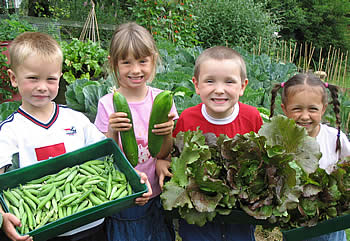
    Harvesting what they've grown is a great thrill for children

    Harvesting what they’ve grown is a great thrill for children

  • When cutting greens give each child a set number of leaves to cut – that way you avoid over cutting which si wasteful if you only want enough for meal and you will also avoid cutting too much and damaging the plants capacity to produce new growth.
  • For root crops and potatoes the digging up is great fun – like finding buried treasure! Potatoes can be dug once the flowers  or leaves have faded – a hand fork could be useful to aid the process. Demonstrate the way to carefully search for the tubers and have a bowl nearby ready for them. They (and carrots etc.) should be scrubbed clean in a bucket of water before taking away for cooking.

    Weighing in- check on crop yields and record these for the future

    Weighing in- check on crop yields and record these for the future

  • Eating straight from the garden is a powerful and memorable activity and you should if at all possible build this into your schedule.
  • Always have a bowl of warm soapy water ready for the children to wash their hands, and have a couple of other buckets of clean water on hand for washing the vegetables, one for an inital scrub, the next for rinsing off. A few scrubbing brushes will be needed. and don’t forget to properly wash plates, cutlery etc. afer use.
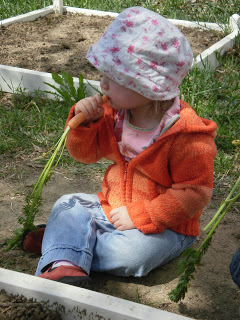
  • Educate the children on where their food left overs should be put – ideally into your compost bin along with any paper plates and cups, shredded for good measure.child eating carrot
  • Think about simple cooking for what you harvest; either eat raw; use for salad or saute/stir fry a mixture of vegetables. Potatoes can be put into the school microwave or oven to enjoy in their jackets. use simple recipes that the children can cook themselves. perhaps after washing thinly cut some raw vegetables and have them with some home-made add ons like light oil and vinegar dressing or yoghurt-based dressing for dipping. think about creating a fire pit around which you can gather to cook and eat.
  • Encourage the children to serve each other and have sufficient seating available for everyone.
  • Enjoy the experience and listen to what the children say – and note it down for use later!

Here’s a video of a high profile harvesting and planting event– the White House Kitchen Garden and Michelle Obama planting the ‘Three Sisters’ with native American children

I hope that you’ve enjoyed reading this series on School Gardening and that it’s been of some use. I’d be very interested to hear of your experiences, ideas and tips, so please use the comment box or email me directly (see ‘About me’ for details).

I’ll regularly report on my own School Gardening activity in this blog, so keep an eye out for special posts or my regular ‘Dear Walter’ letters which capture my gardening year at different times.

Other posts in the series:

Growing Children 6: Top tips for managing and maintaining your School Garden

Growing Children 5: Top tips for School Garden activities

Growing Children 4: AAA rated School Garden in Seven Steps

Growing Children 3: Seven tips for creating your dream School Garden

Growing Children 2: Seven Design tips for your School Garden

Growing Children 1: School Garden start up in Seven Steps

School Gardening – reconnecting children and Nature

Source & Further information:

How to grow a School Garden’ – Arden Bucklin-Spooner and Rachel Kathleen Pringle, Timber Press Books

School Gardening Club- ideas

Budding Gardeners- lots of advice and info

Garden planner tool

Planning your school garden

Food & Agriculture Organisation School Garden Planner

California School Garden Network Guide to School Gardening

School Gardening Wizard

School garden fundraising

Garden Organic support for schools

Old School Gardener

If you’ve enjoyed reading this post and others on this blog, why not comment and join others by signing up for automatic updates via email (see side bar, above right ) or through an RSS feed (see top of page)?

‘The Tree Council is encouraging all UK schools and community groups to plant trees by offering funding through two grant programmes- the ‘Trees for Schools’ and ‘Community Trees’ funds.

They are also offering funds for fruit tree planting in schools through the ‘Orchard Windfalls’ fund. The Tree Council are able to fund projects between £100 and £700 and successful applicants will receive up to 75% towards planting costs.

Applications for 2013 are now open, for more information visit: http://www.treecouncil.org.uk/grants/trees-for-schools
With the generous support of an anonymous donor The Tree Council have produced a teaching and learning resource, which will be sent out free of charge to all successful grant applicants.’

from RHS Campaign for School Gardening

PicPost: Hair raising

school gdn headerIn part one of this series of posts I outlined a few tips on getting your School Garden project up and running. If you’ve got the key people on board, identified what the overall aims and objectives of the project are and hopefully secured some start-up funding and promises of help, it’s time to get serious about the design of your Garden. Here are seven ideas to help you…

1. Who will be using your space and what are their needs? It’s important to think about the range of users and why they’ll want to use your garden. Yes, children, but what numbers and ages? During the school day or afterwards? Will parents or the wider community want to get involved? And just what sorts of activities will your garden need to support: growing food, outdoor play, studying nature, formal lessons (in some sort of shelter?) etc.? It’s important to list these and start to see what they suggest in terms of the overall layout of different areas, spaces, structures etc

2. Survey and appraise your site– you may have your area already defined by walls, fences, hedges etc. or perhaps you’re confined to an area of the playgrround. In any event it’s important to accurately measure out the plot. From these measurements you can create a scale drawing (say 1cm = 1 metre) and any key features that are likely to remain – e.g water taps; significant slopes; trees; hedges; types of soil (you can see if it needs improving and what the pH is by using a simple test kit); the way the site lies (in relation to sun, wind, prevailing rainfall etc.) and how the site is accessed. It’s also worth checking on the current maintenance regime and who’s responsible for this (e.g. if you’re thinking of taking over an area of sports field that is regularly mown).

A gathering place like this shelter is probably important

A gathering place like this shelter is probably important

3. Think about basic needs:

  • Sunlight- ideally you’ll have a space which is open to sun at most times of the day, but use your survey information to identify the sunniest and shadiest spots and start to think about what to place in these
  • Shelter – from strong, cold winds and midday sun – look at boundaries and think about growing hedges , using fences (ideally with gaps to allow slowed wind to pass through) or putting in wind breaks of mesh material. Do you need some trees or an awning to provide a sun shade?
  • Water – either from a tap or through adequate outdoor harvesting of rainwater from sheds, glasshouses, or possibly school buildings
  • Pathways –  to get around the various areas. These need to be wide enough and of a surface and gradient that a wheelchair – user can negotiate without too much effort
  • Good soil – if you’re removing asphalt, the soil underneath is likely to need radical improvement or possibly overlain with imported topsoil. In most situations you’ll need to get organic matter – compost, manure, leafmould– to improve it over time
  • Fencing or another suitable boundary – to keep younger children in and intruders out . You could grow a hedge and whilst this gets established, on one side try a chain link or similar fence which in due course can be removed leaving you the wonderful sight and wildlife value of the hedge
  • Plants– what are you intending to grow? Each type will have different needs – are you envisaging growing under glass/polythene, if so space for a glasshouse/polytunnel will be needed. Do you envisage some sort of wildlife pond, if so this will need a suitable range of plants and may need a secure boundary
  • A gathering area – where groups/classes can be instructed or shown a task. This can be outside and informal (e.g. getting an annual supply of straw bales is a good cheap way of providing seating)  or enclosed within a shelter
  • Storage– a good tool shed, which if large enough can possibly double up for seed sowing/potting up, or alternatively a separate shelter/structure for this if that’s something you envisage doing in your garden
  • Tools and equipment – these will vary according to what you are growing and the size of your plot (and your children), but here’s a guide. Tools:  gloves– enough for everyone who’s gardening at any one time; trowels and hand forks or hand cultivators (enough for half a full class – say 15) ; a mix of adult and child – sized spades, digging/border forks, rakes, hoes (3 or 4 of each); wheelbarrows (probably at least 3); Secateurs, loppers, pruning saws, brooms (1 or 2 of each); watering cans – a couple should do, you can make home made ‘plant showers’ out of plastic tubs with holes in the bottom. Equipment: clipboards (one each for a full class); stationery supplies – paper, pencils, crayons, markers, glue, string, tape, scissors and a First Aid Kit! Also, if you plan to sow and grow your own plants you’ll need a range of other equipment like seed trays etc.
Get some child -sized tools

Get some child -sized tools

4. Get the children involved (and your wider support group) – you will by now have a good idea about what could be in the garden and you need to share these ideas and discuss others with the children who’ll be using the space and those key adults (teachers, parents etc.) who will also want to feel the project is theirs. You can devise some fun ways of engaging these people, perhaps involving n a loose outline drawing of the plot and your first ideas in pictorial form (e.g photos cut out from magazines), from where children can be asked to draw/write/otherwise think about and convey their ideas and wants for their garden (I can guarantee someone will want a swimming pool!). This will generate interest and ownership of the project.

Raised beds, narrow enough to allow access to the centre without walking on the soil

Raised beds, narrow enough to allow access to the centre without walking on the soil


5. Options for planting –  depending on what you want to grow and the space you have available I guess you’ll either be planting in containers (pots, planters and all sorts of quirky planters too), open beds (which have their edges cut into the surrounding ground, often grass) or raised beds– these are edged with boards or other timber and so help to define the growing areas (especially for food crops). If the sides are about 20cms high they can be used to contain additions of manure/compost from year to year as you build up the soil’s goodness and structure. Raised beds can be to varying heights to cater for different ages of children, but ideally they need to be narrow enough to be tilled from the surrounding pathways so that feet don’t trample and compress the growing areas.  Rectangular beds are probably the most efficient shape. These beds can be constructed using pressure – treated timber or alternatively there are several places where ‘ready to assemble’ kits can be purchased. If you want to avoid too much digging of the soil (this can be detrimental to its structure) you can just lay a covering of organic material over the beds each year (taking note of the requirements of different groups of plant if growing food) and lightly fork this top-dressing in as you begin the growing season.

How about a plastic bottle greenhouse?

How about a plastic bottle greenhouse?

6. Go beyond basic needs– it’s important to focus on basic needs in developing your designs, but if we just stick to the functional requirements, we will miss an important opportunity to make the School Garden exciting, fun and an experience for all the senses!  So, think about growing herbs and other plants which have differing fragrances, leaf textures, colours and are in other ways interesting – tall grasses that catch the sunlight and bend in the wind for example, or Stachys (‘Lambs’ Ears’), which has wonderful velvety leaves, Lavender for that midsummer heady smell! Likewise Sunflowers are a wonderful example of the power of nature as they shoot up to enormous heights and beauty starting from little seeds that the children can sow themselves. Similarly, children can get involved in producing signs for different parts of the garden, another way to make them feel that this is their garden and make it look funky too!

A simple scale model heps to convey your design

A simple scale model helps to convey your design

7. Consult on an outline plan – once you’ve taken all of the above into account you can firm up your plans on paper and maybe even produce a simple 3D cardboard/ scrap model of how your garden could look! Models are especially useful for getting children (and adults) to imagine just what features there are and what the layout will look like.  This could go on display at the School for a week or two and you can invite people to put their views on sticky notes nearby so that everyone can see who’s saying what. Gather these up and then  with your committee/support team work out those which should be incorporated into the scheme.

By the end of this process you should have a clear, accurate design plan on paper that everyone is signed up to and which is ready to rock!

In Part 3 of this series I’ll share some thoughts on constructing your School Garden and especially the day you ‘ground break’.

Sources & Further information:

How to grow a School Garden’ – Arden Bucklin-Spooner and Rachel Kathleen Pringle, Timber Press Books

School Gardening Club- ideas

Budding Gardeners- lots of advice and info

Garden planner tool

Planning your school garden

Food & Agriculture Organisation School Garden Planner

California School Garden Network Guide to School Gardening

School Gardening Wizard

Old School Gardener

If you’ve enjoyed reading this post and others on this blog, why not comment and join others by signing up for automatic updates via email (see side bar, above right ) or through an RSS feed (see top of page)?

Finding Nature

Nature Connectedness Research Blog by Prof. Miles Richardson

Norfolk Green Care Network

Connecting People with Nature

Discover WordPress

A daily selection of the best content published on WordPress, collected for you by humans who love to read.

Susan Rushton

Celebrating gardens, photography and a creative life

Unlocking Landscapes

Writing, photography and more by Daniel Greenwood

Alphabet Ravine

Lydia Rae Bush Poetry

TIME GENTS

Australian Pub Project, Established 2013

Vanha Talo Suomi

The Journey from Finnish Rintamamiestalo to Arboretum & Gardens

Marigolds and Gin

Because even in chaos, there’s always gin and a good story …

Bits & Tidbits

RANDOM BITS & MORE TIDBITS

Rambling in the Garden

.....and nurturing my soul

The Interpretation Game

Cultural Heritage and the Digital Economy

pbmGarden

Sense of place, purpose, rejuvenation and joy

SISSINGHURST GARDEN

Notes from the Gardeners...

Deep Green Permaculture

Connecting People to Nature, Empowering People to Live Sustainably

BloominBootiful

A girl and her garden :)