Tag Archive: norfolk


PicPost: Bishybarnabee

Lady birds (Coccinellids) ‘are and have been for very many years a favourite insect of children. The insects had many regional names (now mostly disused) in English, such as the lady-cows, may-bug, golden-knop, golden-bugs (Suffolk); and variations on Bishop-Barnaby (Norfolk dialect) – Barnabee, Burnabee, the Bishop-that-burneth, and bishy bishy barnabee. The etymology is unclear but it may be from St. Barnabas feast in June, when the insect appears or a corruption of “Bishop-that-burneth”, from the fiery elytra of the beetles.

The ladybird was immortalised in the still-popular children’s nursery rhyme Ladybird, Ladybird:

Ladybird, ladybird, fly away home
Your house is on fire and your children are gone
All except one, and that’s Little Anne
For she has crept under the warming pan….’

Source: Wikipedia

An ancestor of mine?

An ancestor of mine?

‘That’s an unusual name – is it Spanish/ Italian/ French?’

If you’re also a Boldero/w/we/oe, this might be a typical response on giving your surname. That’s certainly my experience. And also my wife’s and daughters’- who, unlike me, pronounce the name with a definite latin emphasis on the ero (I prefer stressing the first syllable). Then again it’s my family name so my pronunciation is surely the one that counts? Another response – less frequent, more usually with my wife and tending to be restricted to Norfolk is:

‘Are you the people who do the walks in the Eastern Daily Press?’

My tired response is invariably ‘no’. Though on one occasion (with apologies to Charles and Joy of EDP fame), partly out of exasperation, partly from wishing to see the reaction I got, I answered ‘yes’. Gushing praise and adulation followed about how enjoyable the walks were, how useful the tips on eating out, beer etc. etc.

So what’s in a name like Boldero/w/we/oe? Well my exploration of the family tree suggests quite a lot. It seems to be a classic example of how a name comes to be spelled in several different ways (and some of them hardly resembling the main form and sound). In the less literate past, names were more often talked about but rarely written down and when they were the vagaries of accent, lower levels of literacy etc. all had an influence on what was recorded (in parish registers of births, marriages and deaths for example).

My paternal line seems to feature many agricuultural labourers,living in West Norfol. Her's picture of one of them in the early 20th Century, earning a penny a day for scaring birds away from crops

My paternal line seems to feature many agricultural labourers, living in West Norfolk. Here’s a picture of one of them in the early 20th Century, near Castle Acre, earning a penny a day for scaring birds away from crops!

You probably know about how surnames derive from different sources– some based on where someone lives, some on personal physical features, some on occupations carried out. Some allude to personal character traits and it seems that Boldero stems from a personal name which in old german means ‘bold ruler’. The Penguin Dictionary of British Surnames (John Titford. Penguin Books, 2009), suggests that it is found chiefly in East Anglia and more amusingly is synonymous with Baldrick. So a north european rather than Mediterranean homeland seems likely.

Certainly my family tree research has found strong links back to a John Baldrick (born in South Acre, Norfolk in 1735) and it is interesting to note how the form and spelling of the name has varied over the generations. The Dictionary goes on to say:

‘To those whose understanding of medieval times has been  conditioned by the television series Blackadder, the name Baldrick will forever be associated with the character of that name, a former dung- shoveller played by Tony Robinson, who acted as sidekick and punch-bag to Edmund Blackadder.

Returning to John Baldrick (or rather his son of the same name, 1767- 1821- my 4th great grand uncle, whatever that means), I came across a fascinating entry in the Longham Parish Register which underlines how confusing it must have been in olden days- when was a Baldrick not a Baldrick? so to speak-

‘I have never been able to learn the real name of John Baldrick- sometimes he has been called Balthorpe at others Balderow or Baldrow & at other times Baldrick- As Baldrick was given in the first time I had reason to register his name, I have not thought proper to change it being doubtful of his real name. St. John, Curate’

A further entry on the same page suggests that this ancestor may have been of rather dubious character:

‘John Hubbard Labourer was killed by a Blow received in fighting with John Baldrick June 29th and was buried July 1st 1794- Parish poor – duty paid to Mr Barker’

My paternal Grandfather William Kiddle Boldero- and me!

My paternal Grandfather William Kiddle Boldero- and me!

I’ve also been fascinated by some of the distinctive middle names our ancestors were given. You may well be familiar with the custom of giving a child (more often than not the first born son) a middle name that’s the mother’s maiden name. Not to create the customary ‘double barrelled’ surname but in effect forming a second christian name. Some examples from the Boldero clan are:

William Kiddle Boldero (1888-1982- my grandfather),

William Orford Boldero (1821- 1899),

Richard Orford Boldero (1849- ?),

William Balls Bolderow (1844-1904) ,

John Casey Baldrick (1792-1792),

Charles  Cooper Baldrow (1844-1864),

Arthur Franklin Boldero (1904- 1984)

So, as you can see, being a Boldero/w/we/oe/Baldrick is not only a privilege, but in some ways poses a challenge to the family historian every much as difficult as for a family called Smith!

‘Gardening with Baldrick’enjoy this link!

Old School Gardener

Picture

New Website on Dereham and local museum

Here’s a new website designed by Sue Walker White for the Dereham Antiquarian Society and Bishop Bonners’ Cottage Museum, in Dereham, Norfolk.

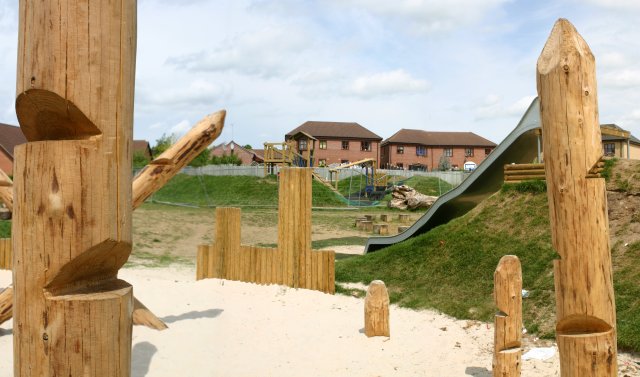
Wensum Way playful landscaThis is my first post profiling some of the ‘Playful Landscapes’ I’ve created in the last few years.

Wensum Way play area, on the southern side of the Norfolk market town of Fakenham, is a sloping site surrounded by housing on three sides and private woodland with public access on the fourth. I was commissioned by North Norfolk District Council to design, produce specifications, assist with procurement and project manage the building of the new play area. The budget was £65,000, funded by a combination of money from the Government  Playbuilder  programme and local Housing Associations. The brief was to create a challenging play experience for mainly older children, including teenagers.

The Council carried out consultation exercises with local people, including children, and the findings informed the final design.  Given the size of the site, budget constraints and proximity of housing (some occupied by elderly residents) this project was a challenge, but a combination of keen pricing by the equipment suppliers and landscapers plus use of ‘custom built’ landscape features, has resulted in a varied popular design. This includes turfed mounds and banks of new planting (both provide screening and play value) and a scooped out ‘bowl’ plus a timber-backed ‘performance area’. There is a mixture of standard play/ sports equipment and wooden posts, cubes, timber log slices and logs are all used to ctreatea range of gathering, imaginative and physical play spaces. The design also features a wild flower meadow, areas of longer grass and picnic tables for families visiting the space. The project was completed in June 2010.

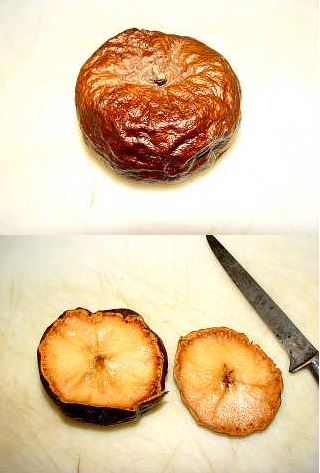
Norfolk Beefing apples before cooking

Norfolk Beefing apples before cooking

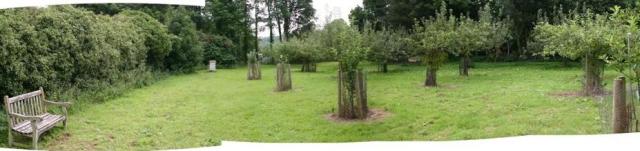
The orchard at Gressenhall Farm and Workhouse Museum, Norfolk, conceals a sacred secret – it was once the workhouse burial ground, where paupers were interred in simple, unmarked graves. And there appears to be no record of who is buried where.

Today the area serves as a demonstration plot for a wide range of Norfolk fruit trees, especially apples. A field gate displays a large number of plaques recording donations of different Norfolk apple trees to the orchard.

Gate to the Orchard showing plaques recording different varieties of donated Norfolk apple trees

Gate to the Orchard showing plaques recording different varieties of donated Norfolk apple trees

One famous local variety, the ‘Norfolk Beefing’ (or ‘biffen/biffin’), is a cooking apple of some reknown. It is recorded as far back as the 1690’s on Lord Walpole’s estate at Mannington, Norfolk. Cottagers used to pick the apples and wrapped them in  straw for a while in a warm oven, after which they would be squashed down and baked again. The final apples were packed in boxes and sent to London where they were a real delicacy, known as a ‘Biffin’.

A Norfolk Biffin after cooking

A Norfolk Biffin after cooking

Biffin/Beefing apples have very tough skins, which allows them to be baked whole, and then preserved cold. Apparently when cooked this way they are “creamy with hints of cinnamon and nutmeg”.  They were mentioned in Dickens’ story “Holly Tree” and also in “A Christmas Carol” :

“Norfolk Biffins, squab and swarthy, setting off the yellow of oranges and lemons, and in the great compactness of their juicy persons, urgently entreating and beseeching to be carried home in paper bags and eaten after dinner.”

Nearby, lies the site of a former Windmill. This can be seen if you look carefully at one of the earliest paintings of the workhouse, by Kerrison. Built in 1781, the Mill provided the workhouse with meal and flour for about 50 years. The Workhouse Master would buy a year’s supply of wheat from the local markets and this was then ground at he Mill.

In 1783, records show that William Pulling (of nearby Shipdham) was the Miller and was paid 6d a week (in old pence, or 2.5 new pence!).

By 1829 just a baker was employed, suggesting that the windmill was no longer in use. In 1837 the remains of the mill were removed. This was just one of the special buildings or rooms set aside for meeting the food and drink requirements of the workhouse, it having had a brewery as well as a bakehouse and kitchens!

Early painting of Gressenhall Workhouse (Kerrison) with windmill ringed in red

Early painting of Gressenhall Workhouse (Kerrison) with windmill ringed in red

Next to this site sits the modern compost making area, well organised and used by the volunteer gardeners to improve the soil and mulch the gardens at the Museum. Originally designed for maintenance by farm machinery, it became under used and recently has been reorganised so that the gardeners can maintain it. A system of different bays provide for the different stages of turning vegetable matter into compost (including stems and branches which are periodically chipped into smaller pieces and incorporated into the mix). There are also areas for creating leaf mould, for depositing paper waste generated by the Museum (which is incorporated into the compost) and also a turf mound which will eventually decompose into a fine loam for use in the gardens. The resulting compost is of a coarse texture, but rich in organic matter which is so good for improving soil structure, moisture retention and adding nutrients to the soil.

apple dayThe Museum  hosts an annual ‘Apple Day’ in October which is a great family day out with a range of stalls, activities and attractions including the fresh pressing of apple juice and an opportunity to bring along any ‘mystery apples’  to get them identified by a number of local experts. This lively event contrasts with the peace of the orchard, which is a fitting commemoration of those buried here long ago.

Other posts in  this series:

Down on the Farm – Gardens to ‘dye’ for at Norfolk Museum…

From Grand entrance to Grand Central at Norfolk Museum

Gypsies, tramps and thieves: garden where poor once trod at Norfolk Museum

Cottage Garden recreates 1930’s at Norfolk Museum

Old Workhouse Garden a wildlife oasis at Norfolk Museum

Unique Heritage Gardens at Norfolk Museum

Gressenhall's orchard - a peaceful place to remember the unamed poor once buried here

Gressenhall’s orchard – a peaceful place to remember the unamed poor once buried here

Old School Gardener

If you’ve enjoyed reading this post and others on this blog, why not comment and join others by signing up for automatic updates via email (see side bar, above right ) or through an RSS feed (see top of page)?

The Farmhouse Garden at Gressenhall Farm and Workhouse Museum

The Farmhouse Garden at Gressenhall Farm and Workhouse Museum

A variety of gardens awaits the visitor to Union Farm, part of the Gressenhall Farm and Workhouse Museum, Norfolk.

The main Farmhouse Garden sits alongside the Victorian farmhouse and was designed and developed around 10 years ago. It was intended to be a ‘sensory garden’ with aromatic, tactile and other plants including a ‘herb wheel’. It was also intended to demonstrate how planting could be used to control pests. This original purpose has been diluted over the years and the garden now provides a pleasant green foil to the farmhouse building. The garden is domestic in scale with a large area of grass and an irregular series of planted island borders, including raised beds edged with split poles. There are a number of shrubs, including climbing roses on the farmhouse wall, bench seats and a wooden shed in the north-eastern corner which contains garden tools.

The kitchen garden at Union Farm

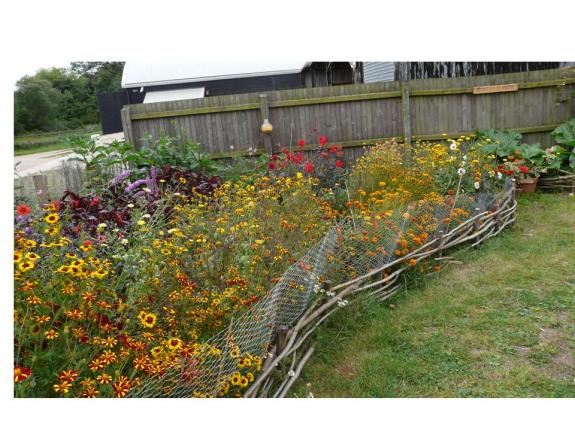
On another side of the Farmhouse a vegetable growing patch has been developed which is used to demonstrate grow your own techniques and different types of vegetables. To the front of the farmhouse sit two other gardens, one with a range of perennial herbs that would have been used in the farmhouse kitchen and another which houses a wide range of plants that were used in the traditional dyeing of cloth. This garden was slightly rearranged last year with new edges to the borders and with a length of low willow fencing to provide both a sense of enclosure and to discourage visitors from trampling in the beds.  The plants are regualrly used here in demonstrations of traditional dyeing.

One side of the Dyers' Garden

One side of the Dyers’ Garden

Developed in recent years by the volunteer dyers, some of the plants grown here include:

Alcea rosea varieties Helianthus annuus varieties
Alkanna tinctoria Hemerocallis varieties
Amaranthus caudatus Isatis tinctoria
Anthemis tinctoria Lythrum salicaria
Berberis vulgaris Mahonia aquifolium
Buddleja davidii Origanum majorana
Calendula officinalis cultivars Perilla frutescens
Carthamus tinctorius Phytolacca americana
Consolida ajacis Pyracantha angustifolia
Convallaria majalis Reseda luteola
Coreopsis tinctoria Rheum x hybridum
Dahlia varieties Rhus typhina
Datisca cannabina Rosa –climbing varieties
Foeniculum vulgare Rubia tinctorum
Forsythia Rudbeckia triloba
Galium verum Solidago
Genista tinctoria Tagetes patula cultivars

Other posts in this series:

From Grand entrance to Grand Central at Norfolk Museum

Gypsies, tramps and thieves: garden where poor once trod at Norfolk Museum

Cottage Garden recreates 1930’s at Norfolk Museum

Old Workhouse Garden a wildlife oasis at Norfolk Museum

Unique Heritage Gardens at Norfolk Museum

Old School Gardener

If you’ve enjoyed reading this post and others on this blog, why not comment and join others by signing up for automatic updates via email (see side bar, above right ) or through an RSS feed (see top of page)?

The entrance to the workhouse as it looked in the early 1900's - the well house stands next to the person to the rear

The entrance to the workhouse as it looked in the early 1900’s – the well house stands next to the person (gardener?) to the rear

The former grand entrance of the Gressenhall Workhouse now performs a very different function. The once ornamental gardens and driveway have given way to a busy hub for this Norfolk Museum’s outdoor events.

As can be seen from the old photograph the main approach to the Workhouse was once a rather grand affair – a heart-shaped island of formal lawns and borders surrounded by a circular drive.  To the front, huge iron gates and a much smaller wooden door provided the entrances from the forbidding outer wall of the complex. The smaller door was the main pedestrian entrance to the workhouse being next to the porter’s lodge, the man who controlled the arrival and departure of Workhouse inmates. This door today still carries the solid metal knocker shaped into a clasped hand around a metal bar – a hint of the prison-like existence to come for the new inmates! They must have entered here with very mixed emotions – relief at having somewhere to get a square(ish) meal and a warm (ish) bed, mixed with guilt at not being able to fend for their families and anxiety about the harsh regime they were entering.

The 'Yew Tree border' in front of the chapel- before the Yews were reduced

The ‘Yew Tree border’ in front of the chapel- before the Yews were reduced

Towards the main building, but long since demolished, once stood a small building enclosing the Workhouse well (still visible in the old photograph) and the front of the 18th century main building once carried a magnificent Wisteria clambering up and along the warm red brickwork. This was, apparently, cut down to the ground by an over – enthusiastic work placement trainee about thirty years ago! A small rooted area remains and is being carefully trained up the walls once more, in the hope of restoring this once glorious feature. To the side the workhouse chapel is fronted by a small border which is dominated by two Yews and a cherry tree with spring bulbs and other under – planting. Recently these Yews were reduced in width in an attempt to provide a more open, sunny site for the other planting (and increase the width of the adjacent paths). The hard cut – back has improved the shape and balance of the border whilst not harming the Yews, where new growth has begun.

The magnificent Copper Beech Tree in autumn

The magnificent Copper Beech Tree in autumn

To the right of the main approach sits a majestic old Copper Beech tree (which gave its name to the Old People’s Home that succeeded the workhouse after the 2nd World war – ‘Beech House’). This area was originally sub divided by walls into exercise yards and a playground for the adjoining boys school, and in later years for those in the nearby infirmary (and featuring two revolving wooden tuberculosis pavilions). There is also an avenue of beech trees on the approach to the Workhouse believed to be 150 years old.

There is some evidence that the southern section of this area, adjoining the modern café was laid out as a formal ‘garden’ but the historical accuracy of this is uncertain. Today this area houses a semi – permanent marquee used for the many events now taking place at the Museum.  A large expanse of grass (useful for picnicking for the Museum’s many summer visitors) is surrounded by areas of planting including an isolated Crab Apple tree, planted in more recent years as a memorial to a former member of the Norfolk Archaeology Department (also housed on the site).

There is also a long south – facing border of mixed shrubs adjoining the walls of the former workhouse, some of which are now rather large for their position adjacent to the building. Others – such as several clumps of Boston Ivy – clamber up the walls and are vigorous enough to get under the eaves and into the roof! Recently these shrubs have been pruned to try to restore their scale and shape as well as encouraging new growth, with some success. And spring bulbs also provide splashes of colour underneath the mainly evergreen shrubs. But a perennial problem is the rabbit population which have burrows in this border and which also occasionally escape into some of the adjoining gardens to wreak havoc!

Shrubs in front of the southern wall of the old Workhouse- showing the arcading that was once open

Shrubs in front of the southern wall of the old Workhouse- showing the arcading that was once open

The walls here still show the evidence of the (once open) arcading that sheltered individual ‘cottages’ for families living in the workhouse. This was before its daily routine became harsher in the mid 19th century, when inmates were divided by sex and age and so families were split up.

One of the borders in the Cafe Garden

One of the borders in the Cafe Garden

Today’s cafe building was once a  fever or isolation ward commonly known as the ‘itch ward’. More recently this was the Museum’s Education Centre, for which a garden was laid out by volunteers in the 1980’s. This was further remodelled into the current space, presumably upon creation of the café and now houses a  delightful, smaller courtyard garden of mixed borders with picnic tables.

Today's courtyard on an event day at the Museum

Today’s courtyard on an event day at the Museum

Today, the large entrance courtyard and its adjoining spaces provide a great setting for the main workhouse buildings and perform an important role as a thoroughfare for the Museum’s visitors as they explore the surrounding gardens and on event days when tents, stalls and other temporary exhibits spring up into a hub of activity.

Other posts in this series:

Gypsies, tramps and thieves: garden where once poor trod at Norfolk Museum

Cottage garden recreates 1930’s at Norfolk Museum

Old Workhouse Garden a wildlife oasis at Norfolk Museum

Unique heritage gardens at Norfolk museum

Old School Gardener

If you’ve enjoyed reading this post and others on this blog, why not comment and join others by signing up for automatic updates via email (see side bar, above right ) or through an RSS feed (see top of page)?

Echeveria- overwintering in Old School Garden Greenhouse

Echeveria- overwintering in Old School Garden Greenhouse

To Walter Degrasse:-

Dear Walter,

It’s been a while since we were in touch, and as it’s windy and wet outside, I thought I’d drop you a line about what’s been going on in ‘my gardening life’. I hope all is well with you and your beautiful garden. It seems ages since I was in my garden for any time to get a sweat up, but it’s that time of year when the pace of things is rather slow, very much focused on ‘basic maintenance jobs’, I suppose. Anyway I’ve used the time in other ways, not least getting my blog up and running, which I’m pleased to say I’m enjoying and also the new relationships it’s bringing with gardening fans around the world!

More practically, I’ve more or less finished my pruning jobs, those new Felco secateurs I had for Christmas are a real joy to use! I’ve got one more Buddleja to do and I’ll need to get the ladders out to do my Fremontodendron, which, on a south-facing wall, has romped away – I think last year’s wet weather gave it a surge of growth, so it’s now over 5 metres tall! The Dogwoods have all been laid low so hopefully we’ll get a good flush of new stems in the summer that give us that wonderful ‘winter glow’. I’ve done my annual cut back of the Eucalyptus to encourage large, colourful new leaves – it always looks forlorn after this major hack back (photo enclosed), but is such a swift grower.

Eucalyptus & Buddleja - pruned

Eucalyptus & Buddleja – pruned

I’ve also been tilling over the beds in the kitchen garden. Did you read my blog post about planning the crops here? It has a layout of what I’m intending to grow and where, trying to rotate crops as best I can in a complex border layout and thinking about succession crops too. You may remember that I put on a layer of leaf mould over most of them (as well as the fruit trees) in the autumn as well as digging in some green manure I grew towards the end of last season – we’ll see if this latter experiment has any marked effect on the crops to come.

I’ve been lightly turning over the topsoil and incorporating the remains of the leaf mould etc., in preparation for some of my friend Rob’s horse manure, which I’m able to collect from his paddock about 2 miles way. It really is lovely stuff, so I’ll use it to mulch my roses, clematis, shrubs, fruit trees and bushes etc. as well as putting a good load down for the potatoes and some of the other vegetables.

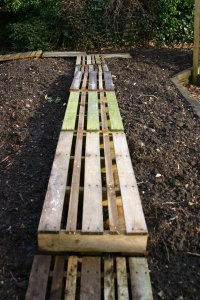
New boardwalk made of old wooden pallets

New boardwalk made of old wooden pallets

You know how poor my carrots were last year – the rotten weather didn’t help, I know, but I think that the bed I grew them in is still a little heavy (in contrast to the rest of the soil) and they don’t respond well to this and over – rich soil (I mistakenly put manure on the area a short time before the new season began). This encourages them to fork, whereas by keeping the soil relatively under – fed early on you apparently encourage them to grow straight and true as they seek out the nutrients further down – at least that’s what I heard Bob Flowerdew say on ‘Gardeners’ Question Time’ last week! Oh, and you remember I’d been collecting a load of old pallets? I’ve finally got round to making good use of them. They cut up nicely into sturdy 500mm – wide board walks which I’ve lain over the top border – this means that I have two manageable – width beds and don’t have to walk on the soil between them.

I’ve also been clearing out a side bed which was becoming choked with a Lilac that was suckering all over the place. This border is a bit on the edge of the kitchen garden and is not ideal for food growing, so I think that I might use it for flowers to attract insects etc. I’ve a good supply of Marigold seeds from last season, so they can go in there.

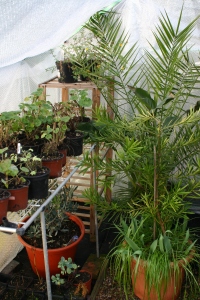
Over-wintering plants in the Old School Garden greenhouse

Over-wintering plants in the Old School Garden greenhouse

The greenhouse seems to be working well at over wintering my pelargoniums and ‘exotics’ and the pots of broad beans and sweet peas I put out a week or two ago are starting to push new growth through. I’ve sown some other seeds in my propagators – just some brightly – coloured Cosmos, Iceland Poppies and Leeks – these seem to be doing well, and hopefully I can pot them up shortly. I’m also chitting two varieties of early potato. You know how much I love ‘Charlotte’, the waxy ‘second early’ and alongside this I’m growing ‘Pentland Javelin’.

It looks like the weather is going to be a bit warmer in the coming week – in fact as I’m writing the rain has stopped and the sun is out! Hopefully I can get out tomorrow and catch up with a few more jobs that need doing – for example putting some pesticide on a couple of Hosta- filled containers to eradicate Vine Weevil (didn’t quite manage to get rid of these last year through a soil change), spraying my dwarf Peach tree with Bordeaux Mixture to help prevent ‘Peach leaf curl’, replanting the many Nerine bulbs I dug up recently from the kitchen garden and getting some more seeds into the propagators.

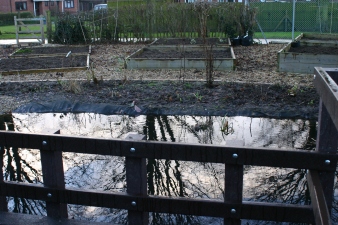
The primary school garden from the new pond dipping platform

The primary school garden from the new pond dipping platform

On the broader front my work with Norfolk ‘Mastergardener’ seems to be picking up once more. I’m helping the local Primary school with their School Garden, as you know. I’m shortly going off to meet with their garden coordinator to discuss plans for the coming year. I’ve offered to go into school one day per week to work with different classes and I’m looking forward to helping them get the most out of the garden, which is now starting to look really good. You may recall that we (staff, parents and children) managed to get a new wildlife pond installed over the summer and I also installed a pond dipping platform for them (made from recycled plastic), so the children will have this new resource for nature study in the coming months.

Yesterday I visited a new food grower I’m supporting for Norfolk Mastergardener. She lives in the next village and has recently moved to a large house with a super plot. I was impressed with the 2 polytunnels she has as well as a fenced off, structured vege growing area. She’s a keen animal lover and has this enormous pig (which her granddaughter rides like a pony!) as well as chickens, ducks, cats, dogs etc! The pond has a large number of enormous Carp in it too.

Any way, she’s a beginner when it comes to gardening and wants me to advise her about food growing for her large family. I’ve suggested she looks at the range of seeds she’s bought (as well as inherited from the previous house owners) and does a rough plan of what she wants to grow and where this might go in her plot. I’ll then talk this through with her and some of the basics about manuring and preparing the soil, sowing seeds, potting up etc. I’ve suggested that she keeps things simple this year and just goes for one crop in each area, rather than think about succession planting, until she sees the amount  of time she’ll need to put in and what her garden will generate in terms of food. We’ll see how it goes, but it’s a wonderful setting and with the polytunnels (one plastic – covered, one netted) she has some great growing areas to play with.

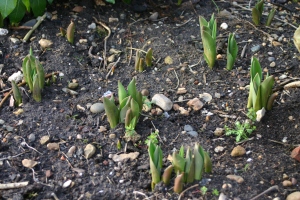
Tulips starting to show themselves in Old School Garden

Tulips starting to show themselves in Old School Garden

Well, I see the time has ticked on and I must be out to my meeting at the School. I’ll drop you another line in a week or two to let you know how I’m getting on, and hopefully we’ll also stay in touch via my blog or by email? By the way I’d welcome any comments or suggestions you might have about the blog, as I’m still finding my way!

Very best wishes from

Old School Garden

If you’ve enjoyed reading this post and others on this blog, why not comment and join others by signing up for automatic updates via email (see side bar, above right ) or through an RSS feed (see top of page)?

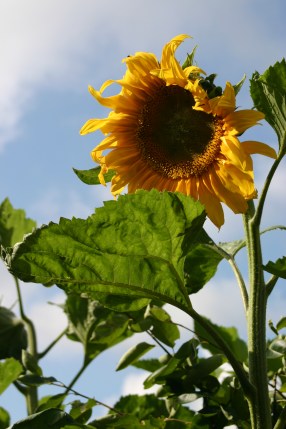
Sunflowers were planted by a local playgroup at the May opening of the garden - with the wet summer they grew to over 2.5 metres tall!

Sunflowers were planted by a local playgroup at the May opening of the garden – with the wet summer they grew to over 2.5 metres tall!

A renovated garden is moving towards maturity in what were once exercise yards for tramps and unmarried mothers at Gressenhall Farm and Workhouse Museum, Norfolk.

The garden occupies what were once two exercise/work yards for inmates of the Victorian Workhouse. The footings of what was once the dividing wall between these two yards can still be seen, emerging as the lawn above is worn away.  In Victorian times these yards joined two blocks of accommodation:

  • for so-called  ‘casuals’ or tramps who used to travel between workhouses earning ‘a night’s board for 2 days hard labour’ – possibly crushing stones for use in road building
  • for unmarried mothers nursing their babies – they wore distinctive uniforms to mark them out from the other workhouse inmates.
The refurbished 'Education Garden'

The refurbished ‘Education Garden’

These buildings today provide the Museum’s Learning Centre and space for occasional groups and events. Until last year the garden area between the two buildings was kept maintained as grass and a range of mixed borders which is an important picnic/ rest spot as well as being used by school and pre school groups for art and learning activities. In 2012 funding from the Friends of the Museum as well as the Museum itself and donations from a range of local businesses were secured to refurbish and redesign it. A number of design issues were tackled, including:

  • Providing further paved terrace space with new picnic tables and some renovated paving
  • Introducing a number of planting containers to add interest to the paved terraces
  • Realigning paths to follow ‘desire lines’ and make access easier
  • Deepening borders to provide more visual interest and unified planting
  • Creating a new ‘curiosity corner’ to provide a space designed for under 5’s which contains a range of features to encourage children to explore.
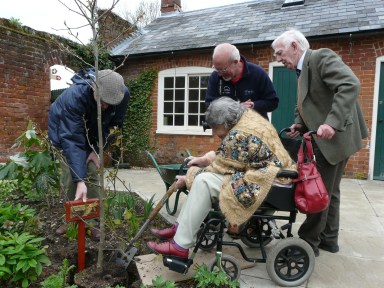
Mary and Derek Manning plant a tree to mark the opening of the garden

Mary and Derek Manning plant a tree to mark the opening of the garden

The newly renovated garden was formally opened on 6th May 2012, and two of the original gardening volunteers, Mary and Derek Manning, planted a ‘Paper Handkerchief Tree‘ to mark the occasion. Local children also played their part and cut ribbons to open ‘Curiosity Corner’.

One of the new residents of the Garden!

One of the new residents of the Garden!

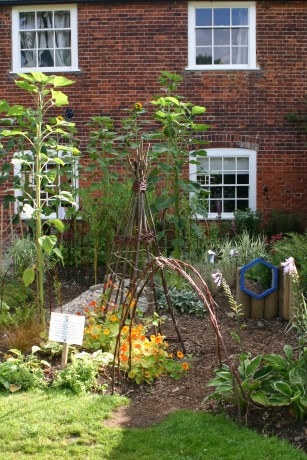
The Curiosity Corner proved to be very popular in its first season last year and included some giant sunflowers planted by a local play group as well as a turf seat; a willow tunnel and arches; hazel wigwam; mirror; ‘fossil slab’; various ‘animals’  hidden away in the planting and a range of different path surfaces and planting. There is also a half barrel filled with stones,water and pond plants, so that youngsters can ‘get up close’ to this watery habitat.

 'Curiosity Corner'

‘Curiosity Corner’

The coming year will see the garden mature further and hopefully there will be sunny days so that visitors can really enjoy this lovely picnic area at its best.

New planters with sweet peas on conical obelisks

New planters with sweet peas on conical obelisks

Quizzicals:

Two more cryptic clues to the names of plants, fruit or veg…

  • The scourge of female chickens
  • Cheap goods in a pile of dung

Old School Gardener

If you’ve enjoyed reading this post and others on this blog, why not comment and also join some other people and sign up for automatic updates via email (see side bar, above right ) or through an RSS feed (see top of page)?

PicPost: Great Garden @ The Old Vicarage

The Old Vicarage – East Ruston, Norfolk

“Throughout the garden you will see many rare and unusual plants growing…. Our garden lies 1½ miles from the North Sea in an exposed prairie landscape containing large arable fields. Many of the wildlife habitats have long been swept away and we have endeavoured throughout the garden to replace these by the planting of mixed hedgerows, banks, wildflower areas and ponds.

The soil here is of excellent quality, a light sandy loam with a neutral pH. Due to the maritime influence the garden suffers little in the way of serious frost damage and we have planted large shelter belts of Pinus radiata, the Monterey Pine, Alnus cordata, the Italian alder and many Eucalyptus. This enhances the garden’s unique microclimate which enables us to grow such a huge range of plants.”

Source : Old Vicarage website

Old School Gardener

Finding Nature

Nature Connectedness Research Blog by Prof. Miles Richardson

Norfolk Green Care Network

Connecting People with Nature

Discover WordPress

A daily selection of the best content published on WordPress, collected for you by humans who love to read.
Susan Rushton

Celebrating gardens, photography and a creative life

Unlocking Landscapes

Writing, photography and more by Daniel Greenwood

Alphabet Ravine

Lydia Rae Bush Poetry

TIME GENTS

Australian Pub Project, Established 2013

Vanha Talo Suomi

The Journey from Finnish Rintamamiestalo to Arboretum & Gardens

Marigolds and Gin

Because even in chaos, there’s always gin and a good story …

Bits & Tidbits

RANDOM BITS & MORE TIDBITS

Rambling in the Garden

.....and nurturing my soul

The Interpretation Game

Cultural Heritage and the Digital Economy

pbmGarden

Sense of place, purpose, rejuvenation and joy

SISSINGHURST GARDEN

Notes from the Gardeners...

Deep Green Permaculture

Connecting People to Nature, Empowering People to Live Sustainably

BloominBootiful

A girl and her garden :)