Tag Archive: norfolk


IMG_7411I recently featured a poem by a former neighbour, Jack Kett. I’ve now picked up one of the books of his poems and thought some of these are so evocative of the landscape around me here in Norfolk, that I’d feature a few more. So here’s the first as we end September…..

‘September morning, with the warm sun growing

In warmth and brightness, scattering mists of pearl,

Which round the waking village flow and furl.

And see, the top of the church tower is glowing,

Splendid, sunlit, above the misty sea,

Now ebbing  fast to set the morning free.

Along the hedgerow countless dying weeds

Show one last beauty in their feathered seeds.

The chattering sparrows wheel, and wheel again

Across the stubble field, and by the lane,

Among the dew-drenched grasses hardly seen,

Yet showing rarely a sun-gilded sheen,

A silver maze of gossamer is spread,

While all around hang berries, richly red.’

‘September Morning’ by John Kett from ‘A late lark Singing’ (Minerva Press 1997)

Related articles:

The Church in the Fields

Old School Gardener

934746_10151676747891970_1023613447_n“A different point of view”- tools to help you assess and get more from your garden.

13 October 2013, 10.00 – 4.00

Gressenhall Farm and Workhouse, Norfolk

Is your garden in need of a revamp or complete makeover, but you don’t know where or how to start? This workshop will help you assess your garden and what you want from it, grasp some of the basics of garden design and how to apply these to your own space.

I’ll be leading the workshop, which will be a mix of presentation, practical exercises and group discussion. Examples and case studies, together with the gardens at Gressenhall Farm and Workhouse, will be used to illustrate key points and inspire you to develop ideas for your garden.“A different point of view”- tools to help you assess and get more from your garden. 13 October 2013 10am - 4pm<br />

£32 per person / £28.50 for Museums Pass holders (including tea and coffee)

For more information and a booking form go to Gressenhall Adult Learning

Old School Gardener

If you’ve enjoyed reading this post and others on this blog, why not comment and join others by signing up for automatic updates via email (see side bar, above right ) or through an RSS feed (see top of page)?

church

I came across this poem the other day. It’s written by a chap called Jack Kett, a lovely Norfolk man who was a former Head teacher at the local school and lay preacher at our local church, St. Peter’s, Haveringland. He and his wife were well known local charatcers who have both now passed on. Many of Jack’s poems describe the local Norfolk landscape.

You may recall that some of the money raised from our recent ‘Open Garden’ event is going towards the upkeep of St. Peter’s, which can be seen from our garden. This important local landmark is, sadly, no longer regularly used for church services, but it has a rich history, including having a second world war airfield plonked next to it, which has resulted in the church being a rather lonely feature in an otherwise flat landscape – the ‘Church in the Fields’.

St.  

St.   St. Peter’s Church, Haveringland

‘Lift up your eyes, and look on the fields’,

He said, ‘your lesson to learn’.

And here, in Haver’land’s fields today,

We also, in our turn,

Witness the pageant of seasons,

The ever – changing scene,

Which, where men work along with God

Turns gold, or brown, or green.


Let us remember our forbears,

Who in the years gone by

Surveyed a scene so different,

Yet under the same great sky.

The days of the Abbey, the Market,

The Manor, the Hall – all pass

Each down the road of history,

Now rubble under the grass.


Wars and rumours of wars have come

And gone, like the stately trees,

And now, where the noisy engines roared

We hear the hum of the bees.

We live in a world of changes,

Yet surely the lesson is clear –

Amidst it all, as on a rock,

St. Peter’s  stands here,


Symbol of Truths that never change,

Of a faith that never yields,

And we find the Eternal Peace of God

In His Church among the fields.


Jack Kett , 1960

Old School Gardener

The blckbirds nesting among the vine in the Courtyard Garden at Old School Garden- picture by Gabbie Joyce and Paul Hill

The blackbirds nesting among the vine in the Courtyard Garden at Old School Garden- picture by Gabbie Joyce and Paul Young

To Walter Degrasse

Dear Walter,

It’s coming to the end of one of the driest and hottest July’s we’ve had in nearly 10 years. Today looks like it will be the hottest of the year to date – somewhere in the upper 20s if not low 30s Celsius in our corner of England (and higher elsewhere)! Having spent a couple of hours this morning planting out the last of my summer annuals, thinning and transplanting wallflowers and planting some leeks, I’ve escaped the worst of the heat and come inside to drop you a line!

As you can imagine, the last few weeks have been very busy on several gardening fronts. I guess the most significant event was our first garden opening last week, which I’ve done a separate article about. This was great fun and I was very pleased with the way the garden looked and the many positive comments from the 70+ visitors. We raised over £300 too which will be going to three local ‘good causes’.

One of these is ‘Master Gardener’, where I continue to offer my voluntary advice and help to those starting  to grow their own food. Gabbie, the local co-ordinator, has come up with the idea of using the money we raised as a special fund to be tapped into by Norfolk Master Gardeners to purchase small items to help their households, groups and other new growers- I’ll tell you more about this in due course. I’ve attended a few events recently and had fun talking with a range of people about their food growing experiences and maybe even helped to recruit a few new households. The latest event was the ‘Destination Aylsham’ Fun Day yesterday, which I helped out at with fellow Master Composter Sally Wilson- Town and co-ordinator David Hawkyard. Well over 70 people came over to discuss composting and ‘growing your own’, though my period at the stall seemed to coincide with the quieter, ‘wind down’ phase towards the end. Still,  no matter, we seem to have promoted composting and food growing to a few more people – and I managed to sell some plants and produce too!

I’ve done my last session this academic year at Cawston Primary School, where we had great fun harvesting potatoes, broad beans and a few onions. In truth, with the exception of the Broad Beans, these were harvested a little too soon, because this was the last opportunity for the children to garden before their holidays which begin on Thursday. Still, the potatoes were of a good size and a reasonable quantity and will be used in the school kitchen this week along with the beans and some of my donated home grown produce (we’ve had some enormous Calabrese and Cauliflowers lately). The children also continued to dig out the old compost bins so that we can make a new start there in the Autumn. However, it’s disappointing that we’ve not been able to keep on top of the weeding in the bog garden around  the wildlife pond (which is also looking extremely dry), as many weeds have now set seed, so that will be an added problem for us in the Autumn, when  hopefully the soil will be damper and weeding easier. However, the Outdoor Learning Co-ordinator , Sharon, tells me that the pond has been a real winner with the children and has yielded examples of a wide range of insect and other wildlife.

The gardens at Gressenhall Farm and Workhouse Museum are struggling in the sun and heat, but the planting and care taken earlier in the year by myself and other volunteer gardeners seem to be paying off. The rambling rose ‘Rambling Rector’ in the Wildife Garden looks particularly splendid as it covers the arbour and adjoining wall, where I and my friend Steve spent an hour or two pruning and tying in last autumn.


At home, Old School Garden is also struggling in the heat, and evening watering sessions of hand held spray and sprinkler have lasted a good few hours in recent weeks – and still many new plantings are wilting! Anyway, the long borders are looking great, though with a few gaps after shearing back the oriental poppies. I’m hoping that my strategically placed pots of tender perennials and plantings of annuals will soon plug these and the overall show will reach a crescendo in a few weeks time. The kitchen garden has proved to be very productive to date, though we  continue to get problems with pests such as pigeons and to a lesser extent blackbirds and aphids. I’ve noticed a few Cabbage White butterflies recently, but hopefully with my planting of Nasturtiums and netting of my Brassicas, we’ll not be too badly affected by their hungry green caterpillars! So far we’ve had crops of :

  • Potatoes – though I had to lift many of these a bit early as blight had started to affect them

  • Calabrese  -huge heads from the F1 variety ‘Beaumont’

  • Cauiliflowers- though a few heads were ‘blown’ as we couldn’t keep up with the supply!

  • Mange Tout – despite early pigeon attacks!

  • Celery – too much to cope with!

  • Carrots – a reasonable first crop though many were twisted and misshapen, possibly a combination of too rich and stony soil

  • Lettucs – a few varieties from the garden have tasted good along with some ‘cut and come again’ varieties in pots.

  • Tomatoes – just a few of the smaller, golden variety to date, but plenty on the plants in the greenhouse, ready for swelling and ripening.

  • Courgettes – the start of what promises to be a bumper year, especially as my friend Steve has given me four ‘Patty Pan’ plants to go with the two green varieties he’d already supplied!

  • Strawberries-  you remember I’d started the process of relocating the strawberry bed? Well the new plants seem to have taken well, though, as youd’ expect I didn’t let them flower or fruit this first year, but the old plants I left hoping for ‘one more year’ of fruit were a disaster. Very few fruits and what there were the blackbirds, slugs and mould seem to have taken. So for the first time in many years I actually bought two punnets of strawberries!

  • Raspberries – these are coming on well and we’ve enjoyed a few days supply so far, though the pigeons, despite my various ‘bird scarers’, seem to be enjoying themselves and breaking off the fruiting stems as they use them like ladder to go up and down the canes!

  • Garlic – most now harvested but some along with the onions are just drying  out before storing

  • Broad Beans – a good crop of a rosy pink variety, though when cooked their attractive colour seems to turn a rather dull grey, but they taste just fine!

  • Gooseberries- first bush harvested , two red varieties to come this weekend

  • Blackcurrants- two bushes harvested and a lot frozen, with one more to come shortly

Later today, I’ll be sowing some further crops of Lettuce, Mange Tout, Carrots and Cabbage as well as some Pansies I got from the Royal Norfolk Show and which  should provide us with some autumn and winter colour. That’s if it is not too hot of course.

Well, old friend, I see that it’s about time for lunch, so I’ll close for now and wish you and your good wifeFerdy’ well. By the way, would she mind terribly if I called her by her second name, which I find so much more attractive? Lise seems to capture her elegant beauty a lot more than that  nickname she got all those years ago at University! We’re looking forward to seeing you both here at Old School Garden in a week or two’s time – hopefully the garden will still look good and the weather will mean we can enjoy some warm summer evenings on the terrace with some good food, and even better wine!

all the best

Old School Gardener

Other posts in this series:

Dear Walter…. letter from Old School Garden 21st June 2013

Dear Walter….letter from Old School Garden, 20th May 2013

Dear Walter….letter from Old School Garden, 18th April May 2013

Dear Walter….letter from Old School Garden, 11th March 2013

Dear Walter… letter from Old School Garden: 15th February 2013

If you’ve enjoyed reading this post and others on this blog, why not comment and join others by signing up for automatic updates via email (see side bar, above right ) or through an RSS feed (see top of page)?

IMG_6053” ‘T was a hot afternoon, the last day of June and the sun was a demon….”

Remember the tune? I’ll give you the title and artist at the end of this article….

Well Sunday afternoon was certainly hot (the hottest day of the year so far) and whilst some may have headed for the beach, hundreds found their way to Gressenhall Farm & Workhouse Museum, Norfolk.

One of the Museum’s ‘Days with a difference’, the event saw a range of stalls selling, advising and demonstrating garden – related topics. I was there for the afternoon as a Master Gardener, offering advice on growing your own food, composting and just enjoying a chat or two with some seasoned garden folk. I particularly liked the ornamental ironwork display with some large pieces that would look good as eye catchers in the garden. And there was a very interesting vegetable stall selling plug plants of some unusual varieties – if I had more space in my kitchen garden I’d have bought some! Here’s a gallery of some of the stalls and their offerings.

And the gardens at the museum (you may recall that I’m a volunteer gardener here), also drew many positive comments and questions about the plans looking good at present – especially the ranks of Salvia sylvestris ‘Mainacht’ fronted by a low hedge of Lavandula angustifolia ‘Little Lady’ just coming into flower. The other gardens also looked good – the ‘Rambling Rector’ rose a colleague and I carefully pruned and tied in earlier in the year is particularly floriferous , tumbling over the metal arbour in the Wildlife Garden as well as draping one of the museum’s walls. Anmd the veg in cherry tree Cottage is starting to fill up the beds well. The Cafe Garden, looked after by volunteer Sue, is superb this year with a varied display of shrubs and perennials witha good mixtures of height, form and colour. Here are some pictures of some of the gardens and the newly reopenend ‘Seed Merchant’s Shop’ on the day.

…and the song?  ‘Summer (the first time)’ by Bobby Goldsboro (1973) – a classic summer song!

Relive it here:

Old School Gardener

If you’ve enjoyed reading this post and others on this blog, why not comment and join others by signing up for automatic updates via email (see side bar, above right ) or through an RSS feed (see top of page)?

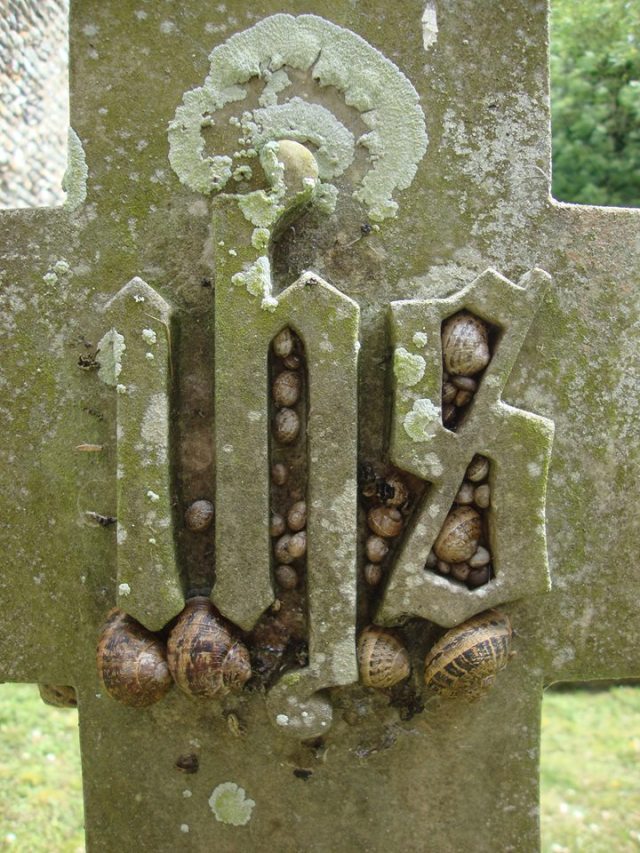
PicPost: Dodman's Rest

Tombstone at Weybourne, Norfolk via http://www.ournorfolk.org.uk

‘A dodman (plural “dodmen”) or a hoddyman dod is a local English vernacular word for a land snail. The word is used in some of the counties of England. This word is found in the Norfolk dialect, according to the Oxford English Dictionary. Fairfax, in his Bulk and Selvedge (1674), speaks of “a snayl or dodman.”

Hodimadod is a similar word for snail that is more commonly used in the Buckinghamshire dialect.

Alternatively (and apparently now more commonly used in the Norfolk dialect) are the closely related words Dodderman or Doddiman. In everyday folklore, these words are popularly said to be derived from the surname of a traveling cloth seller called Dudman, who supposedly had a bent back and carried a large roll of cloth on his back. The words to dodder, doddery, doddering, meaning to progress in an unsteady manner, are popularly said to have the same derivation.

A traditional Norfolk rhyme goes as follows:

“Doddiman, doddiman, put out your horn,
Here comes a thief to steal your corn.”

Source: Dictionary of Phrase and Fable, E. Cobham Brewer, 1894

The ‘inventor’ of ley lines, Alfred Watkins, thought that in the words “dodman” and the builder’s “hod” there was a survival of an ancient British term for a surveyor. Watkins felt that the name came about because the snail’s two horns resembled a surveyor’s two surveying rods. Watkins also supported this idea with an etymology from ‘doddering ‘ along and ‘dodge’ (akin, in his mind, to the series of actions a surveyor would carry out in moving his rod back and forth until it accurately lined up with another one as a backsight or foresight) and the Welsh verb ‘dodi’ meaning to lay or place. He thus decided that The Long Man of Wilmington was an image of an ancient surveyor.’

Source: Wikipedia

IMG_6025

‘Iron Man’ Gorilla outside the County Council tent- one of many hand painted gorillas that have just been put on display around Norwich in aid of a local children’s charity.

Yesterday I spent an enjoyable day at the Royal Norfolk Show, the County’s long established ‘agriculture plus’ event that has its own show ground at Easton near Norwich. My main reason for being there was to help man the ‘Master Gardener’ and ‘Master Composter’ stand, offering information and advice about growing food at home and, of course, how to compost effectively.

Before this afternoon stint I was able to stroll around, camera in hand, and soak up the atmosphere on this first of the two day show. Over both days the organisers are expecting around 90,000 people to attend, and they are aiming to ‘break even’ financially. It’s interesting that the show has managed to survive the tough financial times as some other county shows have folded completely due to dwindling attendances, not moving with the times or a lack of facilities to cope with poor weather. No signs of that at Easton, where there was a busy, joyful atmosphere, especially as the weather (until the very end of the afternoon) was warm and sunny.


As expected the crowds were a curious mix of ‘old and new’, or perhaps more accurately, different social groups  – the well dressed ‘County Setters’ in their blazers, shirts and ties, flowery hats and summer dresses (most involved in farming in some way), alongside groups of school children and more casually dressed families, teenagers and older couples. A microcosm of the local community in what remains predominantly a rural, agricultural County. Of course an agricultural show wouldn’t be the same without the ranks of huge and intricate machinery, some old, some brand spanking new as well as age-old crafts like horse shoeing and sheep shearing – including an impressive display by the Gressenhall Fam Manager, Richard Dalton, using a set of 100 hundred year old hand cranked clippers!


It’s always impressive to see some of the ‘beasts’ entered for the various cattle, horse, pigs and other animal competitions and the efforts put into their grooming and presentation for the judges. On the horticultural front there was an impressive floral display in one marquee, including some delightful orchids, chrysanthemums and looser mixed arrangements of garden plants nicely in flower and leaf. There were also some amazing floristry displays and the usual competitions for different types of home grown fruit and veg- some impressive Gooseberries caught my eye in particular. I managed to come away from the Norwich and Norfolk Horticultrual Society ‘plant tombola’ with a hand full of very nice seed packets, so I now have a supply of purple Pansies, Amaranthus, Morning Glory and Carrots to add to my seed bank!


And the varieties of food on offer reinforced the summery feel too – tumblers full of freshly cut fruit, strawberries and cream and of course ice cream a plenty. And not wasting food was one of the key messages of the Norfolk Waste Reduction Team’s display, which also hosted the Master Composter/Gardener stalls, along with some fascinating crabs illustrating the work of the Fisheries Conservation Agency. This was a great draw for the children who continually asked ‘which one is the most dangerous?’- in truth none of them really, as despite their fierce looking claws, the staff were able to pick them up to show the to the crowds without any apparent fear – or nipping!


My afternoon was spent talking to show goers about growing their own food and composting. I had some very interesting chats including a teacher from a local High School who teaches horticulture there and sounds to have a splendid school garden, several couples about starting or improving their compost, helping children to make paper pots and sow seeds to take home (along with all the other ‘trophies’ they collected from the stalls at the show), and other show goers clearly just enjoying growing their own food and with whom I shared tales of the late spring, compared potato growth rates and discussed rhubarb diseases.  The next door County Council tent with which we were associated also put on a splendid carousel of displays and activities (including live music) illustrating the array of ways in which the Council serves Norfolk – in fact it (and we) were so good that the whole stand won the Show’s top prize for ‘trade’ stands, so congratulations all round!

So, as you can tell, I had both a very pleasant day out – and one that boosted my energy, interest and optimism for gardening!

Old School Gardener

If you’ve enjoyed reading this post and others on this blog, why not comment and join others by signing up for automatic updates via email (see side bar, above right ) or through an RSS feed (see top of page)?

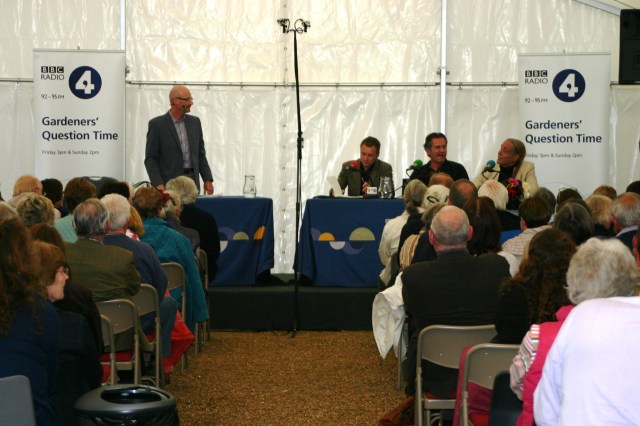
The GQT Panel doing their stuff

The GQT Panel doing their stuff

200 eager gardeners packed the marquee at Gressenhall Farm & Workhouse Museum, Norfolk yesterday. Rather than post my own article answering gardeners’ questions I thought I’d devote this week’s GQT to a report on the real thing!

Well, it turned out to be a fascinating event, especially watching the ‘well oiled machine’ that is GQT in operation. Celebrating its 65th year of broadcasting this year the programme, as chairman Peter Gibbs said, ‘has become a national institution’ attracting some 2.5 million listeners a week. Pleading with the audience not to blame him for the recent weather (for non Brits he’s a well-known TV and Radio weather forecaster as well as a keen gardener), he recalled his time in Norfolk and visiting the Museum with a young family about 15 years ago. He went on to chair not one but two editions of the programme (I’ll give you broadcast dates later). And we were not disappointed with either the range and quality of the questions or the depth and humour of the Panel’s answers.

Earlier I had been involved in a ‘pre recording’ session with some fellow gardeners and the original Museum curator, Bridget Yates. Matthew Wilson and Bob Flowerdew, two of the panelists quizzed us on the history of the place and some of the more recent developments in the gardens. I was mightily impressed with the professionalism of the production team and the two panelists who seemed to conjure an interesting and relevant discussion from the barest of facts – you’ll have to listen in for the full version!

The GQT Team at Gressenhall- from left: Matthew Wilson, Chris Beardshaw, Peter Gibbs, James Wong and Bob Flowerdew

The GQT Team at Gressenhall- from left: Matthew Wilson, Chris Beardshaw, Peter Gibbs, James Wong and Bob Flowerdew

After this I was pleased to have the opportunity of interviewing Matthew Wilson myself, for the online newspaper ‘The Breckland View’. A well known Garden Designer and Director of an historic plant nursery in London, Matthew talked about his (positive) impressions of the Museum gardens and we went on to talk about growing food at home. Matthew believes this is important, not only for the freshness and flavour of the home-grown produce, but as a way for people to ‘reconnect’ with nature in an increasingly ‘virtual’ world. Though his own garden is small, he tries to ensure that his young children are able to experience nature and growing things close up. He seems to be undecided on the ‘GM or not GM’ debate, as frustrated as me on the apparent lack of ‘hard’ evidence to help us decide how to proceed with the urgent business of ‘feeding the world’, though he feels we can still achieve improvements in crops from some of the older techniques of selection and breeding.

The Question time proper featured a dazzling array of questions. The panelists – serial Chelsea gold – winning medallist Chris Beardshaw and ‘new wave’ botanist James Wong  joined Matthew on stage for the first session  – seemed effortless in their answers to questions as diverse as:

  • whether the museum’s collection of historic gardening books and other material is still relevant (a resounding ‘yes’ from all to that one),
  • trying to explain why one poor gardener could only produce some ‘micro rhubarb’ (pencil thin stalks 10 centimetres long) – the ‘answer lies in the soil’ it would seem, specifically the lack of rich, organic matter and the right position, according to Matthew
  • what kinds of veg could be grown in a wet and dismal summer – James came up with some interesting oriental varieties that in a normal hot dry summer would bolt, but in a more dim and damp period would turn out just right
  • selecting some ‘exotic’ but hardy plants for a patio. Chris initially shocked his audience with a suggestion of ‘black negligee and stockings’, but quickly added that these were references to some interesting plants – sorry, the names have eluded me after the initial image he created…!

And I can confirm that, as the programme repeatedly states, the panel were not privy to the questions before they were asked! The audience was very receptive to the ongoing banter and humour between the panelists and seemed to maintain their enthusiasm right through a second session (where James was substituted by well-known Norfolk organic gardener Bob Flowerdew). Chairman Gibbs praised our fortitude and two hours later it was all over! It had been an enjoyable evening and one where gardening colleagues were welcomed from far and wide the gardening Team from Peckover House, Wisbech and Master Gardeners from King’s Lynn being some of the furthest travelled.

The first programme should be broadcast at 3pm on Friday 5th July (repeated Sunday 7th July 2pm) and the second (from a more anonymous ‘Norfolk’ location this one) on the 23rd/25th August. So, tune in to BBC Radio 4 at these times (or try it online via www.bbc.co.uk, on their ‘i player’ or ‘listen again’ facility if you can’t listen ‘live’).

And for anyone within striking distance of Gressenhall this weekend, the Museum has a special interest day on Sunday focused on gardens and gardening, so why not pop along and meet me at the Master Gardener stall, visit the many other attractions on offer and see the gardens, which I must say are looking splendid (but then again I would say that)!

Thanks to Kings Lynn Community Allotment for the photographs

Old School Gardener

If you’ve enjoyed reading this post and others on this blog, why not comment and join others by signing up for automatic updates via email (see side bar, above right ) or through an RSS feed (see top of page)?

The Kitchen Garden at Old School Garden

The Kitchen Garden at Old School Garden

To Walter Degrasse

Dear Walter,

As I write to you on midsummer day it’s cloudy and rain threatens. We have had some warm spells and even some sunshine, but you get the feeling that ‘proper summer’ has yet to find its way to Norfolk. I know that you’ve had pretty similar weather in your neck of the woods and no doubt you’re as curious as me as to the way the ‘late’ (read almost non-existent) spring has had an impact on the plants. A few pointers from Old School Garden as I write:

  • the Magnolia is still in flower as are the Siberian Wallflowers, Pansies and Violas
  • Sweet Williams are just about coming into flower but the pink Peonies, though with huge fat flower buds, have yet to fully unfurl (having said that the earlier, red varieties have been and gone)
  • Irises are looking good (though last year’s Iris Rust problem has retuned to some)
  • Carrots and Broad beans probably need a further week or two to be fully ready for harvesting
  • Second early (but not first early) potatoes are flowering
  • Lettuces are ready to crop

So it’s a story of some things flowering late and running into other things which is making for some interesting combinations and a few weeks of intense colour; certainly the best show at this time of year I can remember for some time!

Rather than spend a lot of words telling you about my gardening activities in the last month I thought that I’d let ‘the pictures do the talking’ so I’ve included three photo galleries and will give you a few guiding comments for each. The first one is a few pictures of the Gardens at Gressenhall Farm and Workhouse Museum, where the Education Garden I redesigned and with volunteer support, replanted last year is looking superb. A mass of pink and orange oriental poppies along with Salvia ‘Mainacht’  with the billowing leaves of Macleaya in the background, are putting on a wonderful show, remarked on by many visitors, it appears.

There’s a call for me to provide some information on the plants included in the borders, so I’ll have to dig out my original design and plant lists and put together some sort of illustrated guide. Likewise, after a clean out and weed, the Wildlife Garden, and especially the pond and bog areas, are filling out nicely, though there doesn’t appear to be much wildlife evident to date. Monday is going to be something special here as BBC Radio 4’s ‘Gardeners’ Question Time’ is being recorded at the Museum and I’ll be on hand to help guide the audience and provide some information on the gardens. I’m not sure when this is broadcast but I’ll let you know when I’m sure, though I know that you’re a regular listener like me.

My voluntary work at the local Primary school continues with a regular weekly slot working with groups of children of different ages in the School Garden. You may have seen my recent post on the vertical planters we’ve made out of old wooden pallets – these are looking very colourful alongside the playground and I’m pleased to say that the children are being diligent in their watering duties. I’m going over there later today so will have a quick look to see that they’re holding up – I’m not sure the compost will hold in place especially if it gets at all dry. At yesterday’s session we weeded around the various veg beds and cracked open the first pods of Broad Beans which the children eagerly popped into their mouths – once I’d assured them that they would be deliciously sweet and tender – there came  a predictable ‘hmmm, yummy’ in response!

The other crops are all coming along well, and the attention to regular weeding and watering has really paid off this year, so we should be cropping potatoes, onions, cabbages, calabrese, peas, runner and broad beans, turnips and carrots soon! The other big  job was to empty out the wooden compost bins which have been clogged up with grass, sticks and soil over the years and are in real need of starting over once more. Hopefully, we’ll get this finished off today and we can then get more of a systematic approach to adding food peelings etc. from the kitchen as well as ‘green waste’ from the school lunches. The wormery seems to be going well, and the School Cook is pleased that the refuse collectors are now collecting food waste for composting at a local centre, too.

My other Master Gardener activity is picking up a bit. I’m doing stints at the Norfolk Show next week and also an event in a nearby village where some Lottery cash looks like it’s going to make some new adult education classes possible, including something from me on growing your own food or maybe design, depending on the level of interest. I’m going along to an open day on this to gauge interest and promote both Master Gardener and the idea of the courses, so we’ll see if anything comes of that.

As far as Old School Garden goes, I’ve mentioned the great show we’ve had recently so will let the photographs give you the details! Its been a month of systematic weeding around the different borders, finishing off staking the herbaceous perennials, dead heading and recently planting out the many annuals I’ve een raising from seed to plug gaps etc. I must say I’m pleased with the result, and after visiting a few gardens recently we’ve decided to open ours for charity in mid July. I’ll let you have details in due course, but we hope to make this a lively afternoon with advice from  my friends in the Master Gardener and Master Composter projects and of course plant sales and some delicious tea and cakes!

I hope that you enjoy the picture gallery which shows a few shots of different parts of the garden taken yesterday. As I was walking around I spotted a female blackbird raiding my cold frame and carrying off some poppy seedlings (and compost) in her beak! Having seen her later in the courtyard garden I suspect she’s gathering material for a new nest! We do seem to have had a lot of Blackbirds this year and they seem intent on disturbing the wood chip mulch I put on the long borders in search of food, with the result that sweeping the paths is rapidly becoming a daily chore!

Well,  matey, I hope this little update finds you and your good lady in the best of health. It’s great that you’re now well on the road to recovery and no doubt pleased that you can get outside and dig your patch once more. Did you manage to find any paid garden help? I know that the grass cutting is your biggest nightmare and this is one thing you could do with some help on. Or maybe you might think about turning some of that grass into flowering meadow? I’ve seen some lovely examples of mown paths through long grass recently that must be less maintenance heavy and more wildlife friendly too – worth a thought.

Well, bye for now and I’ll give you a further update next month, though in the mean time I’ll do a post next week about how the recording of ‘GQT’ goes and my experiences at the Norfolk Show.

all the best

Old School Gardener

Other posts in this series:

Dear Walter….letter from Old School Garden, 20th May 2013

Dear Walter….letter from Old School Garden, 18th April May 2013

Dear Walter….letter from Old School Garden, 11th March 2013

Dear Walter… letter from Old School Garden: 15th February 2013

If you’ve enjoyed reading this post and others on this blog, why not comment and join others by signing up for automatic updates via email (see side bar, above right ) or through an RSS feed (see top of page)?

Well, we had a great day out on Sunday visiting this garden near Fakenham, Norfolk. A Tudor Hall with some fantastic chimneys and gables plus a superbly crafted and well-kept garden. Not normally open to the public, on Sunday the St. John’s Ambulance Brigade were the beneficiaries of the garden day.

Thorpland Hall is a sixteenth century hall set in 6 acres of quintessentially English country gardens.  It is a gem of a place with some very nice touches:

  • grass cut to varying heights to create informal paths and visual interest
  • subtle shrub and plant combinations
  • well stocked, traditional kitchen garden with Broad Beans as well as peas held up by brushwood and interesting intermingling of herbaceous and other perennials
  • A stone flag path with side planting pockets from which various ‘low growers’ soften the edges
  • Use of ‘saved’ architectural features from local churches as well as its own ‘ruined chapel’
  • a vast variety of trees and shrubs all looking mature and well cared for
  • a lily covered lake excavated by the owners, Nigel and Annabel Savory, with a ‘nod to Monet’ in its wooden bridge
  • a delightful ‘shepherds hut’ summer house and ‘his and hers’ rustic chairs.

Well worth a visit, if and when you get the chance!

Finding Nature

Nature Connectedness Research Blog by Prof. Miles Richardson

Norfolk Green Care Network

Connecting People with Nature

Discover WordPress

A daily selection of the best content published on WordPress, collected for you by humans who love to read.

Susan Rushton

Celebrating gardens, photography and a creative life

Unlocking Landscapes

Writing, photography and more by Daniel Greenwood

Alphabet Ravine

Lydia Rae Bush Poetry

TIME GENTS

Australian Pub Project, Established 2013

Vanha Talo Suomi

The Journey from Finnish Rintamamiestalo to Arboretum & Gardens

Marigolds and Gin

Because even in chaos, there’s always gin and a good story …

Bits & Tidbits

RANDOM BITS & MORE TIDBITS

Rambling in the Garden

.....and nurturing my soul

The Interpretation Game

Cultural Heritage and the Digital Economy

pbmGarden

Sense of place, purpose, rejuvenation and joy

SISSINGHURST GARDEN

Notes from the Gardeners...

Deep Green Permaculture

Connecting People to Nature, Empowering People to Live Sustainably

BloominBootiful

A girl and her garden :)