
Tag Archive: nature
 Here’s my second extract from the book ‘Noah’s Children’ by Sara Stein. Here she observes how American (probably western) culture has increasingly divorced children from directly finding things they need or are interested in; things that children used to find outside in the natural world: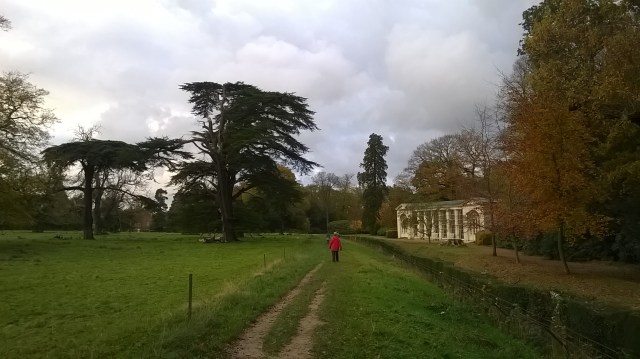
Cedars and the Orangery at Blickling Hall, Norfolk this week
Old School Gardener
 I’ve recently read the book ‘Noah’s Children’ by Sara Stein. You’ll possibly know from my previous posts about children’s play that I’m interested in how we can improve the opportunities for a more ‘natural’ outdoor play experience in our increasingly urbanised, consumerised and technology- dominated world.
I found Stein’s book a stimulating read, which examines a variety of reasons why children in general these days have less opportunity to engage with the natural world in ways that nurture a responsible and intimate relationship with it (as well as raising wider child development issues), so I thought over the next few weeks I’d feature a few extracts. In the first, Stein sets out the basis of the book:
‘Land is nourished or not by humans; humans are nourished or not by land. Place and occupant only seem seprable because we have created such a distance between liveliness and livelihood. In creating that distance, we have unwittingly detached the nature of childhood from the sense it ought to make. Childish curiosity is to make connections, to realize the larger picture, to become able in the physical environment our lives depend on. We’ve removed the red from the fruit, the fruit from the tree, the tree from the wood, the wood from all the things a child might make of it, and so left fragments much harder to connect than laces on a shoe.’
I’d love to hear your thoughts on this and the wider issues raised…
Old School Gardener
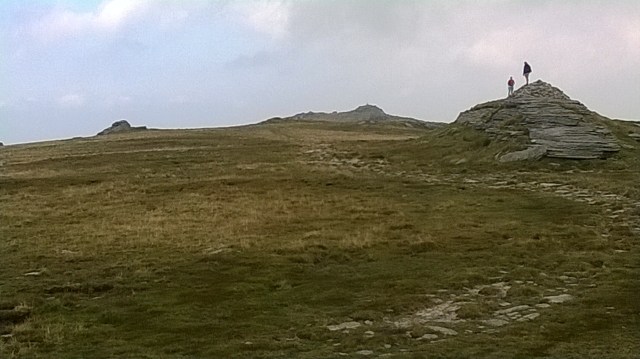 We’re just back from a week in Dartmoor, Devon, walking between some of the well-known, usually prominent rocky features of this beautiful landscape, known as tors.
The Challenge
The tors (there are over 160 of them) are the focus of an annual event known as the Ten Tors Challenge, when around 2400 people aged between 14 and 19 (in over four hundred teams of six), face hikes of 35, 45 or 55 miles (56, 72 or 88km) visiting ten nominated tors over two days. The teams must be self-sufficient, carrying all that they need to complete their route safely despite the terrain and the weather. The latter can be very changeable and at times quite extreme, and success or failure can depend very much on the extent to which a team has been trained for all eventualities.
Not having completed this in her youth, my partner ( a local lass), was keen to do her own ‘Ten Tors Challenge’, but at a more leisurely pace. In the event, extremely good weather meant that we were able to visit double the target number of tors spread over six days, and including excellent overnight accommodation at my mother – in – law’s house in Tavistock! Over a series of posts in the next few days, I hope to give an interesting account of our adventures along with a few pictures. For starters here’s a ‘primer’ on Dartmoor and the tors in question….
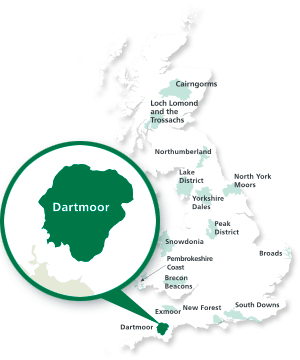 The Moor
Covering an area of 954 sq km (368 sq miles), Dartmoor contains the largest and wildest area of open country in the south of England. By virtue of its outstanding natural beauty it is one of the National Parks of England and Wales. Unlike many National Parks in other countries, for example the USA, the National Parks in England, Wales and Scotland are not owned by the state. The term ‘National’ means that they have been identified as being of importance to our national heritage and as such are worthy of special protection and attention. Within each National Park there are many landowners, including public bodies and private individuals. National Parks are places where people live and work.
Geology
A large part of Dartmoor (65%) is made up of granite, an igneous rock which was intruded some 295 million years ago. This great granite core is surrounded by sedimentary rocks including limestones, shales and sandstones belonging to the Carboniferous and Devonian periods. Those nearest the granite intrusion were altered (metamorphosed) by intense heat and pressure and chemical reactions.
Tors
Dartmoor is known for its tors – hills topped with outcrops of bedrock, which in granite country such as this are usually rounded boulder-like formations. More than 160 of the hills of Dartmoor have the word tor in their name but quite a number do not. However this does not appear to relate to whether or not there is an outcrop of rock on their summit.
The processes resulting in the formation of the Dartmoor tors started about 280 million years ago as the granite forming Dartmoor cooled and solidified from molten rock at a temperature of 900 – 1000˚C. The minerals which make up granite crystallised as closely interlocking grains forming the hard rock. Granite is formed of three main minerals: Quartz – appearing in the granite as translucent slightly greyish looking grains; Feldspar – white grains, sometimes stained yellowish or pink (in parts of the granite feldspar forms large white crystals); and Biotite – dark brown glistening flakes.
 Varying climatic conditions occurring over millions of years, along with the cooling of the molten and other materials were the first, mainly chemical factors in the formation of the tors. Most recently, cold conditions in the Ice Age (between 2 million to 10,000 years ago), have caused major mechanical forces to shape the landscape we see today. Of these the most important is the expansion of freezing water. The deeply weathered granite was forced apart and broken up into blocks by being subjected to frequent freezing and thawing during the cold periods of the Ice Age, and gravity was also important, moving the loose material downhill.
The principal tors are:
| Tor | Height above sea level | |
| High Willhays | 621m (2,039ft) | |
| Yes Tor | 619m (2,030ft) | |
| Great Links Tor | 586m (1,924ft) | |
| Fur Tor | 572m (1,876ft) | |
| Great Mis Tor | 539m (1,768ft) | |
| Great Staple Tor | 455m (1,493ft) | |
| Haytor | 454m (1,490ft) | |
| Hound Tor | 448m (1,469ft) | |
| Sharpitor | 402m (1,320ft) | |
| Sheeps Tor | 320m (1,050ft) | |
| Vixen Tor | 320m (1,050ft) |
Well that’s the basics….except you might be interested in a TV programme that is showing this evening (Tuesday 9th September) on ITV 1 (7.30pm). The first in a new series of ‘Wilderness Walks’ by bushcraft expert Ray Mears focuses on Dartmoor. I’ll certainly be watching….
…so now for an article on the first stage of our trip – and it’s a mysterious beginning to our adventure that awaits…..(I’ll explain more about the nudist along the way too).
Further Information: Dartmoor National Park
Old School Gardener
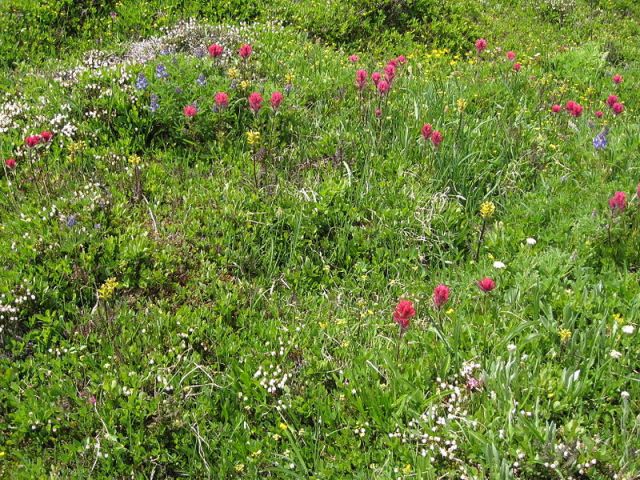
- ‘Wild Gardens’ have a different kind of attractiveness – and value- to those that are more actively ‘gardened’
I’ve just finished reading a fascinating, beautifully written book about taking a more ecological approach to gardening: ‘Noah’s Garden’ by Sara Stein. Set in the suburbs of the USA, she describes how she ‘unbecame’ a gardener and developed her plot into somewhere that bore a closer resemblance to the native surrounding countryside. In short ‘restoring the ecology of our own back yards.’
I have her sequel, ‘Planting Noah’s Garden’ and another book called ‘Noah’s Children’ ready for my summer holiday reading! The latter is about ‘restoring the ecology of childhood’, and I’m especially looking forward to reading this because of my interest in designing and promoting ‘natural play’ spaces. Stein wrote these all about 15 years ago, but they still seem very relevant today (Stein passed away in 2005).
I’m left wondering if and how far the principles she advocates can and should be applied to somewhere like the UK. Here the climate has – at least up to now- enabled us to grow a very wide range of plants, and so has given us the chance to grow more ‘exotics’ than many other places around the globe. Arguably this resulted in a diluting, if not replacement of a ‘native environment’ hundreds of years ago, especially from the foreign travels of the ‘plant hunters’ and the subsequent importation of exotic species, as well as the devleopment of new, hybridised forms.
I guess the principle of gardeners working with nature, acting as ‘managers of the environment’ not ‘controllers’ (or worse still, having no concern for the wider impacts of what we plant, construct or remove in our gardens), is still very valid, and we should always have regard to the impact of our planting on the wider environment – in terms of the wildlife habitats and food sources it provides, for example.
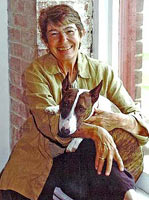
Sara Stein
I was especially taken with Stein’s suggestion in the last few pages of ‘Noah’s Garden’:
‘Let’s imagine a goal: that at some time in the future, the value of a property will be perceived in part according to its value to wildlife. A property hedged with fruiting shrubs will be worth more than one bordered by Forsythia. One with dry-stone walls that provide passageways for chipmunks will be valued higher than one whose walls are cemented stone. Buyers will place a premium on lots that provide summer flowers and fall crops of seed. Perhaps there will be formal incentives; tax abatements geared to the number of native species; deductions for lots that require neither sprays nor sprinklers. A nursery colony of bats might be considered a capital improvement. There could be bonuses for birdhouses.
Oh, brave new world!’…
Well, in the UK the arrival of energy efficiency ratings for houses is perhaps a step in this direction? Maybe we should encourage ‘Garden Ratings’ too?
Old School Gardener

Orfordness Lighthouse- Felicity, Deborah and Nick
Here’s the first article of two covering two very enjoyable days out whilst on holiday with some good friends recently.
Orford Ness is a huge shingle spit, linked to the mainland at Aldeburgh and stretching along the coast to Orford and down to North Wier Point, opposite Shingle Street. It is divided from the mainland by the river alde (Ore off Orford), and was formed by longshore drift along the coast. The material of the spit comes from places further north. Near the middle point of its length, at the foreland point or ‘Ness’, lies the Orfordness Lighhouse.
Orford Ness is an internationally important site for nature conservation. It contains a significant portion of the European reserve of vegetated shingle habitat, which is internationally scarce, highly fragile and very easily damaged.
The peninsula was formerly administered by the Ministry of Defence, which conducted secret military tests during both world wars and during the ‘Cold War’. These included bomb testing, the development of Radar and Atomic weapons testing.
We had a wonderfully sunny day for our ferry crossing and walk around the site, which shows a curious mix of natural beauty and interest with man -made stuctures and debris, much of which has been left in situ. The volunteer guides were very friendly and informative. After returning to the mainland and following a super pub lunch, we explored the river by boat and saw several groups of sea birds, including Avocet, Oyster Catcher, Tern and Sea gulls.
Further information:
National Trust website
Wikipedia
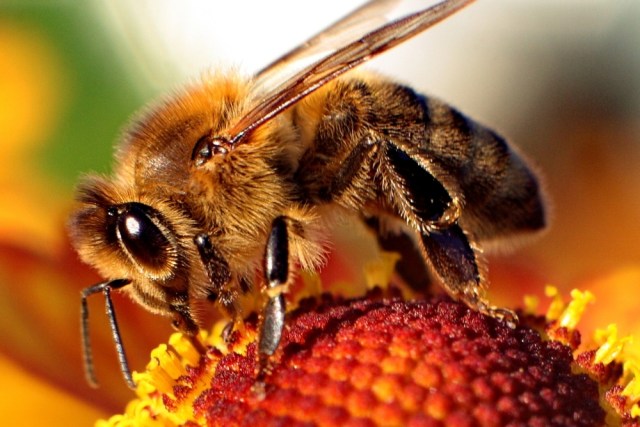
Keeping the bees happy is one aspect of planting a wildlife garden
The latest round of RHS Garden Shows winds it’s way around the country – Hampton Court is next up and opens 0n 8th July. I’ve been to this show twice before and I reckon that most if not all of the show gardens (and this is probably true of the other shows too), tend towards what you might call the ‘middle ground’ of design (perhaps considered a ‘safe bet’?) What I mean is that they usually combine that tried and tested formula of ‘formal structure, informal planting’ – what you might call the classic Arts and Crafts/ English Country House style.
Don’t get me wrong, this is a style I love myself and is what I’m trying to create here at the Old School Garden. But every now and then its refreshing to see something at one of the ‘design extremes’- the sort of creation that pushes you into thinking again about structural features or particular planting choices and combinations in your own garden, or even more fundamentally, what you expect your garden to do.
At this year’s Hampton Court Show one garden looks set to do this and at the same time get across some important messages about the potential food value of gardens- and in particular the wide range of good quality food that nature puts on the menu. ‘The Jordans Wildlife Garden’ has been created to reflect a long-term commitment from Jordans to the British countryside. With a colourful variety of features from edible wild flowers, trees and hedges to oats, fruit and nuts – all of which can be foraged from the countryside – the garden provides a natural ‘larder’ to share as a shelter for birds, bees and butterflies. Its unveiling celebrates the belief that great tasting food comes from working closely with nature, as well as aiming to inspire gardeners everywhere to support British wildlife.
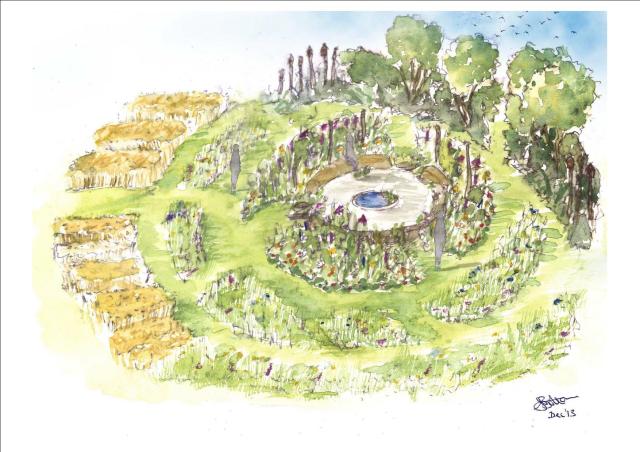
The Jordans Wildlife Garden Design
This Garden is set to showcase the importance of sustainability and protecting the British countryside to RHS visitors from across the country. Oat fields, inspired by Jordans’ farms, outline the sides of the garden, moving through to mown paths of species rich meadow, which curve through the space. Swathes of meadow alongside the paths give a close connection to nature. The garden is surrounded by a cut log wall and grassy banks, which form a wildlife friendly edge to the garden and a habitat for wildlife. A nut terrace that provides an edible treat for both people and wildlife surrounds the elegant, reflective pool in the centre of the garden. There are also sculpted straw benches, created by willow sculptor Spencer Jenkins, that provide a place to rest and enjoy the relaxing atmosphere. Mixed native hedgerow and fruit and nut trees will surround one side of the garden, providing more edible treats for people and animals.
The Garden features have been designed to support local wildlife, including thatched insect hotels, birdhouses and feeding stations. These were all custom crafted for the Garden and add a unique beauty to the space. Design elements such as cut wood stepping-stones, created by chainsaw artist Ella Fielding, will provide further material for animals to make their homes in, whilst the meadow flowers themselves house a beehive – a core feature of any wildlife garden.
All the sustainable elements of the Garden also represent a commitment by Jordans to The Prince’s Countryside Fund, which works to support the people that take care of our countryside and ensures a sustainable future for British farmers and rural communities. And it just shows the ease with which these elements can be brought into compact garden spaces, whilst still supporting local wildlife.
Selina Botham, a passionate wildlife and garden enthusiast, designed the Garden. She has won numerous awards for her beautiful and considered approach to gardening, from Gold Medal to Best In Show for her first ever garden at the RHS Hampton Court Palace Flower Show. And as part of its British countryside celebrations this July, Jordans has enlisted the taste expertise of Great British Bake Off winner, Edd Kimber, to create a series of foraged food recipes inspired by The Jordans Wildlife Garden.

- Selina Botham
 ‘Greenfly, it’s difficult to see
 via Green Renaissance


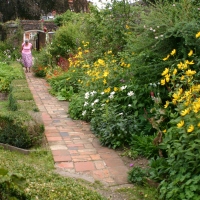


 Old School Garden