

Tag Archive: museum

Red Cabbage seedlings on one of my ‘seedy cills’
Old School Garden
11th March 2013
To Walter Degrasse
Dear Walter,
As it’s a few weeks since I last wrote, and more importantly the weather today has put the block on any practical gardening outside, I thought I’d drop you a line and update you with what’s been happening in Old School Garden and further afield.
First, I was pleased to hear that your operation was successful and that you can now get back to lifting things – but make sure you do it safely next time!
Well, it’s been rather mixed few weeks, reflecting the March weather! today, just for the record we have the return of ‘The Beast from the East’ – average 30 mph winds and occasional snow showers whcuin seem to have plunged us right back into winter. Quite a contrast to the weather last week when it reached 14 degrees C! (today there’s a wind chill which will make it feel like -4 degrees!- not that I plan to be out in it). The sort of day that reminds me of the comment one of the vergers at Winchester Cathedral made when he heard Deborah and I live in Norfolk:
‘So, there are about three strands of barbed wire between you and Siberia!’

Winter returns to the Old School Garden
We met him when we paid a visit to this great building at the end of February (you may have seen some of the photos of our trip south on this blog). One of the highlights of that trip was to Mottisfont Abbey where we had a lovely day in bright sunshine. This was perfect for exploring the gardens of this wonderful old estate, especially the relatively new Winter Garden (there is a gallery of pictures of this visit on the blog). The bright sunshine really set off the colours in the winter stems of Dogwoods, Snake Bark maples and Cyclamen flowers (and there were many drifts of snowdrops too).
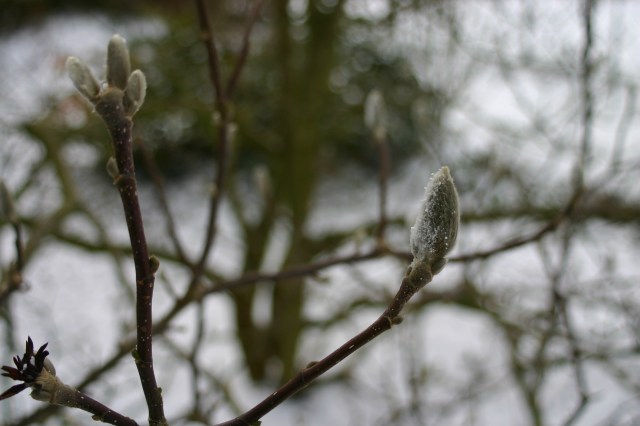
Magnolia flower buds -frosted once more
Closer to home, I’ve managed to make some progress in digging over one of the main mixed borders here, one that didn’t benefit from an autumn clear up. I guess I must be about two-thirds through this and have taken the opportunity to divide and move some perennials (including grasses), so hopefully we’ll have rather more balanced planting as a result. I hope – when weather permits – to get out and finish this, then I’ll feed the main shrubs (with Fish, Blood and Bone) and use my compost to mulch around them.
Talking of mulch, my friend Robert let me have another load of his excellent horse manure so I’ve spread about a tonne of that over most of the Kitchen Garden beds, fruit trees and bushes and roses (having first given them a little rose fertiliser). It really is lovely stuff, friable, and once raked over incorporates into the soil really well.
Apart from this it’s been a few weeks of getting seeds underway. You may recall that I’d started off a few things back in February, but I now think that may been a tad too early, as some of them are struggling to put on enough growth for me to pot them up. Still there’s time yet for having another go. I’ve now got two windowsills and the greenhouse going with seed trays (including a couple of heated propagators), so soon the house will be full of plants at various stages of development as I move them into progressively cooler conditions and larger pots prior to planting out once warmer times have arrived.
One of my ‘seedy’ window cills – veg and flowers underway
One indoor plant that is doing well is the Clivia I bought at the School Fair a few years ago. I must admit that I probably should have potted this on a few months ago, but this doesn’t seem to have held it back, as it’s just about to burst into flower (and we have last years stalk with a seed fruit on it for added colour!).

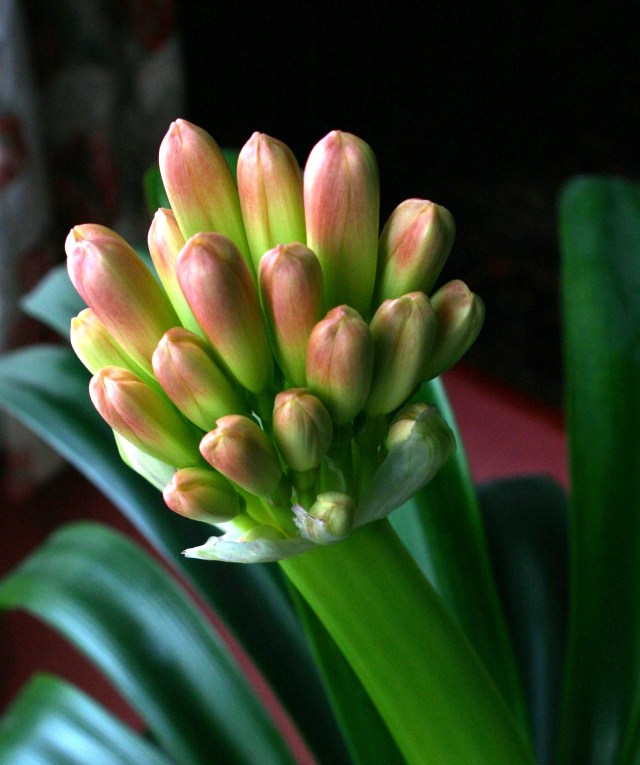
Clivia flower head ready to burst

Clivia fruit – from last year’s flower on the same plant
I’ve returned to the gardens at Gressenhall Farm and Workhouse Museum (you remember I’ve been volunteering here for a couple of years?). The gardens overall seem to be in pretty good shape, but with Steve, a friend who also volunteers here, I’ve begun to clear, dig over and mulch borders in the areas we’re responsible for. I’m also pondering how to make some features of the ‘Curiosity Corner’ for young children a little more robust and secure. Perhaps not surprisingly small feet have wandered off the paths and into the beds so trampling down some plants). Steve has some spare trellis so I might try to put up a low screen of this to deter the kids and at the same time grow some dwarf Sweet Peas up it for fragrance and colour.

Youngsters at Cawston Primary School have been enjoying seed sowing
I’ve also begun my regular Thursday ssessions at the local Primary school. The School Garden there is now really taking off, with much more structured use to which I’m contributing. So far this has focused on what we do in the garden in spring, digging over the raised beds and talking about tools and tool safety etc. We’ve got some onion sets in as well as some Broad Beans, and potatoes are ‘chitting’ ready for planting straight after Easter. I also got hold of some more manure for these beds, which have rather poor soil, so our efforts at breaking this up and digging in the manure will hopefully be repaid later in the year. The children – rotating groups from four of the six classes – have responded well and seem to be enjoying the sessions, though they are only about 30 minutes each. I’ll do a final introductory session on Thursday before we turn our attention to renovating the ‘Nectar Bar’ of insect – friendly plans I installed a few years ago, but which has suffered from lack of maintenance. Then, after the Easter break, I think we’ll be into planting potatoes and some of the seedlings the children have been sowing into paper pots (Broad Beans so far but Turnips and other crops to come, some directly into the ground).

Children have been learning how to prepare soil for seed sowing
Well, looks like coffee time, so I’ll put the kettle on, look out at the snow and try to make the best of the day ahead inside!
I’m currently researching climate change and gardening as this is a topic I expect to be writing a post about shortly. I have a few ideas about what we gardeners might do to cope with not only steadily increasing temperatures (and advancing seasons), but the increased unpredictability of the weather – flood to drought to snow blizzards in as many days! Or as one fellow blogger put it recently ‘Four seasons in a week’ !(we’re not quite up to 4 in a day as per the song).
I’ll be in touch again in a few weeks. In the meantime I hope that your recovery progresses well and that you’ll soon be out and about in your wonderful garden!
Very best wishes,
Old School Gardener
If you’ve enjoyed reading this post and others on this blog, why not comment and join others by signing up for automatic updates via email (see side bar, above right ) or through an RSS feed (see top of page)?

Norfolk Beefing apples before cooking
The orchard at Gressenhall Farm and Workhouse Museum, Norfolk, conceals a sacred secret – it was once the workhouse burial ground, where paupers were interred in simple, unmarked graves. And there appears to be no record of who is buried where.
Today the area serves as a demonstration plot for a wide range of Norfolk fruit trees, especially apples. A field gate displays a large number of plaques recording donations of different Norfolk apple trees to the orchard.

Gate to the Orchard showing plaques recording different varieties of donated Norfolk apple trees
One famous local variety, the ‘Norfolk Beefing’ (or ‘biffen/biffin’), is a cooking apple of some reknown. It is recorded as far back as the 1690’s on Lord Walpole’s estate at Mannington, Norfolk. Cottagers used to pick the apples and wrapped them in straw for a while in a warm oven, after which they would be squashed down and baked again. The final apples were packed in boxes and sent to London where they were a real delicacy, known as a ‘Biffin’.

A Norfolk Biffin after cooking
Biffin/Beefing apples have very tough skins, which allows them to be baked whole, and then preserved cold. Apparently when cooked this way they are “creamy with hints of cinnamon and nutmeg”. They were mentioned in Dickens’ story “Holly Tree” and also in “A Christmas Carol” :
“Norfolk Biffins, squab and swarthy, setting off the yellow of oranges and lemons, and in the great compactness of their juicy persons, urgently entreating and beseeching to be carried home in paper bags and eaten after dinner.”
Nearby, lies the site of a former Windmill. This can be seen if you look carefully at one of the earliest paintings of the workhouse, by Kerrison. Built in 1781, the Mill provided the workhouse with meal and flour for about 50 years. The Workhouse Master would buy a year’s supply of wheat from the local markets and this was then ground at he Mill.
In 1783, records show that William Pulling (of nearby Shipdham) was the Miller and was paid 6d a week (in old pence, or 2.5 new pence!).
By 1829 just a baker was employed, suggesting that the windmill was no longer in use. In 1837 the remains of the mill were removed. This was just one of the special buildings or rooms set aside for meeting the food and drink requirements of the workhouse, it having had a brewery as well as a bakehouse and kitchens!

Early painting of Gressenhall Workhouse (Kerrison) with windmill ringed in red
Next to this site sits the modern compost making area, well organised and used by the volunteer gardeners to improve the soil and mulch the gardens at the Museum. Originally designed for maintenance by farm machinery, it became under used and recently has been reorganised so that the gardeners can maintain it. A system of different bays provide for the different stages of turning vegetable matter into compost (including stems and branches which are periodically chipped into smaller pieces and incorporated into the mix). There are also areas for creating leaf mould, for depositing paper waste generated by the Museum (which is incorporated into the compost) and also a turf mound which will eventually decompose into a fine loam for use in the gardens. The resulting compost is of a coarse texture, but rich in organic matter which is so good for improving soil structure, moisture retention and adding nutrients to the soil.
 The Museum hosts an annual ‘Apple Day’ in October which is a great family day out with a range of stalls, activities and attractions including the fresh pressing of apple juice and an opportunity to bring along any ‘mystery apples’ to get them identified by a number of local experts. This lively event contrasts with the peace of the orchard, which is a fitting commemoration of those buried here long ago.
Other posts in this series:
Down on the Farm – Gardens to ‘dye’ for at Norfolk Museum…
From Grand entrance to Grand Central at Norfolk Museum
Gypsies, tramps and thieves: garden where poor once trod at Norfolk Museum
Cottage Garden recreates 1930’s at Norfolk Museum
Old Workhouse Garden a wildlife oasis at Norfolk Museum
Unique Heritage Gardens at Norfolk Museum
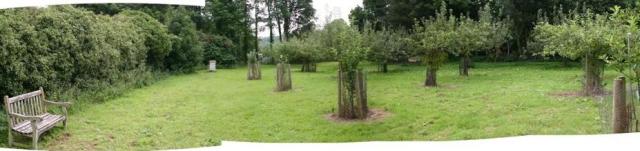
Gressenhall’s orchard – a peaceful place to remember the unamed poor once buried here
Old School Gardener
If you’ve enjoyed reading this post and others on this blog, why not comment and join others by signing up for automatic updates via email (see side bar, above right ) or through an RSS feed (see top of page)?

The entrance to the workhouse as it looked in the early 1900’s – the well house stands next to the person (gardener?) to the rear
The former grand entrance of the Gressenhall Workhouse now performs a very different function. The once ornamental gardens and driveway have given way to a busy hub for this Norfolk Museum’s outdoor events.
As can be seen from the old photograph the main approach to the Workhouse was once a rather grand affair – a heart-shaped island of formal lawns and borders surrounded by a circular drive. To the front, huge iron gates and a much smaller wooden door provided the entrances from the forbidding outer wall of the complex. The smaller door was the main pedestrian entrance to the workhouse being next to the porter’s lodge, the man who controlled the arrival and departure of Workhouse inmates. This door today still carries the solid metal knocker shaped into a clasped hand around a metal bar – a hint of the prison-like existence to come for the new inmates! They must have entered here with very mixed emotions – relief at having somewhere to get a square(ish) meal and a warm (ish) bed, mixed with guilt at not being able to fend for their families and anxiety about the harsh regime they were entering.

The ‘Yew Tree border’ in front of the chapel- before the Yews were reduced
Towards the main building, but long since demolished, once stood a small building enclosing the Workhouse well (still visible in the old photograph) and the front of the 18th century main building once carried a magnificent Wisteria clambering up and along the warm red brickwork. This was, apparently, cut down to the ground by an over – enthusiastic work placement trainee about thirty years ago! A small rooted area remains and is being carefully trained up the walls once more, in the hope of restoring this once glorious feature. To the side the workhouse chapel is fronted by a small border which is dominated by two Yews and a cherry tree with spring bulbs and other under – planting. Recently these Yews were reduced in width in an attempt to provide a more open, sunny site for the other planting (and increase the width of the adjacent paths). The hard cut – back has improved the shape and balance of the border whilst not harming the Yews, where new growth has begun.
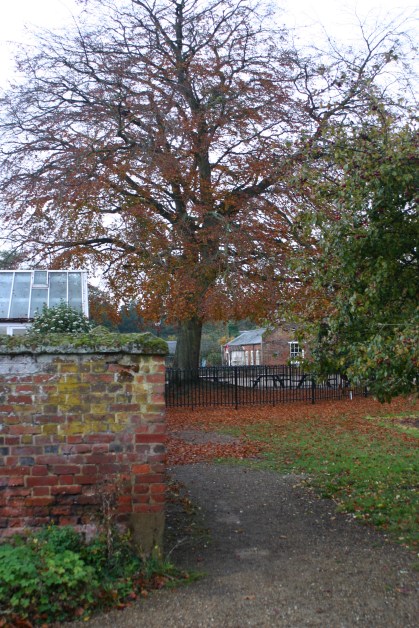
The magnificent Copper Beech Tree in autumn
To the right of the main approach sits a majestic old Copper Beech tree (which gave its name to the Old People’s Home that succeeded the workhouse after the 2nd World war – ‘Beech House’). This area was originally sub divided by walls into exercise yards and a playground for the adjoining boys school, and in later years for those in the nearby infirmary (and featuring two revolving wooden tuberculosis pavilions). There is also an avenue of beech trees on the approach to the Workhouse believed to be 150 years old.
There is some evidence that the southern section of this area, adjoining the modern café was laid out as a formal ‘garden’ but the historical accuracy of this is uncertain. Today this area houses a semi – permanent marquee used for the many events now taking place at the Museum. A large expanse of grass (useful for picnicking for the Museum’s many summer visitors) is surrounded by areas of planting including an isolated Crab Apple tree, planted in more recent years as a memorial to a former member of the Norfolk Archaeology Department (also housed on the site).
There is also a long south – facing border of mixed shrubs adjoining the walls of the former workhouse, some of which are now rather large for their position adjacent to the building. Others – such as several clumps of Boston Ivy – clamber up the walls and are vigorous enough to get under the eaves and into the roof! Recently these shrubs have been pruned to try to restore their scale and shape as well as encouraging new growth, with some success. And spring bulbs also provide splashes of colour underneath the mainly evergreen shrubs. But a perennial problem is the rabbit population which have burrows in this border and which also occasionally escape into some of the adjoining gardens to wreak havoc!
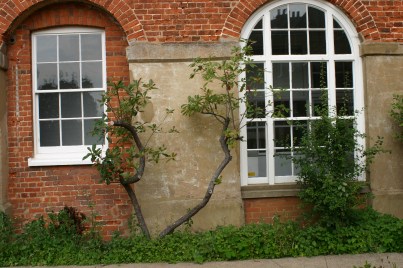
Shrubs in front of the southern wall of the old Workhouse- showing the arcading that was once open
The walls here still show the evidence of the (once open) arcading that sheltered individual ‘cottages’ for families living in the workhouse. This was before its daily routine became harsher in the mid 19th century, when inmates were divided by sex and age and so families were split up.
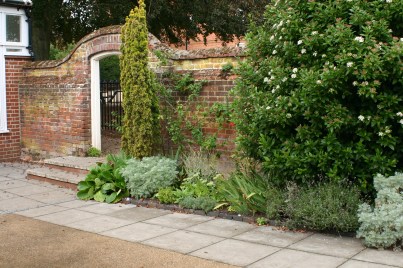
One of the borders in the Cafe Garden
Today’s cafe building was once a fever or isolation ward commonly known as the ‘itch ward’. More recently this was the Museum’s Education Centre, for which a garden was laid out by volunteers in the 1980’s. This was further remodelled into the current space, presumably upon creation of the café and now houses a delightful, smaller courtyard garden of mixed borders with picnic tables.

Today’s courtyard on an event day at the Museum
Today, the large entrance courtyard and its adjoining spaces provide a great setting for the main workhouse buildings and perform an important role as a thoroughfare for the Museum’s visitors as they explore the surrounding gardens and on event days when tents, stalls and other temporary exhibits spring up into a hub of activity.
Other posts in this series:
Gypsies, tramps and thieves: garden where once poor trod at Norfolk Museum
Cottage garden recreates 1930’s at Norfolk Museum
Old Workhouse Garden a wildlife oasis at Norfolk Museum
Unique heritage gardens at Norfolk museum
Old School Gardener
If you’ve enjoyed reading this post and others on this blog, why not comment and join others by signing up for automatic updates via email (see side bar, above right ) or through an RSS feed (see top of page)?
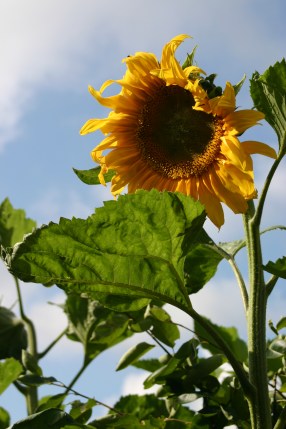
Sunflowers were planted by a local playgroup at the May opening of the garden – with the wet summer they grew to over 2.5 metres tall!
A renovated garden is moving towards maturity in what were once exercise yards for tramps and unmarried mothers at Gressenhall Farm and Workhouse Museum, Norfolk.
The garden occupies what were once two exercise/work yards for inmates of the Victorian Workhouse. The footings of what was once the dividing wall between these two yards can still be seen, emerging as the lawn above is worn away. In Victorian times these yards joined two blocks of accommodation:
- for so-called ‘casuals’ or tramps who used to travel between workhouses earning ‘a night’s board for 2 days hard labour’ – possibly crushing stones for use in road building
- for unmarried mothers nursing their babies – they wore distinctive uniforms to mark them out from the other workhouse inmates.

The refurbished ‘Education Garden’
These buildings today provide the Museum’s Learning Centre and space for occasional groups and events. Until last year the garden area between the two buildings was kept maintained as grass and a range of mixed borders which is an important picnic/ rest spot as well as being used by school and pre school groups for art and learning activities. In 2012 funding from the Friends of the Museum as well as the Museum itself and donations from a range of local businesses were secured to refurbish and redesign it. A number of design issues were tackled, including:
- Providing further paved terrace space with new picnic tables and some renovated paving
- Introducing a number of planting containers to add interest to the paved terraces
- Realigning paths to follow ‘desire lines’ and make access easier
- Deepening borders to provide more visual interest and unified planting
- Creating a new ‘curiosity corner’ to provide a space designed for under 5’s which contains a range of features to encourage children to explore.
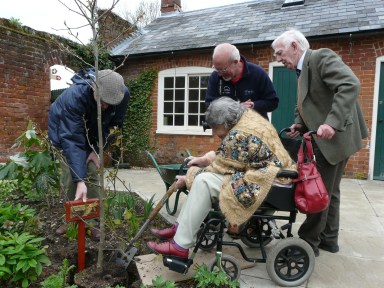
Mary and Derek Manning plant a tree to mark the opening of the garden
The newly renovated garden was formally opened on 6th May 2012, and two of the original gardening volunteers, Mary and Derek Manning, planted a ‘Paper Handkerchief Tree‘ to mark the occasion. Local children also played their part and cut ribbons to open ‘Curiosity Corner’.

One of the new residents of the Garden!
The Curiosity Corner proved to be very popular in its first season last year and included some giant sunflowers planted by a local play group as well as a turf seat; a willow tunnel and arches; hazel wigwam; mirror; ‘fossil slab’; various ‘animals’ hidden away in the planting and a range of different path surfaces and planting. There is also a half barrel filled with stones,water and pond plants, so that youngsters can ‘get up close’ to this watery habitat.
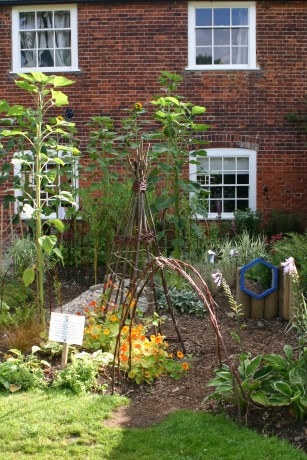
‘Curiosity Corner’
The coming year will see the garden mature further and hopefully there will be sunny days so that visitors can really enjoy this lovely picnic area at its best.

New planters with sweet peas on conical obelisks
Quizzicals:
Two more cryptic clues to the names of plants, fruit or veg…
- The scourge of female chickens
- Cheap goods in a pile of dung
Old School Gardener
If you’ve enjoyed reading this post and others on this blog, why not comment and also join some other people and sign up for automatic updates via email (see side bar, above right ) or through an RSS feed (see top of page)?

‘Whenever I want to escape the hustle and bustle of Lisbon, and don’t want to travel far, I retreat to the gardens of the Calouste Gulbenkian Museum.
Covering roughly 17 acres, this beautifully landscaped garden contains a wide variety of well-established tropical as well as indigenous plants and trees that shelter subtly-appointed benches and seats. In the last few months a network of new, flat, winding paths has been opened through the garden.
There are picnic tables situated next to a lake where you can sit on bright winter days and soak up the sun, or watch the ducks with their fleets of ducklings enjoying the water in spring. At the weekends the gardens come alive with the sound of kids playing in the sunshine.
In the summer months, it is nice to disappear into this garden down one of the maze-like paths that snake through the shrubbery and to feel as if you are the only person in the world, surrounded only by birds scurrying around in the undergrowth or flitting in the trees. Somehow, the vast tree canopies manage to dull the sound of Lisbon traffic to the point you forget it is there and will also shelter you from the heat of the day.
The garden contains an open-air amphitheater where, during the summer, a programme of films or music events takes place in the evenings.
Whether on a hot, sultry summer evening or a bright, sunny winter day this garden is the perfect place to be and feel completely relaxed.’
Old School Gardener
 An old Workhouse Yard has been turned into a showcase cottage garden of the 1930’s at Gressenhall Farm and Workhouse Museum, Norfolk.
What is a cottage garden?
‘The words ‘cottage garden’ conjure up an idyllic image involving roses round the door of a picturesque thatch cottage with towering hollyhocks and delphiniums (or something similar) either side of a brick path that leads to a picket gate. It’s all very romantic, always spring or summer – and always sunny.’ (The Enduring Gardener)
Historically, cottage gardens date from medieval times and were where labourers living in tied cottages grew a lot of their own food to bolster their poor wages. Vegetables were grown – not only to feed the family but also to perhaps to feed a household pig and a few chickens. Fruit was grown – apples and pears for example – with wild strawberries being gathered from the hedgerows. Flowering plants would have been collected from the wild and it is possible that flowers like violets, primroses, cowslips, dog rose and wild honey suckle featured in some cottage gardens.
Monasteries grew herbs for medicinal purposes and vegetables for the monks’ food. Their knowledge was much sought after and this filtered through to the poorer classes.
The 18th and 19th centuries brought many changes – the Enclosure Acts meant that wealthy landowners could remove the peasants’ right to graze animals on common land. This forced many to grow food in their gardens to feed themselves. Gradually living conditions for the poor improved – they were able to use their gardens not just to grow vegetables for food but flowers too. Gardeners exchanged ideas and plants and soon flowers and shrubs that were only ever seen in ‘the big house’ appeared in cottage gardens. The Victorian period also saw many new varieties of bright colourful annuals used as bedding plants.In the late 19th and early 20th centuries Gertrude Jekyll developed the cottage garden style on a grand scale.
The First and Second World Wars brought food shortages and so vegetables and fruit took priority over ornamental planting in every available garden space. Once food rationing finished after the 2nd WW, people could look to their gardens to provide visual interest and not just food, so flowers and shrubs were planted once more.
Today the cottage garden retains its popularity. One approach is the traditional, smaller scale artisan style – creating the garden as you go along, often dividing, collecting seed and gratefully receiving gifts of cuttings or plants from neighbours or friends. Others prefer the more designed approach, with carefully planned borders and precisely laid paths, perhaps in a larger scale setting.
Cherry Tree Cottage Garden
The Museum’s records show that Cherry Tree Cottage and its adjacent open space were created in the 1850’s, probably to house elderly couples (‘no longer of child-bearing age’) from the main Workhouse. It seems that it may have actually housed three couples with a shared kitchen/dining room. The open space was probably just a yard used for sitting or exercise and there is no evidence of it being planted with flowers or vegetables. In 1932, the cottage housed Workhouse staff and it is during this period that possibly a garden was introduced.
The current garden was created in the 1980’s by a team of volunteer gardeners, some of whom are still volunteering today! Mary Manning created the original design to demonstrate a typical cottage garden of the 1900’s, and this was based on extensive research, including the local Women’s Institute. Their members’ memories were used in the garden to reflect the Cottage, which had been set out to resemble a 1912 interior. Later changes in the cottage were also reflected in the garden and today it aims to show how a typical 1930’s rural cottage garden would have looked and been gardened. It includes:
Flower borders – traditional cottage garden plants such as lupins, asters, rambling roses and Buddleja. The snowdrops (Galanthus plicatus) derive from bulbs brought back from the Crimean War in the 1850’s by a Captain Aldington who was from near Swaffham. His mother gave some to a friend in Warham where it is said the local rector, Charles Digby, grew them in the Church yard – they became known as the Warham Snowdrop. This variety is still available today. More recently some heritage daffodils from the 1800’s have been planted in the garden.

Cherry Tree Cottage and some of the vegetable growing area (left)
Vegetable Crops – the early vegetable plots grew a wide range of crops and some old seed varieties of pea (‘Simpsons Special’) and broad beans (‘Big Penny’) ‘were acquired from celebrity gardener Percy Thrower and a local retired gardener respectively. The museum ha some old seed catalogues from two local seed merchants – Daniels and Taylors – and these have been used to research the varieties that might have been grown in the 1930’s. Many of the varieties of fruit and vegetables that were grown in the 1930’s can be seen in the garden today. Garden Organic and The Heritage Seed Library have donated many of the seeds.
Herbs – a range of well known herbs are grown in the garden today. Herbs were used both for flavouring food and medicinal uses – for example a paste made from Comfrey leaves would be used to aid the healing of broken bones hence its common name of ‘Country Knit Joint’!
The garden also houses a chicken run, as it was common for many cottagers to keep chickens , which gave them a good supply of eggs. The chicken manure was also used as a fertiliser on the vegetable plot.
The garden paths were originally grass edged with flint. These were gradually replaced with bricks, local tiles (‘pamments’) and cinder; traditional methods used in cottage gardens. Todays paths are a mix of brick, pamments and gravel – the latter is easier to maintain and is more accessible for wheelchair users.

The Potato Clamp and Scarecrow at Cherry Tree Cottage Garden
Whilst the gardening volunteers are trying to follow gardening practices typical of the 1930’s, sometimes these have to be avoided (e.g avoiding the use of dangerous pesticides). But some interesting examples of old techniques have been demonstrated – for example the creation of a ‘Potato clamp’ which was a method for storing potatoes during the winter months before indoor storage space became more readily available.
Acknowledgement: I am grateful to Kay Davis, Heritage Gardening Trainee 2011-12, for permission to use her article on Cherry Tree Cottage for most of the material used in this post.
Sources and further information:
Plantax 3: Sweet Peas- cottage garden favourite
Unique heritage gardens at Norfolk museum
Old Workhouse Garden a wildlife oasis at Norfolk Museum
Quizzicals:
answers to the two in previous post Transfer Window- 7 tips for successful seedlings –
- Set fire to Ms Allen – Torch lily
- Mythical creature that enjoys a game of cards – Snapdragon
Here are a couple of gardening ditties….
Snowdrops keep falling on my head
Theme tune from The Lone Hydrangea
(with thanks to Les Palmer)
Old School Gardener
If you’ve enjoyed reading this post and others on this blog, why not comment and also join some other people and sign up for automatic updates via email (see side bar, above right ) or through an RSS feed (see top of page)?
 Gressenhall Farm and Workhouse Museum and the Museum of East Anglian life have been awarded £1.1 million from the Heritage Lottery Fund’s Skills for the Future programme to deliver a training project between 2011 and 2015.
Two new traineeships are now on offer:
Public Events traineeship – working with staff and volunteers at the museum to assist with the development and delivery of family and adult leisure learning opportunities.
Heritage Learning traineeship – working as part of a successful learning team at Gressenhall Farm and Workhouse helping to deliver high quality schools learning events to young people of all ages and abilities, also assisting with the museum’s informal learning programme
This project provides an opportunity for young people and adults from any background to develop skills and knowledge in a specific area of traditional skills. Where possible, learning will be tied to accredited qualifications. This will give the trainees both work experience and training, and will be a good stepping stone for further opportunities in the heritage or historic environment sector.
Gressenhall Farm and Workhouse is offering a number of formal apprenticeships in such areas as traditional farming and horticulture in partnership with Easton College.
They will also be offering 6-12 month traineeships that will be targeted at both young people and ‘second careerers’. These will be based around areas such as heritage gardening, woodland & heritage land management, rural collections management and interpretation, and managing historic buildings.
Trainees work alongside staff and volunteers under the supervision of a project officer. Mentoring and career development support is also provided. For people not sure what area they wish to specialise in there is a yearly programme of 3 month traditional skills “taster” courses running at the Museum of East Anglian Life.
If you would like more information on the work taking place at the Museum of East Anglian Life, please see the Skills for the Future page on their website.
Further information:
Skills for the Future – general leaflet
For further information on these two new posts see the Website

Old School Gardener
 There are around ten different heritage gardens or other tended spaces at Gressenhall Farm and Workhouse Museum, near Dereham, Norfolk.
I’ve been a garden volunteer here for the last couple of years and spent time as a trainee Heritage Gardener. I plan to explore these spaces in my blog over the coming weeks. Here’s some background information.
References to ‘gardens’ in the Workhouse records (from late 18th to mid 20th centuries) are relatively few, as most of the spaces within the walls of the former Workhouse were ‘yards’ of various kinds, being used for exercise or work by the inmates (including stone crushing). Records indicate that there were areas of active cultivation, mainly to grow food for the Master, staff and inmates. Major areas of food cultivation (most located just outside the Workhouse walls) no longer exist.
The current workhouse buildings were developed in the late 18th century after an Act of Parliament encouraged ‘Houses of Industry’ to be set up. People unable to look after themselves and/or their families were able to live in the buildings and do work to earn their keep. Before this, from Tudor times, the poor were the responsibility of local parishes and prior to this were looked after by religious orders, or informally by neighbours, friends or family.

The Workhouse meant a harsh, regimented life
1834 saw the Poor Law Reform Act which converted the House of Industry into The Workhouse. Conditions became much harsher with families split up into different groups – adult males, adult females, boys, girls, unmarried mothers with babies, tramps (or ‘casuals’) etc. Dickens’ novel Oliver Twist conveys the strict regime.

Union Farm showcases historic Norfolk farming practices
Gressenhall and other Norfolk workhouses expanded and reorganised accordingly and this system remained largely the same for the next 100 years. The Poor Law was eventually abolished just after the 2nd World War and Gressenhall became an old peoples’ home- ‘Beech House’ (named after the magnificent Copper Beech tree in the main courtyard). Finally, in 1979 the old peoples’ home closed and the site was developed as the Norfolk Rural Life Museum, including the acquisition and development of the adjacent Union Farm as a showcase for farming methods and practices of yesteryear.
The historical role of today’s heritage gardens has resulted in most of them being enclosed by the walls of the workhouse buildings, boundary or dividing walls and sometimes, native species hedges or other natural boundaries. These ‘Gressenhall Gardens’ are principally the result of voluntary effort beginning in the 1980’s. The spaces were developed to support the Museum’s role in telling the story of the Workhouse and Farm, Norfolk’s broader landscape and rural life, as well as the more contemporary issues of environmental sustainability and biodiversity.

An aerial view of Gressenhall Farm and Workhouse Museum, Norfolk
Several of these heritage gardens are domestic in scale and style with mixed planting and other features, probably due to their clear definition into manageable spaces coupled with the interests and ideas of volunteers and staff. Some of them perform specific roles in helping to interpret this Norfolk museum site and deliver some of it’s messages;
- Cherry Tree Cottage Garden illustrates a typical Norfolk cottage garden of the 1930’s, using plants and techniques from that time
- The Wildlife Garden has habitats, planting and other features that are conducive to wildlife. A small border also features ‘useful plants’
- The Orchards are growing varieties of apple and other fruit native to Norfolk (this is located on the graveyard of the old Workhouse)
- The Dyers’ Garden features plants used in natural dyeing
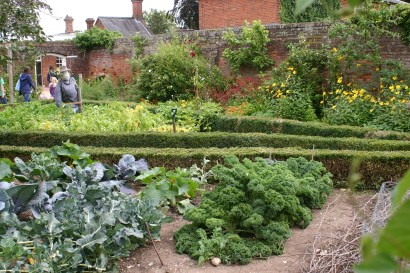
Cherry Tree Cottage garden is set out like a typical 1930’s Norfolk cottage garden with vegetable varieties and techniques of the time
A recent development has focused on the ‘Education Garden’, which is an important space used by the Museum’s Learning Team and others, adjoining as it does the Learning Centre. A new ‘Curiosity Corner’ provides an area for children under 5 to explore – it has various natural and other ‘child-size’ features; eg a willow tunnel, turf seat, rock pile, fossils, various metal birds, insects and animals and a hazel ‘wig wam’.
Over the coming weeks I’ll introduce you to some of the more important heritage gardens in this important Norfolk museum.
Further information:
Gressenhall Farm and Workhouse Museum on Facebook
Gressenhall Farm and Workhouse Museum blog






 Old School Garden