Tag Archive: manure


cover cropMy previous articles on green manure have covered the why, what, where and when –  this final article deals with how to use them to best effect.

Processing your green manure so that the ground can be used again begins around 3 – 4 weeks before you want to make use of the plot for another crop or plant, or alternatively when the green manure approaches maturity – whichever comes first.

There are various ways in which to process the green manure:

  • Dig it in – simply turn the plants back into the soil, using a sharp spade, chopping up clumps as you go. Aim to bury the plants no more than 15cms deep on heavy soils, or 18cms on lighter ground. grazing Rye and perennial green manures can be tough to dig in if they have grown well – to make it easier cut down the foliage first and leave it to wilt and possibly dig the plot twice with a gap of a week or two between each dig.
  • Leave it to the frost – if you sow a frost tender green manure in late summer you can leave this to be killed by the first frost, and the remains can be left on the soil as a cover over winter.
  • Hoeing – annual green manures, like mustard and buckwheat, can be hoed off, leaving the top growth in place or added to a compost heap. You can plant through the green mature foliage or cultivate it further to create a seed bed.
  • Mulching – a light excluding mulch can be used to kill off the green manure – black plastic or large sheets of cardboard held down by straw or bricks etc. Annual green manures will die off in a few weeks whilst perennials and grazing rye will take a bit longer – but you can always plant through the mulch.

No Dig = no green manure?

You may garden using the ‘no dig’ method. If so, you migth feel that grazing rye, even though it is an excellent soil improver, should be avoided. However, you can cut down the rye, spread it with well-rotted manure if required and then plant a crop of ‘no dig’ potatoes on the surface. these can then be covered with a mulch of hay or straw (around 10cm deep) adding more of this as they grow, and topping off with layer of grass mowings before the potato foliage meets across the rows.

Too tough to dig in?

If you forget to deal with your green manure in time and it becomes tough and woody, don’t worry. Just cut off the tops and put them on the compost heap, then dig in the roots or cover with a thick mulch.

Timing is everything…

If you dig in young annual green manures during the summer they will decompose rapidly, leaving you able to plant up the area within a few days of digging in. Tougher plants, like grazing rye, need to be dug in a few weeks in advance of when you need the ground again, especially in spring when decomposition is slower. If you’re aiming to create a fine seed bed after your green manure remember to leave the ground for a longer period than if you are simply planting into the ground. And avoid using green manures where you plan to sow small seeds such as carrots, parsnips and spinach as some green manures have a chemical which inhibits germination.

I hope that these articles on ‘Green Gold’ have been useful, and that you’ll be using green manures in your garden. I’m certainly planning to build on my early experiences last year with sowing more green manures over the coming winter.
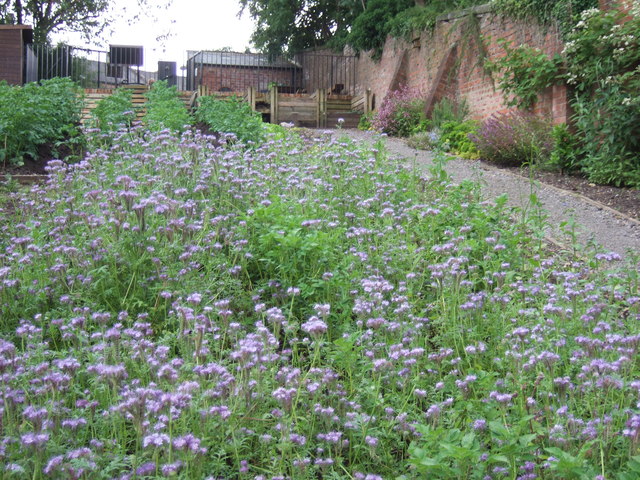
Phacelia in flower

Phacelia in flower

Source: ‘Green Manures’- Garden Organic Guide. September 2010

Other articles in this series:

Green Gold: 12 plants for soil improvement

Green Gold- 7 reasons to use green manures

Green Gold: Where and when to use Green Manures

Old School Gardener

If you’ve enjoyed reading this post and others on this blog, why not comment and join others by signing up for automatic updates via email (see side bar, above right ) or through an RSS feed (see top of page)?

Phacelia tanacetifolia, a  'green manure' that's good to look at and attractive to beneficial insects.

Phacelia tanacetifolia, a ‘green manure’ that’s good to look at and attractive to beneficial insects.

I’ve just been reading about green manures, from a small prize I won at my induction training as a ‘Master Composter’. The prize is a slim booklet produced by Garden Organic and it focuses on the use of green or ‘living’ manure in the garden. So, what is a green manure?

‘a plant which is grown to benefit the soil, not, as some might suppose, under-ripe animal dung!’

I’ve had a couple of tries with green manure (mainly because I like the flowers of Phacelia), but have not been totally convinced of its value – it’s hard to check what benefits it brings unless you conduct some sort of rigourous trial, of course. Anyway, this booklet is giving me the confidence to do more and so I thought I’d share its contents with you in a short series of ‘bite sized’ articles over the next few weeks.

Apparently green manures have been used by farmers for centuries to improve their land and gardeners have begun to realise their value too. Seed companies have begun to stock green manure seeds in packets sized for the average garden. They are most often used in the vegetable plot, but can also be used in other areas. In later articles I’ll cover where and when to use them; some of the plants and their benefits; how to choose and grow the right plants and what to do when you’re ready to use them. Today I’m focusing on seven reasons why to use green manure.

1.To feed the soil – green manure crops ‘mop up’ and hold onto soil nutrients and some deep-rooted types can actually gather nutrients from depths that other plants cannot access. By absorbing nutrients the roots prevent it being washed down into sub soil. Once green manures are turned into the soil the nutrients are ready to be taken up by the next crop.

2. To protect and improve soil structure – green manures help to protect the soil surface from the effects of heavy rain (mainly soil compaction and surface ‘panning’). This is a benefit for both clay and sand – dominated soils where organic matter reduces compaction in the former and helps water and nutrient retention in the latter.

3. To stimulate soil micro organisms – when dug in green manures feed and stimulate microscopic creatures that in the process of decomposing this organic matter boost soil health, which in turn helps to develop strong plants.

4. To prevent weed invasion – nature abhors a vacuum/ bare soil – as soon as plants are removed new ones will try to move in and these can often be weeds. Green manures tend to germinate quickly so can be a quick way of covering bare soil and smothering young weed seedlings, also eliminating the need for constant hoeing to remove the weeds.

5. To control pests – some beneficial crittters (like frogs and beetles) love the shady, damp ground under a green manure. Some green manures can be planted to distract flying insects away from crops you want to protect; e.g. underplanting Brassicas with Trefoil disguises the outline of the crop and seems to deter cabbage root fly. Likewise a small patch of Phacelia tanacetifolia or Clover, if allowed to flower, will attract insects that prey on many garden pests.

6. To improve the look of the garden – a green manure or ‘cover crop’ will not ony help to prevent weeds but can look attractive of itself. Some also help to fix nitrogen in the soil which will help plant growth.

7. To ‘rest’ your soil – after a period of intensive cultivation, soil can benefit from lying fallow for a season. Most usual in the vegetable garden, it’s a technique that can be useful in the ornamental garden especially where a new border is to be planted up.

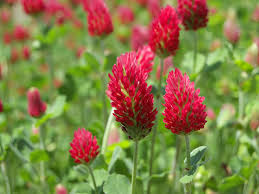
Crimson Clover - another green manure that looks good and helps to 'fix' ntrogen in the soil

Crimson Clover – another green manure that looks good and helps to ‘fix’ ntrogen in the soil

So, on paper the case for using green manures is a strong one. My kitchen garden is currently straining under the weight of the many different crops I have growing in every available patch of soil (and some containers too). But in a month or two, once some crops have been harvested, and where I haven’t planned for any new crops, I’m going to put in a green manure. In next week’s article I’ll cover just where and when to use these valuable plants.

Source: ‘Green Manures’- Garden Organic Guide. September 2010

Old School Gardener

If you’ve enjoyed reading this post and others on this blog, why not comment and join others by signing up for automatic updates via email (see side bar, above right ) or through an RSS feed (see top of page)?
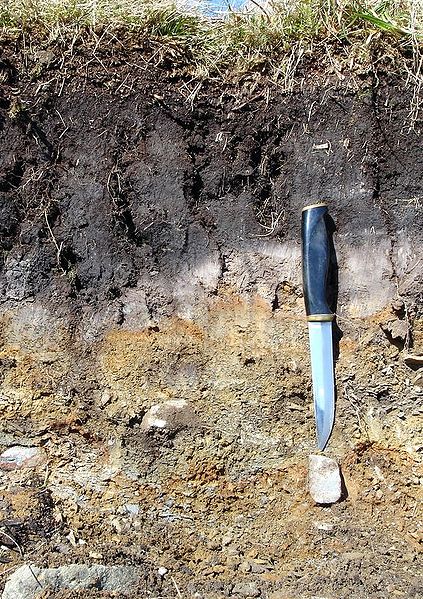
A profile of a typical 'podzol' showing the grey layer of leached out minerals below the dark top level of soil
A profile of a typical ‘podzol’ showing the grey layer of leached out minerals below the dark top level of soil

This week, ‘Gardener’s Question Time’ features soil. A Mr. T. Breck asks:

‘What is a soil pan? I think I may have one in my sandy soil here in south west Norfolk, as my plants don’t seem to be growing very well. Can I do anything to get rid of this?’

Well Mr. Breck, it does sound as though you may have a soil pan. This occurs when certain soil minerals are washed down through the soil by rain lodging some way below the surface. It does often happen in sandy soil containing a high proportion of iron. Over a period of time the minerals weld together to form a hard layer impervious to water. This layer restricts the downward spread of plant roots, so that poor growth results. In former heathland or coniferous forest areas (which is broadly speaking what much of south west Norfolk used to be) these soils may be termed ‘podzols’.

A similar situation can happen if a rotary cultivator is used regularly and its tines  are set at the same depth on each occasion – the action of the tiller blades causes soil compaction at that depth. You can avoid creating this pan by varying the depth of the rotivation.

To remove a pan it’s a case of digging deep and using a pick or fork to break up the welded layer of minerals and incorporating as much organic material (leaf mould, compost, manure) with the replaced topsoil.

More difficult hardpans may be further improved through the action of both adjusting the soil pH with lime if the soil is acidic, and with the addition of gypsum. This combination can help loosen clay particles bound into a hardpan by the actions of hard salts such as iron, calcium carbonate and sodium, by promoting their mobility. It is likely that mechanical removal of the soil pan and some changes to the soil structure as suggested above will be the most successful strategy, rather than relying on just one approach.

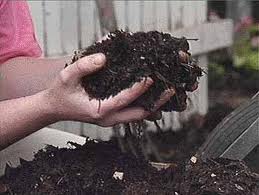
Adding home made compost or other organic matter to your soil will improve its structure and nutrient levels

Adding home made compost or other organic matter to your soil will improve its structure and nutrient levels

Whilst we are talking about soil it is perhaps worth just noting what soil actually is. It is made up of many different ingredients including varying proportions of clay, silt and sand. A soil containing a high proportion of clay is considered to be heavy and, whilst rich in nutrients, is often difficult to cultivate, especially when wet. Sandy soils, on the other hand, are light and easy to work, even after rain.

The soil here in the Old School Garden is a sandy loam and is a joy to cultivate, though I do have to add organic material to improve its moisture retention and nutrient levels. So, decomposing plant remains (or other organic material) is another important ingredient of soil as are air and water. Microbes by the million are also present and these and other organisms like earth worms are doing the job of breaking organic material down and  processing this into soil.

Links:

Improving soil by adding organic matter

The importance of organic matter

Compost – 10 things you wanted to know, but were afraid to ask…

Old School Gardener

If you’ve enjoyed reading this post and others on this blog, why not comment and also join some other people and sign up for automatic updates via email (see side bar, above right ) or through an RSS feed (see top of page)?
Red Cabbage seedlings on one of my 'seedy cills'

Red Cabbage seedlings on one of my ‘seedy cills’

Old School Garden

11th March 2013

To Walter Degrasse

Dear Walter,

As it’s a few weeks since I last wrote, and more importantly the weather today has put the block on any practical gardening outside, I thought I’d drop you a line and update you with what’s been happening in Old School Garden and further afield.

First, I was pleased to hear that your operation was successful and that you can now get back to lifting things – but make sure you do it safely next time!

Well, it’s been rather mixed few weeks, reflecting the March weather! today, just for the record we have the return of ‘The Beast from the East’ – average 30 mph winds and occasional snow  showers whcuin seem to have plunged us right back into winter. Quite a contrast to the weather last week when it reached 14 degrees C! (today there’s a wind chill which will make it feel like -4 degrees!- not that I plan to be out in it). The sort of day that reminds me of the comment one of the vergers at Winchester Cathedral made when he heard Deborah and I live in Norfolk:

‘So, there are about three strands of barbed wire between you and Siberia!’

Winter returns to the Old School Garden

Winter returns to the Old School Garden

We met him when we paid a visit to this great building at the end of February (you may have seen some of the photos of our trip south on this blog). One of the highlights of that trip was to Mottisfont Abbey where we had a lovely day in bright sunshine. This was perfect for exploring the gardens of this wonderful old estate, especially the relatively new Winter Garden (there is a gallery of pictures of this visit on the blog). The bright sunshine really set off the colours in the winter stems of Dogwoods, Snake Bark maples and Cyclamen flowers (and there were many drifts of snowdrops too).

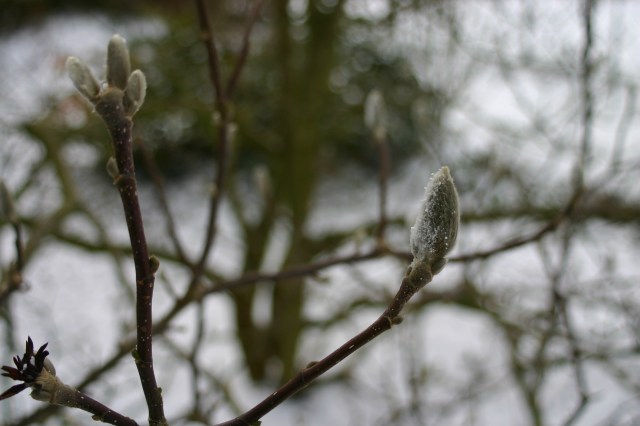
Magnolia flower buds -frosted once more

Magnolia flower buds -frosted once more

Closer to home, I’ve managed to make some progress in digging over one of the main mixed borders here, one that didn’t benefit from an autumn clear up. I guess I must be about two-thirds through this and have taken the opportunity to divide and move some perennials (including grasses), so hopefully we’ll have rather more balanced planting as a result. I hope – when weather permits – to get out and finish this, then I’ll feed the main shrubs (with Fish, Blood and Bone) and use my compost to mulch around them.

Talking of mulch, my friend Robert let me have another load of his excellent horse manure so I’ve spread about a tonne of that over most of the Kitchen Garden beds, fruit trees and bushes and roses (having first given them a little rose fertiliser). It really is lovely stuff, friable, and once raked over incorporates into the soil really well.

Apart from this it’s been a few weeks of getting seeds underway. You may recall that I’d started off a few things back in February, but I now think that may been a tad too early, as some of them are struggling to put on enough growth for me to pot them up. Still there’s time yet for having another go. I’ve now got two windowsills and the greenhouse going with seed trays (including a couple of heated propagators), so soon the house will be full of plants at various stages of development as I move them into progressively cooler conditions and larger pots prior to planting out once warmer times have arrived.

One of my 'seedy' window cills- veg and flowers underway

One of my ‘seedy’ window cills – veg and flowers underway

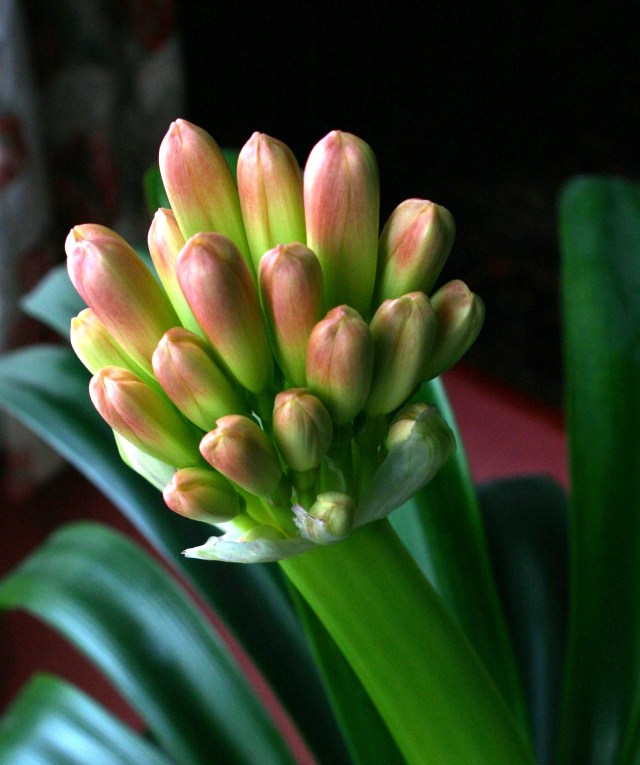
One indoor plant that is doing well is the Clivia I bought at the School Fair a few years ago. I must admit that I probably should have potted this on a few months ago, but this doesn’t seem to have held it back, as it’s just about to burst into flower (and we have last years stalk with a seed fruit on it for added colour!).

Clivia flower head ready to burst

Clivia flower head ready to burst

Clivia fruit - from last year's flower on the same plant

Clivia fruit – from last year’s flower on the same plant

I’ve returned to the gardens at Gressenhall Farm and Workhouse Museum (you remember I’ve been volunteering here for a couple of years?). The gardens overall seem to be in pretty good shape, but with Steve, a friend who also volunteers here, I’ve begun to clear, dig over and mulch borders in the areas we’re responsible for. I’m also pondering how to make some features of the ‘Curiosity Corner’ for young children a little more robust and secure. Perhaps not surprisingly small feet have wandered off the paths and into the beds so trampling down some plants). Steve has some spare trellis so I might try to put up a low screen of this to deter the kids and at the same time grow some dwarf Sweet Peas up it for fragrance and colour.

Youngsters at Cawston Primary School have been enjoying seed sowing

Youngsters at Cawston Primary School have been enjoying seed sowing

I’ve also begun my regular Thursday ssessions at the local Primary school. The School Garden there is now really taking off, with much more structured use to which I’m contributing. So far this has focused on what we do in the garden in spring, digging over the raised beds and talking about tools and tool safety etc. We’ve got some onion sets in as well as some Broad Beans, and potatoes are ‘chitting’ ready for planting straight after Easter. I also got hold of some more manure for these beds, which have rather poor soil, so our efforts at breaking this up and digging in the manure will hopefully be repaid later in the year. The children –  rotating groups from four of the six classes – have responded well and seem to be enjoying the sessions, though they are only about 30 minutes each. I’ll do a final introductory session on Thursday before we turn our attention to renovating the ‘Nectar Bar’ of insect – friendly plans I installed a few years ago, but which has suffered from lack of maintenance. Then, after the Easter break, I think we’ll be into planting potatoes and some of the seedlings the children have been sowing into paper pots (Broad Beans so far but Turnips and other crops to come, some directly into the ground).

Children have been learning how to prepare soil for seed sowing

Children have been learning how to prepare soil for seed sowing

Well, looks like coffee time, so I’ll put the kettle on, look out at the snow and try to make the best of the day ahead inside!

I’m currently researching climate change and gardening as this is a topic I expect to be writing a post about shortly. I have a few ideas about what we gardeners might do to cope with not only steadily increasing temperatures (and advancing seasons), but the increased unpredictability of the weather – flood to drought to snow blizzards in as many days! Or as one fellow blogger put it recently ‘Four seasons in a week’ !(we’re not quite up to 4 in a day as per the song).

I’ll be in touch again in a few weeks. In the meantime I hope that your recovery progresses well and that you’ll soon be out and about in your wonderful garden!

Very best wishes,

Old School Gardener

If you’ve enjoyed reading this post and others on this blog, why not comment and join others by signing up for automatic updates via email (see side bar, above right ) or through an RSS feed (see top of page)?

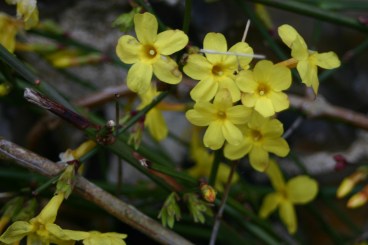
Looking good- Winter Jasmine (Jasminum nudiflorum)

Looking good in Old School Garden at present – Winter Jasmine (Jasminum nudiflorum)

 Planning your crops- to rotate or not to rotate…

Well, I guess that I’m sold on the benefits from rotation. Basically, you reduce the chances of persistent pests and diseases building up (which affect a particular plant or group of plants) and you manage the demands placed on the soil from different crops (and in the case of peas and beans actually stand to replenish, or if not that, then at least not deplete the store of Nitrogen).

Fine in theory, but it’s posed a real challenge to me in planning my crops in the kitchen garden. I’ve survived to date (just) with hasty diagrams on odd scraps of paper and scribbled ideas about what to grow where. To be quite honest, I’ve become muddled about what was previously grown in the different beds, what needs to follow what and whether I should manure, fertilise and/or add lime….sound familiar?  With just the two of us at home to cater for it’s also been a bit difficult avoiding growing either too much or too little of the right things (generally the former).

Part of the problem is that my Kitchen Garden is divided up into a number of raised beds of different sizes and aspects, so it’s a challenge fitting things into the spaces available. I also feel that it’s important to max the growing potential by putting in follow-on crops once early harvests of things like Broad Beans, onions and early potatoes have been ‘garnered in’.

Then there’s the issue of focusing on what we like to eat (sounds simple, eh?). Over recent years we’ve had mixed results:

  • some rather exotic looking French Beans which turned out a pretty yellow on the plant and then went a sort of beige when cooked- not inviting,
  • peas -they seem to involve an awful lot of trouble for not much reward
  • main crop potatoes– they take up a lot of ground and don’t taste that different from a large bag bought for a fiver…

So we’ve started to focus on the crops we like (with a bit of experimenting), things that can be expensive to buy, freezables for the winter months (Courgettes come to mind) and some particular varieties that ‘float our boat’- Mangetout for instance in preference to those whopper peas that pigeons seem to rather enjoy!

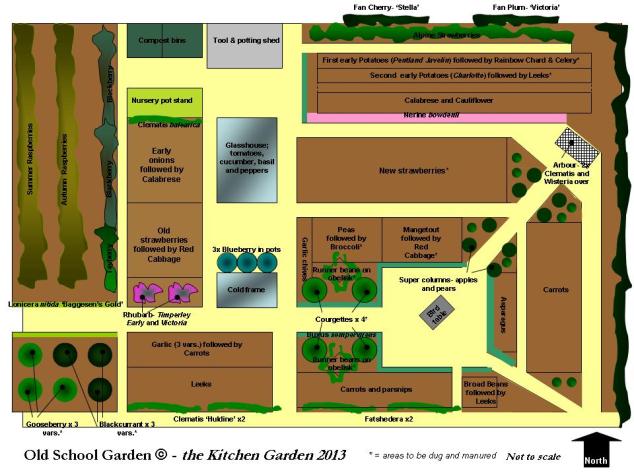
So yesterday (after pruning the apple trees), I spent a couple of hours drawing up a proper diagram of the plot, tried to think through what could go where (once I’ve taken permanent crops like fruit, Rhubarb and Asparagus out of the equation)- and also whether there’s potential for second crops in some areas, too.

I’ve tried to follow the rules on rotation (brassicas following legumes, potatoes following brassicas and onions and roots following potatoes), but I must admit it’s a bit hit and miss, taking all of the other variables into account! What’s your experience and do you have any sure- fire tips to help me?

At last, a cunning plan for food growing in 2013! (I hope)

(click on the image to enlarge and see a panorama video of the garden as it looks today at http://www.youtube.com/watch?v=rZ20lLrTLIc&feature=youtube_gdata_player)

kitchen gdn layout

P.S.  A note on manure:  if you can get some well rotted animal manure it could be good to either dig it into your beds or just lay some on top for the worms to incorporate into the soil. I’d be careful about putting it down everywhere though, as root crops like carrots and parsnips don’t like freshly manured ground (they tend to fork and not grow well in the heavier conditions that are created). However, ‘hungry’ cops like potatoes, brassicas (cabbages, calabrese, cauliflower, broccoli), courgettes, squashes and legumes (peas, beans) would all benefit from some, as would a greenhouse if you’re planning to grow tomatoes. Ideally it needs to be obtained and placed or dug in in the next few weeks in order for the weather to break it down and help to incorporate it into the soil.

Further information: Vegetable Gardening for Beginners: The Complete Guide

Quizzicals: answers to the last two…

  • Private part of a old crooner Periwinkle
  • The organ that enables you to say ‘2 plus 2 = 4’Adder’s Tongue

and just for fun two more ‘gardening ditties’:

‘Pepper’s got a brand new bag’

‘Spice Oddity’ (topical huh?- thanks Les)

Old School Gardener

A view of the Kitchen Garden looking west- east (left to right on the diagram)

Finding Nature

Nature Connectedness Research Blog by Prof. Miles Richardson

Norfolk Green Care Network

Connecting People with Nature

Discover WordPress

A daily selection of the best content published on WordPress, collected for you by humans who love to read.

Susan Rushton

Celebrating gardens, photography and a creative life

Unlocking Landscapes

Writing, photography and more by Daniel Greenwood

Alphabet Ravine

Lydia Rae Bush Poetry

TIME GENTS

Australian Pub Project, Established 2013

Vanha Talo Suomi

The Journey from Finnish Rintamamiestalo to Arboretum & Gardens

Marigolds and Gin

Because even in chaos, there’s always gin and a good story …

Bits & Tidbits

RANDOM BITS & MORE TIDBITS

Rambling in the Garden

.....and nurturing my soul

The Interpretation Game

Cultural Heritage and the Digital Economy

pbmGarden

Sense of place, purpose, rejuvenation and joy

SISSINGHURST GARDEN

Notes from the Gardeners...

Deep Green Permaculture

Connecting People to Nature, Empowering People to Live Sustainably

BloominBootiful

A girl and her garden :)