Tag Archive: leaves


carpinus betulus autumn colourThis is the third in my new series on garden trees. I’ve also done an article about trees and garden design.

Common name: Hornbeam

Native areas: The 30–40 species occur across much of the north temperate regions, including the U.K., with the greatest number of species in east Asia, particularly China. Only two species occur in Europe, and only one in eastern North America. 

Historical notes: Traditionally, the timber of hornbeams has been used to produce mallets, skittles and even the moving parts of pianos! The common English name of “hornbeam” derives from the hardness of the wood (likened to ‘horn’) and the Old English ‘beam’, a tree (similar to the German for tree, “Baum”).

Pleached trees- picture RHS

Features: A large, deciduous tree (growing to 20 metres plus), with a grey-fluted trunk and spreading canopy. It has ovate, ribbed and serrated edge leaves that turn a beautiful clear yellow in autumn. The flowers are wind-pollinated pendulous catkins, produced in spring. The male and female flowers are on separate catkins, but on the same tree (i.e it is monoecious). The fruit is a small nut about 3–6 mm long, held in a leafy bract; the bract may be either trilobed or a simple oval, and is slightly asymmetrical.

Uses:  Wonderful in a parkland setting, grown in groups, it also ideal for pleaching (i.e. training into a ‘hedge on stilts’) and for use along the edges of smaller gardens – just like here at Old School Garden. Received the Award of Garden Merit from the RHS in 2002.  Some of the cultivars are suitable for smaller gardens as their growth habit is more columnar.

Some of the cultivars available include:

‘Fastigiata’– a tree of medium size (10-15 metres in height) and with a pyramidal habit, slender in its youth. Suitable for smaller areas despite developing ‘middle age spread’ (it can grow out to  1o metres wide). Very effective if left feathered at the base to encourage gold and orange autumn leaf colour. Stiffly ascending branches give it a columnar shape, resembling Lombardy Poplar.

‘Fastigiata Frans Fontaine’- selected from a street in the Netherlands in the 1980’s this retains its columnar habit better than the ordinary ‘Fastigiata’ variety (3 metres wide after 25 years) so is even better suited to restricted areas.

‘Purpurea’-  medium height (10-15 metres), introduced in the 1870’s , this is well suited to arboretums and plant collections. Young leaves flush with a purple tinge and then gradually turn deep green and them a similar yellow to the species hornbeam in  autumn. Slower growing and ultimately smaller than the species tree. Well suited to heavier soils.

”Japonica’-  (Japanese hornbeam), introduced from Japan in 1895, a small (5-10 metres tall), rounded tree, very effective if pleached. Darker than the species tree, with heavily corrugated leaves, darker than the species tree. Attractive, prolific hop-like fruit. AGM in 2002

Growing conditions: hornbeams grow well in most soils, including clay and chalk and is useful for planting where there are poor planting conditions.

 Further information:

Wikipedia

RHS- Carpinus betulus

RHS- pleaching

Barcham trees directory

Old School Gardener

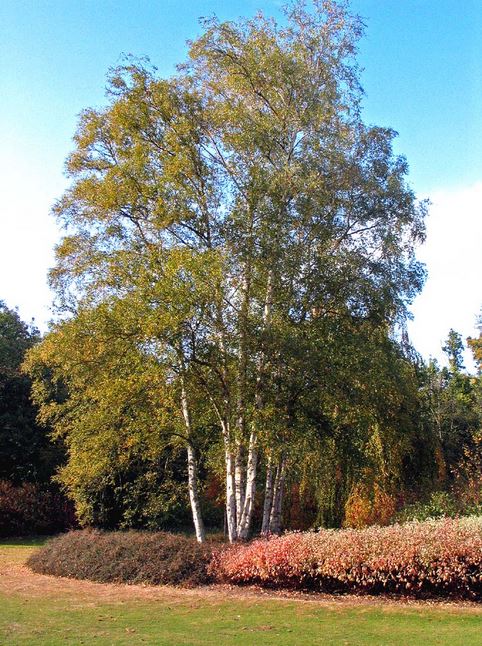
mature betula pendula bartram treesThis is the second in my new series on garden trees. I’ll shortly be doing one or two articles about trees and garden design, in my series ‘Design my garden’, so keep an eye out.

Common name: Silver Birch

Native areas: Europe, though in southern Europe it is only found at higher altitudes

Historical notes: Also known as the ‘Lady of the woods’ because of its slender and graceful appearance. Especially popular in the UK. Grown as an ornamental plant and also for its timber. It is used for a range of purposes, from broom-making and steeple-chase fencing to medicines.

Features: A medium tree (15- 20 metres tall), with a conical, semi weeping habit, with white bark and horizontal lines and large diamond -shaped cracks which form as the tree matures. Leaves ovate, yellow in autumn. Flowers in catkins. Can be grown either as a single or multi-stemmed tree.

This slideshow requires JavaScript.
Uses: Very good as a multi-stemmed tree for exposed or elevated positions as they have a low centre of gravity. These look good in small groups in informal settings. I have a few that contribute to a mixed ‘woodland edge’  here at Old School Garden, providing a natural boundary to the garden. It can also be used as a specimen, though some of the cultivars available perhaps provide more interesting features than the species plant:

‘Dalecarlica’ (Swedish Birch, syn. ‘Laciniata’ or ‘Crispa’)- deeply cut leaves which weep gracefully, white peeling bark

‘Fastigiata’- stiffly ascending branches give it a columnar shape, resembling Lombardy Poplar

‘Purpurea’ slow growing and rare, with new, dark purple leaves,softening t o dark green/purple by summer.

‘Tristis’- tall (15-20 metres), weeping birch, with beautiful winter structure.

‘Youngii’- similar habit to ‘Tristis’ but shorter (5-10 metres) and so more suitable for smaller gardens, especially good as a specimen  in lawns.

‘Zwisters Glory’- from Switzerland, this new variety has gleaming white bark, so makes a good avenue tree and a good choice for urban areas and is quick growing.

Two other species of birch are also worth mentioning:

Betula pubescens- ‘Common White Birch’, prefers damper conditions than B. pendula, also it’s more hardy. It’s ascending branches give it a more solid appearance than B. pendula.

Betula utilis ‘Jacquemontii’/ ‘Doorenbos’-a medium tree with ascending branches, most admired for its almost pure white bark, looking very effective against a dark background.

Growing conditions: grows well in most soils and is good for parks and woodland, but is not suitable for areas which have soil that becomes compacted. Difficult to transfer as a bare rooted specimen, but containerised plants are more successful.

Further information:

Wikipedia

RHS

Barcham trees directory

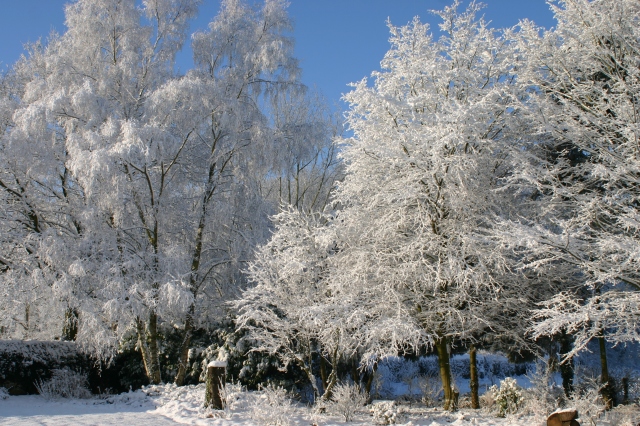
Silver Birch among others in the snow at Old School Garden, January 2013

Old School Gardener

acer campestre by wendy cutler

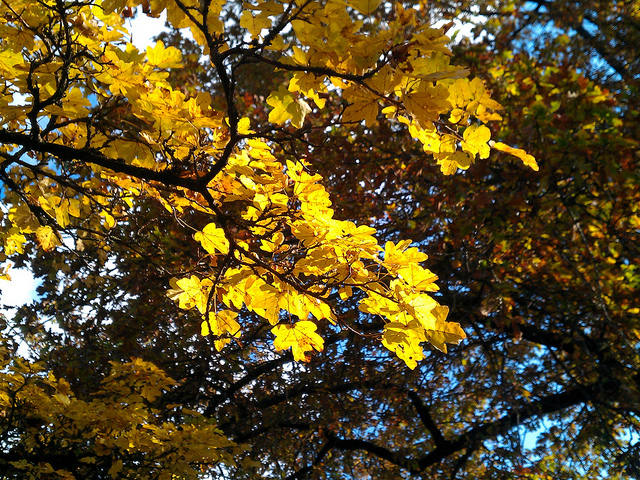
Acer campestre Autumn colour by Wendy Cutler

Welcome to my new ‘A-Z’ series on Garden Trees. My recently concluded series on perennials proved to be very popular so I hope that this will be equally appealing to my blog readers and followers. I plan to give a few brief facts on 26 trees that are suitable for gardens, together with a picture or two and how they might be used in the garden. My companion collection of articles called ‘Design my Garden’ will feature a few articles about the different design uses of trees in parallel with this new series.

I will be using various sources for the articles, but much will come from the very useful catalogues of Barcham Trees,a specialist tree nursery in Cambridgeshire I had the pleasure of visiting a couple of years go. So, here we go…..

Common name: Field Maple

Native areas: England

Historical notes: used for making musical instruments in the Middle Ages.

Features: small to medium height tree (10-15 metres) with rounded for. Leaves with 5 blunt lobes, turning varied tints of yellow, golden brown and red in the autumn.  Flowers small, green, forming typical winged maple fruitsCan be grown as a single or multi-stem tree.

Uses: a tree for woodland settings or used in small groups in large open gardens and landscapes especially valuable for its autumn colour; also useful in hedgerows (it is very wildlife friendly and will tolerate rough pruning in winter to keep its shape). Various clones of Acer campestre are well suited to streetscapes and urban settings as they have a more regular shaped crown than the parent.

Growing conditions: grows best in rich, well-drained soils, but will do well in most soil types and is tolerant of drought, soil compaction and air pollution.

Further information:

Wikipedia

RHS

Barcham trees directory

Old School Gardener

PicPost: Stare Carpet

via Woodland Trust

Picpost: Red wood

All about the leaves- Fatsia japonica

All about the leaves- Fatsia japonica

This latest  ‘snippet on style’  focuses on leaves. You might think that gardens designed around leaves would be boring. Not a bit of it. Foliage comes in all shapes, sizes and many colours (or shades of green). With the occasional splash of floral colour and other focal points thay can provide a  wonderfully soothing, and sometimes exotic air.  Foliage gardens are typified by the use of leaf and plant texture and shapes as well as subtle variations in leaf colour to provide interest, rather than floral display at different times of the year, which tends to drive other garden styles or at least their planting plans.

Sometimes the whole garden is about foliage, punctuated with flower or other colour (for example The Exotic Garden in Norwich – see link below). Sometimes specific areas in a larger garden are devoted to foliage, with the emphasis on contrasting varieties and plant forms. These gardens are typically organic in shape, with no hard edges and informal in layout and feel. They can also feature items such as sculpture or garden furniture made out of rustic materials and used as focal points set off against the foliage. Other key features of foliage gardens include:

  • Bold foliage

  • Colourful highlights

  • Pools and reflections

  • Containers

  • Locally sourced, rough materials

  • Height and structure

Links:

Other articles in the ‘Style Counsel’ series:

Family Gardens

Productive Gardens

Japanese Gardens

Country Gardens

Modernist Gardens

Formal Gardens

Mediterranean Gardens

Cottage gardens

Old School Gardener

If you’ve enjoyed reading this post and others on this blog, why not comment and join others by signing up for automatic updates via email (see side bar, above right ) or through an RSS feed (see top of page)?

Hosta shoots

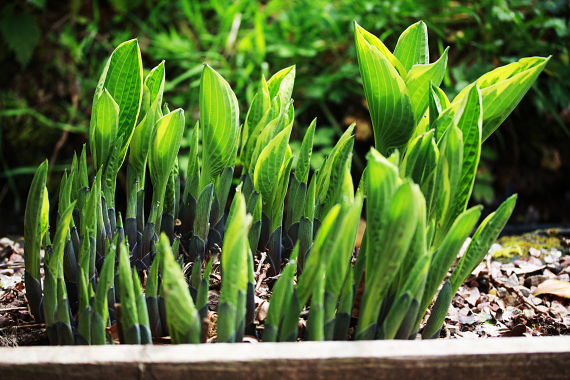
Hosta shoots -courtesy Marcus Bawdon http://www.countrywoodsmoke.com

‘Everyone has Hostas’… OK so you may think them unfashionable, but I love them… the whole growth process –  new shoots spearing up above the soil surface (right now in Old School Garden), the unfurling leaves, the full blousy foliage and the delicate flowers of pinks, lavenders and whites.

Otherwise known as the ‘Plantain lily’, Hostas come originally from eastern Russia, China, Japan and Korea. They are very hardy. Most of the 40 – 70 or so species (there is disagreement over the exact number) and over 7000 cultivars are grown for their foliage, though for many the flowers are also noteable. True perennials, their foliage dies back and they descend underground over winter, to send up new growth spears in spring and achieve their full glory in summer with some varieties flowering into early autumn. Some species also give a second, albeit brief, display in autumn.


The leaves vary between round, ovate, lance or heart – shaped and are between 12cm and 50cm in length. They come in all shades of green, some solid in colour others with margins or centres variegated in shades from white to golden yellow. Flowers range from bell to trumpet shaped, and are held in one-sided racemes or ‘scapes’.


Hostas will grow in full sun to full shade – they flower better if in the sun and the yellow-leaved varieties also do better in full sun. Overall, however, they tend to do best in dappled shade and where they are away from the hot noon-day sun (the blue – green leaved varieties have more intense colouring in the shade). They need moisture at their roots and this is even more the case in full sun – so they need watering in dry spells and generally do best in moist ground which is rich in organic matter and neutral to slightly alkaline . Foliage will start to wilt if they are too dry. They can be easily propagated by division at almost any time of year – a sharp spade or knife thrust down to split the roots is all that’s required.

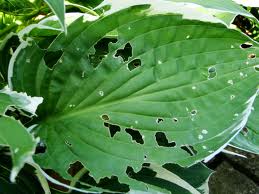
Slug and snail damage

Slug and snail damage

Pest problems focus on slugs and snails which can nibble the emerging shoots – such damage can scar the leaves for the rest of the season, so preventative and quick action to remove slugs and nails is crucial, especially in early spring. Sometimes, especially in water – logged ground, the plants can be susceptible to ‘crown rot’ and if this is the case they should be moved to a more suitable site. Hostas have low levels of allergens. Some Hostas are edible, their young shoots being forced and harvested in the far east, eaten sauted or rolled in proscuitto!


Hostas look good in groups around ponds and damp areas, and are particularly useful in areas of medium to light shade.   Their foliage makes for a bold texture so they are good as focal points, contrasting well with grassy – like leaves and stems. They are also good in containers where the leaves and flowers can be seen close up. I grow most of mine this way, in black planters in our Courtyard Garden – the black provides wonderful contrast to the rich greens and yellows of the foliage. But it’s important to keep them well watered once growth starts. Other ideas for using Hostas include:

  • ‘Plant different varieties in large masses or drifts for reliable color and texture in the garden.

  • Brighten shady garden areas with gold or variegated hostas.

  • Use hostas to bridge gaps in seasonal perennial bloom.

  • Variegated hostas with white or cream margins paired with other white flowering plants glow in “moonlight gardens” when homeowners arrive in the evening from work.

  • Hosta leaves emerge just as spring bulb foliage starts to fade, hiding it from view.

  • A single hosta in a container is dramatic and sculptural. Hostas look great in containers paired with other foliage plants or annuals. Remember to provide adequate water.

  • Plant fragrant hostas close to paths and walkways for best appreciation.

  • Use small hostas for edging along walkways and flower borders.

  • Hosta leaves and flowers are attractive in floral arrangements.’

Source: University of Minnesota Extension

Images from:  Newtonairds Lodge Hostas and Garden (the national collection), Wikipedia and other sites as shown on picture titles.

Further information:

RHS- Growing Hostas

British Hosta and Hemerocallis Society

Slug resistant Hostas

How to lift and divide Hostas (video)

Hosta varieties and where to buy etc.

The National Hosta collection

Winsford Walled Garden, Devon- success with Hostas

Hosta shoots wrapped in prosciutto

Hostas and their flowers


Old School Gardener

If you’ve enjoyed reading this post and others on this blog, why not comment and join others by signing up for automatic updates via email (see side bar, above right ) or through an RSS feed (see top of page)?

Wisley leaves


Old School Gardener

116_1634

Old School Gardener

Finding Nature

Nature Connectedness Research Blog by Prof. Miles Richardson

Norfolk Green Care Network

Connecting People with Nature

Discover WordPress

A daily selection of the best content published on WordPress, collected for you by humans who love to read.

Susan Rushton

Celebrating gardens, photography and a creative life

Unlocking Landscapes

Writing, photography and more by Daniel Greenwood

Alphabet Ravine

Lydia Rae Bush Poetry

TIME GENTS

Australian Pub Project, Established 2013

Vanha Talo Suomi

The Journey from Finnish Rintamamiestalo to Arboretum & Gardens

Marigolds and Gin

Because even in chaos, there’s always gin and a good story …

Bits & Tidbits

RANDOM BITS & MORE TIDBITS

Rambling in the Garden

.....and nurturing my soul

The Interpretation Game

Cultural Heritage and the Digital Economy

pbmGarden

Sense of place, purpose, rejuvenation and joy

SISSINGHURST GARDEN

Notes from the Gardeners...

Deep Green Permaculture

Connecting People to Nature, Empowering People to Live Sustainably

BloominBootiful

A girl and her garden :)