Tag Archive: gardens


Pena PalaceThe Pena National Palace (Palácio Nacional da Pena) is a Romanticist palace in Sintra, Portugal. The palace stands on the top of a hill above the town of Sintra, and on a clear day it can be easily seen from Lisbon. It is a national monument and constitutes one of the major expressions of 19th century Romanticism in the world. The palace is a UNESCO World Heritage Site and one of the ‘Seven Wonders of Portugal’.

Pena Palace Park is a vast forested area completely surrounding the Pena Palace, spreading for over 200 hectares of uneven terrain. The park was created at the same time as the palace by King Ferdinand II, who was assisted in the task by the Baron von Eschwege and the Baron von Kessler. The exotic taste of the Romanticism was applied to the park as it was to the palace. The king ordered trees from diverse, distant lands to be planted there. Those included North American Sequoia, Lawson’s cypress, Magnolia, and Western Red Cedar, Chinese Ginkgo, Japanese Cryptomeria  and a wide variety of ferns and tree ferns from Australia and New Zealand, concentrated in the Queen’s Fern Garden (Feteira da Rainha). The park has a labyrinthine system of paths and narrow roads, connecting the palace to the many points of interest throughout the park, as well as to its two gated exits.

Source: Wikipedia

PicPost: Great Garden @ Barnsdale

Barnsdale Gardens in Rutland, England were made famous by Geoff Hamilton through the BBC television series Gardeners’ World which he presented from 1979 until his death in 1996. With 38 gardens in it’s eight acre site, the gardens have been described as a ‘theme park for gardeners’. Not only do they provide a host of ideas for smaller scale gardens, but they are a delight to experience.

PicPost: Great Garden @ Cambridge Botanic Garden

‘Since its opening in 1846, Cambridge University Botanic Garden has been an inspiration for gardeners, an exciting introduction to the natural world for families and a refreshing oasis for all our visitors. This heritage-listed Garden has been designed for both year-round interest and seasonal inspiration so, whenever you visit, you will find plants to intrigue and enchant.’

Roses are one of the splendours of the gardens

Roses are one of the splendours of the gardens

The Peckovers – a quaker banking family – left behind them a secret gem of a house and garden in Wisbech, Cambridgeshire. This is one ‘banker’s bonus’ that can be shared by everyone.

Peckover House is said to be one of the finest Georgian town houses in the country. It stands proudly fronting the River Nene in this Fenland market town of 20,000 people. Originally built in 1722, the house was initially rented by the Peckovers in 1794, and purchased soon after. Jonathan Peckover had a grocery business and then moved into banking, setting up the first bank in Wisbech in partnership with the Gurney family- who later founded Barclays Bank. Peckover established a good reputation – it was said that during times of financial crisis the Peckover Bank was safer than the Bank of England!

Peckover House was initially called Bank House, reflecting the role of the house and it’s newly built banking wing. The property remained in the family for over 150 years, eventually passing over to the National Trust from its last owner, Alexandrina Peckover, in 1948.

The gardens – of around 2 acres – extend to the rear of the house and grew over the years as the family purchased ground from adjacent landowners. They also included a much larger estate extending to 48 acres, much of which today is used as playing fields and has some character-ful old trees. The Peckovers were also  keen collectors, and introduced a number of foreign plants into the garden. The gardens today maintain the basic layout from Victorian times –  including the old walls that used to mark the boundaries of adjacent properties.

The rear of the hous with the Croquet lawn in front- surrounded by some glorious trees such as the Tulip Tree (Liriodendron tulipifera)

The rear of the house with the Croquet lawn in front- surrounded by some glorious trees such as the Tulip Tree (Liriodendron tulipifera)

Step out into the garden and you feel as though you are back in Victorian times, as you move from one delightful space to another.

Once needing a team of 17 gardeners, todays gardening team of three is headed up by Allison Napier. She finds it difficult to single out her favourite part of the garden –  ‘It depends on the time of year’, she says. ‘In late winter and early spring the Wilderness Walk is full of the colours and scents from bulbs, Hellebores, Winter Honeysuckle, Christmas Box and an impressive Cornus mas. There is also the  fantastic trunk of an old Ginkgo which stands out and this with surrounding evergreens, deciduous shrubs and trees creates a strong framework.’

‘In spring the Orangery is a riot of colour and fragrance from the various bulbs and other spring plants all arranged in terracotta pots on the staging and if the flowering of the Wisteria on the front of the house coincides with the wall flowers in the various formal beds at their peak, then that is a wonderful spot.’
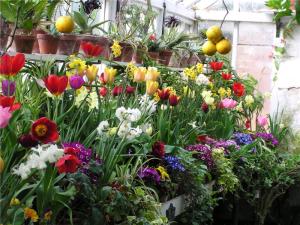
Inside the orangery- a heady mix of seasonal colour and fragrance

Inside the Orangery- a heady mix of seasonal colour and fragrance

And what about the summer The various rose gardens come into their own. There are over 60 species of rose here, many lovingly pruned and tied in every year over several metal pergolas and against walls. The area christened ‘Alexandrina’s Rose Garden‘ is a particular focal point.

But the show isn’t over yet. In late summer and autumn a ‘Red Border’ provides an array of warm colours and varied textures which are set off brilliantly against a golden privet hedge. This and an Autumn Border provide a glorious conclusion to the year. Jenny Windsor, one of the gardening team, loves these herbaceous borders and especially the contrast that they offer to other, more formal areas of the garden. ‘I love nothing more than to ‘have a play’ in the borders,’ she says –  ‘weeding, dead heading, tying in etc.’

Herbaceous borders

Herbaceous borders surrounding the Orchard Lawn with a fine old Quince tree

Many first-time visitors are surprised at the size and variety of plants in the garden. And, not surprisingly, they also commend the high standards of care maintained by the team.

Very few chemicals are used in the gardens and Allison finds that biological controls are effective in the glasshouses. As she says,

‘The healthy populations of beneficial insects, frogs and birds in the garden are testament to the ‘greener gardening’ policies we like to follow.’

The orangery (left) has rotten timbers and is due for a major renovation this year

The orangery (left) has rotten timbers and is due for a major renovation this year

The gardening team is well supported by local volunteers and a small number of trainees who come to gain practical horticultural experience (as I know, because I had the pleasure of being one last year!). Allison also thinks it important to encourage future generations of potential gardeners, so the team actively seeks school visits and has a Garden Club with students from the local grammar school.
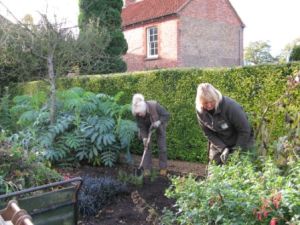
Gardeners Jenny and Janet digging over and mulching the 'Red Border'

Gardeners Jenny and Janet digging over and mulching the ‘Red Border’

What of the future? Well,the forthcoming restoration of the Orangery – with its 300 year old orange trees – is a major project due to get under way this year. Allison plans to complete work on the Conservation Plan for the garden this year, but it will be a major challenge working out the priorities and policies for the future, especially as the climate appears to be entering a very unpredictable phase affecting decisions about the range of plants to be used.

Still, the team seem to be a pretty content bunch, even though on occasions paperwork and ‘office stuff’ may get in the way of being outside and doing what they love. As Allison says, even the laborious turning of the compost heaps can sometimes be rewarding:

  ‘.. it gives you a good workout and you can find a surprising  number of lost hand tools!’

Gardener in charge Allison Napier- normally not sitting on the compost, but turnning it!

Gardener in charge Allison Napier- normally not sitting on the compost, but turning it!

Acknowledgement: thanks to Allison, Jenny and Janet, the Peckover Gardening Team for their contributions.

Quizzicals:

answers to the two on the post ‘Lock down- pros and cons of garden ties’

  • Hello Miss Black – Hyacinth
  • A punch up in the water – hydrophyte

Old School Gardener

If you’ve enjoyed reading this post and others on this blog, why not comment and also join some other people and sign up for automatic updates via email (see side bar, above right ) or through an RSS feed (see top of page)?


MartineauGardens_homepage

The Green Flag Award® scheme is the benchmark national standard for parks and green spaces in the UK. It was first launched in 1996 to recognise and reward the best green spaces in the country.

The first awards were given in 1997 and, many years later, it continues to provide the benchmark against which our parks and green spaces are measured. It is also seen as a way of encouraging others to achieve high environmental standards, setting a benchmark of excellence in recreational green areas.

Entries for the Green Flag Award® are open to parks/green spaces located in the UK. We are also currently piloting the scheme in The Netherlands and Germany.

To apply go to Green Flag Award website


Old School Gardener

PicPost: Great Garden @ Wrest Park

‘After decades behind virtually closed doors, its treasures overgrown and largely unknown, English Heritage is reviving one of Britain’s largest and most important ‘secret gardens’ – Wrest Park in Bedfordshire.

This is a wonderful 90-acre historic landscape and French-style mansion which will take its rightful place amongst the country’s great garden attractions – and give locals and visitors to Bedfordshire a superb new day out.

Stroll in the recently restored Italian and Rose Gardens. Enjoy miles of reinstated historic pathways as you discover the garden buildings, pavilion and statues. Find out more about the garden and the people that shaped it, in our new exhibitions in the house and garden buildings.’

Source: Wrest Park website

Old School Gardener

PicPost: Great Garden @ The Garden House

‘The Garden House is the elegant former home of the vicars of Buckland Monachorum..(near Tavistock, Devon)…

The present building dates from the early 19th century and now accommodates the tearooms and conference centre. The history of this 8-acre garden is closely entwined with that of Buckland Abbey and the local church. In 1305 the Bishop instructed the Abbot to build a house for the parish priest and this site was chosen. At the dissolution of the monasteries, the abbot became the vicar of Buckland Monachorum and by the early 1700s, the vicarage consisted of a substantial 3-storey dwelling. The remains of this building, a tower with spiral staircase and a thatched barn, formerly the kitchen, are now the romantic ruins in the Walled Garden.

A modern vicarage was built in the 1920s and The Garden House was sold as a private dwelling. The house came onto the market again just after the Second World War and was purchased and given its present name by Lionel Fortescue, a retiring master at Eton, and his wife Katharine. Lionel was the son of a Newlyn school painter and had a good eye for colour as well as being an exacting plantsman. Lionel and Katharine immediately set about renovating and developing their garden whilst running a thriving market garden business, providing stock plants for growers in the Tamar Valley, and managing a herd of Jersey dairy cattle.

Over nearly 40 years, the Fortescues created a garden viewed as one of the finest in Britain. By 1961, they had established the Fortescue Garden Trust, an independent registered charity to which they bequeathed the house and garden to ensure the survival of this beautiful place for future generations. After their deaths in the early 1980s, ownership passed to the charity which to this day maintains the Fortescue’s lovely legacy.

The second phase of development took place under Keith Wiley who was appointed by Lionel and spent 25 years as Head Gardener. Keith took the 6 acres of paddocks to the far side of the road into cultivation from 1990, creating a series of gardens that take their inspiration from the natural world. Keith left in 2003 to concentrate on writing and creating his own nursery, Wildside Plants.

Matt Bishop is the present Head Gardener and he is particularly well-known for his expertise on snowdrops and bulbs. Matt’s brief is to care for and respect the legacies of his predecessors whilst ensuring, just as they did, that The Garden House remains a crucible of new ideas and new plants, at the cutting edge of horticultural excellence and innovation. He has undertaken a major refurbishment of the original Fortescue garden as well as ongoing maintenance in other areas to ensure a long opening season of glorious colour and variety. This has been an excellent opportunity to introduce many new plants whilst continuing Lionel’s principle of using only the best forms and cultivars avaialble.

Matt has two horticultural students under training here and a small team of dedicated staff and volunteers who care for the garden.’

Source: The Garden House website

Old School Gardener

Great Garden @ Gulbenkian Museum, Lisbon

‘Whenever I want to escape the hustle and bustle of Lisbon, and don’t want to travel far, I retreat to the gardens of the Calouste Gulbenkian Museum.

Covering roughly 17 acres, this beautifully landscaped garden contains a wide variety of well-established tropical as well as indigenous plants and trees that shelter subtly-appointed benches and seats. In the last few months a network of new, flat, winding paths has been opened through the garden.

There are picnic tables situated next to a lake where you can sit on bright winter days and soak up the sun, or watch the ducks with their fleets of ducklings enjoying the water in spring. At the weekends the gardens come alive with the sound of kids playing in the sunshine.

In the summer months, it is nice to disappear into this garden down one of the maze-like paths that snake through the shrubbery and to feel as if you are the only person in the world, surrounded only by birds scurrying around in the undergrowth or flitting in the trees. Somehow, the vast tree canopies manage to dull the sound of Lisbon traffic to the point you forget it is there and will also shelter you from the heat of the day.

The garden contains an open-air amphitheater where, during the summer, a programme of films or music events takes place in the evenings.

Whether on a hot, sultry summer evening or a bright, sunny winter day this garden is the perfect place to be and feel completely relaxed.’

Katy Pugh

Old School Gardener

garden pic gressenhallThere are around ten different heritage gardens or other tended spaces at Gressenhall Farm and Workhouse Museum, near Dereham, Norfolk.

I’ve been a garden volunteer here for the last couple of years and spent time as a trainee Heritage Gardener. I plan to explore these spaces in my blog over the coming weeks. Here’s some background information.

References to ‘gardens’ in the Workhouse records (from  late 18th to mid 20th centuries) are relatively few, as most of the spaces within the walls of the former Workhouse were ‘yards’ of various kinds, being used for exercise or work by the inmates (including stone crushing). Records indicate that there were areas of active cultivation, mainly to grow food for the Master, staff and inmates. Major areas of food cultivation (most located just outside the Workhouse walls) no longer exist.

The current workhouse buildings were developed in the late 18th century after an Act of Parliament encouraged ‘Houses of Industry’ to be set up. People unable to look after themselves and/or their families were able to live in the buildings and do work to earn their keep. Before this, from Tudor times, the poor were the responsibility of local parishes and prior to this were looked after by religious orders, or informally by neighbours, friends or family.

The Workhouse meant a harsh, regimented life

The Workhouse meant a harsh, regimented life

1834 saw the Poor Law Reform Act  which converted the House of Industry into The Workhouse. Conditions became much harsher with families split up into different groups – adult males, adult females, boys, girls, unmarried mothers with babies, tramps (or ‘casuals’) etc. Dickens’ novel Oliver Twist conveys the strict regime.

Union Farm showcases historic farming practices with animals and fields

Union Farm showcases historic Norfolk farming practices

Gressenhall and other Norfolk workhouses expanded and reorganised accordingly and this system remained largely the same for the next 100 years. The Poor Law  was eventually abolished just after the 2nd World War and Gressenhall became an old peoples’ home- ‘Beech House’ (named after the magnificent Copper Beech tree in the main courtyard). Finally, in 1979 the old peoples’ home closed and the site was developed as the Norfolk Rural Life Museum, including the acquisition and development of the adjacent Union Farm as a showcase for farming methods and practices of yesteryear.

The historical role of today’s heritage gardens has resulted in most of them being enclosed by the walls of the workhouse buildings, boundary or dividing walls and sometimes, native species hedges or other natural boundaries. These ‘Gressenhall Gardens’ are principally the result of voluntary effort beginning in the 1980’s. The spaces were developed to support the Museum’s role in telling the story of the Workhouse and Farm, Norfolk’s broader landscape and rural life, as well as the more contemporary issues of environmental sustainability and biodiversity.

an aerial view of Gressenhall Farm and Workhouse Museum

An aerial view of Gressenhall Farm and Workhouse Museum, Norfolk

Several of these heritage gardens are domestic in scale and style with mixed planting and other features,  probably due to their clear definition into manageable spaces coupled with the interests and ideas of volunteers and staff. Some of them perform specific roles in helping to interpret this Norfolk museum site and deliver some of it’s messages;

  • Cherry Tree Cottage Garden illustrates a typical Norfolk cottage garden of the 1930’s, using plants and techniques from that time
  • The Wildlife Garden has habitats, planting and other features that are conducive to wildlife. A small border also features ‘useful plants’
  • The Orchards are growing varieties of apple and other fruit native to Norfolk (this is located on the graveyard of the old Workhouse)
  • The Dyers’ Garden features plants used in natural dyeing
Cherry Tree Cottage garden is set out like a typical 1930's cottage garden with vegetable varieties and techniques of the time

Cherry Tree Cottage garden is set out like a typical 1930’s Norfolk cottage garden with vegetable varieties and techniques of the time

A recent development has focused on the ‘Education Garden’, which is an important space used by the Museum’s Learning Team and others, adjoining as it does the Learning Centre. A new ‘Curiosity Corner’  provides an area for children under 5 to explore – it has various natural and other ‘child-size’ features; eg a willow tunnel, turf seat, rock pile, fossils, various metal birds, insects and animals and a hazel ‘wig wam’.

Over the coming weeks I’ll introduce you to some of the more important heritage gardens in this important Norfolk museum.

Further information:

Gressenhall Farm and Workhouse Museum on Facebook

Gressenhall Farm and Workhouse Museum blog

Old School Gardener

Finding Nature

Nature Connectedness Research Blog by Prof. Miles Richardson

Norfolk Green Care Network

Connecting People with Nature

Discover WordPress

A daily selection of the best content published on WordPress, collected for you by humans who love to read.

Susan Rushton

Celebrating gardens, photography and a creative life

Unlocking Landscapes

Writing, photography and more by Daniel Greenwood

Alphabet Ravine

Lydia Rae Bush Poetry

TIME GENTS

Australian Pub Project, Established 2013

Vanha Talo Suomi

The Journey from Finnish Rintamamiestalo to Arboretum & Gardens

Marigolds and Gin

Because even in chaos, there’s always gin and a good story …

Bits & Tidbits

RANDOM BITS & MORE TIDBITS

Rambling in the Garden

.....and nurturing my soul

The Interpretation Game

Cultural Heritage and the Digital Economy

pbmGarden

Sense of place, purpose, rejuvenation and joy

SISSINGHURST GARDEN

Notes from the Gardeners...

Deep Green Permaculture

Connecting People to Nature, Empowering People to Live Sustainably

BloominBootiful

A girl and her garden :)