
Tag Archive: gardens
 Some of the wonderful planting at Queen’s Lower School for girls, Chester
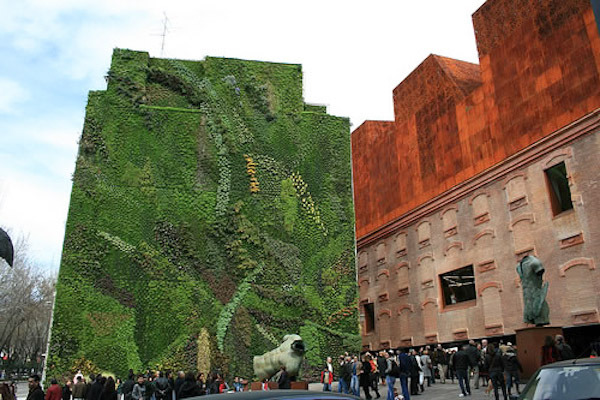
Vertical gardens or ‘green walls’ seem to be increasingly popular, from the humble vertical planters made out of recycled materials like pallets, to the enormous ‘frescoes’ seen on new buildings around the world.
This is a testament to their value in both a domestic setting- where they are one way of adding height and so ‘structure’ to a garden as well as providing either a splash of colour or a source of food – and to their role in helping to ‘green’ our cities and other built up areas, managing air temperatures and providing an attractive texture to what might otherwise be a boring facade.
I’ve gathered together a few pictures here of some examples that might inspire you!
Old School Gardener
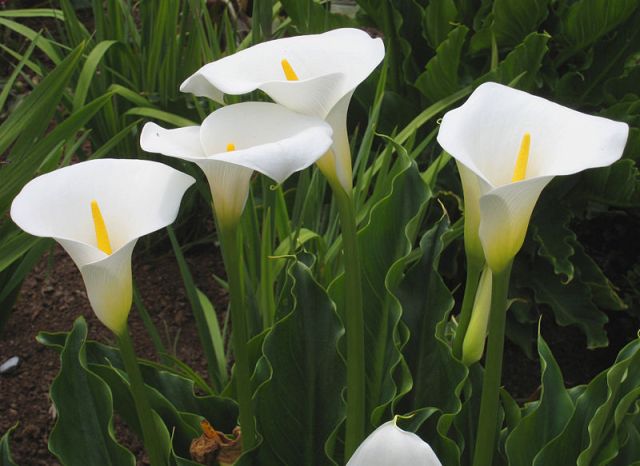
- Zantedeschia aethiopica
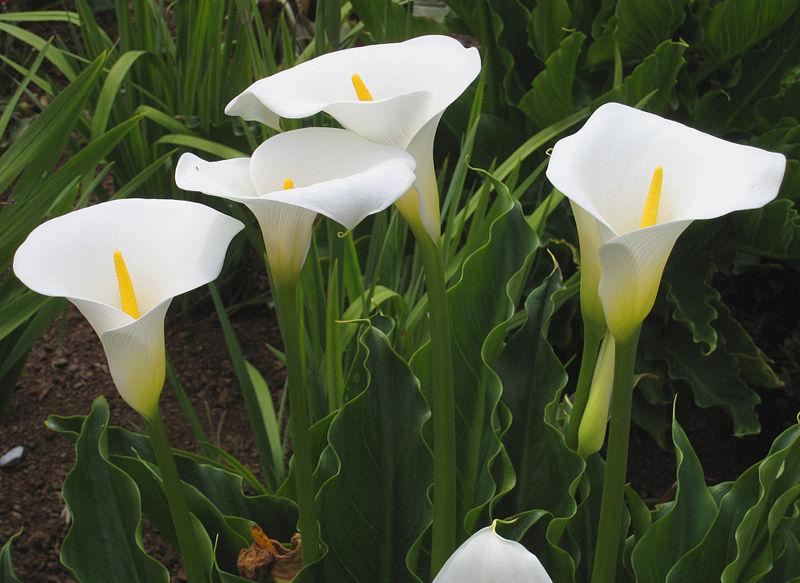
Zantedeschia is a genus of about 8 tuberous or rhizomatous perennials, found in swamps or moist soils at the margins of lakes in southern and eastern Africa. The name of the genus was given as a tribute to Italian botanist Giovanni Zantedeschi (1773–1846) by the German botanist Kurt Sprengel (1766–1833).
Zantedeschia fall into two main types:
-
hardier outdoor forms (Z. aethiopica and Z. pentlandii ), often called arum lilies, with striking white flowers (these are in fact ‘spathes’ – a coloured bract or leaf- wrapped round a thin, creamy yellow column, or spadice); and
-
the more tender hybrid forms, typically with white-spotted leaves and pretty yellow, orange, pink or dark purple spathes (Z. elliottiana and Z. rehmannii hybrids), which are borne in spring or summer. Z. elliottiana have broadly, heart shaped leaves, most with a covering of translucent white dots and usually yellow spathes, whereas Z. rehmannii have mid to dark green, lance – shaped leaves, rarely spotted, with white to pink or dark purple spathes. These are often called calla lilies.
However, Zantedeschia is neither a true lily (Liliaceae) nor an Arum or a Calla!
It has often been used in paintings, and is visible in many of Diego Rivera’s works of art (see The Flower Vendor, amongst others). It was a favourite subject of the painter Georgia O’Keefe.

- Zantedeschia aethiopica

Z. aethiopica is the most common form in British gardens, grown as a marginal aquatic plant. This is a wonderful architectural plant for pond margins in areas that do not suffer from very hard frosts. The leaves alone are an attraction. They are large, 40cm (16in) long, and arrow-shaped, and a bright, glossy green with distinct veins. However, arum lilies are mainly popular for their serene, white flowers.They make superb, classy cut flowers.
Grow the arum lily as a water plant, planting it into a special aquatic basket, in water up to 30cm (12in) deep. Or you can plant it into moist soil around the pond, protecting it with a deep mulch over winter. The Royal Horticultural Society have given it their prestigious Award of Garden Merit.
In frost – prone areas they should be covered with a deep winter mulch. Where temperatures fall below 10 celsius more tender arums can be grown in a warm greenhouse or as houseplants, or can be planted out in summer in a sunny site. Zantedeschia can be propagated by seed or division (divide in spring).
 Zantedeschia elliottiana
  Z. elliottiana close up
Zantedeschia elliottiana
Z. elliottiana close up
For early flowering plants at Easter, plant the rhizomes in December. Keep in a light, cool place at a temperature of 16°C (61°F) by night and 18°C (65°F) during the day. Feed fortnightly with a high-nitrogen fertiliser when in active growth but withhold feed during flowering. A high potassium feed such as a tomato fertiliser can be given once a week after flowering.
Both types of Zantedeschia can be grown in containers. When planting, use a loam-based compost such as John Innes No. 2 and plant the rhizomes (underground stems) just showing at the surface of a container with the eyes of the rhizome uppermost.
 Z. albomaculata by Forest and Kim Starr
  Z. ‘Neon Amour’ by Stan Shrebs
Z. albomaculata by Forest and Kim Starr
Z. ‘Neon Amour’ by Stan Shrebs
Water freely through the summer and feed with a balanced liquid fertiliser every two weeks until the flowers have faded. Zantedeschia are generally pest and disease free, but can suffer from winter cold unless protected.
Zantedeschia species are poisonous due to the presence of calcium oxalate. All parts of the plant are poisonous, typically producing local irritation or a burning sensation in the mouth and occasionally vomiting and diarrhoea. However leaves are sometimes cooked and eaten.
Sources and further information:
Wikipedia
RHS guide to growing Zantedeschia
Lakeside guide to growing Callas
Gardeners’ World guide to Z. aethiopica
Kew Gardens- Z. aethiopica
This concludes my series ‘A-Z of Perennials’, started last year. I hope you’ve enjoyed it and will also like my new series- ‘A-Z of Garden Trees’, coming soon!
Old School Gardener

- An early show from Euphorbia characias in Old School Garden

To Walter Degrasse – 27th February 2014
Dear Walter,
Mild weather has continued here and so I’ve taken the opportunity to start lightly turning over the soil, cutting back dead stems on herbaceous perennials and grasses and recently pruned back some shrubs such as Cornus and Buddleja to channel the new growth that’s starting to emerge.
In the last couple of weeks, the basal growths of new leaves around many plants have started to push upwards and the pattern of planting in the mixed borders is slowly taking shape – a very satisfying sight too.
 Flowers lon the Vinurnum tinus ‘Eve Price’
  New growth starting to push through in a mixed border
  sprign show of crocus, miniature narcissus and Euphorbia myrsinites
  Clematis balearica
  Tulips and Nepeta leaves pushing through in the courtyard planters
Flowers lon the Vinurnum tinus ‘Eve Price’
New growth starting to push through in a mixed border
sprign show of crocus, miniature narcissus and Euphorbia myrsinites
Clematis balearica
Tulips and Nepeta leaves pushing through in the courtyard planters
I was surprised at how easily my kitchen garden soil responded to a light forking over, which included turning in some green manures and removal of a few weeds. With all the rain we’ve had I was expecting it to be rather claggy, but then again my sandy loam is always a joy to work with, so I should have known better. It’s also been perfect weather for dividing and moving some herbaceous perennials I didn’t get around to doing last year.
Having repaired the little storm damage we’ve had (a few bent hinges on one of the garage doors and a fence post needing to be replaced), I’ve also finally taken apart my wooden planters built about 7 years ago, but unfortunately not with pressure treated timber, so that all the money and effort has not lasted as long as I’d hoped. Still, I’ve been pleasantly surprised at an offer from a Scottish Raised bed manufacturer (‘Woodblockx’).
They’ve kindly donated me a new planter and I’m finalising my plans about where best to use this, possibly as a feature in the courtyard with alpines or maybe somewhere in the kitchen garden for food growing. The system they use looks both very strong and relatively easy to build, but I’ll do a review on the blog as I get to grips with the build in the next few weeks.
 Out with the old- and rather rotten planters
  In with the new- my new ‘Woodblockx’ planter awaiting construction
Out with the old- and rather rotten planters
In with the new- my new ‘Woodblockx’ planter awaiting construction
Having completed all the pruning and clearing of spent stems and foliage, I’ll also be turning my attention to further spring soil turning in the next few weeks. My first batches of seeds have germinated pretty well and I’ll be potting up some french marigolds and moving on some early food crops (Calabrese, Cauliflower and Leeks). To date the new bed of asparagus I planted last autumn doesn’t appear to have made any growth above ground, but it’s still bit early for that, perhaps.
Next door the garlic bulbs and most of the broad beans I sowed last autumn are now doing well, as are the patches of onion sets (Red and white) and some Red cabbage and spinach. Mole activity seems to have subsided a little of late – hopefully it will tail off further as I get to give the lawn its first cut – and new grass will come up where the mole hills once lay.
Further afield, I’ve continued my new support at Fakenham Academy (a local high School), helping three groups of students prepare a food growing plot each in their school garden; in fact three plots of 12m x 6m, all of which have either been covered with weeds or grass.
Getting these ready for sowing is proving to be a tough job, the weather requiring us to turn over the clumps of grass/weeds and soil to allow for some drying out, so that we can remove most of the soil before piling up the weeds and turves in separate heaps for rotting down. Still, it does look like we’re making progress.
However, I discovered the other day that due to there being some asbestos in the better of two greenhouses there, we will have to wait longer for a propagation space. This is unfortunate as I’d hoped to have broken up the hard physical toil with some lighter seed sowing activity especially as I have now bought the seeds and seed potatoes in line with the crops the students say that they want to grow. It’s fun working with these students, though not surprisingly they can get tired and bored of digging and so behaviour standards can sometimes drop!
Yesterday I returned to Gressenhall Farm and Workhouse Museum (where I volunteer) and was pleased to commence a tidy up of the gardens I’m responsible for. It was also encouraging to meet two new volunteers, Jonathan and Mike, as well as two new Heritage Gardening trainees, Sam and Sonny.
This new injection of person power will make it a lot easier to keep on top of the maintenance of the gardens and may even allow us some scope for further improvement projects.
It was a lovely day too, which makes garden tidying a real joy! The museum opens to the public again on 9th March, so next week no doubt we’ll all be trying to get the gardens looking presentable. The tubs of pansies and spring bulbs I planted in the autumn are looking good and along with other spring interest should give the gardens a splash of early colour- the pinky blushed Hellebores in the Education Garden are looking good for example.
 French margiolds ready for potting up
  Early potatoes chitting away nicely
  Overwintering Echeveria, Geraniums and Dahlia tubers in the greenhouse- I don’t think the heater has been on much to date.. s
French margiolds ready for potting up
Early potatoes chitting away nicely
Overwintering Echeveria, Geraniums and Dahlia tubers in the greenhouse- I don’t think the heater has been on much to date.. s
I’m just back from a morning at my local primary school (first visit since early winter) to help with their ‘outdoor learning’, focusing on the garden. The morning began rather wet but we managed to spend a couple of hours with two groups of children turning over soil and weeding as well as moving a pile of wood chips around the fire pit- these had come from a fallen hawthorn tree that toppled over in the main drive during the recent storms. Some of the children also worked out how many potatioes they’d need for one of the raised beds and I took in a few fruit boxes with moulded paper liners to help with ‘chitting’.
The children seemed to have a great time and were especially interested in the warmth that had built up in the pile of wood chippings – a great opportunity to explain the rudiments of composting!
I’m also pleased that we have some extra help in the garden, in the form of Ann, one of the students on the GYO course I did last autumn and a parent of one of the children at the school. And our current house guest, Lisa, also helped out with groups spotting the ‘first signs of spring’. Lisa is staying with us for a few months to experience British school life and brush up her English before commencing her own university career with a view to teaching. She’s from Muenster in Germany – and we are also eagerly anticipating the arrival of her mother, Anne tomorrow for a weekend stay.
Seems like this is the time for important germans to visit the UK, as their Chancellor, Angela Merkel is in London today, addressing the Houses of Parliament and taking tea with the Queen!
 Dog woods pruned to encourage new colourful stems for next winter
  asparagus trench- no signs of growth…yet
  Autumn sown broad beans- a few gaps to fill
  A few of the turned raised beds in the kitchen garden- its a joy having a sandy loam soil!
  Red cabbages sown last autumn and over wintered to give an early crop this year
Dog woods pruned to encourage new colourful stems for next winter
asparagus trench- no signs of growth…yet
Autumn sown broad beans- a few gaps to fill
A few of the turned raised beds in the kitchen garden- its a joy having a sandy loam soil!
Red cabbages sown last autumn and over wintered to give an early crop this year
The Garden Design course that I’m running at Reepham seems to be progressing well, with 9 enthusiastic participants. They have all pretty much surveyed and drawn up a scale base plan of their gardens and are now exploring functional and form layouts as well as developing sketch designs incorporating ideas for creating structure in their designs. Next week we turn our attention to planting design as the ‘fourth dimension’ (seasonal variations) adding to the 2D and 3D views of the garden we’ve covered to date.
Tonight I’m off to County Hall in Norwich to attend an event for the Norfolk Master Composters, featuring a talk by well known Norfolk organic gardener, Bob Flowerdew – and there’s a buffet too!
I hope you and Lise are well and getting stuck into your plot once more – remember to take it easy and limber up before you do anything strenuous – you don’t want that back problem again!
all the best,
Old School Gardener

Phacelia via Gardening Naturally

Roof top prairie planting via Urban Gardens
Old School Gardener

Here are a few whizz ideas for garden seating…most made from pallets and other recycled materials.

Pallet chair and platform- vibrant…

Get close to the plants….

Chevy bench..

Pallet bar and stools…

Pallet bench..
Old School Gardener
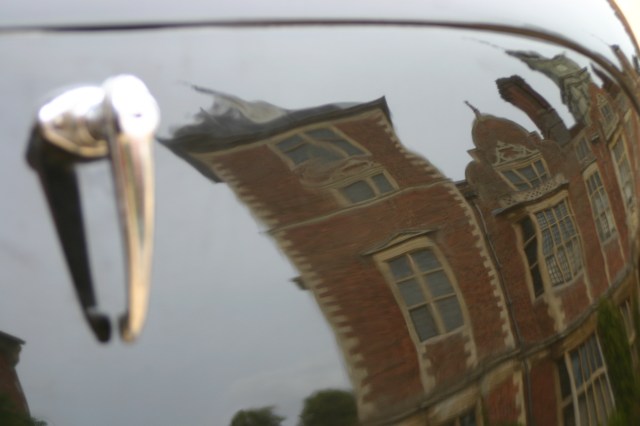 I frequently visit this wonderful Jacobean Mansion and more particularly it’s gardens and parkland. After all it is just 7 miles from home. A walk around the park after a Christmas Day ‘brunch’ has become something of a family institution, often complete with festive headwear!

I try to visit the gardens at different times of the year as they offer something for every season, and back in September I was keen to experience the late summer colour festival of its herbaceous and other plantings. At this time of year it’s mix of formal and informal styles is most evident.


Coincidentally, there was a splendid event going on to celebrate the role of the Hall in the Second World War, including people dressed in military uniforms and plenty of vehicles and ‘kit’ from the time. This is my photo record of my most recent visit along with a very good summary of the gardens’ history and features from Wikipedia:
‘A house and garden existed at Blickling before the estate was purchased by the Boleyn family in the 1450s, but no records survive to give an indication of their appearance. After Sir Henry Hobart acquired the estate in 1616, he remodelled the gardens to include ponds, wilderness and a parterre. A garden mount– an artificial hill in Blickling’s flat landscape, was made to provide views of the new garden. With the accession of Sir John Hobart (later the 1st Earl of Buckingham) in 1698 the garden was expanded to add a new wilderness and the temple was constructed.
In the latter half of the 18th century John Hobart, 2nd Earl of Buckingham, embarked on works that would radically change the appearance of the gardens. All traces of formality were removed, and naturally arranged clumps of trees were planted to create a landscape garden. By the 1780s an orangery had been built to overwinter tender citrus trees. Following the 2nd Earl’s death in 1793, his youngest daughter Caroline, Lady Suffield, employed landscape gardener Humphry Repton and his son John Adey Repton to advise on garden matters. John Adey Repton would go on to provide designs for many garden features. 


The estate was inherited by nine-year-old William Schomberg Robert Kerr, 8th Marquess of Lothian in 1840. He later re-introduced the formality and colour schemes of the parterre. After his death at the age of 38, responsibility for the gardens rested with Lady Lothian and her head gardener Mr Lyon. Philip Henry Kerr, 11th Marquis of Lothian, inherited the estate in 1930. After disparaging comments in a publication of Country Life, Lothian engaged socialite gardener Norah Lindsay to remodel the gardens. In the parterre she replaced the jumble of minuscule flower beds with four large square beds planted with a mixture of herbaceous plants in graduated and harmonious colours. Other improvements included removal of a line of conifers in the Temple walk, which were replaced with plantings of azaleas.
The garden today
The garden at Blickling covers 55 acres (22 ha) and contains formal and informal gardens, Grade II listed buildings and structures, woodland, specimen trees, Victorian garden ornaments, topiary, the kitchen garden .. and 18th century yew hedges.
The lawns which frame the main approach to the hall are bounded by yew hedges which were first recorded by William Freeman of Hamels in 1745. Surrounding the hall on three sides is the dry Moat. The plantings in the moist, sheltered conditions of the moat were considerably revised by Lindsay who introduced hosta, species of hydrangea, buddleja and rosemary. 


To the rear of the hall is the noted Parterre garden which is located on the east lawn. Originally created as a Victorian sunken garden it was remodelled by Lindsay in the early 1930s. Set around an 18th-century listed stone fountain, she divided the garden into four large, colourful herbaceous beds surrounded by L shaped borders stocked with roses and catmint with an acorn shaped yew marking each corner. 


In the terraces above the parterre there are plantings of peony, seasonal beds and the Double Borders created in 2006, contain a wide variety of perennials, shrubs and grasses with colours ranging from hot to cool. Close by, are the White and Black Borders which were established in 2009, together with a collection of eleagnus. 


The western side of the garden features the lawned Acre which is fringed by a spreading oriental plane tree. Outdoor sports such as croquet are played here in the summer months. Further highlights are a collection of magnolia underplanted with autumn cyclamen, the shell fountain and the kitchen garden. To the north of the parterre is the Wilderness garden which is bisected by radial grassed avenues flanked with turkey oak, lime and beech trees and naturalised bulbs. The wilderness hides a Secret Garden with a summerhouse, scented plants and a central sundial. 


Nearby is the listed 18th century orangery which houses a collection of citrus trees. Adjacent, to the building is the steep sided Dell which is home to many woodland plants including a selection of hellebore and foxglove. In 2009, an area of woodland was cleared close to the orangery to create a new garden. Stocked with a wide range of woodland plants including camellia and varieties of mahonia. Opened in 2010, it will be known as the Orangery Garden.
The Grade II listed Temple is approached by the Temple walk which is lined with azalea planted by Lindsay in her original 1930s design. Scattered throughout the garden are many garden ornaments including thirty pieces supplied to Lady Lothian in 1877 by Austin & Seeley of Euston Road, London.
Future projects include the creation of a philadelphus and rose garden. Both of which will be located in the Wilderness and open to the public in the near future .’ (Note – these have now been established and are open to the public- see pics below). 







 Old School Garden