
Tag Archive: gardens
come
Vertical gardening and planting seems to be taking off. If it isn’t home-made planters for herbs and the like then its mega green walls in public places. Here are a few of the latest examples I’ve come across.
-

- Edible wall at Atlanta Botanical Garden
-

- Second highest green wall- Colombia
-

- Steel and greenery
-

- Mixed verti gardening
-

- A green screen to help with temperature control
-

- All walls can be green
-

- You can even compost vertically- here’s a design for a wormery!
Old School Gardener
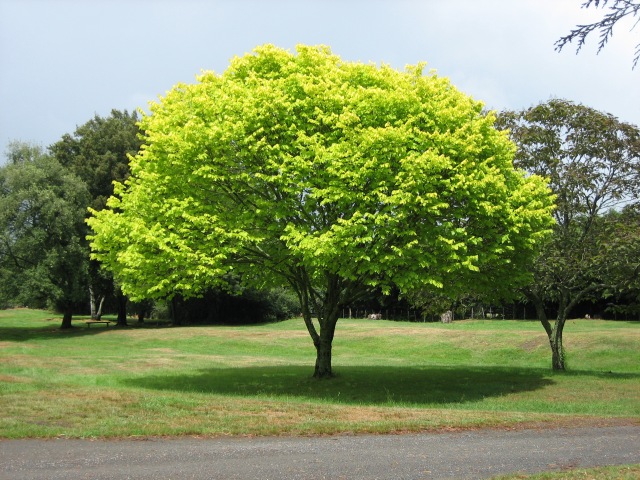 As trees tend to be the largest and longest lived plants in the garden, they should be one of, if not THE first item to consider when designing or redesigning your garden.They rank alongside some of the hard landscaping elements (seats, arches, pergolas, arbours etc.) in helping to provide the ‘bones’ or structural framework of a garden i.e. the structure by which we navigate ourselves around the plot both visually and in terms of guiding our movement. Shrubs (especially evergreens), provide a similar service and should be thought about in conjunction with whether, where and what sorts of trees to include in a design or redesign.
Trees also offer a range of other potential sources of interest in a garden apart from their overall shape or form; leaf size shape and colour (which may vary from season to season), bark (colour, texture or special effects such as peeling or patterned), flowers and fruit (catkins, conkers, apples and so on).
In visual terms the planting of a tree or trees can have a dramatic effect on the layout (or form) and perspectives around the garden. They can be used as a focal point to draw the eye. This includes those planted as a ‘specimen’. Those planted in the foreground or middle distance help to increase the sense of depth or perspective in a garden, while those planted further away help to give a sense of scale to the overall space. So, in a small garden a large tree in the foreground and a small tree at the end will make the garden seem longer.
Leaf size and texture is another important consideration. If you want a strong shape to provide a key structural element all year round in the garden, then go for small leaved, evergreen varieties with distinctive shapes or which can be pruned (topiarised) into these- e.g. Box.

- Horse Chestnut flower about to burst
Why not take a look at your garden and ask if you have one or more trees that aren’t in the right place- are they are too tall, too broad, drying out the soil or causing shade where you don’t want it? Perhaps removal or pruning is the answer. Could you introduce a tree or two and help to strengthen what your garden has to offer- providing food or a home for birds, for example or adding a brilliant show of flowers or autumn leaf colour?
Traditionally we seem to have used trees in gardens as stand alone ‘specimens’, often in an island in the middle of a lawn for example. Today, with the wide range of trees available and with characteristics that suit almost any situation, its possible to be a bit freer with how we use them- in groups or among other planting in borders.
If you are using a tree as a specimen think about its positioning carefully- if it’s planted by itself without any surrounding planting to soften its impact, it will be a focal point from the start, and as it grows bigger this impact will become even more pronounced.
If planting several trees together, including adding one or two to an existing group, think about their ultimate height and spread. As in nature, some trees grow well together; eg. Betula pendula, or ‘Silver Birch’- see my recent article in the A-Z of Trees series. The wild cherry (Prunus avium), is another example. So as with any other tree planting think carefully about their ultimate height and spread and allow room for them to grow. If you want to give a denser appearance in the time it takes the trees to mature, try growing them closer together, but expect to remove some as they mature to allow the remaining ones to grow to full size.
When planting more than one tree together in an area of grass, the relationship of one to another will determine the effect and this can change depending on where you are in the garden. A good idea is to use large posts or bamboo canes to mark their positions. Try out different positions to see what effect you like the best. Look at the positioning from different places, including from inside the house. and remember to think about their ultimate height and width and what they might obscure or hide.

- Chracterisitcs of the White Fir
We tend to think short term when it comes to gardens- we want immediate impact or effect.
The danger here is that you’ll end up with something that outgrows its space and gives you problems- a classic example is the Monkey Puzzle tree (Araucaria araucana) that was planted in the front garden of a Victorian terrace house or villa and is now way too large and tottering precariously above and perhaps towards the house! So the speed of growth is also a consideration; very slow growing trees may take 30 years to have a significant impact, so if you want an impact over a shorter period than this, then that’s perhaps a good choice.
If you have a relatively small garden, don’t think that you can’t have any trees. Smaller varieities of many different types are often available, and by choosing trees that have a more conical or upward habit you can achieve an impact without having a major loss of garden space .
Planting trees too near to buildings is another common problem. Some have relatively compact root systems ; e.g. Birch (Betula), Sorbus, Hornbeam and Magnolia are good examples and rarely cause problems. However trees like Willow will seek out water and their roots are liable to invade drains if planted close by.
If an existing tree is of concern seek the advice of a qualified tree surgeon. and if you think a tree may be subject to a Tree Preservation Order, make sure you consult your local authority before doing anything to affect it. And always consider your neighbours- trees planted close to boundaries may look good from your side of the fence, but think about what impact the tree is going to have on your neighbour’s garden and house. The inconsiderate planting of hedges of Leylandii conifers is the most familiar example of the wrong species being chosen to achieve rapid but usually unattractive results. Left to its own device this tree will grow to well over 100′ high and it looks superb, so don’t expect it to enjoy continually being hacked back!
Old School Gardener
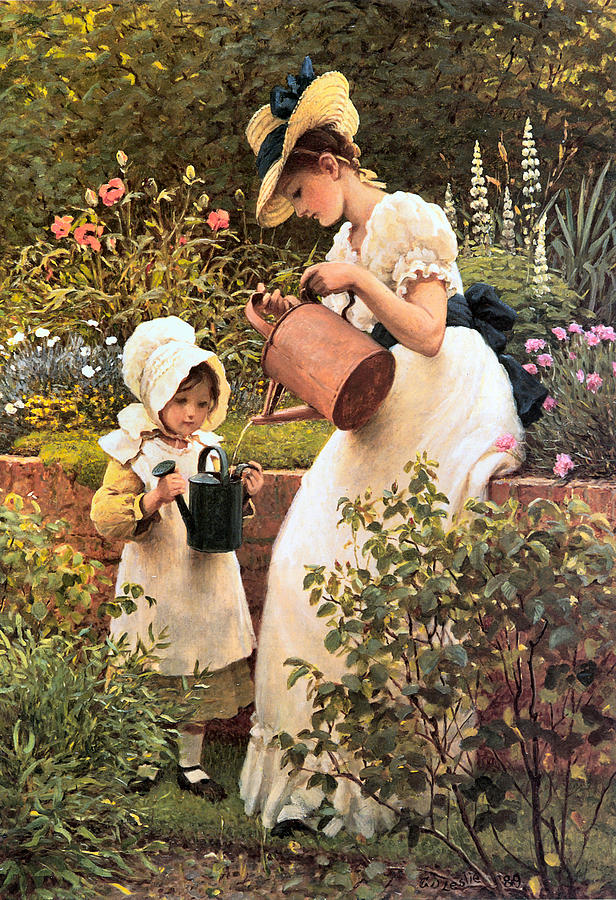
‘The Young Gardener’- George Dunlop Leslie1889
‘Gardeners are good. Such vices as they have
Are like the warts and bosses in the wood
Of an old oak. They’re patient, stubborn folk,
As needs must be whose busyness it is
To tutor wildness, making war on weeds.’
Gerald Bullett
I set you a little challenge last Sunday. I photographed these two old gardening tools at Erdigg House and Gardens and asked what you thought they were used for. Thanks to those of you who had a go….

This is a harvesting device for blackcurrants and similar fruit that hang in clusters. Modern day advice is to use a fork, but I think this looks a lot more effficient!

I wonder how efficient this lawn edger was? As somemone who’s been out with his half moon this week, it looks like this might be worth a go!
Old School Gardener
I love land art. You can often see it in protected landscapes or the grounds of important buildings. Sometimes, more riskily, it can be found in the open landscape, where it can make a wonderful contribution to an overall scene, aid interpretation of a place or maybe even just define a space that would otherwise be unremarkable.
I feel this way about wind turbines- I know that having them placed up against your plot might be a pain. Their numbers, groupings and locations do need careful thought, but I think we should embrace them more as potentially positive additions to our landscape (as well as out at sea). Rather than try to ‘hide’ them by leaving them creamy white, why not make more of them as land art – a clever paint job or perhaps adding some whimsical ornamentation could actually make them something we look forward to seeing.
Coming back to earth, or rather back to the garden, what about land art in a more domestic setting?
In my opinion, a lot of ‘off the shelf’ garden sculptures and other ‘features’ are just plain dull and many others too sickly sweet or twee to be given house room- or should I say garden room. We also sometimes place small, insignificant items in our gardens which are out of proportion and are soon ‘lost’. We really ought to be thinking big(ger).
Well, enough of my Monday rant, here are a few examples of some superb pieces of land/garden art in stone. What do you think of them and what about more land art in gardens?
-
- Stony stream
-
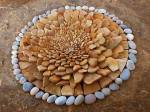
- Ammeer 146
-

- Eye of the Storm by Johnny Clasper
-

- Natural Stone mosaic via ancient art of stone
-

- Stone Tree via Quentin Jeandel
-

- Arch by Chris Booth
-

- Thea Sunshine Alvin
-

- Iain Blake
-

- Max Nowell
-

- Jaime Filipe
-

- Michael Grab
-
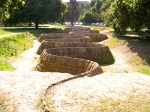
- Andy Goldsworthy
-

- Richard Long
-
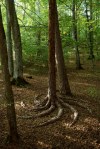
- Sylvain Mayer
-

- Escher land Art via Studio G
Old School Gardener
OK, here’s a little challenge for you to start the new week. I photographed these two old gardening tools at Erdigg House and Gardens last week. I wonder how efficient they were, as I can certainly see me using them both in Old School Garden.
What do you think they were used for? Have you used them, or do you have them in your garden? Please leave me a comment!
This is a harvesting device for blackcurrants and similar fruit that hang in clusters. Modern day advice is to use a fork, but I think this looks a lot more effficient!
I wonder how efficient this lawn edger was? As somemone who’s been out with his half moon this week, it looks like this might be worth a go!
Old School Gardener

Last weekend, whilst staying in Chester, we took a little trip out to Wales, specifically to the elegant house and gardens at Erdigg, near Wrexham. It was well worth the effort as we found a beautiful formal garden stemming from the 18th century and showing evidence of later period garden design fashions.
Erddig was owned by the Yorke family for 240 years. Each of them was called either Simon or Philip. The first Simon Yorke inherited the house in 1733 from his uncle, John Meller. Erddig’s garden was begun in 1685. Each of Erddig’s owners has altered and added to it, but each has respected their predessors work. Today you can still see evidence of the gardens of the past. Erddig’s walled garden is one of the most important surviving 18th century formal gardens in Britain.
The gardens contain rare fruit trees, a canal, a pond, a Victorian era parterre and are home to the NCCPG National Plant Collection of Hedera (ivy). The arrangement of alcoves in the yew hedges in the formal gardens may be a form of bee bole – a cavity or alcove in a wall or a separate free-standing structure set against a wall (the Scots word ‘bole’ means a recess in a wall). A skep is placed inside the bee bole. Before the development of modern bee hives, bee boles were a practical way of keeping bees in some parts of Britain, although most beekeepers kept their skeps in the open covered by, for example, old pots, or sacking. The bee bole helped to keep the wind and rain away from the skep and the bees living inside.


Further information:
National Trust Website
Wikipedia
Old School Gardener
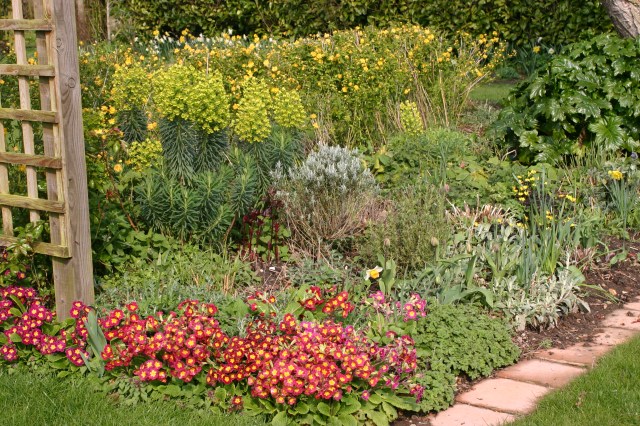
Spring has sprung at Old School Garden
To Walter Degrasse
Dear Walter,
I’m a bit under the weather at present. A heavy cold was preceded earlier in the week with an infection in the nerves of one of my teeth- very painful, but thankfully the antibiotics are now dealing with it. However, I can ‘look forward’ to some root canal work and a crown in a few week’s time!
The illnesses have rather put back my gardening activities this week, but I’ve still managed to make some progress. You probably saw my articles about the new alpine planter in the Courtyard; I’m really pleased with how that’s turned out and look forward to a new horticultural experience with alpines, which I haven’t grown before. Another project I’m hoping to start today is to turn an old wooden bike rack into a ‘pot plant theatre’ – this should be a fairly simple challenge and will hopefully add another nice feature to the courtyard garden- more on this next week!
The rest of the garden is really starting to kick in too- bulbs appearing in all sorts of places (including some I’d forgotten about), and the early flowering shrubs and trees- Viburnum, Forsythia, Chaenomeles, Cherry, Clematis (armandii and balearica), Currants and magnolias are all looking great. The pink magnolia in the front garden is just about coming into flower- we need a few days of the warmth of a week or two ago. And the Amelanchier is just about to give us its spring shower of white blossom- I can’t wait.

Star Magnolia underplanted with red Wallflowers- just starting to emerge

This Magnolia just needs a couple of warm days to pop

Clematis armandii

Chaenomeles
I’ve begun weeding and tidying the various borders but had hoped to be further on by now (I always seem to be saying that). Still, a few days next week should see the bulk of this done. I’ve also spent a good couple of days pressure washing the terrace, paths and copurtyard floors- this seems to get harder each year, or maybe it’s because we’ve had the warm, wet conditions over the winter that help algae to grow! A weather presenter last week reported that one frosty night (when temperatures fell to about -5 degrees C) had been not only the coldest of the spring, but also of the entire winter too!

Early Tulips in the front of house border

Primula and a box cone

The main mixed borders are really starting to fill out

Pots of early Tulips, Anenomess, Bellis, backed by dwarf Narcissus and Euphorbia myrsinites
I’ve been sowing seeds- veg and flowers- and most of these have so far been successful, though a couple of packets of perennials I bought have been disappointing, yielding only one plant each from packets of 10 or so seeds- maybe I didn’t get the conditions quite right for these. I’m now getting to the stage when I need to clear the greenhouse of the remaining tender, over-wintered plants to create space for further racking for more seed trays.
That reminds me, last week there was a minor disaster in the greenhouse, which is already jam-packed with trays and modules. Our cat decided to ‘explore’ – he jumped up onto the staging and managed to tip three trays of seeds onto the floor! I think I’ve managed to salvage many of the seedlings in two of these, but the third one hadn’t yet germinated, so I may not see anything from that given the way the compost (and seed) was turned upside down!
I’ve finished turning over the soil in the kitchen garden and started to mulch the fruit with manure. The rhubarb is looking good and we had our first crop of ‘forced’ stems last week- very sweet too. The first crops of broad beans, carrots, red cabbage, spinach, onions and garlic are all in (some sown last autumn and over wintered), so we should be getting some tender new veg in a few months. I gave the lawn its first cut a week or two back and it looks like it now needs another, so that’s a further job for the next few days- and edging this will also take some time, especially as I want to straighten out one section that isn’t quite parallel with its opposite edge.

Greenhouse starting to fill..

i’m trying out some new grasses from seed this year
Further afield I’ve continued with my support to two schools (one primary, the other a secondary). Yesterday – despite some heavy rain (or maybe because of it), the younger primary school children had great fun making ‘mud creatures’ in the grounds- a creative use of the many mole hills in what’s called the ‘Eco Park’. We also set up a greenhouse (which was bought with some of the money raised st the opening of Old School Garden last year) and pallet planting spaces (using the vertical planters I made with some of the children last year, but this time using them horizontally). The two younger classes will use these to get growing close to their classrooms – they had great fun filling these with compost yesterday, a natural follow on from getting their hands muddy making ‘mud creatures’!

Potatoes planted in the main School Garden at Cawston

Onions and Garlic coming on and weed-free!

Broad beans starting to bush up nicely
This area will focus on container growing and provide the children with an introduction to growing which they can then use to progress into the main school garden area. This is starting to look very neat and tidy and has a range of crops already underway. Yesterday the class whose responsibility is the potatoes, planted three varieties of ‘earlies’ out in the raised bed we’ve earmarked for this (covered with sheets of polycarbonate). We’ve told them about rotation too – this plot had peas and beans in it last year. Oh, and I’m pleased to say that the School has now been confirmed as achieving the highest award for ‘Learning Outside the Classroom’ -Gold, which will sit nicely alongside its top marks in the RHS Campaign for School Gardening (where it has achieved Level 5, again the highest possible).

The new growing area for younger children- new greenhouse and pallet planters

Having fun filling the planters with compost- and learnign about the stages of compost -making.

Mud land art -a great use for large mole hills!

This one looks ‘thatched’!
At the secondary school, we’ve just about managed to get the three plots (of 12m x 6m each) ready for planting- last week saw a local chap come in with his rotivator to finish off tilling the soil- though we have had to limit this in one plot as we’ve discovered what looks like an old lead water pipe! Still, I hope next week to get temporary landscape fabric paths laid and potatoes planted with each year group. The process of weeding/taking off grass has been a real challenge, not least for children with short attention spans! Still, we’re nearly there and so we can start to plan out next term’s activities to bring in a bit more variety to what they do.
It’s sad that the Master Gardener programme has been wound up in most of Norfolk, as the original funding has come to an end, but it is progressing in one or two community gardening projects and in the whole of the Breckland area, where the Council has kindly agreed to continue funding it. I’m going off to the induction day for the new Breckland Master Gardener volunteers on Sunday, hopefully to inspire rather than de-motivate!

- A beauty from inside the house- Clivia
Well that’s about it for this month’s update, Walter. I was pleased to hear that you’ve taken on an allotment with Ferdy but sympathise with you on the tiring preparatory work, similar to what I’ve experienced at the secondary school! Still, it sounds like you’re nearly ready to sow and plant like us, so all the best for that. I’m sure you’ll really enjoy ‘growing your own’ alongside tending your fabulous ornamental garden at home.
Tomorrow, our young German guest, Lisa, is returning home. This will be a sad day as she’s been a delightful addition to our rather depleted household over the last few months. One can fall into stereotyping today’s youngsters as rather shallow, lacking interest in anyone but themselves and focused on ‘having fun’. Lisa has rebalanced my perspective, and we wish her every success in her university studies and chosen career in teaching.
Stay in touch old friend,
Old School Gardener
 My earlier article described how I put together a new wooden planter for my courtyard garden, made by Woodblocx. I’ve now finished it.
First, I gave the rough planed outside a sand down with a medium grade sanding disc, wiped it over and then applied two coats of Dulux Woodsheen (colour Ebony) to make the finished article match in with the other black planters in the garden. This gives it a nice semi gloss finish. I then fixed some hammer- in studs to the bottom to raise it slightly off the ground (to prevent it being in contact with standing water), and lined it with landscape fabric, stapled to the sides to give a neat finish. This will hold the soil in and also protect the inside surfaces of the planter.

- The planter painted and lined, ready to fill.
I then made up a mix to fill it- roughly 3 parts soil, 2 parts compost and 2 parts horticultural grit, to ensure that the soil is free draining. Having really packed this in and slightly overfilled it to allow for settlement, I arranged a selection of alpine plants I’d bought from my local nursery (£12.50 for ten plants – I ended up buying 20 – and then a few more larger plants to give the planting a bit of structure).


The planter isn’t really large enough for me to create a more ‘mountain-like’ scene with rocks and crevices to create shady conditions, but hopefully the plants that need a shadier spot will be helped by the shade cast by the larger plants. To finish off or ‘dress’ the surface I used a bag of ‘Eco Aggregate’ – this is a range of recycled stones. I chose crushed terracotta (old tiles) which picks up the colours of some of the other terracotta pots, brickwork and floor pavers.
I’m pleased with the result – it will add an interesting feature to the courtyard and is low enough to be viewed from the seating next to it. What do you think? If you’re interested in finding out more about ‘Woodblocx’ click the link on the right hand side.




 Old School Garden