
- The Garden- man made artifice?
‘Let us, then, begin by defining what a garden is, and what it ought to be. It is a piece of ground fenced off from cattle, and appropriated to the use and pleasure of man: it is or ought to be, cultivated and enriched by art, with such products as are not natural to this country, and consequently, it must be artificial in its treatment, and may, without impropriety, be so in its appearance; yet, there is so much of littleness in art, when compared with nature, that they cannot be well blended; it were, therefore, to be wished, that the exterior of a garden should be made to assimilate with park scenery, of the landscape of nature; the interior may then be laid out with all the variety, contrast, and even whim, that can produce pleasing objects to the eye.’
Tag Archive: gardening

nWh
-
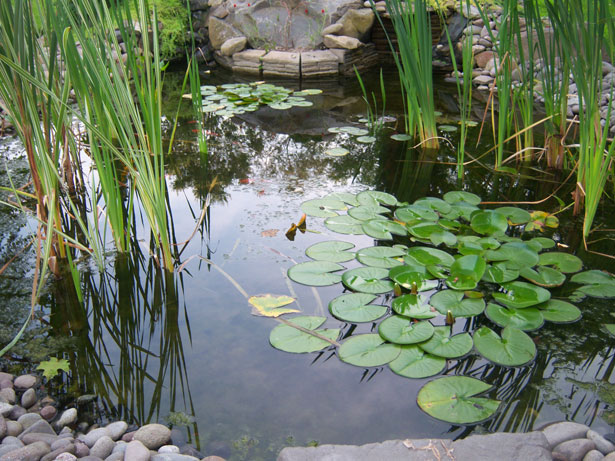
A pond is a fantastic resource for wildlife
Most gardens play an important part in promoting biodiversity and maintaining ecosystems – vital if we are to have a sustainable planet. You might want to further enhance your garden’s ecological value, or perhaps promote wildlife to help pollinate plants (important if you want to gather your own seed and/or are growing your own food) and to help control unwanted pests.
Promoting wildlife is also a way or enriching the garden experience – just think about birdsong, the buzzing and gentle flitting of bees from flower to flower, the colourful displays of butterflies and the fascinating movements of the myriad insects and other ‘critters’ out there! So how can you ‘design’ wildlife into your garden and gardening activities?

-
Plant nectar- rich flowers to attract pollinators
First it’s important to recognise that you and your friends and family are also going to use the garden, so there’s no need to ‘go completely wild’ and make it unpleasant or difficult for humans to use the garden. In fact the best designed and managed gardens (and often the most beautiful) can also be the best for wildlife. These are the places where nature has not been allowed to take over.
You can ‘tip the balance in favour of wildlife’ in a number of ways. If you have a large garden you can adopt a ‘conservation’ approach and set out separate areas to attract and support different types of wildlife. If your garden is smaller, you can provide a range of features for the wildlife species you want to encourage. This approach is especially important if you want to actively harness nature to control pests.

-
Bird feeders need to be out of the reach of cats!
So what can you do?
Create habitats that mimic those in nature and complement the local range outside the garden
Provide natural shelter, nesting, food and drink – important as ‘stopping off’ points for temporary visitors to your garden as well as for longer term residents
Aim to increase diversity- and recognise that this is going to be a gradual process
Build in some key features, such as…..
-
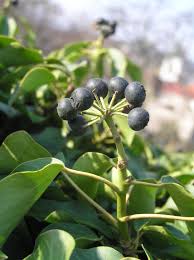
Climbing plants like Ivy provide a valuable food source for wildlife
-
Native plants- these act as a host to many more species than non native plants
-
Wildflowers, grasses, weeds- these attract butterflies and many other insects. Nettles are important hosts for species that aid a healthy garden; butterflies and ladybirds. Maybe you can grow these in a container if you don’t have the space to leave patch in the garden?
-
Nectar and pollen rich flowering plants- these feed butterflies, bees, hoverflies etc.- which in turn attract birds
-
Trees, flowering and fruiting shrubs- these provide food and shelter for birds
-
Climbing plants- they provide food and cover for birds and food for insects and butterflies. Examples include Ivy, honeysuckle, quince, wisteria, clematis..
-
Hedges- these give food and shelter for wildlife (e.g hedgehogs, voles and shrews), food and nesting for birds- where it’s practical choose to install a hedge rather than a fence
-
Water- a pond brings masses of creatures to drink as well as attracting resident pond life
-
Wood piles – insects colonise the decaying wood, attracting spiders and birds; beetles lay grubs; toads and hedgehogs hibernate underneath; slow worms use it as home (and these prey on slugs)
-
Compost heap – provides both food for the soil and home for minute insects and other ‘mini beasts’ which feed birds, hedgehogs, toads. It also acts as a possible nesting place for hedgehogs, toads and slow worms.
-
Bird and Bat boxes, tables, feeders and baths- put these up in secluded and sheltered spots out of full sun – and out of the reach of cats! Birds need extra food in winter. provide a range of foods according to the species you want to attract. Birds need to drink and bathe to keep their plumage in good order- even in winter, so keep birdbaths unfrozen
-
Stones and walls- toads, newts and female frogs usually spend winter on land, under rockery stones (or in a log pile). Beetles, spiders, insects live in nooks and crannies
-
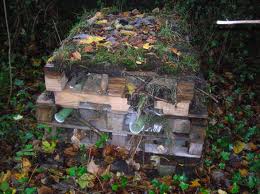
‘Bug hotels’ can provide a ‘man made’ substitute for the above, and are good fun to make with children.
-
‘Bug Hotels’ can provide a ‘Des Res’ for many insects and other critters
Further information: A range of useful wildlife gardening guides
Old School Gardener
 Here’s another profile of a food plant produced by one of the participants in the ‘Grow your Own’ course I ran at Foulsham, Norfolk.
Grape (Vitis vinifera)
Guest article by Kay Elvin
Black Hamburg is a popular, outside, late grape that can be used for desserts or wine making.
Planting- Dig a large hole, adding plenty of farmyard manure and water well. Plant bareroot vines in winter, but containerised specimens can be planted at any season.
Location- Vines like to grow on a sunny, south or west wall. Support the vines with horizontal wires held in place by vine eyes, about 12”- 16” apart.
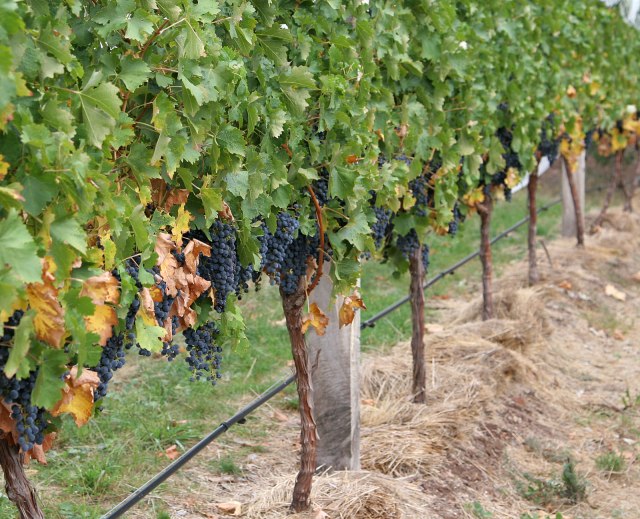 Growing – Allow about three stems to grow vertically during the first year. Pinch out shoots that grow from the side to one leaf. The next year in spring aim to have a shoot every 6”. When fruits appear thin out to one bunch every 12”. Remove some of the foliage to improve air flow.
Feed with high potash. Vines can be affected by scale insects, vine weevil, downy mildew and mould. When harvesting avoid touching the fruits, cut each bunch with a ‘handle’ (2” of stem).
Beware – Do not park your car under a grape arbour- they damage the paintwork! Grapes are also poisonous to dogs.
 Recipe- Grape Jam
Ingredients:
4lb ripe grapes
1 box powdered fruit pectin
3.25 lbs sugar
Method:
Slip skins from grapes and set aside
Add 1 cup of water to pulp, bring to boil cover and simmer for 5 mins.
Press through a sieve to remove seeds.
Chop or grind skins, add to pulp.
Measure 6 cups into a very large saucepan.
Then make jam, add powdered pectin to the fruit in pan and mix well.
Bring to hard boil over high heat, stirring constantly. At once stir in the sugar.
Bring to a full rolling boil and boil for 1 minute, stirring all the time.
Remove from heat and skim off foam with a metal spoon, then alternately stir and skim for 5 mins..
Cool slightly, ladle into jars, cover jam at once.
Makes 6 half pound jars.
For spicier jam add 1 teaspoon each of cinnamon, ginger and allspice to the grapes before simmering.
Old School Gardener
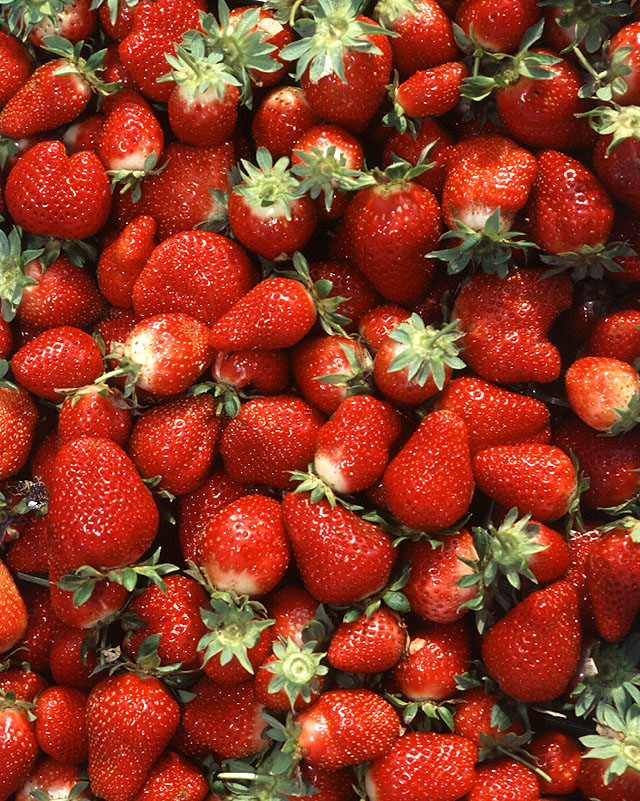 Here’s the second article in the new series ‘Eat Me’. This one has been written by another of the participants in the ‘Grow Your Own’ course that I ran recently in Foulsham, Norfolk.
Strawberries- a guest article by Colin Ferris
The fruit of the strawberry is not a berry but rather is a pseudo fruit or accessory fruit; some would not even accept the definition as a fruit. Indeed what appear to be the seeds on the outside are achenes, each of which is really a single seeded fruit.
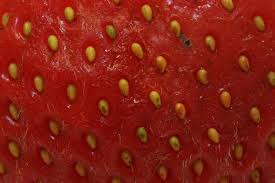
- Close up of strawberry
HISTORY
The wild strawberry Fragaria vesca was the first to be grown and cultivated for its fruit until the hybrid ‘garden strawberry’ Fragaria x ananassa was bred in France in 1750. It is a cross between the North American F. virginiana and F. chiloensis from Chile.
CLASSIFICATION
Fragaria is a flowering plant (Angiosperm) in the family Rosaceae. The Genus Fragaria contains about 20 species plus many hybrids and cultivars. The structure of the strawberry plant is quite typical of a member of the rose family, most noticeably when looking at the flower with its five petals.

CULTIVATION
Whilst generally considered in this country as a very typical British fruit, it is surprising to find that the UK does not even make it in the top ten of the world strawberry producers. By far the biggest producer is the USA, growing about 1.5 million tons of fruit per year. Strawberries grow well in any fertile soil and respond well to the addition of manure or fertiliser. It is not advisable however to grow them in soil that has previously been used to grow potatoes, chrysanthemums or tomatoes, due to the build up of soil pests and diseases. Plants will grow well for four or five years after which they decline and do not fruit well. It is thus best to replace them when four years old but not to grow the new plants in the same soil previously used for strawberries, i.e. employ suitable crop rotation.

- Strawberries being grown hydroponically
PLANTING
Plant rooted runners or bought plants in fertile but well drained soil either in the ground, or in any form of container that can be suitably positioned in a sunny place and watered frequently. Plant in autumn or early spring but avoid cold wet weather and avoid areas prone to frost. Space plants about 14 inches apart with 30 inches between rows. Keep plants well watered especially in dry spells but take care not to rot the crown with too much water given from above. When fruits begin to form a mulch, typically straw, should be tucked underneath them to prevent rotting from the soil. Keep weed free. After cropping has finished remove old leaves and straw. If you will not be using them runners should be removed to prevent energy being wasted on them.

- Strawberry flower
PROPAGATION
In order to produce new plants with the same characteristics as the parent plant, it is best to use strawberry runners. The stolons or runners produced by the plant are a form of vegetative reproduction and so produces plants that are genetically identical to the parent. It is important to let the new plants remain on the runner until a good healthy set of roots has formed.
CULTIVARS
Summer fruiting varieties– These are the most popular with large fruits over a short but heavy cropping period of a few weeks. There are early, mid-, and late types.
Perpetual varieties – These have a much longer fruiting season but fruits are smaller and crops not so heavy.

- Strawberry display at Chelsea Flower Show 2009
PROBLEMS
Fungus – Botrytis grey mould, powdery mildew, leaf spot, Verticillium wilt, and red core: remove dead material immediately, lower humidity around plants, remove weeds and prevent overcrowding.
Pests – Red spider mite, seed beetle and vine weevil: use appropriate sprays or preferably biological control. Birds: use netting or preferably a fruit cage, bird scarers may help but generally are of little benefit.
USES
Strawberries have such a wonderful flavour that they are used in so many recipes that it is impossible to list them. They are best when picked fully ripe (bright red in colour) when the sun has warmed them, and they taste extremely good with a little sprinkling of sugar and some fresh cream. Given that they crop heavily over a short period, strawberries are often used to make jam.

- Strawberries and Cream- the tatse of an English summer…
Old School Gardener
 Old School Garden raised some funding to help support Norfolk local food growing projects under the ‘Master Gardener’ programme. Here’s a story about how some of the money, raised from a garden open day, has been used.
Based at Great Hockham Primary School, Norfolk, Hockham Herbs is a young gardening group established by Master Gardener, Bev Page back in 2011. When Bev stepped back from leading this group, one of the children’s Dads, Rob Muggridge, took over. In July 2013, Mr Muggridge was tragically killed in a road traffic accident.
Bev applied for funds to purchase a tree that the Herbs group could plant in memory of Mr Muggridge. The children adored their growing mentor and coming back this autumn was difficult for them.
To have the opportunity to plant “Rob’s tree”, care for it and watch it flourish will help them come to terms with their grief and loss.
Bev was awarded funds and she purchased a Morello Cherry Tree from Thetford Garden centre and she had enough money left over to add a bird box. The tree was planted on Wednesday, 13 November in the school orchard, with the help of the Hockham Herbs and Mrs Muggridge. The bird box is destined for a mature tree trunk in the school woodland.
Old School Gardener with thanks to Bev Page and Gabbie Joyce

 Tulipa (Tulips) is a genus of some 100 species of hardy, bulbous perennials from Europe, asia and the middle east- especially Central Asia. They prefer sun but will take light shade, and must have a well-drained soil, though seem to prefer heavier soils than lighter ones. Tulips are grown for their showy flowers, which are usually at the end of a stem and upright, with six tepals. They vary from cup- or bowl-shaped to goblet-shaped, some with long, very narrow tepals, or lily-like or star-shaped- some are fringed.
There is a wide range of colours and bi colours. Depending on the species, tulip plants can grow as short as 4 inches (10 cm) or as high as 28 inches (71 cm). The leaves are usually grown from the base of the main stems, are broadly ovate in shape and sometimes are wavy-edged or channelled.
Tulips can be planted in groups among other plants in a border, in pots or ‘naturalised’ in grass. They tend to be later flowering than Narcissus and crocus so growing these together can produce a flowering display lasting up to three or four months.
The bulbs should be planted 15cm deep in the autumn. Cultivars benefit from being lifted and ripened every year once the leaves have died down. Most of the Darwin hybrids (such as ‘Apeldoorn’), the Greigii and Kaufmanniana groups and the species tulips can be left in the ground for a number of years; mark the position to avoid damaging the bulbs with other planting. The size of flowers will diminish over time and they will also benefit from being lifted and divided every few years – this should be done as soon as the foliage dies down.
Mice love tulip bulbs, so store lifted bulbs out of reach and protect newly planted bulbs from disturbance. Some people have an allergic reaction to any part of the plant which may cause skin irritation, and all parts can be mildly poisonous if eaten (though the flower petals can apparently be eaten – see link below).
 Tulip- flaming parrot cultivar
  Tulip ‘Yonina’
Tulip- flaming parrot cultivar
Tulip ‘Yonina’
Although tulips are often associated with the Netherlands, commercial cultivation of the flower began in early Persia probably somewhere in the 10th century. Early cultivars must have emerged from hybridisation in gardens from wild collected plants, which were then favoured, possibly due to flower size or growth vigour. During the Ottoman Empire, numerous tulips were cultivated and bred.

- Bulbs fields in Holland
The word tulip, which earlier appeared in English in forms such as tulipa or tulipant, entered the language by way of the French tulipe and its obsolete form tulipan or by way of Modern Latin. The word derives from the Persian word for ‘turban’ chosen because of a perceived resemblance of the shape of a tulip flower to that of a turban This may have been due to a translation error in early times, when it was fashion in the Ottoman Empire to wear tulips on their turbans. The translator possibly confused the flower for the turban.
Between 1634 and 1637, the early enthusiasm for the new flowers in the Netherlands triggered a speculative frenzy now known as Tulip Mania. Tulips became so expensive that they were treated as a form of currency. To this day, tulips are associated with the Netherlands, and the cultivated forms of the tulip are often called “Dutch tulips.” In addition to the tulip industry and tulip festivals, the Netherlands has the world’s largest permanent display of tulips at Keukenhof, although the display is only open to the public seasonally.
 Tulip showing the variegation associated with the ‘breaking virus’
  Close up of Tulip flower
Tulip showing the variegation associated with the ‘breaking virus’
Close up of Tulip flower
In horticulture, tulips are divided up into fifteen groups (Divisions) mostly based on flower characteristics and plant size.
-
Div. 1: Single early – with cup-shaped single flowers, no larger than 8 cm across (3 inches). They bloom early to mid season. Growing 15 to 45 cm tall.
-
Div. 2: Double early – with fully double flowers, bowl-shaped to 8 cm across. Plants typically grow from 30–40 cm tall.
-
Div. 3: Triumph – single, cup-shaped flowers up to 6 cm wide. Plants grow 35–60 cm tall and bloom mid to late season.
-
Div. 4: Darwin hybrid – single flowers are ovoid in shape and up to 8 cm wide. Plants grow 50–70 cm tall and bloom mid to late season. This group should not be confused with older Darwin tulips, which belong in the Single Late Group below.
-
Div. 5: Single late – cup or goblet-shaded flowers up to 8 cm wide, some plants produce multi-flowering stems. Plants grow 45–75 cm tall and bloom late season.
-
Div. 6: Lily-flowered – the flowers possess a distinct narrow ‘waist’ with pointed and reflexed petals. Previously included with the old Darwins, only becoming a group in their own right in 1958.
-
Div. 7: Fringed (Crispa)
-
Div. 8: Viridiflora
-
Div. 9: Rembrandt
-
Div. 10: Parrot
-
Div. 11: Double late – Large, heavy blooms. They range from 18 to 22 in. tall
-
Div. 12: Kaufmanniana – Waterlily tulip. Medium-large creamy yellow flowers marked red on the outside and yellow at the center. Stems 6 in. tall.
-
Div. 13: Fosteriana (Emperor)
-
Div. 14: Greigii – Scarlet flowers 6 in. across, on 10 in. stems. Foliage mottled with brown.
-
Div. 15: Species (Botanical)
-
Div. 16: Multiflowering – not an official division, these tulips belong in the first 15 divisions but are often listed separately because they have multiple blooms per bulb.
They may also be classified by their flowering season:
Early flowering: Single Early Tulips, Double Early Tulips, Greigii Tulips, Kaufmanniana Tulips, Fosteriana Tulips, Species Tulips
Mid-season flowering: Darwin Hybrid Tulips, Triumph Tulips, Parrot Tulips
Late season flowering: Single Late Tulips, Double Late Tulips, Viridiflora Tulips, Lily-flowering Tulips, Fringed Tulips, Rembrandt Tulips
I mentioned my visit to the Amsterdam Flower Market recenrtly and here’s the 70 tulips I have for adding to the many groups that I already have in borders and pots at Old School Garden.
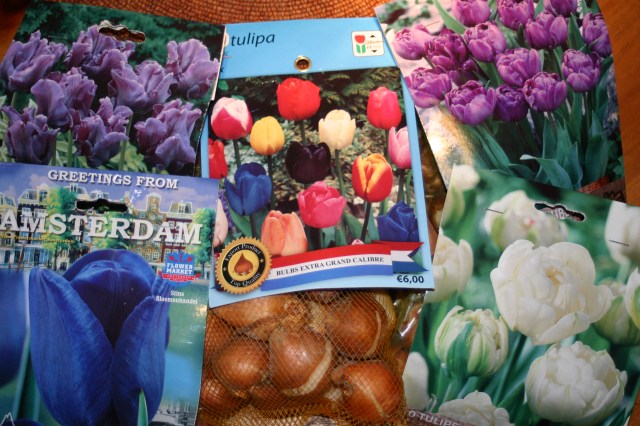
- Tulips from Amsterdam…
Sources and further information:
Wikipedia
Growing Tulips- RHS
How to grow Tulips- Bunny Guinness
Tulips and Holland
Tulip Mania
Eating Tulip flowers
Related articles:
It’s Time to Talk Tulipsage
PicPost: Tulip Mania
Tip Toe Through the Tulips
Tulip mania and Bitcoin
Bloemen Marvellous
November in the Garden: 10 Top Tips
A-Z of Perennials: Q is for Quamash
GQT: Grow-bag Bulbs
Pleasing Planters
May in the Garden- Top 10 Tips
Plants to die for…
Old School Gardener
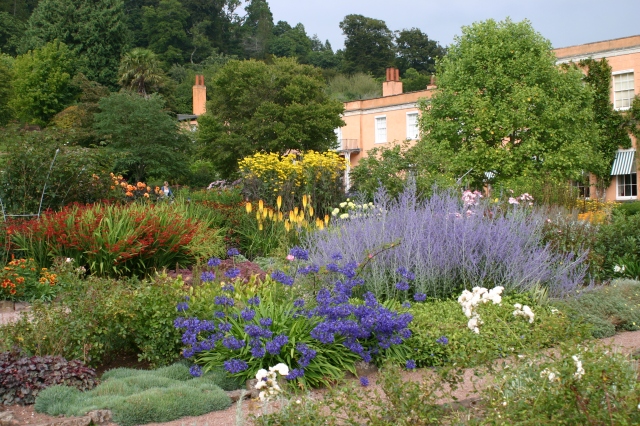
Our last, late summer visit to a west country garden, Killerton, did not disappoint. We enjoyed a very informative tour in a golf buggy and strolled around the grounds on a sunny afternoon. Lying just outside Exeter, Killerton is a massive estate and we had a little trouble actually finding the entrance (road signs and sat nav conspired against us!). Nevertheless we had a warm welcome.
Killerton is notable as the ‘home given away’. It’s last private owner, Sir Richard Acland did just this with the whole estate of over 2,500 hectares (including 20 farms and 200-plus cottages), one of the largest acquired by the National Trust. Acland held a strong belief in the common ownership of land and was a founder member of the British Common Wealth Party, formed in 1942 to oppose the wartime coalition and to advocate a co-operative form of socialism, in contrast to the state-led approach of the Labour Party. However, the group never achieved an electoral break through and Acland joined the Labour Party in 1945. He was also one of the founders of the Campaign for Nuclear Disarmament (CND).
The original gardens at Killerton were designed in the late 18th century by John Veitch, one of the leading landscape designers of the time. It features rhododendrons, magnolias, herbaceous borders and rare trees surrounded by rolling Devon countryside. Many of the trees and the views of the surrounding countryside are very impressive – here are some pictures.


The grounds also house – typically for the 19th century – an Ice House and a curious Summer House which is of a rather gothic design and features a strange assortment of decorative materials – including animal bones, hides and fir cones! Here’s a second set of pictures.

To the Summer House…


Hides….

Bones…

Wooden slices floor…

Cones above…

Stained glass window in the Summer House

Into the Ice House…
However, the ‘parterres’ or mixed herbaceous borders, full of late summer colour when we visited, stand out as my most significant memory of Killerton. These were designed by the late 19th century gardener, garden writer and designer William Robinson. They have some classic plant combinations and bold drifts, typical of the mixed herbaceous borders coming into vogue around this time, and which have been influential in English garden design up to the present day. This area features a central path and secondary paths with Coade stone urns as focal points. The layout of the borders is perhaps curious given Robinson’s advocacy of ‘wild gardens’ – a more naturalistic approach to garden design. But even these semi formal designs, with their ‘loose planting’, were seen as revolutionary. Apparently, Killerton’s head gardener at the time said:
‘it of course spoilt the park, starting as it does and ending nowhere, I got into bad odour condemning it’.
Robinson’s ideas about ‘wild gardening’ spurred the movement that evolved into the English cottage garden, a parallel to the search for honest simplicity and vernacular style of the British Arts and Crafts movement. Robinson is credited as an early practitioner of the mixed herbaceous border of hardy perennial plants, a ‘naturalistic’ look in stark contrast to the high Victorian ‘pattern garden’ of planted-out bedding schemes. Here is a gallery that, hopefully captures the best of these glorious borders.


Further information:
National Trust website
William Robinson- Wikipedia
Old School Gardener
With the first real ‘icy blast’ due in the UK this week, here’s a useful video reminder of some key jobs to do before winter really takes hold! (Thanks to Grow Veg)
Old School Gardener





 Old School Garden