
Tag Archive: gardening
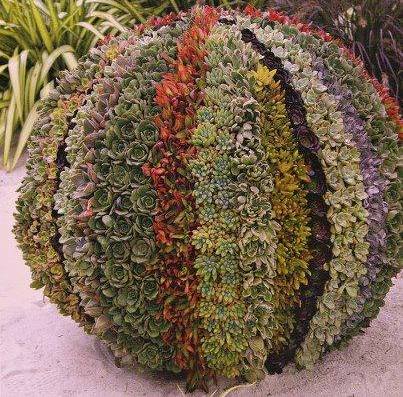 A ball of succulents- a whole new approach to carpet bedding!
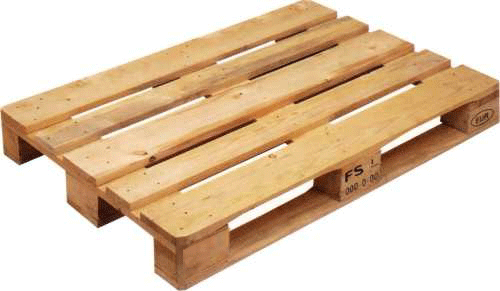
Pallet Precautions
Click on the title for a useful article about checking to see if that pallet you’re planning to use, is safe.
 Old School Gardener
 Today’s question comes from a gardener in North Yorkshire. Ernie Uplad of Richmond has just created a new garden pond in an open, sunny spot away from trees and wants some advice about planting:
‘I’m pleased with my new pond but need some help with deciding when to plant it up, the mix of plants to use and how to go about this- can you help, please?’
When to plant?
Well Ernie, you seem to have made a great start with the choice of a good location for your pond. As for planting now (early spring to mid June) is the perfect time, as the weather is warming up. If you plant to put in some fish (I wouldn’t myself as they tend to eat much of the other wildlife that will inhabit your pond), then it’s important to plant up before you install them as they might go hungry unless you take the trouble to feed them yourself.
What to plant?
Some plants are essential for a pond (whether it’s for ornamental or wildlife value) – oxygenators. These are plants which live almost entirely underwater and help to maintain an adequate level of oxygen for the other plants, fish and other animal life. They also help to reduce the level of algae, as do water lilies. The oxygenators include Canadian pondweed (Elodea canandensis), which is vigourous; Egeria densa (less vigourous); water Milfoil (Myriophyllum spicatum), with its delightful feathery foliage; and M. verticillatum, also with feathery foliage, and which also likes limy water.There are also plants you should avoid at all costs- the so called space invaders! Here’s a useful guide to these.
You migth also like to consider ‘marginals’ – these are grown on the inside edge of the pond- here’s a guide to marginal plants. And, don’t forget plants that grow in permanently damp soil- in a bog garden you may have created next door to your pond. Here’s another useful guide to plants for a bog garden.
For planting actually in the pond here is a selection of plants to add height (they all grow up to around 45 cms (18ins) high) and will add other interest:
Water hawthorn (Aponogeton distachyus), with white flowers with dark spots throughout the year
Acorus gramineus ‘Variegatus’, for foliage colour in green and gold
Bog Arum (Calla palustris) with white flowers in summer
Calla palustris ‘Plena’ with double yellow flowers in March- April
Cotula coronopifolia with yellow ‘buttons’ in July- August
Hydrocharis morsus-ranae, with white-flowered floaters all summer
Mimulus moschatus and M. ‘Whitecroft Scarlet’ with yellow and red flowers, respectively, all summer
Golden Club (Orontium aticum) with yellow club flowers in May- June
All medium-sized lilies (Nymphaea) in red, white, pink and yellow shades throughout the summer.

Egeria densa close up

Acorus gramineus ‘Variegatus’ via RHS

Hydrocharis morsus – ranae, male flowers
How to plant?
Well, let’s take water lilies first.The crowns (rhizomes or tubers) should be planted in a medium to heavy loam with the crown tips exposed and upright- they must not be buried. all other container plants can be planted in the same type of soil and to the same depth as they were at the nursery or when you propagated them, but avoid over rich soils; you can buy special aquatic compost if you like, but by avoiding rich soils you will minimise problems with algae and weed through raising the nutrient levels in the water. The oxygenators will need to be weighted if this has not already been done by the nursery. Clumps of 6-12 small pieces should be put on the floor of the pool and held in a group by a lead weight. This will keep them from floating to the surface. Natural floaters like Hydrocharis morsus-ranae are simply put on the surface.
How to propagate?
You might in due course want to propagate your own plants and for most water plants this is very simple. you just divide them in the spring after lifting out the containers any plants you require. Division is achieved by driving in either two handforks (or two larger forks for larger plants) back to back, then pushing the forks apart to prise away the outermost plants in the clump. Do not use the centre crowns; these are the oldest parts of the plant and should be disposed of.

- A pond is a fantastic resource for wildlife
Further information: RHS guide to aqauatic planting
Old School Gardener

A ‘screen’ of air plants
Old School Gardener

Patterns to move through- Alliums and Laburnum tunnel= glorious
Old School Gardener
 Two new rounds of my courses on Garden Design and Grow Your Own Food for Beginners start soon, and I’m also offering a new, one day course on Wildlife Gardening. I ran the last Garden Design course earlier this year and had great feedback on it (I even had a thank you present from the students!). All the courses feature a lot of group discussion and some practical tasks as well as useful tips and tricks to help particpants apply what they learn to their own plots.

The Garden Design course takes students through a customised design process, prompting a fresh look at participants’ own gardens, giving them the opportunity to develop their own ideas in a systematic way and benefitting from ideas generated in the whole group. I support participants to draw up their own scale plan design for their garden and supply plenty of useful background information and links to helpful web sources as well as the opportunity to borrow from my own garden book library. The course can also feature a visit to a well known garden to look at design ideas in practice.
The ‘GYO’ course is aimed at food-growing beginners or novices and gets off to a flying start with making paper pots and sowing broad bean seeds. It also prompts students to look at what they want to eat/grow and how they might do this most effectively in their own plots – this can include growing in containers for those with little or no garden.The course includes a visit to Old School Garden to look at my own approach to food growing, and covers topics like soils and soil improvement, growing under glass, encouraging beneficial wildlife into your garden and how to effectively control pests and diseases.
 Narrow beds in the Kitchen Garden at Old School Garden

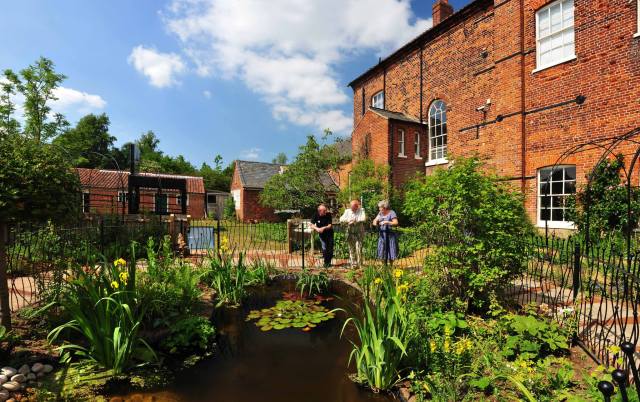
The one day Wildlife Gardening course, taking place at Gressenhall Farm and Workhouse Museum, makes use of the Wildlife Garden at the Museum and includes some practical work to help develop the wildlife -friendly features there as well as helping participants to focus on their own gardens and gardening practices. The aim is for them to develop their own action plans for the future.
-
The Wild life Garden at Gressenhall Farm and Museum
The courses are fast filling up but there are some places still available if you’re quick!
They are running as follows:
Garden Design– 6 Monday evenings, 7pm-9pm at Reepham High School & College, commencing on 12th May.
Grow Your Own Food for Beginners – 6 Wednesday evenings, 7pm-9pm at Reepham High School and College, commencing 14th May.
Get more details and how to enrol at www.reephamlearningcommunity.co.uk
Wildlife Gardening- Sunday 18th May, 10am-4pm at Gressenhall Farm and Workhouse Museum, near Dereham.
For more information on this and other short courses at the Museum see www.museums.norfolk.gov.uk
Old School Gardener

picture via Green Renaissance
Old School Gardener

or maybe ‘Front End loaded’?
Old School Gardener
To Walter Degrasse
28th April 2014
Dear Walter
I hope all’s well with you and Lise and that you’re managing to get out and about in your garden at this busy time. I’m certainly behind where I should be here at Old School Garden. I’ve weeded and dug over about two-thirds of the borders here and managed to mulch the fruit with a mix of horse manure and compost. I edged the lawns for the first time the other day and then cut the grass – all in all it took me about 4 hours! Still it does look the better for it.
-
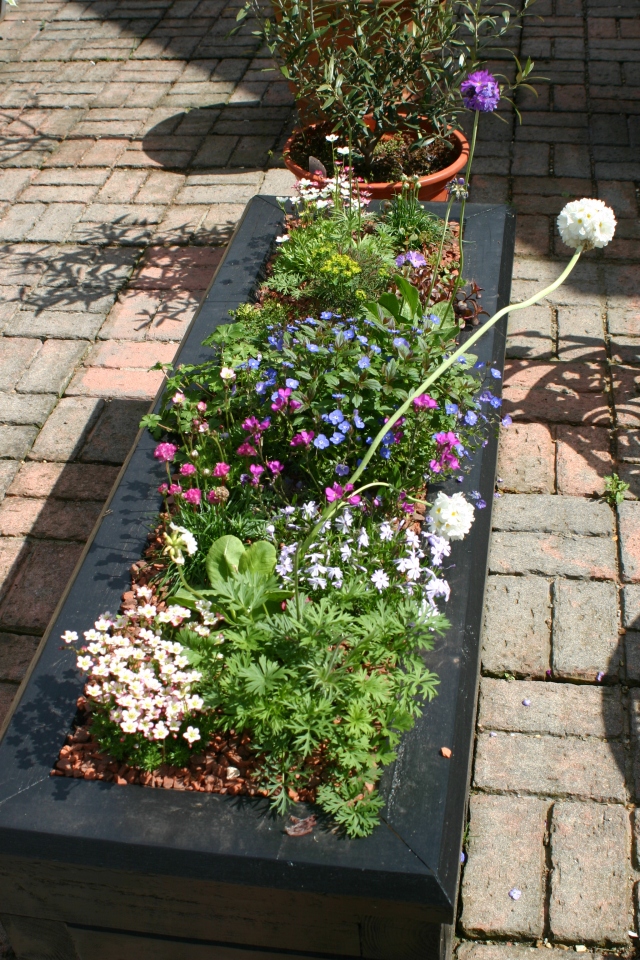
The alpine planter I made from ‘Woodblocx’ and planted up a few weeks ago- delightful if getting a bit overcrowded…
Apart from being behind with the weeding etc. everything elses is pretty much on track. The greenhouse and cold frame (as well as the lunge window sill) are packed full of seed trays and seedlings at various stages of growth. I’ve tried experimenting with a mix of multi purpose compost as a base layer and then some John Innes seed compost on top to get the seeds started; I’m still not very happy with the John Innes, as it seems to get water sodden and so not very healthy, quite quickly, whereas the multi purpose is not really fine enough for the really small seeds. I shall have to try further mixes.
The flower borders are starting to fill out very nicely, and I’m just about to mulch these with old wood chips and put in staking for the larger perennials. The bulbs and other spring flowering plants are also making a good show at present, though I’ve been disappointed with the tulip bulbs I bought in Amsterdam last November. Only one of the three packs I bought has come up as expected, the other two being nowhere close to the blue or violet colours promised on the packaging. So, the best laid colour mixing plans have gone out of the window and I’ll have to rearrange these in the autumn. The other, more established tulips are looking grand; I’m especially pleased with the way some old cast offs from Peckover House, planted 18 months ago, have responded to their new situation. They are flowering very well in the sandier soil here, perhaps evidence that you can leave tulips in this sort of soil, but in heavier soils they tend to shrivel up and rot- the soil here is a lot more sandy than the siltier, clayey material in Wisbech.
Food crops are coming along, and I managed to spot the stem of an artichoke the other day (just one!), so the roots I put in last autumn may have not been a complete write off. I obviously miscalculated the amount of seed potatoes I needed, as I’ve ended up with s ix rows instead of the planned two! So, the kitchen garden plan has already had to be amended! Anyway, most of the beds are full of growth now; broad beans, mangetout peas, chard, lettuce,chives, calabrese, cauliflower, red cabbage, spinach, carrots, onions and garlic as well as the potatoes and more permanent beds of fruit. So far so good (and pests seem to be under control)!

The Kitchen Garden

Ist Early potatoes poking through

Cold frame full to overflowing
We recently visited my mother-in-law in Devon and I spent a good day or two pruning back a number of over grown shrubs. The cuttings amounted to about 10 big bags, so I must have made an impact! As you will recall, her garden is on a steep slope overlooking the edge of Tavistock and farmland beyond. A lovely setting, but a garden that is just too much for her to cope with now. She does get some gardening help, but this seems to amount to grass cutting and not much more. You may have gathered that whilst there we managed to visit several lovely gardens and other places, so keep an eye out for more articles and photographs in the next couple of weeks.
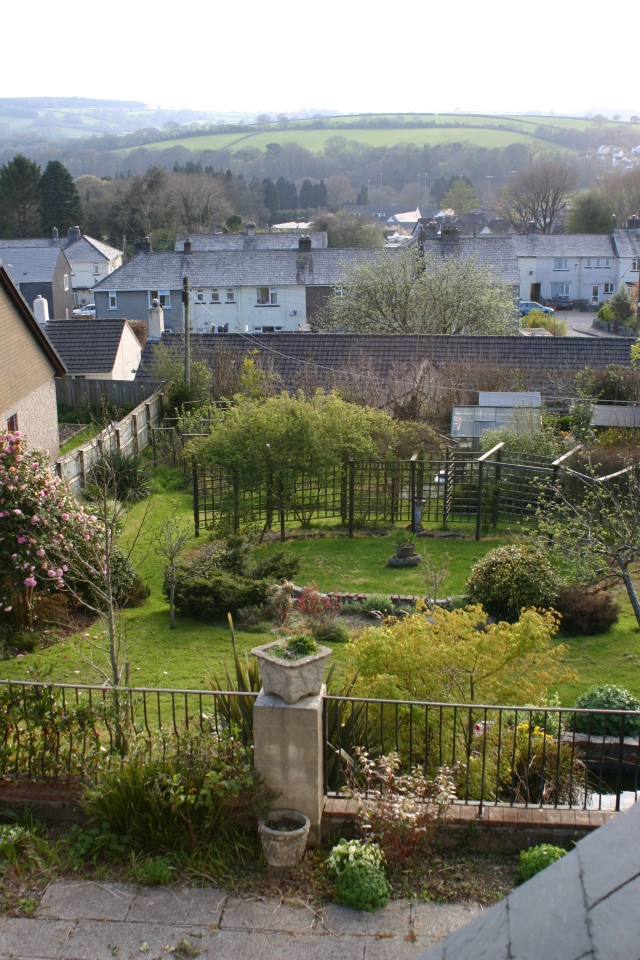
- My Mother-in-Law’s garden in Devon
I’ve continued with my work with the three groups of students at Fakenham Academy and am pleased to say that the three plots are now starting to fill up- we’ve planted a lot of potatoes, some beetroot (grown by the students from seed) and in the next couple of weeks we’ll be sowing and planting a lot more. Hopefully this activity will start to generate more enthusiasm in the students who, to be fair have had not much more than digging to keep them occupied up to now. On Thursday I also begin work on a planting scheme for a border in the grounds of the community centre at Fakenham. This is backed by a lovely old ‘crinkle crankle’ wall which is over 200 years old. The first job- with volunteers assisting I hope – is to clear the majority of the borders of an invasion of Borage and other plants and then to measure up and start to consider a planting plan. The local primary school is also getting involved and we hope to complete the project by the end of May. I’ll do some articles and pictures about this as it progresses.
The Cawston School garden is also looking full, though I haven’t been there for a few weeks, so it must be in dire need of weeding! I think I may have told you that the School has now not only achieved the highest grading in the RHS Campaign for School Gardening (level 5) but has also achieved a gold standard in the broader ‘learning outside the classroom’ that they do. On that note I’m giving a presentation about education for sustainability at a national network of early years landscape professionals tomorrow, and hope to cover a wide range of projects that I’m involved with. I’ll let you know how it goes- I’m particularly looking forward to seeing the outside environment at the Earlham Early Years Centre in Norwich where the meeting is taking place- must remember my camera!
Work to promote my forthcoming courses has been progressing and I’m going along to Gressenhall Farm and Workhouse Museum for its ‘Going Wild’ event on 5th May to conduct a couple of garden tours and promote the Wild life Gardening course there on 18th May. I’m not yet sure about the numbers signed up for this or the other two courses that are scheduled to begin in early May. Both of these are in the evening at Reepham High School and College and once again I’m covering garden design and growing your own food. Fingers crossed I get the numbers that mean they’ll go ahead.
Well, this is obviously a busy time and so far today I’ve spent the morning on the computer and occasionally looking out at the weeding still to be done and all the other jobs in the garden, so I must get moving! Bye for now, old friend, and all the best until I write again in a few weeks time.
Old School Gardener

On our recent trip to Devon we visited a few National Trust houses and gardens. We’d been to Saltram, near Plymouth, before, but not in the spring. It was a beautiful sunny day and the photos below show the house and gardens at their best, with deep, sharp shadows adding to the atmosphere.
‘Saltram overlooks the River Plym and is set in a rolling landscape park that provides precious green space on the outskirts of Plymouth. Strolling along the riverside or through the woodland, you can almost forget that the city lies so close. Saltram was home to the Parker family from 1743, when an earlier mansion was remodelled to reflect the family’s increasingly prominent position. It’s magnificently decorated, with original contents including Chinese wallpapers and an exceptional collection of paintings (several by Sir Joshua Reynolds). It also has a superb country house library and Robert Adam’s Neo-classical Saloon…The garden is mostly 19th century, with a working 18th-century orangery and follies, beautiful shrubberies and imposing specimen trees providing year-round interest.’




 Old School Garden