
‘…the snail, whose tender horns beign hit,
Shrinks backward in his shelly cave with pain,
And there, all smother’d up, in shade doth sit,
Long after fearing to creep forth again:’William Shakespeare
Tag Archive: gardening
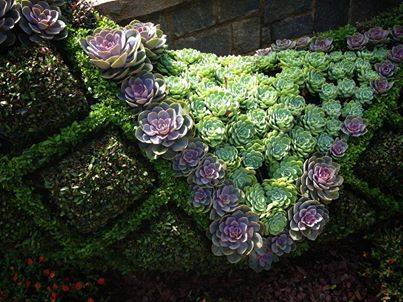
Patterned succulents from Argentina
Old School Gardener

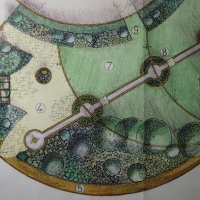
‘Lavender Labyrinth’ at Kastellaun, Germany. Imagine the ‘scentsation’ of walking this route!
Old School Gardener

Old School Garden
30th June 2014
To Walter Degrasse
Dear Walter,
As I sit looking out at the courtyard here at Old School Garden, the sun has returned after a series of heavy showers that have dominated the weather here over the last few days (some have been thundery). The last month has been a mix of sunshine and rain, the heat building, but not yet above the low 20’s Celsius- quite pleasant, though.
The month in the garden has been typical – the bulk of the ‘heavy’ work was completed in May and this month I’ve been rather focused on ‘preening and planting’ (when the weather permits). Having said that I did undertake a project to reinforce the ‘Fruit Fence’ I erected a few years ago. You might remember seeing this in the kitchen garden. It sits on the northern boundary of the garden next to a wood and effectively forms the edge of a raised bed I created to make use of some surplus soil and create an elevated space for food growing.
I have a Cherry and Plum I’m training into fans against this fence, but over time the posts have leaned over and some work was needed to strengthen this and put in a proper edge to the raised bed (I used sleepers on the other edges). Having got hold of some pallets I decided to try to use these, along with landscape fabric, to create the edge and add in some further posts to buttress the existing ones. I’m pretty pleased with the outcome (see pictures below). As you know, old friend, I’m a fan of recycling in the garden, and especially if it involves those modular wooden wonders, pallets.

The new storage area behind a pallet wall

Detail of the retaining wall made of pallets cut in half and ‘wrapped’ in landscaping fabric
The project involved digging out holes next to the four uprights and screwing these to the existing posts. I then cleared an area of nettles and dug out a trench on the woodland side to receive the pallets, which I’d earlier cut into halves. I fixed a length of batten to the frame to which I could then fix the pallets, I used landscaping fabric to ‘wrap’ the pallet sections along the length of the frame, and then extended this for a couple of metres over the adjacent woodland floor, to provide a new storage area for things like plastic plant trays, baskets and chicken wire.
Finally, I used plastic green shading fabric to provide a full backdrop to the frame. I reckon this should help both to shelter the plants a little, as well as providing a dark surface to absorb the sun and so warm the area for the fruit. The additional storage area, which is screened from the main garden, is a real boon and I plan to clear a further area of nettles to keep the woodland edge at bay. And talking of ‘recycling’, you may have also seen my recent post on the old bike rack I converted to a plant stand or ‘theatre’, on which now sit six rows of pelargoniums, nicely lined up in small terracotta pots.

The finished ‘Plant Theatre’
The last couple of weeks has seen the first crops of fruit and veg from the garden; we’ve had Raspberries, Strawberries, Calabrese, Broad beans, Chard, Mangetout and early Potatoes in good quantities, testimony to the mild and wet winter and spring we’ve had. Here are some pictures from the Kitchen Garden…
The potatoes were a real surprise. I left the first earlies in the ground and waited for the flowers to die down before investigating – a bit too late as it turns out as when I dug up the first row I was amazed at the size of some of them – as the pictures below show, we had some real whoppers! However the first row (which was the one receiving the most sun) was as productive as the other three rows put together! Two rows of second earlies, harvested at the same time, have produced an equivalent amount of better- sized potatoes. The first of these (‘Charlotte’) were delicious the other day.
However, I’m disappointed with the apples this year- I think the mild and wet weather brought a dose of ‘blossom wilt’ (as well as some insect damage), so there are relatively few fruits developing on the trees. In contrast the pears and plums are looking good, and we’ve had the first crop of (large) Gooseberries. The blackcurrants are already dripping from the bushes, so that’ll be a another harvesting job for the coming week (we’re still eating last year’s harvest from the freezer!). We’ve also had a couple of ‘ridge’ cucumbers grown outside in a pot and more are on the way, as are the tomatoes, mainly growing in the greenhouse. Here are some pictures of the produce and the kitchen garden.
Pest control has never been far from my mind, recently. The new ‘plastic owl’ bird scarer I bought seems to have had little effect, I’m sorry to say, so the only sure-fire method of keeping the birds (mainly wood pigeons but also blackbirds and smaller birds) at bay is netting. I’ve adopted and adapted an old-fashioned method of protecting bush fruit by using some lengths of ‘Enviromesh’ draped over the Raspberries and this seems to have been pretty effective. I believe that in days gone by old net curtains were used to achieve the same result! I’ve also netted the Strawberry patch over some more plastic hoops and this is working well.
Apart from birds, slugs and snails seem to have been effectively reduced (I must admit to using an emergency dose of pellets to cure this particular problem a few weeks ago), although the Hostas in the courtyard seem to have suffered a little. The other main problem is moles – they seem intent on re-creating a scene from World War 1 on the edges of the lawn and in the borders too, undermining newly planted flowers and creating, ridges, trenches and mole hills in all sorts of places! I think it may be time to recruit a mole catcher to deal with this particular issue which is getting out of hand!

Moles are creating havoc across the lawn and into borders

‘Enviromesh’ covering the raspberries from the birds- quite a succesful and easy way of reducing pest damage/theft!
But I mustn’t really complain, as the ornamental aspects of the garden are looking good, if not quite at their peak as I write. We bought three large terracotta pots yesterday and these now provide homes for three tender, exotic looking specimens and together add a nice feature at one end of the Terrace Lawn. You recall that I mentioned the amount of flower buds on the Philadelphus which I moved around 10 years ago and which hadn’t flowered since? Well, it’s now beautifully covered in the small white flowers of this super shrub and of course the citrus fragrance of ‘mock orange’ is a delight. Here’s a gallery of the latest images from the ornamental gardens.
On a broader front I’ve continued with my support of gardening at two schools. As I write it looks uncertain if the project at Fakenham Academy will continue however, due to budget cuts- a shame as I was starting to think the at least some of the youngsters were ‘getting into gardening’ and actually looking forward to their sessions outside. You may recall that I’ve been working with three groups of ‘foundation skills’ students from years 7, 8 and 9? Next week sees what will effectively be the last sessions this term, so we’ll focus on harvesting the potatoes and doing some general tidying up, I think.
Here are pictures of the Fakenham set up ‘before’ and ‘after’ to give you some idea of the amount of work involved in getting these plots back into production. First, how things looked back in January…
And now the scene in June. six months later….
At the other School where I help, Cawston, we had an interesting twilight training session run by the RHS Regional coordinator for their Campaign for School Gardening. This saw just under 20 teachers and volunteers from local schools hearing tips about school gardening and outdoor learning and I was able to contribute a little about how the school gardens and grounds have been developed. Here, too, attention is now turning to harvesting; potatoes as well as autumn – sown broad beans, onions and garlic.
On Saturday I did a stint on manning the Norfolk ‘Master Composter’ stand at an event at Sheringham Park, run by Victory Housing Trust- effectively a ‘garden party’ for its tenants from across north Norfolk. This was a lively and well- attended event (and included free ice cream!). I talked to several people who are interested in starting composting at home and it’s always fun showing the children the Wormery and the ‘products’ from this, including a bottle of ‘worm wee’ as well as the beautiful, fine compost they leave behind.
Well, the sun beckons Walter, so I must get outside and shear back a few early flowering perennials and do a number of other ‘odd jobs’ before the rian returns this afternoon. I hope you and Ferdy are faring well, and looking forward to some sun too- especially as I believe you’ve had rather more rain than us – as usual!
Al the best for now,
Old School Gardener
‘Sometimes we try to be a bit too clever in this world. Take the poor old gardener who’s plagued by blackfly. He’ll spend a small fortune on sprays and things when all he need do is take a little soil from the bottom of the plant and sprinkle it like powder all over those blessed blackfly. That’ll finish them off…it gets in their teeth you know!’
Fred Streeter
It’s been a while since I put together a few examples of recycling innovation in the garden using pallets and other things- there seem to be fewer ‘new ideas’ around these days. Perhaps there are just so many things you can do with a pallet (and other stuff)?! Anyway here is a set of four great ideas that have caught my eye in the last few months.

Crate Garden!

Pallet play house

Pallet wall planter

Pallet hut/shed/playhouse
Old School Gardener
 ‘The mowing was of course done by a stout little pony in leather boots and the soothing hum of the mowing machine was one of the pleasures of summer, instead of the noisy, smelly mowers which one now has to endure.’
Audrey Holland- Hibbert Hortus

Old School Gardener
 You may have read previously that one of my latest projects involves designing, and then helping to install a new border alongside a 200-year-old ‘Crinkle Crankle’ Wall, near Fakenham town centre, Norfolk. I’m not sure about the history of the wall, but it seems to have enclosed a substantial garden for an important house next to the Church (possibly the old Vicarage or Rectory?). There’s certainly evidence of lean-to glasshouses on some (straight) parts of the wall, which are all ‘listed’ as being of historic or architectural interest.
Crinkle Crankle walls have an interesting history, as Wikipedia says:
‘A crinkle crankle wall, also known as a crinkum crankum, serpentine, ribbon or wavy wall, is an unusual type of garden wall.
The crinkle crankle wall economizes on bricks, despite its sinuous configuration, because it can be made just one brick thin. If a wall this thin were to be made in a straight line, without buttresses, it would easily topple over. The alternate convex and concave curves in the wall provide stability and help it to resist lateral forces.
Both crinkle and crankle are defined as something with bends and turns (Webster’s), but the term is also thought to come from Old English meaning zig-zag. The earliest reference to this meaning has been cited in 1598, but it was not until the 18th century that the term began to be applied to wavy walls. At that time these garden walls were usually aligned east-west, so that one side faced south (Dictionary of Architecture and Landscape Architecture by James Stevens Curl) to catch the warming sun and were historically used for growing fruit.
Many crinkle crankle walls are found in the East Anglia area of England where the marshes of the fen country were drained by Dutch engineers starting in the mid-1600s. The walls’ construction is attributed to these engineers who called them slange muur, meaning snaking wall……’
The Fakenham wall (which must be one of the oldest surviving examples in the U.K.), now encloses the Town’s Community Centre, Registry Office and other community buildings and the surrounding site is mainly laid to grass, with some areas of mature trees and more formal borders. Next to the wall is an old asphalt tennis court (no longer in use) and the border immediately in front was covered in weeds (mainly Alkanet- it has a pretty blue flower, but also has tough tap roots and is a real ‘spreader’), as well as a large area of Hemerocallis (Day Lily). Perhaps a legacy from the wall’s days as a backdrop for fruit growing, each ‘bay’ created by the wavy wall has a fruit tree- apple, cherry or fig. These old trees are all looking rather uncared for and one of my first jobs was to cut back the fig which was covering one of the old brick and slate seats that once must have been used to watch the tennis. Here’s what the area looked like at the start of the project….


The clients (the Community Centre and the Gardening in Fakenham Town – GiFT project) have ideas for improving this wider area and perhaps encouraging it as a space for wedding photos, outdoor events etc. The brief was to come up with a planting plan for the border in front of the south -facing wall to better show off its features, use plants that require limited maintenance and which can cope with the poor soil and aspect.
My design involved limited pruning of the other fruit trees, thinning out the large area of Day Lilies and using the thinnings to create a continuous ribbon of these around the base of the wall, and introducing a few shrubs and sub shrubs (Buddleja and Lavender) at key points. These, and a range of herbaceous perennials and grasses were positioned to provide contrasting textures and forms within a broadly colour-themed series of ‘waves’ to pick up the shape of the wall, and taking account of the other strong structural features of the seats and fruit trees.
These waves are alternating combinations of mainly blue and red; blue and yellow and with purple (including purple foliage) to tie these together as a more continuous ribbon through the whole scheme. In addition a selection of different grasses (including Stipa gigantea and Miscanthus sinensis) have been used around each seat to provide a taller, contrasting, soft veil effect with both flowers and foliage to catch the sunlight. I also suggested that old bricks, to harmonise with the wall, could be laid as flooring in front of each seat, softened with ad hoc planting of varieties of Thyme. The first of these seating areas has been used to pilot this and it is hoped that further work will be done to complete the other areas as voluntary help and materials become available.
Children from the local Junior School were involved alongside a handful of volunteers to help me clear the border, prepare the soil and then to plant it up. Here’s how it looked after clearing and planting up…


The final scheme involved planting over 200 plants supplied in the main by Howard Nursery of Wortham, Suffolk and Taverham Nursery Centre, Norfolk. The planting has deliberately been placed closer together than would ultimately be necessary, so as to speed up the ground coverage and so reduce the need for weeding. However, not surprisingly, some roots of the Alkanet remain and have started to sprout once more, so the border will need to be carefully managed to ensure the plants survive and the weeds are removed in its early days.
This week, the children from the Junior School returned to carry out the ‘first weed’ since planting and to draw the wall and look out for insects etc. This marked the formal completion of the project. Here are some pictures of that event…
And here’s one of me together with representatives of the main partners: from left to right Rhoda Hincks (Junior School), Janet Holdom (Community Centre) and Pauline Chamberlain (GiFT).

This has been an interesting and enjoyable project and I look forward to seeing the border in a few months once it has become better established and to seeing progress on the improvements to the wider area. If you’d like to look at pictures and a brief account of the Junior School’s involvement take a look at their blog.
Old School Gardener
 We paid a visit to an ‘open garden’ under the National Gardens Scheme at the weekend, Oulton Hall, not far from Old School Garden. And we cycled! (about 10 miles in total).
Home of the Agnew family, originally Oulton Hall was built in the 16th Century, but the present building is Georgian in style and incorporates a yellow brick stable. The house and stable block are surrounded by a garden (or rather gardens) designed by Chelsea medal winner, Clare Agnew.
With a strong overall structure, the gardens are a combination of spaces which together hang together as a delightful country landscape. However, there are several spaces which give a different feel to the place- Mediterranean and more contemporary designs (including ornamental grasses) are well integrated and used to good effect. The journey through the various small courtyards and niches as well as the grander open lawns, wider woodland and lakeside areas was a joy on a sunny Sunday afternoon.
I particularly liked the series of pergolas enclosing an old church font at the centre, overhung with white and lavender Wisteria, creating a quiet, monastic feel (see main picture, above). I also liked the vines trained into ‘parasols’ which, with surrounding features, create a mediterranean atmosphere. There is also a superb, densely planted walk with a seat by a bubbling water feature, illuminated by the sunshine. Certainly a garden where a lot of thought and skill has gone into creating a mix of experiences which aren’t overpowering, with the emphasis on the intimate and restful. Here’s a photo gallery of our visit.
And here’s a selection of some of the flowers in bloom when we visited.


 A couple of interesting garden observations this week. Having just seen the first signs of slug and snail attack on my newly planted summer bedding (Portulaca) I resorted to the ‘blue sweeties’ to attract and ‘deal’ with the little ….pests. (Yes, I know I shouldn’t, but I find that they are the most effective way of dealign with mass infestations).




 Old School Garden